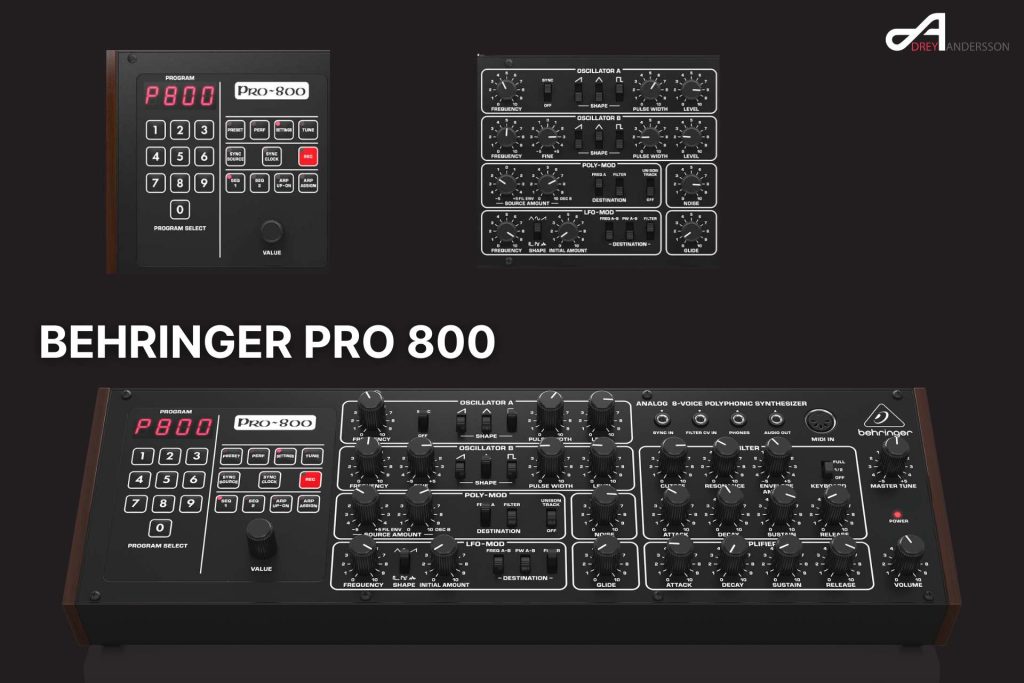
The Behringer Pro-800 is an 8-voice analog polyphonic synthesizer in a keyboard-less desktop case. It’s Behringer’s recreation of the Sequential Circuits Prophet-600 from 1982, with two VCOs per voice, a 4-pole resonant filter and the Prophet’s poly-mod section. It ships with the community GliGli firmware mods built in, and it adds two voices to the original’s six.
In short
- Type: 8-voice analog polysynth, desktop module with no keyboard, 80 HP wide.
- Based on: the Sequential Circuits Prophet-600 (1982), with the community GliGli firmware mods built in.
- Sound engine: two 3340 VCOs per voice (16 in total), a 4-pole 24 dB/oct low-pass filter, poly-mod, 2 ADSR envelopes, 1 LFO.
- Extras: 400 program memories, arpeggiator, 2-track polyphonic sequencer, chord memory, sync and filter CV inputs.
- Released: announced December 2022, shipping from April 2023 at $399 list. On 2 November 2026: €249 at Thomann, $379 at Sweetwater.
Behringer Pro-800 overview
The Pro-800 is a polysynth module from Behringer (model code 0718-ABF). It was announced in December 2022 at an estimated $599 and started shipping in April 2023 at a $399 list price (Synthtopia). The voice architecture follows the Prophet-600, and the firmware implements the GliGli mods, a community rewrite of the Prophet-600’s operating system.
The front panel carries a 4-digit display and a value encoder. There’s no keyboard: you play it over 5-pin MIDI or USB. Behringer lists the case as 80 HP wide in Eurorack terms, the same width as its monophonic Behringer Pro-1.
Behringer Pro-800 specifications
Specifications come from Behringer’s product page, which I read on 2 November 2026. The Prophet-600 voice count is from E&MM (April 1983).
| Voices | 8 (the Prophet-600 had 6) |
|---|---|
| Oscillators | 2 x 3340 VCO per voice, 16 in total; 32.70 Hz to 8,372 Hz across 4 ranges; up to 6 shapes at once |
| Waveforms | Sawtooth, triangle and pulse on both oscillators; pulse width and PWM; hard sync |
| Filter | 4-pole (24 dB/oct) low-pass, self-resonating |
| Poly-mod | Oscillator B and the filter envelope modulate oscillator A pitch and filter cutoff |
| LFO | 1 LFO, 0.08 Hz to 20 Hz, 6 waveforms; targets pitch, pulse width and cutoff |
| Envelopes | 2 x ADSR (filter, amplifier) |
| Noise | Noise generator from the rare Japanese MMI 6E3.1 version of the Prophet-600 |
| Performance | Unison (16 oscillators), polyphonic glide, chord memory |
| Arpeggiator / sequencer | Arpeggiator (up, down, up/down, key-assign modes); polyphonic 2-track sequencer, two banks, about 400 notes |
| Memory | 400 program memories; preset randomise |
| MIDI | 5-pin DIN In and Out/Thru, 16 channels; class-compliant USB-B; NRPN/CC control of all parameters; bulk load/save |
| Other inputs | Sync in (1PPS, 2, 24, 48 PPQ), filter CV in (0 to +10 V), footswitch |
| Outputs | 1/4″ mono out (max +5.0 dBu), 1/8″ audio out, 1/8″ headphones |
| Power | External 12 V DC 1200 mA adaptor, 14.4 W max |
| Format | Desktop module, 80 HP Eurorack width, no keyboard |
| Display | 4-digit 8-segment program display, value encoder |
Sound engine and architecture
Each of the eight voices runs two 3340 oscillators, the same oscillator design the Prophet-600 used as the Curtis CEM3340. Both oscillators offer sawtooth, triangle and pulse with pulse width modulation. They can run several shapes at once, and hard sync is available. Their combined range runs from 32.70 Hz to 8,372 Hz.
The filter is a 4-pole, 24 dB-per-octave low-pass that self-oscillates, and its circuit differs from the original. The Prophet-600 used the CEM3372, one chip per voice holding the mixer, filter and VCA. A teardown published on maffez.com found that Behringer built the filter and VCA stage from a Coolaudio V3320 filter (a CEM3320 clone) and V13700 OTAs instead.
Modulation follows the Prophet layout. Poly-mod lets oscillator B and the filter envelope bend oscillator A’s pitch and the filter cutoff. One LFO with six waveforms runs from 0.08 Hz to 20 Hz and targets pitch, pulse width and cutoff. Two ADSR envelopes drive the filter and the amplifier. A noise generator comes from the rare Japanese version of the Prophet-600, which Behringer names as the MMI 6E3.1.
The performance section covers unison, glide, chord memory, an arpeggiator and a sequencer. Unison stacks all 16 oscillators on one note, polyphonic glide slides every voice, and chord memory stores a chord shape you can transpose across the keyboard. The arpeggiator runs up, down or up/down. The polyphonic 2-track sequencer has two banks with room for up to about 400 notes, and the sync input takes 1PPS, 2, 24 or 48 PPQ clocks. A 0 to +10 V filter CV input lets modular gear move the cutoff.
History: from the Prophet-600 to the Pro-800
Sequential Circuits released the Prophet-600 in 1982, four years after its Prophet-5. It had six voices with two oscillators each and a suggested list price of $1,995 in the US (Electronics & Music Maker, April 1983). Inside, CEM3340 oscillators fed one CEM3372 per voice (E&MM review, April 1983).
The Prophet-600 was one of the first instruments with MIDI. At the 1983 Winter NAMM show in Anaheim, a Prophet-600 and a Roland Jupiter-6 played in sync over a single MIDI cable (Sonicstate). Later, a developer known as GliGli replaced the Prophet-600’s Z80 brain with a Teensy microcontroller running open-source firmware. It brought higher-resolution envelopes with several curves, a higher-resolution LFO with more range and shapes, a separate vibrato LFO, unison detune and full MIDI CC control with velocity (Sonicstate).
Behringer’s Pro-800 was announced in December 2022 as an eight-voice Prophet-600 recreation. Synthtopia reported it shipping on 30 April 2023 with the GliGli mods implemented, and Thomann has listed it since June 2023.
Pro-800 vs Prophet-600 vs Pro-1
The Pro-800 sits between two related instruments: the 1982 polysynth it recreates and Behringer’s own monosynth from the same Sequential family. For the mono side of that history, see the Sequential Pro-One.
| Spec | Behringer Pro-800 | Sequential Prophet-600 | Behringer Pro-1 |
|---|---|---|---|
| Year | 2023 (shipping) | 1982 (release) | 2019 (Thomann listing) |
| Voices | 8 | 6 | 1 (monophonic) |
| Oscillators | 2 x 3340 VCO per voice | 2 x CEM3340 VCO per voice | 2 x 3340 VCO |
| Filter | 4-pole 24 dB/oct low-pass (V3320 chip) | CEM3372 (mixer, filter and VCA in one chip) | 24 dB/oct low-pass (chip not listed) |
| Memory | 400 programs | 100 programs | Not listed |
| Sequencer | 2-track polyphonic, about 400 notes | 2 sequencers | 64 notes |
| Keyboard | No (desktop) | Yes, 5 octaves (61 keys) | No (desktop) |
| Price | $233 at Thomann US (2026) | $1,995 list (1983) | $166 at Thomann US (2026) |
Sources: Behringer and Thomann product pages (2026), E&MM (April 1983) for the Prophet-600, the maffez.com teardown for the Pro-800 filter chip. The Prophet-600’s 100 programs, two sequencers and 5-octave keyboard are from the E&MM review.
Behringer Pro-800 price and availability
The Pro-800 is sold new and was in stock at all three retailers I checked. On 2 November 2026 it cost €249 at Thomann, $233 at Thomann US and $379 at Sweetwater.
The chart below lists five other analog polysynths with eight or more voices at Thomann US, four of them also Behringer models. To keep the numbers comparable, every price comes from that one retailer on the same day.
All prices from one retailer, Thomann US, so they compare like for like. Sweetwater listed the Pro-800 higher, at $379. The Polyeight was a sold-out pre-order and the JN-80 showed a 9-12 week wait. The DeepMind 12D and Korg Prologue 8 are left out because Thomann lists both as no longer available. DCO means a digitally controlled analog oscillator.
Frequently asked questions
What is the Behringer Pro-800?
The Behringer Pro-800 is an 8-voice analog polyphonic synthesizer in a desktop case. It recreates the 1982 Sequential Circuits Prophet-600 with two 3340 VCOs per voice, a 4-pole low-pass filter and poly-mod. It adds the GliGli firmware features, 400 program memories instead of 100, and two extra voices.
How much does the Behringer Pro-800 cost?
When I checked on 2 November 2026, the Pro-800 cost €249 at Thomann in Germany, $233 at Thomann US and $379 at Sweetwater, all in stock. It launched in April 2023 at a $399 list price after Behringer had estimated $599 when it was announced in December 2022.
Is the Behringer Pro-800 fully analog?
The audio path is analog: two 3340 VCOs per voice feed an analog 4-pole filter and analog VCAs. The design follows the Prophet-600, whose Z80A processor already generated the envelopes in software and summed the LFO digitally. Patch memory, MIDI and the sequencer are digital.
Does the Behringer Pro-800 have a keyboard?
No. The Pro-800 is a desktop module with no keys, so you play it from a MIDI keyboard or a computer over 5-pin DIN or USB. Behringer lists its width as 80 HP in Eurorack terms, the same width it uses for the Pro-1.
Does the Behringer Pro-800 have a sequencer?
Yes. It has a polyphonic 2-track sequencer with two banks and room for up to about 400 notes, plus an arpeggiator with up, down and up/down modes. Chord memory stores a chord shape and transposes it across the keyboard, and a sync input accepts an external clock pulse.
What is the difference between the Behringer Pro-1 and the Pro-800?
The Pro-1 is a monophonic desktop synth based on the Sequential Pro-One, with a 64-note sequencer. The Pro-800 is an 8-voice polysynth based on the Prophet-600, with 400 program memories and a 2-track polyphonic sequencer. Both use two 3340-type VCOs per voice and share the same 80 HP desktop width.
Official specifications are on the Behringer Pro-800 product page. For more instruments, see the Music Production Terms index.
Back to Music Production Terms Index Page