Why Solo Producers Are Missing Out
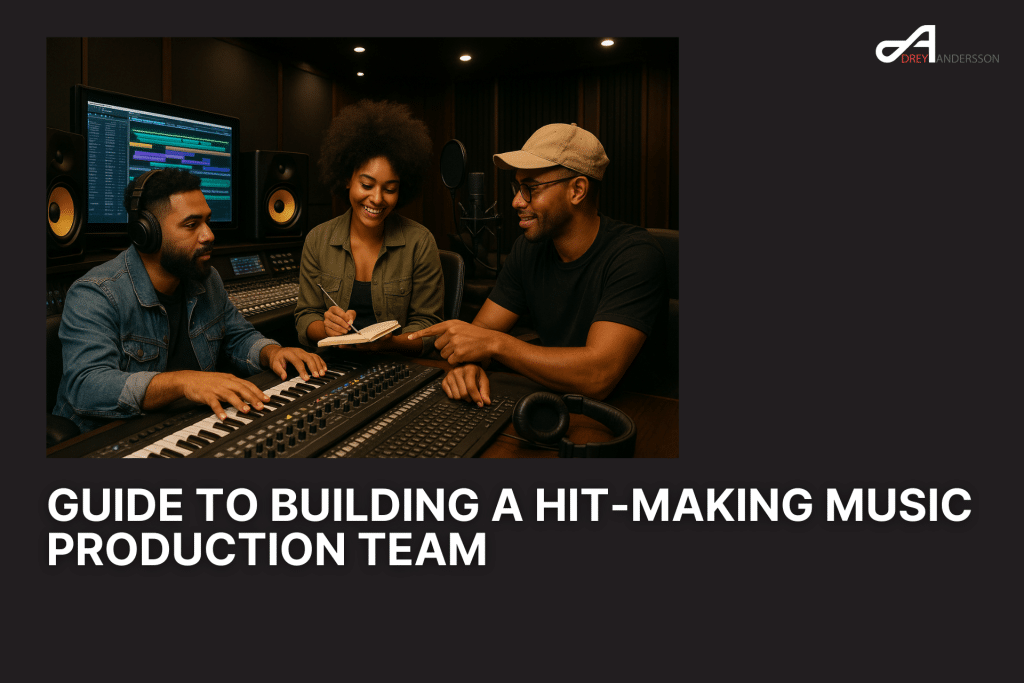
Let’s be real: the myth of the lone genius producer locked in a studio making hit after hit is exactly that—a myth.
Look at the credits on any major release from the past decade. You’ll see 5, 10, sometimes 15+ names. Producers, co-producers, engineers, writers, vocal producers, mix engineers. Modern hits are built by teams, not individuals.
And there’s a good reason for that.
When you’re trying to create something that needs to work across streaming platforms, radio, TikTok, clubs, and headphones—while also being catchy, emotional, and commercially viable—you need more than one brain in the room.
The best producers I know aren’t trying to do everything themselves. They’re building teams of specialists who complement their weaknesses and amplify their strengths.
This guide breaks down exactly how to build that team, from identifying the roles you need to managing workflows that actually work. Whether you’re producing pop, electronic, hip-hop, or anything in between, these principles will help you level up your collaborative game.
Part 1: Understanding Team Dynamics in Music Production
Why Teams Beat Solo Producers
Here’s what happens when you try to do everything yourself:
You spend three hours programming drums when you could have had a rhythm specialist nail it in 20 minutes. You struggle with vocal arrangements because lyrics aren’t your thing. Your mixes are okay but not great because you’re better at composition than engineering.
Meanwhile, the competition is working in teams where everyone’s operating in their zone of genius.
The math is simple:
- You working alone = 100% of your skills
- You + 3 specialists = 400% combined expertise
But it’s not just about skill multiplication. Teams bring:
Different perspectives – Someone else hears what you’re missing
Faster iterations – Parallel workflows instead of sequential
Quality checks – Built-in feedback loops
Creative friction – The best ideas come from respectful disagreement
Specialization – Each person becomes exceptional at their thing
The Core Team Roles You Actually Need
Not every project needs a 15-person team. But most successful productions benefit from these four core roles:
1. The Vision Keeper (Producer/Creative Director)
This is often you if you’re reading this. The vision keeper:
- Defines the overall creative direction
- Makes final decisions when the team disagrees
- Manages artist relationships and expectations
- Keeps the project on track and on budget
- Knows when something is “done”
2. The Sound Architect (Arranger/Programmer)
Handles the musical structure and sonic palette:
- Song arrangement and structure
- Programming synths, keyboards, pads
- Choosing sounds and instruments
- Building the harmonic framework
- Creating transitions and builds
3. The Rhythm Engineer (Drums/Groove Specialist)
Responsible for everything that makes people move:
- Drum programming and percussion
- Groove creation and pocket
- Low-end balance and interaction
- Rhythmic variations and fills
- Energy management throughout the track
4. The Melody Master (Topline/Vocal Specialist)
Focuses on what listeners remember:
- Melody writing and hook creation
- Lyric development and storytelling
- Vocal arrangement and harmonies
- Vocal production and comping
- Performance coaching
Note: In smaller teams, people wear multiple hats. You might be both Vision Keeper and Sound Architect. That’s fine—just know which role you’re in at any given moment.
Part 2: Finding Your Team Members
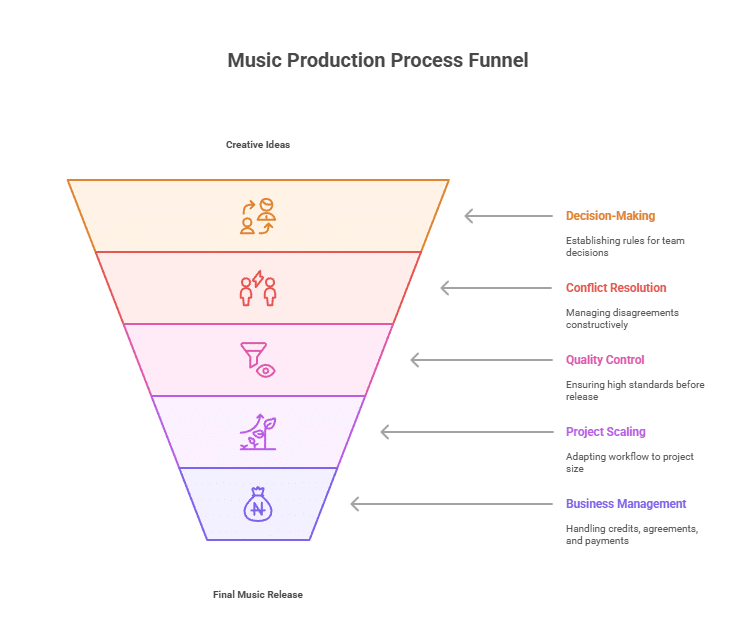
Where to Actually Find Collaborators
The usual advice is “network at industry events” or “join online communities.” Cool. But let’s get specific:
Local Music Scene
- Recording studios (engineers often produce)
- Music schools and universities (hungry talent)
- Live music venues (musicians who understand performance)
- Beat battles and producer meetups
- Local artist showcases
Online Platforms
- Discord servers for your genre
- Reddit communities (r/WeAreTheMusicMakers, r/edmproduction, etc.)
- Producer forums and Facebook groups
- SoundCloud and Beatstars comments
- Splice community
- BeatConnect, Vampr, SessionWire
Professional Networks
- Studio assistants and interns (often skilled but building their network)
- Session musicians looking to expand into production
- Artists who produce their own demos
- Mix engineers who want to get involved earlier in the process
- Music tech employees who make beats on the side
The Secret Weapon: Be Useful First
Don’t just ask “wanna collab?” Bring value first:
- Offer feedback on someone’s track
- Share their music to your audience
- Connect them with someone who could help them
- Contribute to their project before asking them to contribute to yours
Red Flags vs. Green Flags
Green Flags (work with these people):
- ✅ Responds to messages within 24-48 hours
- ✅ Delivers stems organized and labeled
- ✅ Gives honest feedback, not just “fire bro”
- ✅ Asks questions about the vision before diving in
- ✅ Suggests ideas but doesn’t force them
- ✅ Credits everyone properly
- ✅ Understands that quality takes time
- ✅ Excited to experiment but professional about deadlines
Red Flags (avoid or set clear boundaries):
- ❌Disappears for weeks, then shows up with excuses
- ❌ Sends unorganized sessions with no file structure
- ❌ Gets defensive about feedback
- ❌ Talks more about their success than actually working
- ❌ Tries to take creative control of your vision
- ❌ Unclear about splits and credits
- ❌ “Collaboration” means they want you to fix their track for free
- ❌ Only wants to work when they need something
The Trial Run Strategy
Never commit to a major project with someone you’ve never worked with. Instead:
Start Small:
- One-day remix challenge
- Quick beat flip or sample flip
- Single verse or hook development
- Mixing one track instead of a whole EP
Test These Things:
- Communication style and speed
- File organization and workflow compatibility
- Creative chemistry and taste alignment
- Ability to meet deadlines
- How they handle feedback
- Whether they’re fun to work with (this matters!)
If It Works:
- Move to a slightly bigger project
- Establish clear agreements
- Build trust gradually
- Eventually consider long-term partnership
Part 3: Workflows That Actually Work
The 3-Phase Production System
Most amateur teams fail because they don’t have a system. Everyone’s working on everything at once, files are everywhere, and nobody knows what’s happening.
Here’s a simple framework that scales:
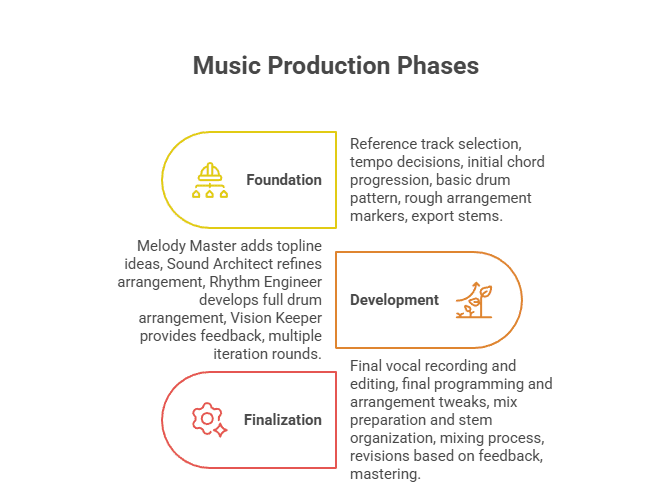
Phase 1: FOUNDATION (Days 1-2)
Who’s Involved: Vision Keeper + Sound Architect + Rhythm Engineer
What Happens:
- Reference track selection (2-3 tracks that nail the vibe)
- Tempo, key, and basic structure decisions
- Initial chord progression or harmonic idea
- Basic drum pattern and groove
- Rough arrangement markers (intro, verse, chorus, etc.)
- Export stems for everyone
Output: 60-90 second demo with clear direction
Phase 2: DEVELOPMENT (Days 3-5)
Who’s Involved: Full team
What Happens:
- Melody Master adds topline ideas and rough vocal guide
- Sound Architect refines arrangement and adds layers
- Rhythm Engineer develops full drum arrangement
- Vision Keeper provides feedback and keeps everyone aligned
- Multiple iteration rounds with shared feedback sessions
Output: Complete demo with guide vocals and 80% arrangement
Phase 3: FINALIZATION (Days 6-10)
Who’s Involved: Full team + any specialists (mixing, mastering)
What Happens:
- Final vocal recording and editing
- Final programming and arrangement tweaks
- Mix preparation and stem organization
- Mixing process
- Revisions based on client/artist feedback
- Mastering
Output: Finished, mastered track ready for release
File Organization (Don’t Skip This)
A messy project kills productivity. Here’s the structure every team member should follow:
Project Name - Artist Name/
├── 01_References/
│   ├── ref_track_01.mp3
│   └── ref_track_02.mp3
├── 02_Demos/
│   ├── v1_rough_idea.mp3
│   ├── v2_with_vocals.mp3
│   └── v3_final_demo.mp3
├── 03_Stems/
│   ├── drums/
│   ├── bass/
│   ├── keys/
│   ├── synths/
│   └── vocals/
├── 04_Sessions/
│   ├── production_session_v1.als (or .logic, .flp, etc.)
│   ├── production_session_v2.als
│   └── final_mix_session.als
├── 05_Samples/
│   └── custom_samples/
├── 06_Finals/
│   ├── final_mix.wav
│   └── final_master.wav
└── project_notes.txt
Naming Convention:
YYYYMMDD_ProjectName_Version_WhatChanged.wav- Example:
20251115_SummerNights_v3_AddedStrings.wav
Communication Protocols
Daily Check-ins During Active Projects:
- Slack/Discord message: “Working on X today, will have Y done by EOD”
- Share progress clips (even rough ones)
- Flag any blockers immediately
Weekly Team Calls:
- Review last week’s progress
- Plan next week’s priorities
- Address any creative disagreements
- Celebrate wins
Feedback Format: Use this structure to keep feedback constructive:
TIMESTAMP - ELEMENT - ISSUE - SUGGESTION

Example:
1:23 - Kick drum - Getting lost in the mix - Try sidechaining the bass more aggressively or boost 60Hz

2:45 - Vocal - Feels slightly behind the beat - Shift 10-15ms earlier or try a more aggressive delivery
Not: “The kick is weak” or “I don’t like the vocal”
Part 4: Managing the Creative Process
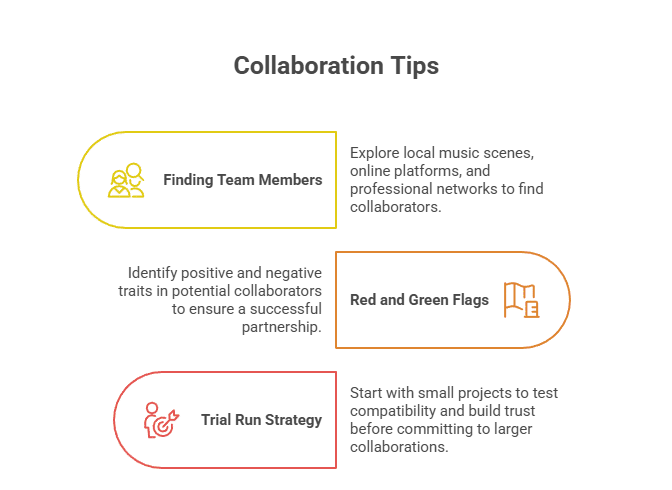
Decision-Making Framework
Every team needs a system for making decisions, or you’ll spend forever debating and nothing gets finished.
The 3-Person Rule: If three people agree on something, it stays. If it’s split, the Vision Keeper (producer) makes the call.
The Reference Track Test: When in doubt, go back to your references. Does the decision move you closer to or further from the vibe?
The Fresh Ears Policy: If you’ve been debating something for more than 20 minutes, table it. Come back with fresh ears the next day.
The Client/Artist Has Veto Power: Obviously. But educate them on why you made certain choices. Sometimes they just need to understand the reasoning.
Handling Creative Conflicts
You will disagree. That’s not a bug, it’s a feature. Here’s how to handle it:
1. Separate the Person from the Idea
Bad: “Your melody doesn’t work”
Good: “I’m not sure this melody fits the vibe we agreed on”
2. Use A/B Tests
Instead of arguing, make both versions. Let the song decide.
3. Define the “Why” Before the “What”
Team Member: “We should add strings here”
You: “What are we trying to achieve?”
Team Member: “More emotion in the chorus”
You: “Cool, strings could work. Could also try vocal layers or a pad. Let’s test all three.”
4. Time-Box Debates
Set a timer for 10 minutes. If you can’t resolve it, the Vision Keeper decides or you move on.
5. Remember the Goal
You’re not trying to prove you’re right. You’re trying to make the best song possible.
Quality Control Checkpoints
Before calling anything “done,” run it through these filters:
The Song Test:
- Does it have a clear hook?
- Does the arrangement maintain interest?
- Does it deliver on the emotional promise?
- Would you listen to this for fun, not just work?
The Technical Test:
- Is everything in time and in tune?
- Does it translate on different systems? (phone, car, headphones, club)
- Are there any phase issues or technical problems?
- Is the mix ready for mastering?
The Commercial Test:
- Does it fit the current market while feeling fresh?
- Is it playlist-friendly for the target genre?
- Does it showcase the artist’s strengths?
- Would someone press play again after the first listen?
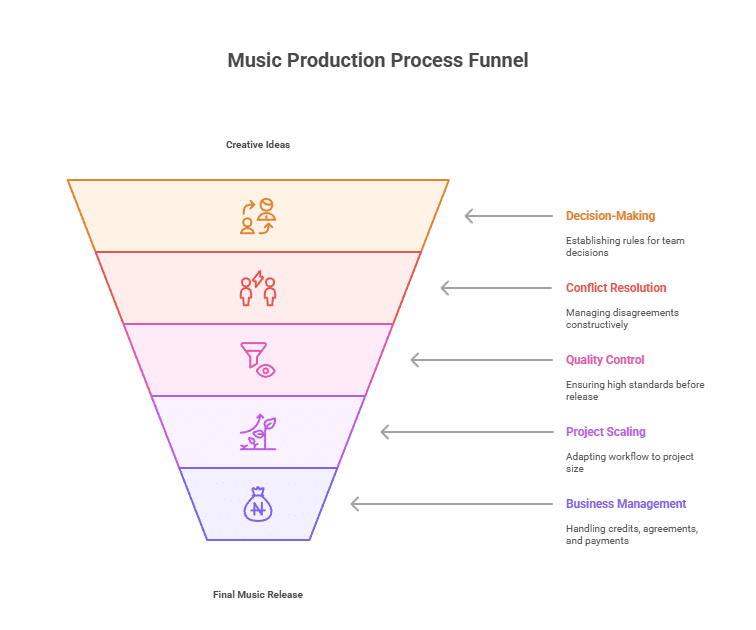
Part 5: Scaling for Different Project Types
The Weekend Collab (1-2 Days)
Team Size: 2-3 people
Goal: Finish a complete idea or flip
Roles: Often combined (everyone does a bit of everything)
Workflow:
- Day 1 Morning: Foundation (4 hours)
- Day 1 Afternoon: Development (4 hours)
- Day 2 Morning: Finalization (3-4 hours)
- Day 2 Afternoon: Mix and bounce (2-3 hours)
Pro Tip: Limit your sound palette. Pick 10-15 sounds max and really make them work.
The Single Production (1-2 Weeks)
Team Size: 3-5 people
Goal: Release-ready single with full production
Roles: Clearly defined specializations
Workflow:
- Week 1: Foundation + Development
- Week 2: Finalization + Mixing
- Additional time: Artist revisions + Mastering
Pro Tip: Build in buffer time. Artists always want changes after hearing the “final.”
The EP/Album Project (1-3 Months)
Team Size: 5-10+ people
Goal: Cohesive body of work with high production value
Roles: Highly specialized + additional roles (string arranger, mastering engineer, etc.)
Workflow:
- Pre-production: 1-2 weeks (song selection, references, planning)
- Production: 2-6 weeks (all tracks to demo stage)
- Recording: 1-2 weeks (all final vocals and live elements)
- Mixing: 1-2 weeks (with revision rounds)
- Mastering: 3-5 days
- Revisions: 1 week buffer
Pro Tip: Work on multiple tracks simultaneously but at different phases. While mixing track 1, be developing track 3 and laying foundations for track 5.
Part 6: The Business Side (Don’t Skip This)
Credits and Splits
Get this in writing before you start. Not after. Not when the song blows up. Before.
Basic Split Framework:
Production Credit (Master Recording):
- Lead Producer: 40-60%
- Co-Producers: Split remaining based on contribution
- Engineers: Usually paid upfront OR 5-10% points
Songwriting Credit (Publishing):
- Writers: Split evenly unless agreed otherwise
- Producers who contribute to composition: Negotiate percentage
- Topliners/melody writers: Usually 50% or more
Example:
Song: "Summer Nights"

Master Recording Points:
- You (Producer/Vision Keeper): 50%
- Co-Producer (Sound Architect): 25%
- Co-Producer (Rhythm Engineer): 15%
- Mixing Engineer: 10%

Publishing:
- Topliner (wrote melody/lyrics): 50%
- You (wrote chords/arrangement): 25%
- Co-Producer (contributed to melody): 25%
The Agreement Template
Use this for every collaboration:
PROJECT: [Song Title]
DATE: [Today's Date]
TEAM MEMBERS: [Names]

ROLES:
[Name] - [Role] - [Specific Responsibilities]

CREDITS:
Production: [Percentages]
Songwriting: [Percentages]

PAYMENT STRUCTURE:
Upfront Fees: [If any]
Backend Points: [Percentages above]

OWNERSHIP:
Master Recording: [Who owns what %]
Publishing: [Who owns what %]

TIMELINE:
Start Date: [Date]
Delivery Date: [Date]
Revision Rounds: [Number agreed]

EXPENSES:
How are shared expenses handled? [Split equally / One person fronts / etc.]

SIGNED:
[All team members]
Pro Tip: Use a service like Songtrust or TuneCore Publishing to register splits immediately after finishing the track.
Payment Models
Model 1: Backend Only
- No upfront payment
- Everyone gets their % of royalties forever
- Best for: Equal collaborators betting on the song’s success
Model 2: Hybrid
- Small upfront fee for time
- Reduced backend points
- Best for: Mixing engineers, session musicians, specialists
Model 3: Work-for-Hire
- One-time payment
- No backend royalties
- Best for: Quick turnaround, client work, ghostwriting
What I Recommend:
For your core team: Backend only or hybrid
For specialists you hire: Work-for-hire
For artists: They typically keep master ownership, you get producer points
Protecting Your Work
Register Everything:
- Copyright your songs with your country’s copyright office
- Register with a PRO (ASCAP, BMI, GEMA, PRS, etc.)
- Use split sheet apps (SplitSuite, Songtrust, etc.)
Document Everything:
- Save all project files with dates
- Keep email trails of who contributed what
- Screenshot agreements (even text messages)
- Back up everything to cloud storage
Use Contracts: Even with friends. Especially with friends. Contracts protect everyone.
Part 7: Tools and Technology
Essential Software Stack
DAW Options:
- Ableton Live: Best for electronic, loop-based production, live performance
- FL Studio: Great for hip-hop, trap, beat-making
- Logic Pro: Excellent all-rounder, especially for pop/rock
- Pro Tools: Industry standard for recording and mixing
- Studio One: Modern workflow, great for hybrid productions
For Teams: Pick one as your primary and make sure everyone knows it. Or use stems and let people work in their preferred DAW.
Collaboration Tools:
Project Management:
- Notion: All-in-one workspace for notes, tasks, databases
- Trello: Visual board for tracking song progress
- Asana: More robust for complex projects
- Milanote: Visual mood boarding and idea organization
Communication:
- Slack: Organized channels for different projects
- Discord: Voice channels + screen sharing, great for creative sessions
- Telegram: Fast messaging, good file sharing
- Zoom: Video calls for feedback sessions
File Sharing:
- Dropbox: Reliable, good version history
- Google Drive: Free tier is solid, integrates with Docs
- WeTransfer: Quick sends for large files
- Splice: Built for music production, includes sample library
Cloud Collaboration:
- Splice Studio: Version control for Ableton, Logic, FL
- Sessionwire: Real-time studio collaboration
- AudioMovers ListenTo: High-quality audio streaming for remote mixing
- Audiomovers Omnibus: Real-time audio streaming between DAWs
Remote Collaboration Best Practices
Session Setup:
- Agree on sample rate and bit depth (usually 48kHz/24-bit)
- Use the same BPM and start point
- Export stems dry (no master bus processing)
- Include MIDI where relevant
- Name everything clearly
Stem Export Checklist:
□ All tracks labeled clearly
□ All tracks starting at bar 1 (or documented offset)
□ All tracks exported to same length
□ No clipping or distortion
□ Rendered at project sample rate
□ Consolidated (no gaps or edits missed)
□ Organized in folders by type
□ Reference mix included
□ BPM and key noted in file name or readme
Communication During Remote Sessions:
Before the session:
- Share reference tracks
- Clarify the goal for this session
- Confirm everyone has the right files
- Set a time limit
During the session:
- Screen share the DAW
- Use voice chat, not just text
- Record the session (Zoom/Discord can do this)
- Take breaks every 60-90 minutes
After the session:
- Share updated files immediately
- Document decisions made
- Assign next steps to specific people
- Set deadline for next deliverable
Part 8: Advanced Team Strategies
Building Your Production Squad
Don’t just collect collaborators randomly. Build a squad—a core group of 3-5 people who:
- Have complementary skills
- Share similar taste and standards
- Communicate well together
- Are reliable and professional
- Enjoy working together
Your squad becomes your secret weapon. When a big opportunity comes, you can move fast because you already have chemistry.
The Specialist Network
Beyond your core squad, build a network of specialists you can call for specific needs:
- String arranger for orchestral sections
- Live guitarist for authentic rock/indie elements
- Vocalist for demo vocals and reference tracks
- Mix engineer who specializes in your genre
- Mastering engineer you trust
- Session musicians for specific instruments
Pro Tip: Pay specialists well and on time. They’ll prioritize your projects over others.
Genre-Specific Team Structures
Pop Production:
- Focus on songwriting and vocal production
- Need strong melody and arrangement skills
- Often involves more people (writers camp model)
- Speed matters—trends move fast
Electronic/Dance:
- Sound design and mixing are crucial
- Often 1-2 person teams with specialists for mixing
- DJ/club testing is part of the process
- Technical skills matter more than songwriting
Hip-Hop/R&B:
- Beat maker + engineer is common core
- Vocal producer is essential
- Often involve artist heavily in production
- Sample clearance knowledge important
Rock/Alternative:
- Live recording skills matter
- Arrangement for full band
- Pre-production is crucial
- Often need dedicated engineer
Managing Multiple Projects
Once you’re running multiple productions simultaneously:
The Color-Coding System:
- ???? Red = Urgent, deadline within 72 hours
- ???? Yellow = Active, working on this week
- ✅ Green = Scheduled, starting soon
- ???? Blue = Backlog, future projects
- ⚫ Black = Waiting on client/artist
The Monday Planning Session: Review all active projects and assign the week’s priorities.
The Friday Review: Check what got done, what’s rolling over, what needs to be communicated to clients.
Time Blocking:
- Morning: Fresh ears mixing and creative work
- Afternoon: Production and recording
- Evening: Admin, communication, file organization
Part 9: Leveling Up Your Team
Continuous Improvement
Monthly Team Reviews:
What’s working?
- Which workflows are smooth?
- Which tools are helping?
- What creative approaches are clicking?
What’s not working?
- Where are we wasting time?
- What’s causing friction?
- What skills are we missing?
Action items:
- Specific changes to implement
- Training or education needed
- Tools to try or replace
Skill Development
Invest in Learning Together:
- Watch tutorials as a team and discuss
- Take online courses together
- Analyze hit songs in your genre
- Attend workshops and conferences
- Experiment with new techniques monthly
Knowledge Sharing:
Create a shared knowledge base:
- Processing chains that work
- Arrangement templates
- Reference track collections
- Industry contacts
- Pricing standards
- Contract templates
Building Your Reputation
Document Your Wins:
- Keep a portfolio of your best work
- Get testimonials from artists
- Track your streaming numbers and chart positions
- Document your process (content for social media)
Social Proof:
- Credits on Genius, Wikipedia, AllMusic
- Production credits on streaming platforms
- Case studies of successful projects
- Before/after examples
Content Creation:
- Behind-the-scenes content
- Production breakdowns
- Tutorial videos
- Podcast appearances
- Studio vlogs
Part 10: Avoiding Common Team Mistakes
Mistake #1: No Clear Leader
Problem: Everyone thinks they’re in charge. Decisions take forever. Nothing gets finished.
Solution: Designate one person as the final decision maker for each project. That person isn’t a dictator, but when the team can’t agree, they make the call.
Mistake #2: Unclear Splits and Credits
Problem: Song blows up, lawyers get involved, friendships end.
Solution: Written agreement before starting. Every time. No exceptions.
Mistake #3: Too Many Cooks
Problem: Seven people all have opinions. Song becomes a mess trying to please everyone.
Solution: Limit core creative team to 3-5 people. Others can contribute specific elements but don’t get full creative input.
Mistake #4: No Quality Standards
Problem: One person delivers fire, another delivers garbage. Finished product is inconsistent.
Solution: Establish minimum quality standards. Create reference tracks. Do quality checks before combining elements.
Mistake #5: Poor Communication
Problem: Someone disappears for a week. Files get lost. Nobody knows what’s happening.
Solution: Daily check-ins during active projects. Clear communication channels. File organization system everyone follows.
Mistake #6: Working with Friends Who Can’t Deliver
Problem: Your friend is cool but unreliable. You keep working with them because you don’t want to hurt their feelings.
Solution: Business is business. Have honest conversations. If they can’t level up, work with them on side projects, not client work.
Mistake #7: Scope Creep
Problem: “Just one more revision” turns into 47 revisions.
Solution: Define revision rounds upfront. After that, it’s paid hourly.
Mistake #8: Not Backing Up Projects
Problem: Computer dies. Months of work gone.
Solution: Automatic cloud backup. Multiple redundancies. No excuses.
Part 11: The Future of Production Teams
Emerging Trends
AI-Assisted Production:
AI tools are getting scary good at:
- Mixing and mastering (LANDR, iZotope, etc.)
- Stem separation (LALAL.AI, RipX)
- Voice conversion and synthesis
- Arrangement suggestions
- Sample generation
- SUNO for rough ideas
What this means: Teams that learn to use AI tools efficiently will move faster and offer more services.
Global Remote Teams:
You can now work with:
- A topliner in Sweden
- A mix engineer in LA
- A mastering engineer in London
- While you’re in Berlin
What this means: Competition is global, but so is your talent pool.
Platform-Specific Production:
Different platforms need different approaches:
- TikTok = Hook in first 3 seconds
- Spotify = First 30 seconds crucial for saves
- Radio = Intro can’t be too long
- DJ sets = Extended intros/outros needed
What this means: Teams might need platform optimization specialists.
Direct-to-Fan Models:
Artists are bypassing labels:
- Selling directly to fans
- Crowdfunding albums
- Building on Patreon/OnlyFans
- Using Discord communities
What this means: More opportunities for independent production teams, but you need to understand marketing and fan building.
Preparing for What’s Next
Stay Curious:
- Test new tools monthly
- Follow industry news
- Join beta programs
- Experiment with new formats (spatial audio, gaming music, etc.)
Diversify Income:
- Don’t rely only on royalties
- Offer mixing and mastering
- Create sample packs
- Teach production
- Consulting for other producers
Build in Public:
- Share your process
- Grow your audience
- Create educational content
- Build your personal brand
Conclusion: Your Action Plan
Building a hit-making production team isn’t rocket science, but it does require intentionality.
Here’s your roadmap:
This Week:
Day 1-2: Assess your skills honestly
- What are you genuinely good at?
- What do you struggle with?
- What do you enjoy vs. what drains you?
Day 3-4: Define your ideal team
- What roles would complement you?
- What kind of music do you want to make?
- What’s your budget reality?
Day 5-7: Start networking
- Join 2-3 communities
- Reach out to 5 potential collaborators
- Set up one test session
This Month:
Week 2: Run your first test collaboration
- Pick a simple project
- Use the 3-phase workflow
- Document what worked and what didn’t
Week 3: Refine and repeat
- Adjust your process based on learnings
- Try working with 1-2 new people
- Start building your squad
Week 4: Establish systems
- Set up your file organization
- Create your split agreement template
- Choose your collaboration tools
This Quarter:
Month 2: Build momentum
- Complete 3-5 collaborative projects
- Identify your core squad (2-3 people)
- Start establishing your sound
Month 3: Go professional
- Get your legal templates sorted
- Register with PRO
- Set your rates and split structures
- Create your portfolio
By the end of 90 days, you should have:
- ✅ A core team of 2-3 reliable collaborators
- ✅ A working system for files, communication, and workflow
- ✅ 5-10 completed collaborative projects
- ✅ Legal and business foundations in place
- ✅ Clear understanding of what works for you
The Real Secret
There’s no magic formula. The best production teams are built on:
Trust – People who deliver what they promise
Chemistry – People who enjoy working together
Standards – People who give a shit about quality
System – People who follow a process
Respect – People who value each other’s contributions
Find those people. Build those systems. Make great music together.
The rest is just details.
Now stop reading and go make something.