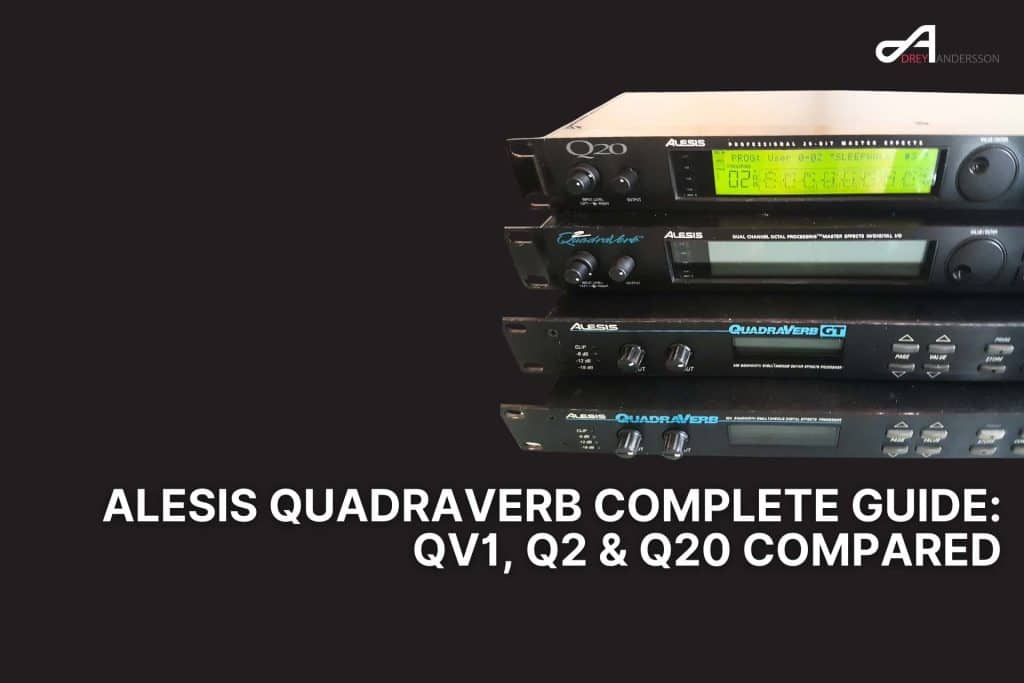
Three boxes. The same six letters on the front panel. Wildly different machines inside. If you’ve ever searched for a used QuadraVerb and come away confused about which one you actually want, this guide is the one I wish I’d had.According to Paul White’s 1998 review in Sound on Sound, the original Alesis QuadraVerb was “one of the best selling multi-effects units of all time” (Sound on Sound, Dec 1998). That reputation is exactly why the name got reused across a decade of hardware that shares almost nothing under the hood. I’ve spent years with these units in my studio, and the short version is this: the QuadraVerb, the QuadraVerb 2, and the Q20 are three separate instruments wearing one badge.
Key Takeaways
- The original QuadraVerb (1988) has a hybrid analog/digital path and a grainy 16-bit reverb that no successor reproduces. It’s the “character” box.
- The QuadraVerb 2 (Q2, 1994) is a clean, fully-digital redesign with 8 simultaneous effects and ADAT. Sound on Sound said it “set new standards within its price range” (SOS, Oct 1994). Underrated.
- The Q20 (1998) adds 20-bit converters, XLR/S-PDIF I/O and built-in sampling. It’s the transparent, pro-studio option.
- Sampling on the QV1 and Q2 needs an EPROM chip swap (no soldering). The Q20 has it stock.
Alesis QuadraVerb family: a quick history
The QuadraVerb line ran from 1988 to 1998 and split into three architecturally distinct units, not three revisions of one design. The original sold in huge numbers and defined the affordable-rack category (Sound on Sound, Dec 1998); the Q2 (reviewed by SOS in October 1994) rebuilt the platform as a fully-digital, 8-effect machine; and the Q20 (1998) pushed it into 20-bit professional territory.
Here’s the timeline at a glance.
The units differ in three ways that actually matter to your ears and your wallet:
- The original is grainy and lo-fi on purpose, thanks to 16-bit hardware and a hybrid analog/digital signal chain.
- The Q2 is cleaner, hugely more flexible to route, and still gets slept on.
- The Q20 is the most refined: 20-bit converters, pro I/O, and sampling baked in.
One naming quirk trips everyone up. “Quadra” implies four effects, but the Q2 and Q20 run eight at once through what Alesis called Octal Processing. The name stuck around long after the four-effect limit did. Confusing? Very. That’s half of why this guide runs so long.
Before we get into the demo below, here’s Hainbach making the case for the original as an ambient machine, which is a great ear-level intro to why people still chase these boxes.
QuadraVerb (Original, 1988)
The original QuadraVerb runs four simultaneous effects (reverb, delay, pitch, EQ) in 1U at 16-bit, and its defining trait is a hybrid analog/digital path: the dry signal never gets digitized. That’s the whole reason it sounds “warm” and grainy in a way plugins struggle to fake, and it’s why Sound on Sound still called it a best-seller a decade later (SOS, Dec 1998).
Specs
| Specification | Value |
|---|---|
| Year | 1988 |
| Bit Depth | 16-bit linear PCM |
| Signal Path | Analog dry path + digital FX |
| DSP Speed | 24 MIPS |
| Simultaneous FX | 4 |
| Frequency Response | 16Hz to 20kHz |
| Dynamic Range | 85 dB |
| Distortion (THD+N) | < 0.1% |
| Analog I/O | Unbalanced TS (1/4″) only |
| Digital I/O | None |
| Programs | 100 (90 ROM, rest user) |
| Sampling (stock) | No |
| Sampling (via mod) | Yes, QuadraVerb Plus EPROM |
| MIDI | Full implementation, 8 real-time CCs |
| Made in | U.S.A. |
What makes it special
The dry signal runs through voltage-controlled amplifiers (VCAs) instead of getting fully digitized. That one design choice is why the original doesn’t sound like anything that came after it. There’s a warmth and a coloration on the dry path that the fully-digital Q2 and Q20 simply don’t have.
The reverb algorithms are deliberately grainy and a little metallic. That’s not a bug. It’s 1988 DSP running four effects at 16-bit and doing the best it can, and the result is dense, smeared, atmospheric tails that got baked into a decade of hip-hop, ambient and electronic records. Aphex Twin is the clearest documented example: the QuadraVerb is widely reported as central to Selected Ambient Works 85-92, pushing pitch-shifts and delays into reverbs for that dark, muddy wash (MusicRadar; breakdown at Reverb Machine).
You’ll see other big names (Orbital, FSOL, Global Communication) attached to this box in gear roundups. I’ll be honest: I couldn’t find primary sources naming them, so treat those as producer folklore rather than fact. Aphex is the one that’s actually documented.
Effects available
- Reverb: room, hall, plate, chamber
- Delay: standard, multitap, ping-pong
- Pitch/Modulation: mono and stereo chorus, mono and stereo flange, pitch detune, phase shifter
- EQ: lowpass, bandpass, highpass, shelving, 1 to 4 band parametric, 5-band graphic, resonator, mono/stereo tremolo, stereo simulator
The resonator is the one to care about. It’s a MIDI-playable multi-tap comb filter that generates those distinctive dub and ambient textures, and here’s the kicker: Alesis dropped it from both the Q2 and the Q20. If that sound is what you’re after, no other QuadraVerb will do. The original is the only one.
The QuadraVerb Plus EPROM upgrade
“QuadraVerb Plus” isn’t a separate product. It’s a stock QuadraVerb with a different firmware EPROM inside. The hardware is identical, and your original patches still load. Swapping the chip unlocks:
- Configuration 8: sampling mode
- Multi-tap delay (up to 8 taps)
- Ring modulator
- Leslie / rotary speaker simulation
- Auto-panning
- Tremolo on the EQ output
- Tap tempo for delay
ROM images and documentation live at quadraverb.nl, which is the community hub for these units (manuals, hardware notes, EPROM contents). More on the sampling side below.
MIDI control
The QuadraVerb modulates eight parameters per patch in real time over MIDI CC. Delay time, reverb decay, ring mod balance, resonator tuning: all of it responds live from any controller. Two caveats worth knowing before you build a live rig around it. Some parameters zipper-noise on smooth sweeps, and there’s no MIDI clock response, so you can’t tempo-sync it.
Known issues to watch for
- Right channel output failure (cold solder joints on the output connectors, common, a tech can fix it)
- Failing VCA chip (PA381) on the analog dry path: when it goes, you lose the unprocessed signal
- Input sensitivity quirks: either it overloads easily or feels weak, depending on your source
- LCD backlight fade on older units
QuadraVerb 2 (Q2, 1994)
The Q2 is a ground-up redesign, not a QuadraVerb with a bigger number: fully digital, 18-bit converters, and up to eight simultaneous effects in a free routing matrix. Sound on Sound reviewed it in October 1994 and said its sound quality and usability “set new standards within its price range” (SOS, Oct 1994). It landed to a lukewarm reception, and I think that was a mistake buyers are still correcting on the used market.
Specs
| Specification | Value |
|---|---|
| Year | 1994 |
| A/D Conversion | 18-bit, 128x oversampling Delta-Sigma |
| D/A Conversion | 18-bit, 64x oversampling |
| Internal DSP | 24-bit proprietary Alesis chip |
| Signal Path | Fully digital |
| Sampling Rate | 48kHz |
| Simultaneous FX | Up to 8 (Octal Processing) |
| Frequency Response | 20Hz to 20kHz |
| Dynamic Range | > 90 dB (A-weighted) |
| Distortion (THD+N) | < 0.009% @ 1kHz |
| Crosstalk | < 91 dB |
| Analog I/O | Balanced TRS (balanced or unbalanced) |
| Digital I/O | ADAT optical |
| User Programs | 100 stock; 200 with v2.0 EPROM |
| Sampling (stock) | No |
| Sampling (via mod) | Yes, v2.00 / v2.01 EPROM |
| DSP Overload Warning | Yes |
| Power Supply | External wall-wart (proprietary) |
The Q2 is not “just a better QuadraVerb”
Why did the Q2 get a cool reception? Naming, mostly. People expected a hotter-rodded original and got a different machine at a higher price. But go through what actually changed and the “disappointment” reads as a misunderstanding:
- Fully digital path, no analog dry signal (cleaner, less colored than the QV1)
- 18-bit converters vs 16-bit (measurably lower noise floor)
- Octal Processing: eight effects in a free routing matrix
- Backlit graphical LCD that draws your signal flow
- ADAT optical I/O, unusual on budget gear in 1994
- DSP overload warnings when you push the processor too far
Sound on Sound singled out the reverb quality as class-leading for the price (SOS, Oct 1994). The market judged it against the original’s character instead of on its own terms, and that’s exactly the gap value-hunters can exploit today.
Octal Processing: 8 simultaneous effects
Instead of the original’s fixed “configurations,” the Q2 lets you drop eight effect blocks in any order and wire them how you like, with the backlit LCD showing the chain. Left and right channels can even run completely separate effect paths, which the original can’t do at all.
There’s a ceiling, of course. Premium stereo reverb alone eats a big chunk of DSP, so you can’t stack eight heavy effects and expect them all to fire. The unit warns you when you’re near the limit, which is genuinely useful.
ADAT digital I/O
The Q2’s ADAT optical port let you patch straight into an ADAT multitrack and stay in the digital domain, skipping needless D/A then A/D conversion. On a budget box in 1994, that was a real feature, not a spec-sheet flex.
v2.01 EPROM upgrade (strongly recommended)
Stock Q2s can’t sample. The v2.00 firmware (final release v2.01) adds sampling as a routable block plus a stack of other features. The chip still turns up on Reverb.com for roughly €15 to 30. To check what you’ve got, hold [PROGRAM] + [GLOBAL] while powering on and read the version. Full feature list is in the sampling section below.
What the Q2 is missing vs the original
- The MIDI-playable resonators are gone. For certain dub and ambient sounds, that’s a real loss.
- The pitch shifter is widely judged less musical than you’d hope.
- The analog dry-path coloration is gone entirely. Cleaner, yes. But different.
Known issues to watch for
- The proprietary wall-wart power supply. If it’s missing, sourcing one is a pain. Confirm it’s included before you buy. Non-negotiable.
- The data entry wheel. Give it a spin and make sure it’s smooth.
Q20 Professional (1998)
The Q20 is the most refined unit in the line: same 24-bit Alesis DSP as the Q2, but with 20-bit converters, balanced XLR and S/PDIF I/O, an internal power supply, and sampling built in with no mod required. When Sound on Sound reviewed it in December 1998, this was Alesis positioning the QuadraVerb name as a genuinely professional tool (SOS, Dec 1998).
Specs
| Specification | Value |
|---|---|
| Year | 1998 |
| A/D Conversion | 20-bit, 256x oversampling |
| D/A Conversion | 20-bit, 256x oversampling |
| Internal DSP | 24-bit proprietary Alesis chip |
| Signal Path | Fully digital |
| Sampling Rate | 48kHz (variable 40.4 to 50.8kHz under external control) |
| Simultaneous FX | Up to 8 (Octal Processing) |
| Frequency Response | 20Hz to 20kHz ±0.2dB |
| Dynamic Range | > 92 dB (A-weighted) |
| Distortion (THD+N) | < 0.005% @ 1kHz |
| Crosstalk | > 88 dB below full scale |
| Analog Inputs | Combo XLR / 1/4″ TRS, balanced/unbalanced |
| Analog Outputs | XLR + 1/4″ TRS (both simultaneously) |
| Digital I/O | ADAT optical + S/PDIF + BNC 48kHz word clock in |
| Factory Programs (ROM) | 100 |
| User Programs (RAM) | 200 |
| Effect Algorithms | 51 types |
| Sampling (stock) | Yes, native, no mod needed |
| Max Sample Time | Up to 5 seconds |
| Stereo Sampling | Yes (2 blocks simultaneously) |
| Power Supply | Internal (no wall-wart) |
| Rack Size | 1U |
| Dimensions | 19″ × 1.75″ × 7″ |
| Weight | 4.25 lbs (1.9 kg) |
What the Q20 improves over the Q2
Same DSP heart, better everything around it. The upgrades cluster around converters, connectivity and convenience:
- 20-bit converters (up from 18-bit): cleaner reverb tails, more headroom, better top-end
- S/PDIF added alongside ADAT
- BNC word clock input for 48kHz master sync (BRC, AI-2, and friends)
- Balanced XLR I/O (the Q2 was TRS only)
- Internal power supply, so no wall-wart to lose
- 200 user programs, double the Q2’s stock 100
- Quick Route: send any block straight to the input or output
To the ears, the reverb is audibly smoother and cleaner than the Q2, with better high-frequency extension and a lower noise floor. This is the “disappear into the mix” box.
The fidelity climb across the three generations is the clearest single-number story in the whole line:
51 effect algorithms, full list by category
EQ / Dynamics: lowpass, bandpass, highpass filter, 1-band parametric, 3-band parametric, 5-band parametric, 5-band graphic, 11-band graphic, resonator, mono tremolo, stereo tremolo, stereo simulator, soft overdrive, hard overdrive, triggered panning, phase inverter
Pitch / Modulation: chorus, stereo chorus, flange, stereo flange, ring modulator, rotary speaker (Leslie), pitch shift
Delays: mono delay, stereo delay, ping-pong delay, multi-tap delay, tap tempo mono delay, tap tempo ping-pong delay, sampling (up to 5 seconds)
Reverb: mono room, room 1, hall 1, plate 1, chamber 1, room 2, hall 2, plate 2, chamber 2, large plate, large room, spring, nonlinear, reverse reverb
Native stereo sampling
Sampling lives in the Delays category as a normal routable block. Each sampler block is mono, but run two at once inside one program and you get true stereo sampling. It’s fully MIDI-triggerable in One Shot and Gated modes, and you can transpose playback across a MIDI note range you set. No chip swap, no compromise.
Want to hear the 20-bit character before you spend anything? This no-talk demo is a clean listen:
Full specification comparison
Across the three, the numbers march in one direction on fidelity and flexibility, and in the opposite direction on that one-of-a-kind analog character. Bit depth climbs 16 → 18 → 20, effects double from 4 to 8, and only the original keeps the analog dry path and the resonators. Here’s the whole picture.
Core specs
| Specification | QuadraVerb (QV1) | QuadraVerb 2 (Q2) | Q20 |
|---|---|---|---|
| Year | 1988 | 1994 | 1998 |
| A/D Bit Depth | 16-bit linear PCM | 18-bit, 128x oversamp. | 20-bit, 256x oversamp. |
| D/A Bit Depth | 16-bit | 18-bit, 64x oversamp. | 20-bit, 256x oversamp. |
| Internal DSP | 16-bit / 24 MIPS | 24-bit Alesis chip | 24-bit Alesis chip |
| Signal Path | Analog dry + digital FX | Fully digital | Fully digital |
| Sampling Rate | ~32kHz (est.) | 48kHz | 48kHz |
| Dynamic Range | 85 dB | > 90 dB (A-wtd) | > 92 dB (A-wtd) |
| THD+N | < 0.1% | < 0.009% | < 0.005% |
| Freq. Response | 16Hz to 20kHz | 20Hz to 20kHz | 20Hz to 20kHz ±0.2dB |
| Simultaneous FX | 4 | Up to 8 | Up to 8 |
| Effect Routing | 5 fixed configurations | Free graphical matrix | Free graphical matrix |
I/O
| I/O | QuadraVerb (QV1) | QuadraVerb 2 (Q2) | Q20 |
|---|---|---|---|
| Analog Inputs | Unbalanced TS | Balanced TRS | Combo XLR / TRS balanced |
| Analog Outputs | Unbalanced TS | Balanced TRS | XLR + TRS (both) |
| ADAT Optical | ✗ | ✓ | ✓ |
| S/PDIF | ✗ | ✗ | ✓ |
| Word Clock In | ✗ | ✗ | ✓ (BNC, 48kHz) |
| Power Supply | External wall-wart | External wall-wart | Internal |
Programs & features
| Feature | QuadraVerb (QV1) | QuadraVerb 2 (Q2) | Q20 |
|---|---|---|---|
| Factory Programs | 90 ROM | Varies | 100 ROM |
| User Programs | 100 total | 100 (200 w/ v2.0) | 200 |
| Effect Algorithms | ~20 types | 40+ | 51 |
| DSP Overload Warning | ✗ | ✓ | ✓ |
| Tap Tempo | Plus EPROM only | ✓ | ✓ |
| Ring Modulator | Plus EPROM only | ✓ | ✓ |
| Overdrive | ✗ | ✓ (v2.0+) | ✓ |
| MIDI Playable Resonators | ✓ | ✗ | ✗ |
| Real-Time MIDI CC Control | ✓ (8 params) | ✓ (8 params) | ✓ (8 params) |
| MIDI Clock Sync | ✗ | ✗ | ✗ |
The sampling mods explained
Only the Q20 samples out of the box. On the QV1 and Q2, sampling arrives through a post-launch firmware EPROM upgrade: you replace one chip. No soldering, no circuit surgery, just a screwdriver and a steady hand. The three implementations differ a lot in flexibility, though, so here’s each one.
QV1: QuadraVerb Plus EPROM
“QuadraVerb Plus” is a stock QuadraVerb with the Plus EPROM installed. The name describes firmware, not a different box, and all your original patches still work. Installing it adds:
- Configuration 8: sampling mode
- Multi-tap delay (up to 8 taps)
- Ring modulator
- Leslie / rotary speaker simulation
- Auto-panning
- Tremolo on the EQ output
- Tap tempo for delay
How the sampler works:
- Select Configuration 8 with the CONFIG button. Sampling parameters live under the DELAY button in this mode.
- Pick your record method: audio threshold trigger (auto-records once signal passes −18dB) or manual trigger (hit BYPASS to record instantly).
- Trigger playback from the front panel, an audio trigger, or MIDI. MIDI playback runs in One Shot (plays the whole sample regardless of key hold) or Gated (stops on key release).
- Set the root MIDI note and playable range for chromatic transposition.
- Adjust start and end points in 10ms steps, with looping. Output level runs 0 to 99.
One limitation to know: you can’t MIDI-control the start/end points. It’s a frequently requested feature that simply isn’t there. The chips are uncommon but circulate in producer communities, and ROM documentation lives at quadraverb.nl.
Q2: v2.00 / v2.01 EPROM
Stock Q2s don’t sample. Firmware v2.00 (final release v2.01) adds sampling as a routable block inside the full Octal matrix, which is far more flexible than the QV1’s fixed Configuration 8. The v2.00 update also brings:
- Sampling (as a routable effect block)
- Soft and Hard Overdrive blocks
- Phase inversion
- Triggered panning
- Triggered mono/stereo flanging
- 100 extra user program slots (100 → 200)
- LFO local modulation generator
- Negative flanger feedback
- Block bypass
- Improved Stereo Leslie (Linear + Circular modes)
- Block copy/paste
- Footswitch as a modulation source
Why this beats the QV Plus sampler: on the Q2, the sampler is a free block, so you can chain it with reverb, EQ, delay and pitch in any order. The QV Plus locks sampling into Configuration 8 with fixed routing. If you want to sample and mangle, the Q2 wins easily.
The v2.01 chip runs about €15 to 30 on Reverb.com. Check your version with [PROGRAM] + [GLOBAL] on power-up.
Q20: sampling built in (no mod needed)
The Q20 has the sampler as a stock effect in the Delays category, no chip required. You get up to 5 seconds at 48kHz through 20-bit converters, noticeably cleaner than the QV Plus sampler’s lower-rate hardware.
Sampling comparison
| Feature | QV Plus | Q2 (v2.0+) | Q20 |
|---|---|---|---|
| How to activate | EPROM swap | EPROM swap | Stock |
| Location in UI | Config 8 (fixed routing) | Routable block | Routable block |
| Sound quality | 16-bit, lower sample rate | 48kHz / 18-bit | 48kHz / 20-bit |
| Stereo sampling | Mono only | Mono block | 2 blocks = true stereo |
| Max sample time | Short (hardware RAM limited) | ~2 to 3 sec (est.) | Up to 5 seconds |
| Record trigger: audio | ✓ (−18dB threshold) | ✓ | ✓ |
| Record trigger: manual | ✓ (BYPASS button) | ✓ | ✓ |
| MIDI trigger | ✓ | ✓ | ✓ |
| MIDI gate mode | ✓ | ✓ | ✓ |
| MIDI pitch range | ✓ | ✓ | ✓ |
| MIDI ctrl of start/end | ✗ | ✗ | ✗ |
| Chain with other FX | ✗ (Config 8 only) | ✓ (full matrix) | ✓ (full matrix) |
| EPROM availability | Rare / community | Available on Reverb.com | N/A |
Sound character guide
If you strip away the specs, the three units split cleanly by vibe: the QV1 is grainy and atmospheric, the Q2 is clean and musical, and the Q20 is transparent and pro-grade. Pick by the sound you’re chasing, not by the highest number. Here’s how each one actually behaves in a mix.
QuadraVerb (QV1): grainy, dense, atmospheric
The original has a fingerprint you can pick out on records: thick reverb tails with a metallic, slightly grainy edge, courtesy of 16-bit DSP running flat out. The analog dry path adds a warmth the digital successors just don’t have. This is the QuadraVerb you hear on classic boom-bap drums, early-90s trance pads, and reverb-drenched ambient. It doesn’t model real rooms so much as build strange ones: washy, decaying, physically dense.
Best for: lo-fi hip-hop, boom-bap drums, ambient and drone, experimental sound design, vintage electronic, anywhere the reverb is meant to be heard, not hidden.
QuadraVerb 2 (Q2): clean, musical, underestimated
The Q2 reverb is clearly cleaner: smoother decay, better highs, lower noise floor. Less “vintage,” more “professional studio.” As a clean hall or plate on a track or a mix bus, it still holds up in 2026, and the flexible Octal routing gives you multi-effects reach the original can’t touch. It’s the box I reach for when I want quality reverb without the QV1’s obvious color.
Best for: synth processing, ambient, general studio use, anything that wants reverb quality without a signature stamped on it. Electronic and ambient producers especially.
Q20: transparent, smooth, pro-grade
The Q20 takes the Q2’s character and cleans it up further with 20-bit converters. More dynamic range, more resolution, reverb tails that breathe and decay naturally. This is the one for jobs that demand transparency: mixing, mastering, vocal reverb, pro tracking rooms.
Best for: professional mixing, vocal reverb, mastering, and studios that want pro I/O and maximum transparency.
Genre & use-case cheat sheet
| Use Case | Best Unit |
|---|---|
| Boom-bap / lo-fi hip-hop drums | QV1 |
| Lo-fi / vintage electronic | QV1 |
| Ambient / drone / experimental | QV1 (character) or Q2 (flexibility) |
| Synth processing / modular | QV1 (resonators), Q2 (routing) |
| Electronic / dance / techno reverb | Q2 or Q20 |
| General studio mixing | Q20 |
| Vocal reverb / mastering | Q20 |
| ADAT studio workflow | Q2 or Q20 |
| Guitar / live rig | QV1 (Plus EPROM for tap tempo) |
| Sound design / multi-effects | Q2 (v2.01), most routing flexibility |
Buying guide & current prices
Expect to pay roughly $150 to 300 for a QV1 or a Q2 and somewhere around $250 to 400 for a Q20 on the used market in mid-2026, based on Reverb, eBay and Equipboard listings observed on 2026-07-08 (Equipboard; eBay). These are asking-price ranges, not verified sold data, and prices swing hard with condition and firmware.
Indicative used prices (mid-2026)
A note for my European readers: I couldn’t pin down firm EUR sold-prices for this update, so treat the USD ranges as a guide and pull live EUR medians from Reverb (set currency to EUR) and eBay.de before you commit. The Q2 in particular has been climbing as producers rediscover it.
What to check before buying
QuadraVerb (QV1):
- Test both output channels (right-channel failure is the known weak point; a tech can fix the solder joints)
- Check the firmware version (original vs Plus, ask the seller)
- Test input gain staging for overload or weakness
- Check the LCD backlight for even brightness
- Ask about the VCA chip (PA381): if the dry signal is missing or weak, it’s likely gone, but it’s replaceable
QuadraVerb 2 (Q2):
- Confirm the external power supply is included. The proprietary wall-wart is a pain to source. Non-negotiable.
- Check the firmware: ideally v2.01 already installed, or budget ~€20 for the chip
- Test the data entry wheel for smooth operation
- Verify the ADAT optical output if your setup needs it
Q20:
- Verify both XLR and TRS outputs
- Test ADAT and S/PDIF I/O if your workflow uses them
- Check LCD contrast and button response
- The internal PSU makes the Q20 the most reliable of the three, generally
The verdict
| QuadraVerb (QV1) | QuadraVerb 2 (Q2) | Q20 | |
|---|---|---|---|
| Best for | Character & vibe | Flexibility & value | Professional studio use |
| Sound | Grainy, lo-fi, iconic | Clean, musical, underrated | Transparent, smooth, pro |
| Recommended firmware | Plus EPROM (strongly) | v2.01 EPROM (essential) | Stock (sampling built in) |
| Buy if… | You want the sound | You want routing power | You want the best specs |
| Skip if… | You need clean reverb | You want QV1 character | You’re on a tight budget |
My honest take? If you make lo-fi, hip-hop or ambient and you want that grain, buy the original with the Plus EPROM. If you want the most flexible, best-value box in the line, the Q2 with v2.01 is a steal for what it does. And if you need clean, transparent, pro-grade reverb with real I/O, the Q20 is the one. There’s no single “best.” There’s the best for your music.
Are there plugin emulations of the QuadraVerb?
No official QuadraVerb plugin exists as of mid-2026. The closest software approximations are Valhalla’s reverbs: producers reach for ValhallaRoom or ValhallaVintageVerb (Dark color mode) to get near the low-sample-rate grain, and Valhalla’s own Sean Costello has noted these aren’t an exact match to the Alesis allpass topology, just a way to approach the character (KVR forum; Gearspace discussion). There are also impulse responses of specific QuadraVerb reverbs floating around, useful for a convolution approximation. But for the full experience, especially the resonators and live MIDI modulation, the hardware is still the only real answer.
FAQ
Is the QuadraVerb 2 just a better QuadraVerb?
No, they’re genuinely different architectures. The Q2 is fully digital (the original has an analog dry path), runs eight simultaneous effects instead of four, uses a free routing matrix instead of fixed configurations, adds ADAT digital I/O, and sounds noticeably cleaner. Some original features, especially the MIDI-playable resonators, are completely absent from the Q2.
Do I need to modify the QuadraVerb to get sampling?
Yes, for the QV1 and Q2. Both need an EPROM chip swap, a non-destructive mod that takes only a screwdriver. The QuadraVerb Plus EPROM enables sampling on the original; the Q2 needs the v2.01 firmware chip (available on Reverb.com). The Q20 has sampling built in, no mod required.
Can I control the QuadraVerb’s effects with MIDI in real time?
Yes. All three units support real-time MIDI CC control of eight simultaneous per-patch parameters, which is great for live performance and sound design. Two caveats: some parameters produce zipper noise on smooth sweeps, and none of the units respond to MIDI clock, so there’s no tempo sync.
Which unit sounds most like the original QuadraVerb?
The original itself. There’s no substitute, because the analog dry path and 16-bit DSP grain are baked into the hardware. If you must rank the successors, the Q2 gets closer than the Q20, though both are much cleaner. For genuine lo-fi reverb character, the original hardware is irreplaceable.
Are there plugin emulations of the QuadraVerb?
No official plugin exists. ValhallaRoom and ValhallaVintageVerb are the usual character approximations, and impulse responses of specific algorithms let you get close with convolution (KVR). For the full experience, resonators and MIDI modulation included, the hardware is still the only real option.
What’s the difference between the QuadraVerb and the QuadraVerb GT?
The GT is a guitar-focused version of the original, with an analog guitar preamp (compression, overdrive, distortion, amp/cabinet simulation, parametric tone, noise gate) in front of the same digital effects engine. The effects architecture matches the QV1, and it adds an effects loop. Think of it as a guitar preamp and multi-effects combined.
Is the Q2’s external power supply a problem?
It can be. The Q2 uses a proprietary wall-wart that’s difficult and expensive to source separately if it’s missing. When buying used, always confirm the PSU is included. Non-negotiable. The Q20 sidesteps the whole issue with an internal supply.
Who famously used these units?
The best-documented case is Aphex Twin, who used the original QuadraVerb across Selected Ambient Works 85-92 (MusicRadar). The original is also tied to classic boom-bap production, where the SP-1200 + S950 + QuadraVerb combo is well-known producer lore. A QuadraVerb 2 is visible in a roughly-2002 photo of Guy-Manuel de Homem-Christo’s (Daft Punk) studio per Equipboard, though that’s a sighting, not a documented production credit (Equipboard).
About the author
Drey Andersson is a Berlin-based music producer, sound designer and synthesist with over 20 years of production experience. He co-produced Shekhinah’s Different (SAMA award, RiSA Gold certification), won the Beatleague Beat Battle in Berlin, and built a 100K+ community around sound design and synthesis education. He co-founded the Berlin producer collective Beat Unit and releases sounds through his own Serum banks and free downloads.