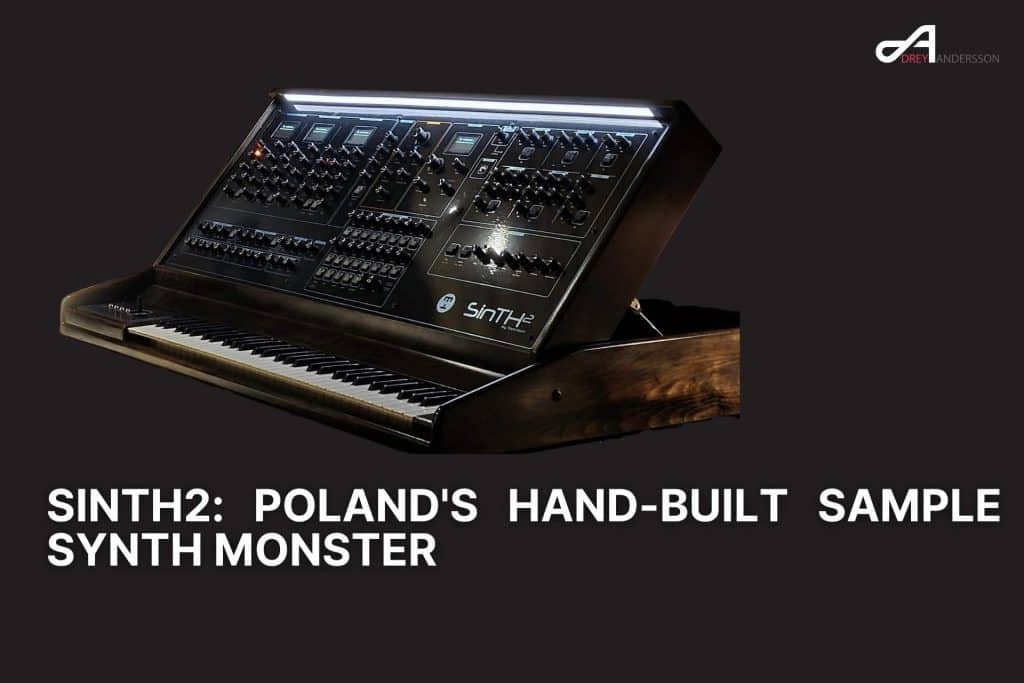
Sample-based synthesizers almost always make you dig through menus to change a sound. The SinTH2 refuses to. It is a hand-built Polish hybrid that puts every parameter under its own knob, with five oscillators, 60-voice polyphony and 3 GB of onboard samples, and it carries official prices of €5,800 to €6,999 across three versions (SinTH2). It premiered on 18 July 2026 (Synth Anatomy), so this is a first look built from that premiere and the maker’s own spec sheet, not a hands-on review.
Key Takeaways
- The SinTH2 is a hand-built, sample-based hybrid synth from Tom Horn (Tomasz Rożek) in Piła, Poland, with five oscillators across three blocks plus a separate noise oscillator (gearnews).
- It runs 60-voice polyphony over 3 GB of samples, with an 18 dB multimode filter, four LFOs, a 16-step polyphonic sequencer and motion recording on every knob (SinTH2).
- The whole point is old-school immediacy: one physical control per parameter, the way Roland’s 1991 JD-800 rebelled against menu-driven synths (Roland).
- Three made-to-order versions are priced €5,800 (desktop) to €6,999 (folding panel), introductory pricing through 15 August 2026 (SinTH2).
- It is genuinely boutique: the builder says he can make about two a month, and the premiere unit is his own number 001 (premiere interview).
What is the SinTH2?
The SinTH2 is a large, hand-built hybrid synthesizer from Poland that combines multisampled and single-cycle waveforms with immediate, knob-per-function editing. It packs five oscillators, a separate noise source, an 18 dB filter, six effects and a 16-step sequencer into a wooden fold-out chassis, and it premiered on 18 July 2026 (Synth Anatomy).
It is the work of one person and a small team. The builder trades as Tom Horn — the real name is Tomasz Rożek — and works out of Piła in Poland (SinTH2). He showed it for the first time in a Polish-language premiere on Paweł Lemański’s channel, presenting it as a two-year build that started as a private project (Bonedo). The “2” is not marketing: an earlier six-oscillator SinTH came first, and this is the follow-up he actually intends to sell.
The format will look familiar to synth watchers. With its massive wooden housing and a panel that folds flat for transport, the SinTH2 sits in the same rare category as the Schmidt Eightvoice, the German boutique “monster” that trades for around €20,000 (Synthtopia). The difference is what is under the hood: where the Schmidt is pure analog, the SinTH2 is a sample player at heart.
Why put a sample engine behind a wall of knobs?
Because that is the one thing sample synths have almost never offered, and it is the SinTH2’s entire reason to exist. In the premiere, Tom Horn name-checks the Roland JD-800 as his touchstone (gearnews) — the 1991 synth that put a physical control on nearly every parameter at a time when everything else hid its sound behind a two-line screen.
That reference is exact, not decorative. The JD-800 was a sample-based, PCM digital synth wrapped in roughly 69 sliders and knobs, built deliberately as a reaction against menu-driven design (Wikipedia). Roland’s own history of the instrument quotes designer Kazuhisa Takahashi saying he “became frustrated by the technique of creating sounds numerically on small LCD screens” (Roland). Swap 1991 for 2026 and you have the SinTH2’s pitch word for word.
Most sample instruments since then went the other way. A modern software sampler or VST rompler gives you thousands of sounds and a mouse, and every tweak means a trip through a page of parameters. The SinTH2’s bet is that producers will pay a premium to reach for a real attack knob, a real filter slider and a real effect send instead. Whether that bet pays off is exactly the hands-on-versus-in-the-box question every hardware buyer already wrestles with.
What is inside the SinTH2 sound engine?
The SinTH2 carries five oscillators spread across three blocks: the first two blocks each hold a pair of samplers, and the third holds a single sampler, backed by a separate noise oscillator (gearnews). All of it runs at 60-voice polyphony over 3 GB of onboard samples (SinTH2).
There are two flavours of raw material, and the distinction matters. The multisample oscillators play full, velocity-mapped instrument captures — the builder says he sampled and layered sounds, including a real piano, over many years. The single-cycle oscillators hold short looping waveforms closer to what a subtractive synth would call a wave, including analog-style strings and basses. In the premiere he estimates around 7,000 samples on board in total, all instantly reachable, with about 3 GB held in memory so nothing has to load (premiere interview).
From the oscillators the signal hits a single 18 dB multimode filter offering low-pass, band-pass and high-pass shapes (SinTH2). Shaping comes from two envelopes covering filter and amplifier, with an extra envelope available on the single-oscillator layer for building attacks and pads. It is a deliberately compact engine — there is no sprawling modulation matrix here — and that is the point: fewer routings, every one of them on a knob.
What can the effects, LFOs and motion recorder do?
The SinTH2 keeps a full effects and modulation section on the panel so a patch is finished without a computer. There are six effects — drive, ensemble, phaser, analog-style delay, reverb and a wide-range EQ — plus four LFOs and a global pitch LFO on top (Synth Anatomy).
The four LFOs are assignable to filter, amplitude, pitch and pan, and the pan LFO has a neat trick: on a single oscillator it walks the sound across the stereo field per voice, so stacked notes move independently. The reverb carries its own filter and length controls, and the delay locks to the sequencer tempo. None of this is exotic on paper, but having it all one button-press away is the difference the SinTH2 is selling.
The headline modulation feature is motion recording. Arm it, move any knob, and the instrument captures that gesture and loops it back — the same idea as the motion sequencing Korg has shipped for years, which “remembers and reproduces the movements of the knobs” (Korg). On the SinTH2 it works on every knob at once, so a whole evolving patch can be performed and stored the way you would draw automation in a DAW, except with your hands. A second control clears any single knob’s recorded motion without wiping the rest.
One more touch keeps the samples from sounding static. An “analog tune” function randomises each sample’s playback slightly so notes never trigger identically, and it can be linked to velocity so that how hard you play shifts where the sample starts (premiere interview). A time-stretch mode that slows a sample without changing pitch is on board too, though the builder flags it as still in development.
How does the 16-step sequencer work?
The SinTH2 has a 16-step polyphonic sequencer with per-step control over note pitch, step count and note value, and it can drive any combination of oscillators (SinTH2). Crucially, it can also be pointed at the filter instead of the pitch, turning it into a rhythmic modulator rather than a melody line.
That flexibility is where the builder’s “no hidden menus” rule bends a little. To avoid adding yet more buttons to an already enormous panel, a few functions live behind held presses of the sequencer keys. Hold a step button and it recalls a stored sound; hold it longer and it saves the current patch to that slot, giving you 16 instant sound snapshots under your fingers. It is the one concession to complexity on an instrument built to have none.
A dedicated Hold function rounds it out for live use, letting you latch a sequence or chord and then play the filter and effects over the top. If you have used the step sequencer on a groovebox or an arpeggiator-driven synth, none of this needs a manual, which is exactly the reaction the SinTH2 is designed to provoke.
What is the SinTH2 built from?
The SinTH2 is built like the boutique object its price implies: a Fatar keybed with a joystick, a solid wood casing, and a control surface of 120 potentiometers, nine encoders, 36 buttons and four OLED displays (SinTH2). The keyboard choice is the industry-standard one — Fatar is the Italian OEM behind the actions in a long list of premium synths, which is why the SinTH2’s feel is a known quantity rather than a gamble, as covered in this guide to Fatar keybeds.
The chassis is where boutique meets practical. The housing is solid wood, which is what gives the instrument most of its weight — the builder estimates around 15 kg in the premiere — while the front panel itself is a lighter aluminium-composite (Dibond) board (premiere interview). Dibond is a standard sign-industry material, two thin aluminium skins bonded over a plastic core (3A Composites), so it keeps a big panel rigid without adding mass. The buttons are 1980s Roland-style parts chosen for a long click life, and connectivity covers balanced XLR outputs, a stereo audio input that runs external gear through the effects, and 5-pin MIDI (SinTH2).
It comes in three physical formats: a folding-panel keyboard that lays flat for transport, a fixed-panel keyboard, and a desktop module for players who already have a controller. That the same engine ships as a hybrid keyboard or a bare module makes it, in spirit, a digital instrument with an analog-era body — the sound is sampled, the interaction is entirely physical.
What does the SinTH2 cost, and who is it for?
The SinTH2 is sold made-to-order in three versions, priced €5,800 for the desktop module, €6,799 for the fixed-panel keyboard and €6,999 for the folding-panel keyboard, VAT included and introductory through 15 August 2026 (SinTH2). Each unit is built to order in roughly two to three weeks.
Read against the wider market, that is a lot of money for a sample synth and a relative bargain for a hand-built wooden one. A mass-produced flagship keyboard lands in the same bracket, and the Schmidt monster it visually resembles costs three times as much. The SinTH2 is not aimed at the bedroom producer with a laptop and a MIDI controller; it is aimed at the player who wants a signature, physical instrument on stage and is willing to wait for one to be made. The builder is candid that this is small-batch work — he reckons about two a month — which is the boutique deal in a nutshell: you trade availability and price for something almost nobody else will own.
What are the honest caveats?
Plenty, and they matter more than usual because nobody outside the maker’s circle has reviewed one yet. Every specification above traces back to a single premiere interview and the builder’s own site; there is no independent hands-on test, no long-term reliability data and no third-party sound comparison in circulation (Synth Anatomy).
Several details are still moving. The unit shown is number 001 and, by the builder’s own account, not quite final — small cosmetic parts are unfinished. Only around 100 of the roughly 1,920 preset slots are filled so far, so the factory sound library is a work in progress. The time-stretch feature is described as still in development. And the question buyers ask first — can you load your own samples? — has no firm answer: it was designed as a closed library, and a user sample bank is under consideration but not promised.
Two facts also rest on the premiere alone rather than published specs: the Dibond front panel (press coverage only mentions the wooden housing) and the roughly 15 kg weight. Treat both as the builder’s figures pending confirmation. None of this makes the SinTH2 less interesting — a two-year, one-person build that plays three concerts and survives a 550 km drive to its own premiere is a real instrument, not vapourware — but it does mean the sensible move is to hear one before wiring €6,000.
SinTH2 specifications
| Specification | Detail |
|---|---|
| Type | Hybrid sample-based synthesizer (multisample + single-cycle) |
| Builder | Tom Horn (Tomasz Rożek), Piła, Poland |
| Premiere | 18 July 2026 |
| Oscillators | 5 sample oscillators across 3 blocks (2 dual-sampler, 1 single) + noise oscillator |
| Polyphony | 60 voices |
| Sample memory | 3 GB onboard; ~7,000 samples (builder’s figure) |
| Filter | 18 dB multimode (low-pass, band-pass, high-pass) |
| Envelopes | 2 (filter, amp) + extra envelope on single-oscillator layer |
| LFOs | 4 assignable (filter, amp, pitch, pan) + 1 global pitch LFO |
| Effects | Drive, ensemble, phaser, delay, reverb, EQ |
| Sequencer | 16-step polyphonic; motion recording on all knobs |
| Presets | 1,920 slots (15 banks of 128) |
| Keyboard | Fatar with joystick |
| Controls | 120 potentiometers, 9 encoders, 36 buttons, 4 OLED displays |
| Housing | Solid wood; Dibond front panel (per premiere) |
| Connectivity | Balanced XLR outputs, stereo audio input to FX, 5-pin MIDI |
| Versions | Folding panel, fixed panel, desktop module |
| Price | €5,800 to €6,999 (VAT incl., through 15 Aug 2026) |
| Weight | ~15 kg (builder’s estimate) |
Frequently asked questions
What is the SinTH2 synthesizer?
The SinTH2 is a large, hand-built hybrid synthesizer from Poland that plays back 3 GB of samples through five oscillators, an 18 dB filter and six effects. Its defining idea is immediacy: every parameter sits under its own physical knob, so you shape sounds without diving into menus.
How much does the SinTH2 cost?
The maker lists three made-to-order versions: the desktop module at EUR 5,800, the fixed-panel keyboard at EUR 6,799, and the folding-panel version at EUR 6,999, with VAT included. That introductory pricing is valid through 15 August 2026, and each instrument is built to order in about two to three weeks.
How is the SinTH2 different from a software sampler?
A software sampler hides most of its controls behind a screen and a mouse. The SinTH2 turns the whole engine into hardware, with 120 knobs, four OLED displays and a motion recorder that captures every knob move you make. It is built for hands-on, real-time sound design rather than editing with a cursor.
Who builds the SinTH2, and where?
The SinTH2 is designed and hand-assembled by Tom Horn, the working name of Polish musician Tomasz Rozek, with a small team in Pila, Poland. He describes it as a two-year project that grew out of an earlier instrument called the SinTH, and says he can currently build about two units a month.
Can you load your own samples into the SinTH2?
Not confirmed yet. The SinTH2 ships with about 7,000 built-in samples across its banks, and Tom Horn originally designed it as a closed library. In the premiere he said he is considering adding a single user bank for custom samples, but stopped short of promising it, so treat user sampling as a maybe.