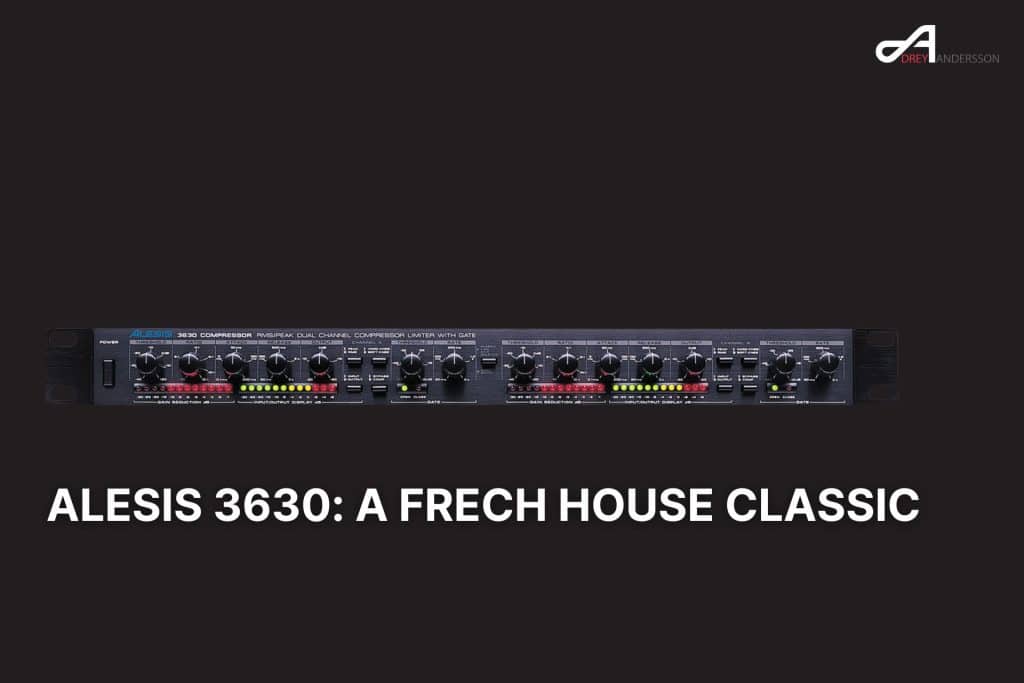
Ask a mastering engineer about the Alesis 3630 and you’ll get a sigh. Ask a house producer and you’ll get a grin. This $300 compressor is the one Daft Punk used across Homework and Discovery, and the pumping, breathing sound it helped create still gets chased today, right up to a 2020 number-one album. It’s cheap, it’s noisy, and it’s one of the most quietly influential boxes in dance music. Here’s the full story, plus how the sound actually works. For the dry specs, alternatives and current prices, the Alesis 3630 reference page has the tables.
Key takeaways
- Daft Punk called the 3630 “the main one we used on Homework and Discovery” (Mix, 2001).
- The classic French-house pump came from over-driving a whole mix through one hardware compressor, not modern sidechain plugins.
- Stardust’s “Music Sounds Better With You” put two 3630s on the record and sold around 2 million copies.
- By 2020, Lady Gaga’s Chromatica team was reverse-engineering the same sound this cheap Alesis defined.
How did a $300 compressor end up on Daft Punk’s records?
Because it was cheap, aggressive, and did something expensive gear refused to do. In a 2001 Mix interview, Guy-Manuel de Homem-Christo said it plainly: “We have a really small compressor, the Alesis 3630, which is $300. That’s the main one we used on Homework and Discovery.” A budget utility box, sitting at the heart of two records that reshaped dance music.
Bangalter has talked for years about preferring imperfect, characterful gear over pristine studio tools, and the 3630 fits that worldview exactly. The full quote ends with the duo noting it was “one of the cheapest ones on the market,” said almost as a point of pride. While a lot of late-1990s dance music chased a clean digital sheen, they leaned the other way, and the rough little Alesis helped them sound warm, gritty and human.
The wider setup matters here. Daft Punk worked mostly in hardware: Roland drum machines and synths, Akai samplers, everything printed to tape and DAT rather than mixed in a computer. Push a signal like that through a 12-bit sampler and then a rough VCA compressor and you don’t get clean. You get grit, movement, and attitude. The 3630’s harsh character, the exact thing studios complained about, was a feature in that chain, not a bug.
One caution worth stating, because the internet gets it wrong constantly. The quote is album-level. Daft Punk said the 3630 was their main compressor across those two albums, not that it’s the reason any single track sounds the way it does. Nobody has documented “the 3630 on Around the World.” Treat it as their workhorse, not a track-by-track credit.
What is the “French house pump,” really?
It’s the sound of a whole mix breathing in time with the kick drum, and most people today make it the wrong way for the vintage version. Mixer Tom Norris, who studied these records closely, points out in a 2020 Sound On Sound feature that modern keyed sidechain “wasn’t even possible when classic 1990s house records were made.” So how did they get the pump? By pushing everything through one compressor.
Here’s the mechanism. In the modern method, your kick feeds a compressor’s key input and ducks the other tracks in time with a beat the listener never hears in that compressor’s output. Clean, surgical, and everywhere in current EDM. The vintage method is blunter. You run the full mix, kick included, into one hardware VCA compressor. The kick is the loudest transient, so it triggers the gain reduction, and the entire mix ducks and recovers around each hit. No routing tricks. Just a loud kick and a compressor working too hard on purpose.
That’s why the 3630 fit. It’s a two-channel VCA unit you can stereo-link and slam across a bus, and Stardust literally put one on their master. The two approaches also want different settings, which trips people up.
My own habit, after years making house in Berlin: reach for the slow attack. A too-fast attack clamps the kick itself and the groove stops feeling French. Let the transient through, around 9 to 10 ms, use a gentle ratio near 4:1, and tune the release so the mix has fully recovered just before the next kick lands. Get the release wrong and the mix either chokes or never breathes.
Placement matters as much as the knobs. I rarely put it on the kick alone, since the 3630 thins low end, and instead run it across a synth bus, a drum bus or a full submix so the ducking has something to move. Parallel compression is the safety net: blend the crushed, pumping version under the clean one and you keep the punch while adding the breath. Want to hear it built step by step? This walkthrough covers the vintage approach well.
A happy accident: the budget origins

The 3630 was never meant to be an artistic tool. Alesis, founded by Keith Barr in 1984, built it during the late-1980s home-recording boom to put dual-channel compression within reach of project studios that couldn’t afford a dbx 160 or an 1176. Sound On Sound reviewed it as a new product in August 1991, which places it in the early 1990s despite the “1989” date that floats around online.
Barr had co-founded MXR back in 1973, and Alesis ran on the same idea: maximum features at minimum cost, custom chips instead of premium parts. The 3630 was that thinking in a 1U box, offering dual-channel compression, sidechain access and pro-looking specs for the price of a decent microphone.
To hit $300, Alesis made a smart trade. The unit uses the same dbx-designed VCA chips found in far pricier compressors, then surrounds them with cheap supporting parts: basic op-amps, a little external wall-wart supply, and a noise gate you can’t switch out of the signal path. That combination is where the harshness comes from. The good chip does the compression; the budget everything-else adds the grit.
Alesis had no idea what it had made. The company sold the 3630 as a plain utility box for general recording. It never guessed that the corners it cut to hit a price would become the defining texture of a genre. Character, in this case, was a manufacturing accident.
Why engineers called it garbage and producers called it magic
The same traits show up as flaws or features depending on who’s listening. Sound On Sound’s 1991 review respected the feature set but flagged the blunt, colored sound, and traditional engineers have piled on ever since: it’s noisy, it clicks on bass, and under real compression it distorts. On a jazz vocal, that’s a dealbreaker. On a drum bus for a house record, it’s the whole point.
The specific culprits are no mystery. The always-in-circuit noise gate adds hiss and artifacts, the underpowered wall-wart supply limits headroom, and the cheap op-amps around those good VCAs smear the midrange. None of it is fatal, and all of it is exactly why the mod scene exists. The circuit is fine. The parts around it are where Alesis saved money, and where the rough edges live.
The bass problem is real and worth knowing. Push the 3630 hard on low-end material and it can thin out or “click” on the fundamentals, which is why plenty of people keep it off the kick and put it across synths, drums or the full bus instead. It rewards deliberate use and punishes lazy use. From what I’ve seen, that’s the honest line: it’s a bad transparent compressor and a great effect.
Nobody put it better than Lady Gaga’s engineer Benjamin Rice, who told Mix in 2023: “I brought in my Alesis 3630 compressor, which is a total piece of crap, but…” That “but” is the entire reason the thing is still in demand. Curious what’s actually inside? This teardown pulls one apart and tests the “worst compressor ever made” reputation.
From “Music Sounds Better With You” to a Lady Gaga number one
The clearest documented use outside Daft Punk is Stardust’s 1998 anthem “Music Sounds Better With You,” which reportedly ran two 3630s, one on Benjamin Diamond’s vocal and one on the master bus, according to Alan Braxe’s Future Music interview (MusicRadar). That single reached UK number two and sold roughly 2 million copies worldwide, going three-times Platinum in the UK. The French-touch pump was never a niche studio trick. It was a mass-market sound.
Around it grew a whole scene: Bangalter’s Roule label, Cassius, Alan Braxe, Bob Sinclar, Etienne de Crecy, and Modjo, whose “Lady (Hear Me Tonight)” debuted at UK number one in 2000 and sold another 2 million. A quick honesty note, since gear lore loves to overreach: outside Daft Punk and Stardust, these acts share the aesthetic, not a documented 3630. They’re the movement whose pumping signature the little Alesis came to typify.
What tied the scene together was an approach, not one box. French touch was built on filtered loops of 1970s and 80s disco and funk, chopped, looped and squeezed until they pulsed. The pumping compression was the finishing move that turned a warm sample into something that moved air on a dancefloor. The 3630 was one common way to get there, cheap enough that a bedroom producer in Paris could afford the same trick as a hit record.
Then the loop closed. When Lady Gaga’s team built Chromatica in 2020, they chased this exact sound on purpose. Engineers brought real 3630s to the sessions, and Tom Norris had bought one years earlier specifically because Daft Punk used it, even reverse-engineering “One More Time” to study the processing. The 3630 didn’t make the final singles, and they got the pump from an SSL bus compressor instead while banning modern sidechain to keep the record true to the 1990s. Twenty years on, a $50 box was still the reference point.
Can you fix a 3630 with mods?
Yes, and there’s a deep community around it, precisely because the core design is sound and the cheap parts are swappable. The famous starting point is the Tape Op issue 45 mod: clip two jumpers to pull the noise-gate detection circuit out of the path, and the unit sounds closer to a proper dbx compressor right away. It’s about the easiest mod in audio, and it fixes the single most-complained-about trait.
From there the rabbit hole goes deep. DIY Recording Equipment documents a full upgrade path: swap the stock VCAs for THAT 2180-series chips, replace the LF347N op-amps with better parts, improve the power supply, and re-ground the input and output stages. If soldering isn’t your thing, Black Lion Audio built an entire mod kit that rebuilds the signal path with premium components, reviewed back in Tape Op #48 (2005) at around $115 and roughly ten hours of work.
Is it worth it? If you already own one and love its character, the two-jumper mod is a no-brainer and costs nothing. Going all the way is more of a hobby than an economic decision, since a fully modded 3630 can cost more than a better stock compressor. Do it for love, not for value.
Do plugins get you there?
Mostly, yes, because the sound lives in the method more than the metal. The heart of the French-house pump is running a mix hard through one compressor, and any decent VCA-style plugin can do that. Slam a bus compressor, tune the attack and release the same way, and you’re most of the way to the sound without owning any hardware.
What a plugin doesn’t hand you for free is the 3630’s specific baggage: the noise, the slight bass-thinning, the way it breaks up when pushed. Some producers chase exactly that texture, and for them the cheap hardware still earns its space on the rack. For everyone else, a clean plugin doing the right technique gets you most of the way there, and the last little bit of grit you can add other ways.
So the honest answer depends on why you want it. If you’re after the sound, learn the bus-pump method first and almost any compressor will serve. If you’re after the exact character of that one budget box, or you just like hardware, a used 3630 is cheap enough to be worth the fun. Either way, the technique is the part worth studying, not the model number.
Should you buy an Alesis 3630 in 2026?
Only if you want the sound, not clean compression. Used units run about $50 to 100, which is the entire appeal, and there’s no shortage of them since they were mass-produced for over a decade. For transparent work, almost any modern compressor or plugin beats it. For deliberate grit and that vintage analog pump on drums, bass or a synth bus, it still does something specific and cheap.
A couple of practical warnings if you do buy one. Many used units turn up without their original 9VAC wall adapter, and it’s a slightly unusual AC supply, so budget another $20 to 30 to replace it. The connections are unbalanced quarter-inch jacks, so you may need adapters for a balanced setup, and the rear switch should sit at +4 dBu for the best headroom. A “cheap” 3630 with a missing supply and no adapters can cost more to get running than the sticker suggests.
If you’d rather see the numbers side by side, the Alesis 3630 reference page lays out the full specs and the best modern alternatives (the dbx 266xs, the Alesis 3632 and the FMR RNC) with current prices. And if the deeper question is whether old hardware is worth the trouble at all, I get into that in does analog gear actually sound better.
Frequently asked questions
What compressor did Daft Punk use?
The Alesis 3630. In a 2001 Mix interview, Guy-Manuel de Homem-Christo called it “the main one we used on Homework and Discovery,” and noted it cost only $300. Mixer Tom Norris later confirmed he bought his own 3630 specifically because Daft Punk used it on those early records.
How do you get the French house pump with a 3630?
Run your whole mix, kick included, through the compressor rather than using a keyed sidechain. The loud kick triggers the gain reduction, so the mix ducks and breathes on each hit. Try a gentle ratio near 4:1, a slower attack around 9 to 10 ms, and a release tuned so the mix recovers just before the next kick.
Did Lady Gaga use the Alesis 3630?
Sort of. For Chromatica in 2020, engineers brought real 3630s to the sessions and reverse-engineered Daft Punk’s approach, but the 3630 didn’t make the final singles. Tom Norris got the pump from an SSL bus compressor instead and avoided modern sidechain, chasing the exact 1990s sound the 3630 defined.
What is the best Alesis 3630 mod?
The Tape Op issue 45 gate-bypass. You clip two jumpers to remove the noise-gate detection circuit, and the unit immediately sounds cleaner and more like a dbx compressor. For a full rebuild, the THAT 2180-series VCA swap documented by DIY Recording Equipment, or a Black Lion Audio kit, takes it much further.
Is the Alesis 3630 worth buying today?
As a character effect, yes. At roughly $50 to 100 used, it’s a cheap way to get an authentic French-house pump and vintage grit on drums, bass or a bus. As a clean, transparent compressor it’s poor, so buy it as a flavor and use a modern unit or plugin for everything else.
That’s the long version of how a budget box became a genre’s signature. For the specs, alternatives and buying details in one place, head to the Alesis 3630 reference page.