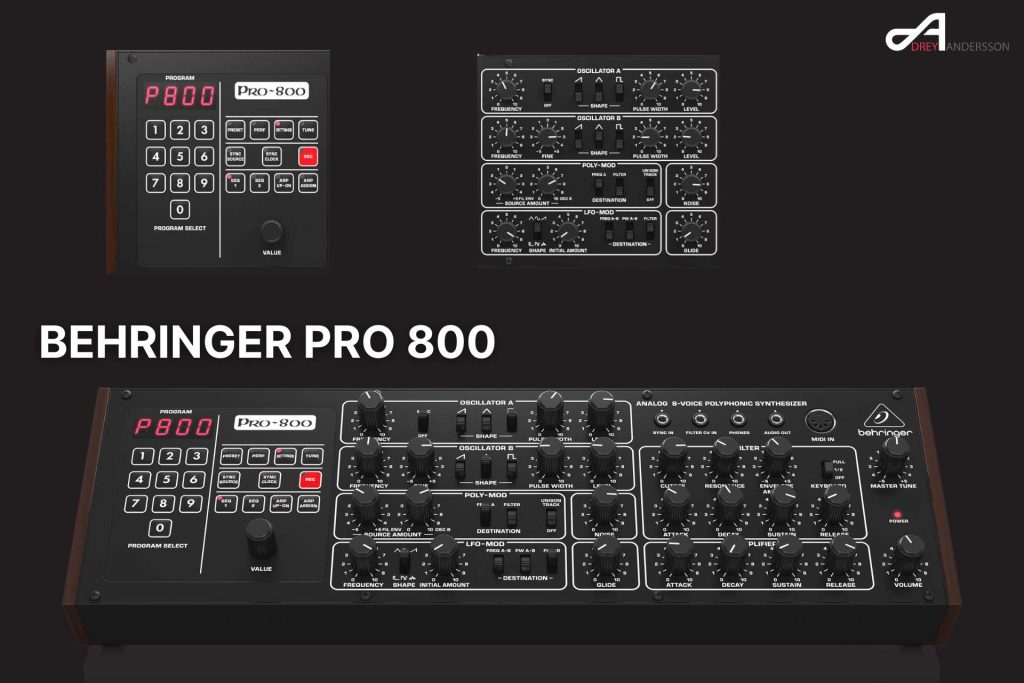
The Behringer Pro-800 is an 8-voice analog polysynth in a small desktop box, and at roughly €249 / $239 it is the cheapest true-analog 8-voice synthesizer you can buy new. It’s Behringer’s recreation of the 1982 Sequential Prophet-600, rebuilt with real Curtis-style oscillators and the community GliGli operating system baked in. That price is what makes it interesting: eight genuinely analog voices for about the cost of a single boutique effects pedal.
Key Takeaways
- At about €249 / $239, the Pro-800 is the cheapest 8-voice true-analog synth in production, roughly $30 per voice (Thomann, July 2026).
- Its signal path is genuinely analog: two Coolaudio V3340 oscillators per voice (a Curtis CEM3340 clone) feeding a 4-pole resonant filter.
- It’s a keyboard-less remake of Sequential’s 1982 Prophet-600, running the GliGli OS for a polyphonic sequencer, arpeggiator and 16-oscillator unison.
- The next-cheapest true-analog poly with 8+ voices, Behringer’s own DeepMind 12D, costs over three times as much ($779).
What is the Behringer Pro-800?
The Pro-800 is a fully polyphonic, 8-voice analog synthesizer built as a keyboard-less desktop module. It’s Behringer’s clone of the Sequential Circuits Prophet-600, the 1982 poly that helped introduce MIDI, and it runs firmware based on the community-built GliGli operating system. It shipped in 2023 at a $399 list price and now sells for about €249 / $239 (Thomann, July 2026). You get 400 patch memories, a built-in sequencer, an arpeggiator, and both DIN and USB MIDI.
Behringer added two voices the original never had. Where the Prophet-600 gave you six, the Pro-800 gives you eight. It sits in the same family as Behringer’s monophonic Pro-1, another faithful Sequential recreation, so if you already know that box you’ll feel at home here.
Why the Pro-800 is the cheapest 8-voice analog synth you can buy
Here’s the short answer: nothing else comes close. A true-analog polysynth with eight or more voices normally starts around $780 and climbs to nearly $2,000. The Pro-800 undercuts that entire field at roughly $239, which works out to about $30 per analog voice. Even Behringer’s own DeepMind 12D, the next-cheapest option, costs more than three times as much per unit.
Street prices, July 2026. Pro-800 from Thomann (in stock); DeepMind 12D, UB-Xa D, Korg Prologue 8 and Prophet Rev2-08 from Sweetwater. Only true-analog synths with 8+ voices are shown. Digital and hybrid-oscillator polys (Hydrasynth, Novation Peak and Summit, UDO Super 6) are left out because their oscillators are not analog. Sources: Thomann, Sweetwater.
Look at it per voice and the gap gets even wider. The Pro-800 costs around $30 for each analog voice. The UB-Xa spreads its price over 16 voices and still lands near $59 each. The Prophet Rev2 sits at roughly $250 per voice. Want the honest caveat? Two of the pricier rivals here use DCOs rather than true VCOs, so the Pro-800 isn’t just the cheapest, it’s arguably among the most analog-authentic of the bunch.
Unit price divided by voice count, July 2026 street prices. Behringer pitched it as “the world’s first analogue 8-voice polysynth that is affordable for everyone” (MusicRadar).
What’s inside the sound engine?
The Pro-800 is analog where it counts. Each of its eight voices runs two Coolaudio V3340 oscillators, a clone of the Curtis CEM3340 chip used in the 1982 original, which adds up to 16 real VCOs across the whole instrument (chip teardown). Both oscillators offer sawtooth, triangle and pulse waves with pulse-width modulation, plus hard sync. The filter is a 4-pole, 24 dB-per-octave resonant low-pass that self-oscillates, built from Coolaudio V3320 and LM13700-style OTAs.
On top of that raw voice architecture you get the modulation the Prophet line was known for. There’s a poly-mod section, where oscillator B and the filter envelope can bend oscillator A’s pitch and the cutoff. A single LFO with six shapes targets pitch, pulse width and the filter. Two ADSR envelopes handle the filter and amp, and yes, they’re authentically slow, just like the original. Push all eight voices into unison and you’re stacking up to 16 oscillators on one note. There’s also a noise generator that the base Prophet-600 never shipped with.
Behringer Pro-800 specs at a glance
| Voices | 8 (the original Prophet-600 had 6) |
|---|---|
| Oscillators | 2 true VCOs per voice (Coolaudio V3340 / CEM3340 clone), 16 total |
| Waveforms | Sawtooth, triangle, pulse with PWM; hard sync |
| Filter | 4-pole (24 dB/oct) resonant, self-oscillating low-pass (V3320 + LM13700 OTAs) |
| Modulation | Poly-mod; 1 LFO with 6 shapes; 2 ADSR envelopes |
| Unison | Up to 16-oscillator unison |
| Sequencer / Arp | Polyphonic step sequencer + arpeggiator (GliGli OS) |
| Memory | 400 patch slots |
| MIDI | DIN + USB, full CC control, MIDI clock sync, velocity-sensitive |
| Format | Desktop module, no keyboard; Eurorack-mountable |
| Price | About €249 / $239 (down from a $399 list) |
The Prophet-600 lineage
To understand the Pro-800, look at what it copies. The Sequential Circuits Prophet-600 arrived in 1982 as a smaller, cheaper sibling to the legendary Prophet-5. It was the first synthesizer to ship with MIDI, and the protocol’s public debut in early 1983 famously linked a Prophet-600 to a Roland Jupiter-6. It carried six voices and a trimmed-down version of the Prophet-5’s fast Poly-Mod section.
The story doesn’t end in the eighties, though. A programmer known as GliGli later rewrote the Prophet-600’s firmware, adding a sequencer, better tuning and unison. Behringer’s Pro-800 ships with that community work built in, then bumps the voice count from six to eight. So you’re getting 1982 analog voice circuitry with four decades of refinement layered on top. If you like this branch of synth history, the monophonic Sequential Pro-One is the mono cousin worth knowing.
Is the Behringer Pro-800 worth buying?
For the money, it’s hard to argue against. Reviewers consistently praise the thick low-mids, the authentic Prophet character and that sharp resonant filter (gearnews). It’s a legitimate source of analog pads, strings, brass and basses at a price that used to buy you a single-voice desktop toy. The common complaints are fair, too: the high end can turn thin and fizzy with the filter wide open, the envelopes are slow, the membrane buttons feel cheap, and Behringer cloned the original’s quirks a little too faithfully.
One practical tip from using boxes like this. The Pro-800’s raw oscillators really come alive through a good reverb or multi-effects unit, so budget for one. But keep the money sensible. There’s no point pairing a €249 synth with a €500 boutique pedal, because the maths stops making sense. A used vintage rack reverb gets you lush space for synth-money instead. If you want a concrete example of that thinking, my Yamaha REV500 review covers a cheap, great-sounding unit that pairs perfectly with a budget analog poly.
Frequently asked questions
How much does the Behringer Pro-800 cost?
The Behringer Pro-800 sells for about €249 in Europe and $239 in the US as of July 2026, in stock at Thomann. That’s roughly $30 per analog voice, and it’s a clear drop from the $399 list price it launched at in 2023. No other true-analog 8-voice synth comes close to this figure.
Is the Behringer Pro-800 a true analog synthesizer?
Yes. Its audio path is fully analog: two Coolaudio V3340 oscillators per voice, a Curtis CEM3340 clone, feeding an analog 4-pole resonant filter, for 16 real VCOs in total. Only the envelopes, LFO, tuning, MIDI and patch storage are digital, which is normal for a Prophet-600-style instrument.
Is the Pro-800 the cheapest 8-voice analog synth you can buy?
Yes, in current production. At about $239 it undercuts every other true-analog synth with eight or more voices. The next-cheapest, Behringer’s own DeepMind 12D, costs $779, more than three times as much, and it uses DCOs rather than the Pro-800’s true VCOs. That value gap is the Pro-800’s whole appeal.
What synth is the Behringer Pro-800 a clone of?
The Pro-800 is a clone of the Sequential Circuits Prophet-600 from 1982, the first synth to feature MIDI. It also bakes in the community GliGli operating system, which adds a sequencer, arpeggiator and unison, and it raises the voice count from the original’s six to eight.
Does the Behringer Pro-800 have a keyboard?
No. The Pro-800 is a keyboard-less desktop module, so you play it from any external MIDI controller over DIN or USB. It’s also Eurorack-mountable if you want it in a modular case. Leaving off the keys is part of how Behringer hit the roughly €249 price point.
You can also check the official Behringer product page, or head back to the Music Production Terms index for more gear explainers.
Back to Music Production Terms Index Page