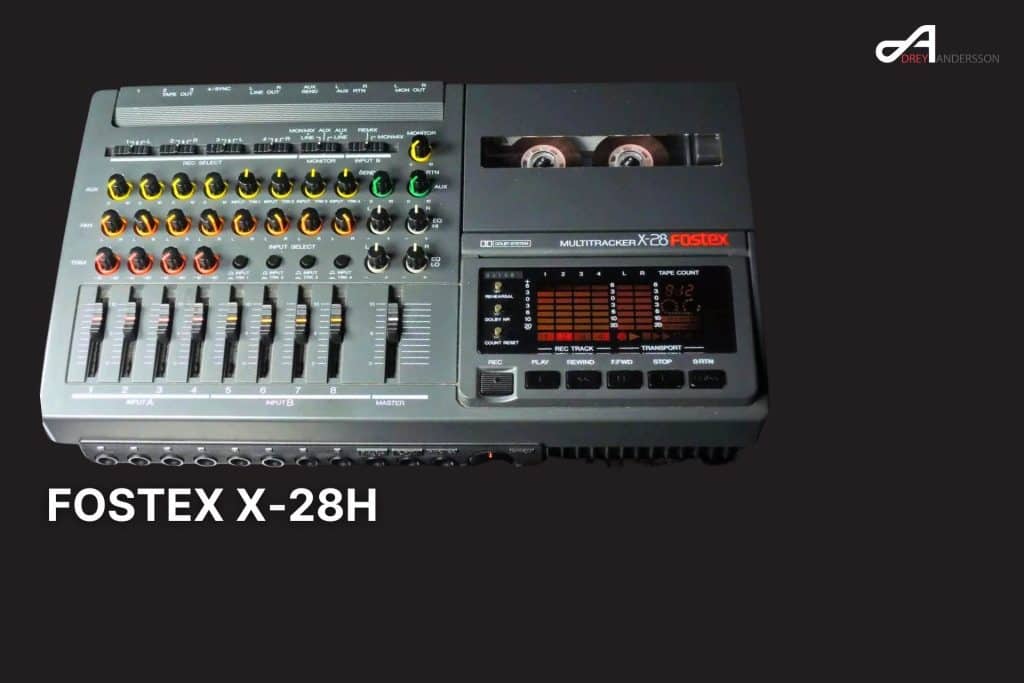
Fostex built a four-track cassette machine in the early 1990s that beat most of its rivals on paper, and almost nobody noticed. The X-28H spent its whole commercial life in Tascam’s shadow. Now that cassette texture is back in demand for sampling and lo-fi production, that obscurity has quietly flipped into an advantage: the X-28H is one of the cheapest capable 4-tracks you can still buy, precisely because its name never became a household word. This guide covers what it does, what it actually costs in 2026, how it stacks up against its X-26 and X-28 siblings, and how to pull real vintage character out of it.
Key Takeaways
- The X-28H records four tracks at standard cassette speed (4.75 cm/s) with a 40Hz–12.5kHz response and 58dB signal-to-noise via Dolby B. A 1992 reviewer said the results matched “a good-quality reel-to-reel” (Music Technology, Feb 1992).
- The “H” means high-speed dubbing, not a faster recording speed. The plain X-28 is identical apart from that one feature, so the “slower X-28 sounds more saturated” claim you’ll read online is a myth.
- Real 2026 used prices run about $150–$300 depending on condition (Reverb), far below the $700–$1,200 often quoted. Budget another $50–$150 for belts and servicing.
What is the Fostex X-28H, and why did it get overlooked?
The Fostex X-28H is an early-1990s four-track cassette multitracker built around an eight-input mixer, Dolby B noise reduction, and a 40Hz–12.5kHz frequency response (Music Technology, Feb 1992). Strong specs, weak sales: that gap is the whole story of the machine.
The mixer is where it earns its keep. You get four gain-adjustable mic/line inputs plus four more line inputs, all usable at once, with individual level, pan, and aux send per channel and a two-band EQ on the stereo bus. Add dual-function aux sends and a rehearsal mode for punch-ins, and you have routing that cost a lot more money on rival gear. So why did almost nobody buy one?
Two reasons. Fostex leaned on quiet competence rather than marketing, and the transport hid its cleverness behind plain soft-touch buttons. The result was a machine that quietly did more than its price suggested, aimed at a buyer who mostly walked past it toward a Tascam. That is a marketing failure, not an engineering one, and it is exactly why the X-28H is a bargain today.
Why did Tascam win and Fostex disappear?
Tascam had already turned “Portastudio” into the generic name for a cassette four-track by the time the X-28H shipped, and brand recognition beat spec sheets. The clearest proof is cultural: Springsteen cut Nebraska in 1982 on a Tascam 144, the original Portastudio, not on any Fostex (TASCAM).
That single album did more for Tascam than any advertising could. It planted the idea that a cassette four-track was a legitimate creative tool, and it stamped a Tascam model number onto the myth. Fostex never got a Nebraska. Its machines went home with hobbyists and demo-writers who rarely name-checked the brand, so the X-28H racked up satisfied owners and zero legend.
There was a practical side too. Tascam ran a deeper service network and a reputation for tank-like reliability, which mattered to anyone treating a multitracker as a workhorse. Fostex offered comparable, sometimes better, technical performance, but it wore the perception of being the cheaper alternative. Superior routing does not sell a machine if buyers never audition it.
What does a Fostex X-28H cost used in 2026?
Recent Reverb listings put working X-28H units at roughly $150 to $300, with non-working machines near $150 and clean, boxed examples reaching about $295 (Reverb, 2024–2025). That is a fraction of the $700–$1,200 figures repeated across older buyer guides, so check real sold prices before you overpay.
Condition is the whole game. The most common fault on aging units is the display freeze, where the LCD lights up fully and the transport stops responding. Belt deterioration, transport wear, and tired power supplies show up often enough that you should assume a service is coming. Japanese sellers tend to grade honestly and document condition well, which is worth a small premium.
Here is the correction that saves you money. Because so many guides inflate the numbers, buyers brace for $800 and feel relieved paying $500. Look at what clean units really sell for and the picture changes.
Why the X-28H still matters for modern sampling
At roughly $200 for a clean working unit (Reverb, 2024–2025), the X-28H buys you controlled tape degradation rather than random failure. Its transport is stable and its record levels are consistent, so the cassette character it adds is repeatable, which is exactly what you want when a texture has to survive being chopped into a sample.
The mixer opens up more than plain four-track capture. You can push the aux sends for parallel processing, shape tone with the onboard EQ while recording, and set up layered overdubs that print character at every stage. For textured, multi-generation samples, that flexibility beats a barebones deck that only records and plays.
Getting audio into a DAW is painless. The line-level outputs feed a modern interface cleanly with no extra gain stage, and the stable transport makes tempo-sensitive sampling more predictable than it is on twitchier vintage machines. Want the tape sound without the tape drama? That is the pitch.
Fostex X-28H technical specifications
The verified core, drawn from the period review and the owner’s manual, is a standard-speed four-track with a 40Hz–12.5kHz response and 58dB signal-to-noise (Music Technology, Feb 1992). The full list below combines those measured figures with the manual’s published details.
Recording system
- 4-track simultaneous recording
- Type II (high-bias) tape optimization with 70-microsecond equalization
- Standard cassette speed: 4.75 cm/s (1-7/8 ips)
- Dolby B noise reduction (switchable)
- High-speed dubbing for fast tape-to-tape copying
Performance
- Frequency response: 40Hz–12.5kHz
- Signal-to-noise ratio: 58dB (with Dolby B)
- Crosstalk: 50dB
- Wow & flutter: under 0.25% (WRMS)
- Total harmonic distortion: under 1.5% at 0dB
Mixer section
- 8-input console: 4 gain-adjustable mic/line (channels 1–4) plus 4 line (channels 5–8)
- Individual level, pan, and aux send per channel
- 2-band stereo-bus EQ: 12dB of cut or boost at 100Hz and 10kHz
- Pre-fade aux on mic inputs, post-fade on line inputs
Transport, control and connectivity
- Logic-controlled soft-touch transport with return-to-zero and rehearsal-mode punch in/out
- Pitch control up to 12 percent
- Backlit LCD: four track meters, stereo-bus meters, three-digit counter, Dolby indicator
- Eight 1/4-inch jack inputs, RCA tape and stereo outputs, aux returns, headphone out, footswitch inputs
- External DC supply, roughly 430 x 350 x 100 mm, about 4.2 kg
What does the X-28H sound like?
Its Dolby B path is gentler than the dbx systems on many rivals, keeping more natural high end while accepting a slightly higher noise floor. The trade is a warmer, more open sound, and it is the reason a 1992 reviewer wrote that the clarity “took me by surprise” (Music Technology, Feb 1992).
For lo-fi work, the saturation behaves. Recording into the red produces harmonically rich distortion instead of the brittle mess cheaper decks make, and the pitch control adds subtle wow and flutter on demand. The machine rewards a heavy hand: it colours the signal without falling apart.
In my own sampling, its best trick is cumulative generation loss. Because the transport and levels stay consistent, I can bounce tracks 1 and 2 down to 3 and 4, then back again, and predict what each pass does to the sound. Cheaper decks throw dropouts and speed lurches into the middle of a take; this one does not. That controllability is where high-speed dubbing earns its place in a workflow.
How reliable is the X-28H, and can you still fix one?
Plan on maintenance, because every one of these machines is now at least thirty years old. The belt-driven transport needs more attention than a direct-drive deck, and a fresh set of belts plus a clean and demagnetize is the standard first service, usually in the region of $50 to $150 for parts and basic labour.
Beyond belts, the usual jobs are refreshing aging electrolytic capacitors and cleaning the controls. Head alignment every few years keeps performance tight, though a tech who will do it is getting harder to find. Modification communities are thin compared with the popular Tascams, so you are mostly on your own for anything clever.
Parts are the real constraint. Belts and generic components are easy, but anything specific to the X-28H can be tough or impossible to source. That makes the buying decision matter more than the restoring one: a well-kept unit is worth paying up for, because a heavy rebuild may cost more than the machine will ever be worth.
The verdict: who should buy one?
Budget around $200 to $400 all-in for a working X-28H plus a service, not the $500 to $800 older guides suggest (Reverb, 2024–2025). At that price it is a genuine bargain for a specific job: adding controllable cassette character to samples and productions.
Treat it as a texture tool, not a main recorder. Its strengths are the flexible mixer, the predictable saturation, and the low entry price its obscurity created. Its weaknesses are fragile parts availability and the display-freeze risk. Understand both and the X-28H rewards you. Ignore them and you have bought a heavy paperweight.
If you specifically want its warmer, Dolby-B voice and the routing to build layered samples, it is worth seeking out. If you just need any cassette four-track and value easy servicing, a well-supported Tascam may suit you better. Both are valid. The X-28H simply asks that you go in with clear eyes.
The Fostex family: X-26 vs X-28 vs X-28H
Fostex sold three closely related cassette four-tracks, and the differences are smaller than the model numbers suggest. All three record four tracks at the same 4.75 cm/s standard speed with the same 40Hz–12.5kHz response; what changes is the mixer size, the weight, and whether you get high-speed dubbing (Fostex owner’s manuals).
| Model | Tracks | Mixer | High-speed dubbing | Weight | Typical used (2025) |
|---|---|---|---|---|---|
| X-26 (1988) | 4 | Simpler, fewer inputs | No | ~1.8 kg | ~$50–$90 |
| X-28 | 4 | 8-input | No | ~4.2 kg | ~$150–$250 |
| X-28H | 4 | 8-input | Yes | ~4.2 kg | ~$150–$300 |
The X-26: the lighter, cheaper entry point
The X-26 arrived in 1988 as the compact, affordable start of the line. It shares the family’s core recording spec but wears a much simpler mixer and weighs roughly 1.8 kg, against about 4.2 kg for the bigger units. For basic overdubbing and deliberately constrained lo-fi work, its stripped-back control set is a feature, not a limitation, and it turns up used for pocket money.
The plain X-28: an X-28H without fast dubbing
Here is the naming trap worth clearing up. The standard X-28 and the X-28H share the same eight-input mixer, the same connectors, the same 4.75 cm/s recording speed, and the same reliability quirks. The only meaningful difference is high-speed dubbing, which the plain X-28 does not have. Any claim that the X-28 runs slower and therefore sounds more saturated is simply wrong: both record at the identical standard cassette speed.
Which Fostex should you actually buy?
For most people, the X-26 is the smart first move: light, cheap, reliable through simplicity, and plenty for entry-level sampling. Step up to the X-28 or X-28H when you need the eight-input mixer and its routing. Pay the small extra for the X-28H specifically if fast generation-copying matters to your workflow, since its high-speed dubbing turns a slow tape-to-tape chore into a quick one. Beyond that, the family is more a spread of options than a good-better-best ladder.
Pro tips: getting maximum vintage character
Want to push the X-28H past clean capture into full lo-fi territory? These are the techniques that reliably add character without wrecking a take. Keep a clean reference version first, then experiment on copies.
Tape selection. Skip premium stock and reach for “wrong” tape. Type I (normal bias) cassettes work despite the mismatched bias, rolling off the highs and adding saturation. Old pre-recorded tapes bring their own wear, and cheap no-name cassettes from the 80s and 90s add unpredictable mechanical wobble. For a cleaner reference, stick to fresh Type II.
Recording for controlled damage. Push the master well into the red for tape saturation, and overdrive the input for harmonic grit. Build generations by bouncing: record tracks 1 and 2, mix to 3 and 4, then bounce back, letting each pass stack artifacts. Ride the pitch control during recording for live wow and flutter.
Transport and Dolby tricks. Start and stop the transport between takes to nudge the tape and introduce tiny speed shifts. Best of all, record with Dolby B on and play back with it off for naturally dulled highs, or reverse it for exaggerated, hissy brightness. That mismatch gives more convincing degradation than any plugin filter, and it costs nothing.
Frequently asked questions
Is the Fostex X-28H the same as the X-28?
Almost. The X-28H and the standard X-28 share the same eight-input mixer, four-track recording, Dolby B, and 4.75 cm/s tape speed. The only real difference is high-speed dubbing, a fast tape-to-tape copy mode the plain X-28 lacks. For most sampling work the two sound identical.
What tape speed does the Fostex X-28H run at?
The X-28H records at 4.75 cm/s (1-7/8 ips), the standard compact-cassette speed, exactly like the X-28 and X-26. Despite the high-speed badge, it does not run tape faster during recording. The H refers only to its high-speed dubbing function for copying between tapes.
How much is a Fostex X-28H worth in 2026?
Recent Reverb listings put working X-28H units at roughly $150 to $300, with non-working examples near $150 and clean, boxed units reaching about $295. Older buyer guides quoting $700 to $1,200 are well above what the machine actually sells for today. Budget $50 to $150 more for servicing.
What tape should I use in a Fostex X-28H?
The X-28H is optimized for Type II (high-bias, chrome or ferricobalt) cassettes with 70-microsecond equalization, and C-60 or C-90 lengths are safest. C-120 tape is too thin and prone to jamming. For deliberately lo-fi results, some producers load Type I tape and accept the resulting high-frequency roll-off.
Did Springsteen record Nebraska on a Fostex?
No. Nebraska was tracked in 1982 on a TEAC/Tascam 144 Portastudio, the original cassette four-track, not a Fostex. The Fostex X-28H arrived roughly a decade later. The story is a reminder that cultural fame followed the Tascam brand more than the raw specifications of any single machine.
See the X-28H in action
If you want to hear the machine before you buy, this hands-on demo runs through recording straight to tape on the X-28H, including transport handling and the character it prints on a signal.
« Back to Music Production Terms Index Page
Back to Music Production Terms Index Page