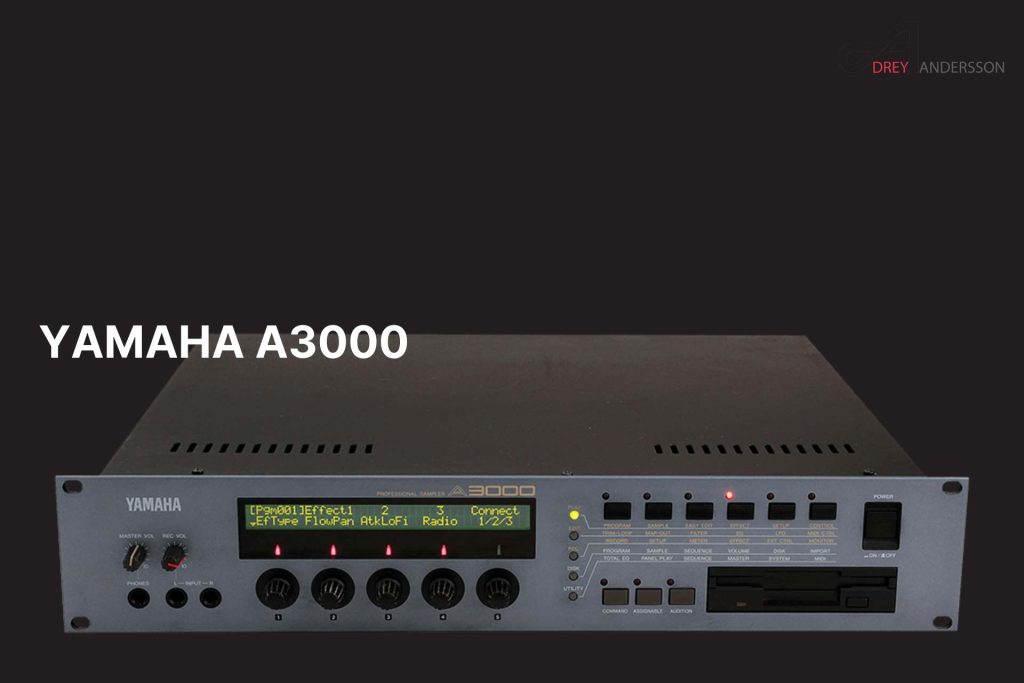
The Yamaha A3000 is a 2U rackmount digital sampler released in 1997 at a UK list price of £1,299 (Sound On Sound, July 1997). It offers 64-note polyphony, 16-part multitimbrality and 128 programs, expandable from 2 MB to 128 MB of sample RAM. What set it apart was not the sampling engine. It was the filter section and the three-block effects processor, both of which shipped as standard while Akai charged extra for far less.
- Released 1997, £1,299 in the UK. 64-note polyphony, 16 parts, 2 MB stock RAM expandable to 128 MB.
- Six resonant multimode filter types as standard. The Akai S2000 of the same era shipped one, and charged £399 for its effects board.
- Three effect blocks drawing on a library of 54 algorithms, not 54 per block. The A3000 can also process external audio, so it doubles as an outboard FX unit.
- Version 2 firmware (1998) added Loop Remix and raised the filter count from 6 to 16. Buy a v2.00 unit if you can.
- The rotary encoders are the known weak point. Test every knob before buying.
What is the Yamaha A3000?
Strip the marketing away and it’s a hardware sampler: a rack unit that records audio into RAM, lets you edit and loop it, then plays it back across a MIDI keyboard. Yamaha launched it in 1997 (Yamaha) as the successor to the TX16W of 1988 (Wikipedia). It records 16-bit linear audio at 44.1, 22.05, 11.025 or 5.5125 kHz, and its AWM2 tone generator also supplies plain synth waveforms, sine, saw, square, pulse and triangle, as oscillator sources next to your own samples (Synth-DB).
That last detail matters more than it sounds. The Yamaha A3000 sampler hands you raw waveforms, a resonant filter with its own envelope, and an overdriveable gain stage, which puts it halfway to being a synthesizer. That’s a large part of why the machine still gets bought.
Yamaha A3000 specifications
Headline numbers first: 64-note polyphony, 16-part multitimbral, 128 programs, and a 2 MB starting allocation that stretches to 128 MB (Sound On Sound, July 1997). To put the memory ceiling in perspective, Yamaha’s own manual rates 32 MB at 6 minutes 20 seconds of mono 44.1 kHz audio, so a fully loaded machine holds roughly 25 minutes.
| Specification | Yamaha A3000 |
|---|---|
| Released | 1997, £1,299 UK list |
| Sampling | 16-bit linear, mono or stereo |
| Sample rates | 44.1 / 22.05 / 11.025 / 5.5125 kHz |
| Polyphony | 64 notes, 16 parts multitimbral |
| Programs | 128, up to 128 samples each |
| Memory | 2 MB standard, 128 MB maximum |
| RAM type | 4 sockets, 72-pin SIMMs, 70 ns or faster, fitted in pairs (secondary sources) |
| Filters | 6 resonant types (16 under v2 firmware) |
| Effects | 3 blocks, 54-algorithm library, parallel or serial |
| EQ | 4-band parametric on main out, plus 1 band per sample |
| Analog outputs | 4 (stereo out, plus assignable L and R) |
| SCSI | Standard, 50-pin rear connector |
| Digital I/O | Optional AIEB1 board (£149), adds S/PDIF and 6 more outs |
| Storage | 3.5 inch 1.44 MB floppy; internal hard drive optional |
| Size and weight | 2U rack, 483 x 403 x 90 mm, 6.9 kg |
Sources: Sound On Sound (July 1997) for the engine and pricing rows; the Yamaha A3000 Owner’s Manual specifications page for connectors, dimensions and weight. The SIMM detail, the sample-rate list and the samples-per-program figure come from secondary spec aggregators rather than the manual page, which does not list them. Checked July 2026.
Why the A3000 filters mattered in 1997
The A3000 shipped with six resonant multimode filter types as standard: HiPass1, HiPass2, LowPass1, LowPass2, BandPass and BandElim (Yamaha Owner’s Manual). Its direct rivals, the Akai S2000 and S3000XL, each shipped a single 12 dB/oct resonant lowpass. On the S3000XL, highpass and bandpass required the paid IB304F board (Sound On Sound, December 1995). This is the reason to care about the machine.
Each sample gets its own filter, its own envelope generator, its own LFO depth, and a gain stage you can push into overdrive, per the spec aggregator Synth-DB, which is a secondary source rather than Yamaha documentation. That last one is the fun part. Drive the input, sweep a resonant band, and the A3000 starts behaving like a synth rather than a playback box.
One caveat worth stating plainly, because most A3000 pages get it wrong. Vintage Synth Explorer lists the filters as 12 dB, while SonicState lists them as 12 and 24 dB. Nobody has published a primary figure. Treat any confident “4-pole” claim about this machine with suspicion, including the ones you’ll find on other spec sites.
Three effect blocks, 54 algorithms, and the FX box trick
The A3000 has three independent effect blocks (Efct1, Efct2, Efct3) drawing on a shared library of 54 algorithms. It does not have 54 effects per block, a number that circulates widely. Yamaha’s Effect Type List runs as a single sequence: types 1 to 24 on page 337, types 25 to 54 on page 338 (Yamaha Owner’s Manual). That’s 54 total, not 162.
Those blocks run in parallel by default and can be rewired in series. What makes the library worth having is how strange it gets. Alongside the expected Hall, Room, Plate and Chorus algorithms sit Scratch, TurnTbl, Radio, AmpSim, Basemnt and Canyon: 1997 ideas about what a sampler should do to a breakbeat, and not the sort of thing a modern plugin bundle ships with.
Now the part that keeps these units in racks. The effects can bypass the sample engine entirely and process external audio coming in the front-panel inputs, which turns the A3000 into a standalone outboard effects unit. That’s confirmed by Sound On Sound, by Wikipedia, and by the manual’s own page 14, which notes the assignable outputs can carry the front-panel input signal. If that’s your interest, the Alesis QuadraVerb guide covers the same territory from the dedicated-FX side.
- 3 effect blocks, 54 algorithms
- 6 resonant filter types
- SCSI built in
- 64-note polyphony
- 128 MB memory ceiling
- Digital I/O: £149 extra
- No effects at all
- 1 lowpass filter type
- SCSI built in
- 32-note polyphony
- 32 MB memory ceiling
- Effects board: £399 extra
Blush Response demonstrates the A3000 in use
Blush Response spends 28 minutes testing what the channel calls the sampler’s “hyper advanced (for 1997)” functionality. It covers the machine broadly rather than the effects alone, and it’s the fastest way to hear how one actually behaves.
What version 2 firmware added in 1998
Yamaha shipped a substantial v2 update in September 1998, priced at £100 for existing owners (Sound On Sound). It raised the filter count from 6 to 16 and added two loop tools that were genuinely ahead of their moment. Loop Divide splits a loop into 2 to 32 slices, each adjustable from 10% to 800% of its original length. Loop Remix rearranges those chunks at random and re-splices them cleanly.
Beat slicing, in a rack unit, in 1998. Version 2 also brought a Program LFO that modulates every sample in a program and syncs to MIDI clock, plus stereo-to-mono conversion and input metering. What it did not bring: any new effects, any new oscillator waveforms, or better waveform editing. Sound On Sound was blunt about that last one.
For buyers this is simple. Firmware vendors and forum threads report that the last OS is 2.00, that it arrives as a single EPROM chip you swap in, that the installed version shows on the boot screen, and that you’ll generally want a factory reset afterwards (YamahaMusicians forum). Yamaha has published nothing on this, so treat it as owner knowledge rather than documentation.
Yamaha A3000 vs A4000 vs A5000
Yamaha replaced the A3000 in 1999 with two machines rather than one (Yamaha). The Yamaha A4000 came in cheaper at £999 with the same 64-note polyphony, while the Yamaha A5000 went to £1,499 and nearly doubled the engine: 126 notes, 32 parts and six effect blocks instead of three (Sound On Sound, April 2000).
| Model | A3000 | A4000 | A5000 |
|---|---|---|---|
| Year | 1997 | 1999 | 1999 |
| UK price | £1,299 | £999 | £1,499 |
| Polyphony | 64 | 64 | 126 |
| Multitimbral parts | 16 | 16 | 32 |
| Effect blocks | 3 | 3 | 6 |
| Stock / max RAM | 2 MB / 128 MB | 4 MB / 128 MB | 4 MB / 128 MB |
Sources: Yamaha synth chronology for release years and Sound On Sound for prices and specs. Yamaha dates both successors to 1999; UK reviews appeared in April 2000.
So which one should you actually buy? If you want the effects and the filters, all three deliver, and the A4000 is the bargain of the group, with the caveat that its effects are not expandable. If you want polyphony and headroom, the A5000 is the only real answer. The A3000 sits in the middle, and being the oldest of the three, it’s also the one most likely to need recommissioning.
Living with an A3000
Sound On Sound called the operating system “arcane” in its original 1997 review and noted that Yamaha had given the machine more features than a two-line display could reasonably present. That assessment has aged well. MusicTech’s reviewer, writing from ownership, reported that his unit “would occasionally freeze at will, and would subsequently take nearly 10 minutes to reload all the samples into memory” (MusicTech). That last account, and the Daedelus one below, come from people who actually owned one.
Those constraints shaped at least one career. Daedelus built his early work around an A3000 and eventually left it behind for the Monome, explaining that “I only had ten fingers and at most they could change one or two parameters at a time. It felt really slow” (DJ TechTools, 2014). Read that as a fair warning about the workflow, not a verdict on the sound.
The rotary encoders are the thing to check
If you buy one A3000 fault to worry about, buy this one. Repair documentation from todbot and the SynthNitZ teardown series traces it to a design flaw in how the encoders are mechanically supported, which lifts copper traces off the circuit board over time. These are practitioner repair sources rather than official documentation, but they agree with each other and trace the fault to the same cause. The symptom looks cosmetic; the cause is not.
Symptoms: a knob that does nothing, or one that jumps 10 to 20 steps per click, and shafts that feel loose. The stock part is an ALPS EC11E15244. Contact cleaner buys time and does not fix it.
Two more things to test. Run the floppy drive, since owners on the Vintage Synth and HxC forums report both drive failures and trouble getting emulator swaps working. And check the display lights and reads cleanly, as you would on any machine this age.
What a Yamaha A3000 costs in 2026
Less than you’d expect, and the market is thin enough that a single average would mislead you. A Reverb search on 20 July 2026 returned 29 results for “yamaha a3000” of which exactly two were complete samplers: a faulty unit asking €289 in France, and a serviced version-2 machine asking €285 in Ireland. A broken one listed above a working one tells you how few data points there are.
Look at what the other 27 listings were, though. Mainboards, panel boards, power supplies, internal drive kits, v2 EPROMs at €14 to €21, USB floppy emulators at €192 to €251, and replacement LCD screens at €48 to €79 sold as new stock by several vendors at once.
Budget accordingly. The unit itself is cheap, and the two documented repairs are the encoders and the floppy drive. Neither is a trivial job, and the encoder fix in particular means board-level work rather than a parts swap. If the machine you’re looking at already has the AIEB1 digital I/O board fitted, that’s a genuine bonus: it was a £149 option in 1997 rather than standard equipment.
Is the Yamaha A3000 still worth buying?
Verdict: 4 out of 5, based on published reviews, Yamaha’s own documentation and practitioner repair sources rather than hands-on testing. It’s worth it for two specific reasons, and not really for a third. The filter section and the effects engine are the draw: six resonant types feeding three blocks of a 54-algorithm library, with a gain stage you can overdrive, is an unusual signal path to find in a sampler at any price. Using it purely as an outboard FX box for external audio is a completely legitimate reason to own one.
What it isn’t is a good sampler to sample with in 2026. A two-line display, an arcane menu system and a ten-minute reload after a freeze are not workflow advantages. If you want a Yamaha rack from this era for its sound rather than its sampling, the SY77 and TG77 are worth a look, and the REV500 covers the cheap-reverb end. For the wider argument about old hardware against modern plugins, see analog vs digital synthesizers, and for context on how Akai came to dominate this market, the history of the Akai MPC fills in the other side.
Frequently asked questions
What is the Yamaha A3000?
The Yamaha A3000 is a 2U rackmount digital sampler released in 1997 at a UK list price of 1,299 pounds. It records 16-bit audio, offers 64-note polyphony across 16 multitimbral parts, and holds 128 programs. Sample memory starts at 2 MB and expands to a documented maximum of 128 MB.
How many effects does the Yamaha A3000 have?
The A3000 has three independent effect blocks that draw on a shared library of 54 algorithms, not 54 effects per block. Yamaha’s manual lists the effect types as a single run from 1 to 54. The blocks can be configured in parallel or rewired in series.
Can the Yamaha A3000 be used as an effects unit?
Yes. The effects can bypass the sample engine entirely and process external audio arriving at the front-panel inputs, so the A3000 works as a standalone outboard effects processor. Yamaha’s manual confirms the assignable outputs can carry that front-panel input signal directly.
What is the difference between the Yamaha A3000, A4000 and A5000?
The A4000 and A5000 replaced the A3000 in 1999. The A4000 cost 999 pounds and matched the A3000’s 64-note polyphony and three effect blocks. The A5000 cost 1,499 pounds and offered 126 notes, 32 multitimbral parts and six effect blocks, roughly double the engine.
What should I check before buying a used Yamaha A3000?
Test every rotary encoder first. A documented design flaw lifts copper traces off the circuit board, so knobs stop responding or jump many steps per click. Also run the floppy drive and check the display. Owners report version 2.00 is the last firmware, shown on the boot screen.
How much is a Yamaha A3000 worth?
The market is thin. A Reverb check in July 2026 found 29 listings but only two complete samplers, asking around 285 to 289 euros. Most listings were spare parts rather than working machines. Factor in repair costs, since the rotary encoders are a documented weak point on these units.
Back to Music Production Terms Index Page
Back to Music Production Terms Index Page