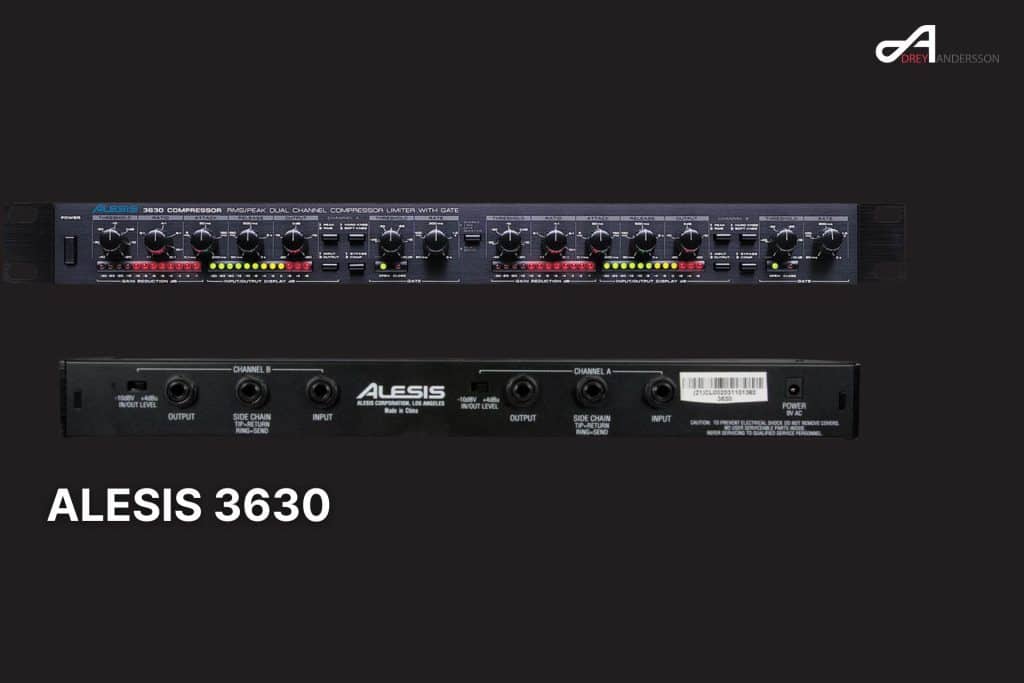
The Alesis 3630 is a two-channel analog compressor, limiter and gate that sold from the early 1990s for around $300. It picked up two reputations at the same time. Budget studios called it noisy and blunt. Electronic producers heard those same traits as character, and Daft Punk built the pumping sound of Homework and Discovery around one. This page is the quick reference: what it is, what the specs actually say, and whether it’s worth buying now. For the full French house story, read the in-depth Alesis 3630 feature.
Key takeaways
- What it is: a dual-channel VCA compressor/limiter/gate in one rack space, roughly $300 new.
- Why it’s famous: Daft Punk’s main compressor on Homework and Discovery (Mix, 2001).
- The trade-off: aggressive, pumping, a little noisy. A flaw for clean work, a feature for house and techno.
- Today: about $50 to 100 used (serviced units cost more), with alternatives from around $149.
What is the Alesis 3630?
The Alesis 3630 is a two-channel analog compressor, limiter and gate housed in a single rack unit, introduced in the early 1990s at roughly $300. Guy-Manuel de Homem-Christo confirmed that price himself in a 2001 Mix interview. Each channel gives you peak or RMS detection, hard or soft knee, plus independent controls.
Under the hood it’s a VCA design, so gain is controlled by a voltage-controlled amplifier rather than an optical cell or a valve. Alesis used a dbx-designed VCA paired with cheaper supporting parts, and that combination is exactly where its sound comes from. Set the threshold, dial a ratio, and it clamps down fast. When I reach for one, it’s never for invisible gain control. It’s for attitude.
Alesis 3630 specifications at a glance
Every figure below is taken straight from the official Alesis 3630 reference manual, not marketing copy. On paper it reads clean: dynamic range above 118 dB and total harmonic distortion under 0.05% at +4 dBu. The rough edges come from the supporting circuitry and the gate, not from these headline numbers.
| Specification | Value |
|---|---|
| Configuration | 2 channels, dual-mono or stereo-linked |
| Dynamic range | >118 dB (A-weighted) |
| Signal-to-noise | >100 dB (A-weighted) |
| Frequency response | 10 Hz to 30 kHz |
| THD | <0.05% at +4 dBu |
| Compression ratio | 1:1 to ∞:1 |
| Attack time | 0.1 ms to 200 ms |
| Release time | 50 ms to 3 s |
| Threshold range | -40 dBu to +20 dBu |
| Max headroom | +18 dBu |
| Detection / knee | Peak or RMS; hard or soft knee |
Source: Alesis 3630 Reference Manual.
Where the 3630 earns its reputation is timing. The attack sweeps from a genuinely fast 0.1 ms up to a slow 200 ms, and release stretches from 50 ms out to a full 3 seconds. That wide window is what lets you dial in an obvious pump on a drum or bass bus.
Why did a $300 compressor become famous?
Because Daft Punk said so, on the record. In a 2001 Mix interview, Guy-Manuel de Homem-Christo put it plainly: “We have a really small compressor, the Alesis 3630, which is $300. That’s the main one we used on Homework and Discovery.” That one line turned a bargain-bin unit into a French house signature, and demand for used 3630s has never really cooled since.
So why does a cheap compressor end up defining a genre? The pumping. Push a fast attack and a slow release hard, and the 3630 ducks and breathes in a way expensive units are designed not to. The full story, from Stardust and Roule Records through to later pop records, lives in the in-depth French house feature.
Alesis 3630 sound and character
Sound design aside, the honest answer is: aggressive. Sound On Sound’s original review back in August 1991 already flagged the blunt, colored character that producers now chase on purpose. Drive it and it grabs the signal hard, with obvious movement and a bit of grit. On a lead vocal for a jazz record, that’s a problem. On a house drum bus, it’s the point.
From what I’ve seen, people fall into two camps fast. If you want the compressor to disappear, you’ll hate it. If you want it to leave fingerprints, few units this cheap stamp harder. The noise floor and the gate are the real weak spots, and both are fixable, which brings us to the mods.
What are the best Alesis 3630 alternatives?
If you want the dbx-style sound the 3630 imitates, or simply something quieter, three units come up again and again. The chart below shows where each sits on price today. The 3630 stays the cheapest by a wide margin, which is a big part of why it survives.
The dbx 266xs (around $149 new) is the obvious step up: it’s the proper dbx compressor the 3630 borrows its VCA from, and it’s quieter. The Alesis 3632 is the factory-tidied version of the 3630 itself, though it’s largely discontinued now and turns up as new-old-stock near $130. The FMR Audio RNC1773 ($199.99) is the small-box giant killer that many engineers keep even after buying pricier gear. For a wider field, see the guide to hardware stereo compressors.
Can you improve the Alesis 3630 with mods?
Yes, and the mods are well documented. The simplest one comes from Tape Op issue 45: clip two wires to take the gate-detection circuit out of the path, and the unit behaves more like a proper dbx compressor straight away. DIY Recording Equipment documents the fuller route, swapping the stock VCAs for THAT 2180-series chips and cleaning up the power supply for a real drop in noise.
Is it worth the soldering? If you already own one and like its character, an evening with a soldering iron and a few cheap parts removes the biggest complaints. New to the 3630? The full 3630 mod walkthrough and the extended notes in the in-depth feature are worth reading before you buy.
Is the Alesis 3630 worth buying in 2026?
A used 3630 runs about $50 to 100, and serviced units with a warranty cost more. That price is the whole argument. For clean, transparent compression, almost any modern unit or plugin beats it. For deliberate pumping and lo-fi grit on drums, bass, or a synth bus, very little gives you that specific analog attitude for the money.
My take after years around this box: buy it as a flavor, not as a workhorse. Producing house, techno, or anything that should breathe? It earns its rack space. For faithful recordings of acoustic sources, spend the money elsewhere. For the bigger question behind that choice, see does analog gear actually sound better.
Frequently asked questions
Is the Alesis 3630 a good compressor?
It depends what you want. As a clean, transparent compressor it’s mediocre, with a noisy gate and blunt behavior that Sound On Sound noted back in 1991. As a character tool for house, techno, and lo-fi production it’s excellent, which is why Daft Punk built the pumping sound of two albums around one.
What compressor did Daft Punk use?
The Alesis 3630. In a 2001 Mix interview, Guy-Manuel de Homem-Christo said it was “the main one we used on Homework and Discovery,” and noted it cost only $300. That single, cheap dual-channel compressor is a big part of the pumping French house sound the duo became known for.
When was the Alesis 3630 released?
In the early 1990s. Sources disagree on the exact year, but Sound On Sound reviewed it as a brand-new product in its August 1991 issue, which places the launch around 1990 to 1991. Claims of a 1989 release trace mostly to reseller listings rather than to any Alesis document.
Is the Alesis 3630 worth modding?
If you already own one, yes. The Tape Op gate-bypass mod costs almost nothing and removes the noisiest part of the circuit, while a THAT 2180-series VCA swap brings it closer to a dbx unit. For a mint stock 3630 you plan to resell, leave it alone, since modified units can be harder to sell.
What are good alternatives to the Alesis 3630?
The dbx 266xs (around $149) is the quieter compressor the 3630’s VCA is based on. The Alesis 3632 is a tidied factory version, and the FMR Audio RNC1773 ($199.99) is a small, well-loved unit that punches above its price. Each offers cleaner results than a stock 3630 for a modest step up in cost.
That’s the reference version. For the long read on how a budget compressor shaped a genre, head to the Alesis 3630 French house feature, or go back to the Music Production Terms index.
Back to Music Production Terms Index Page