What is vector synthesis?
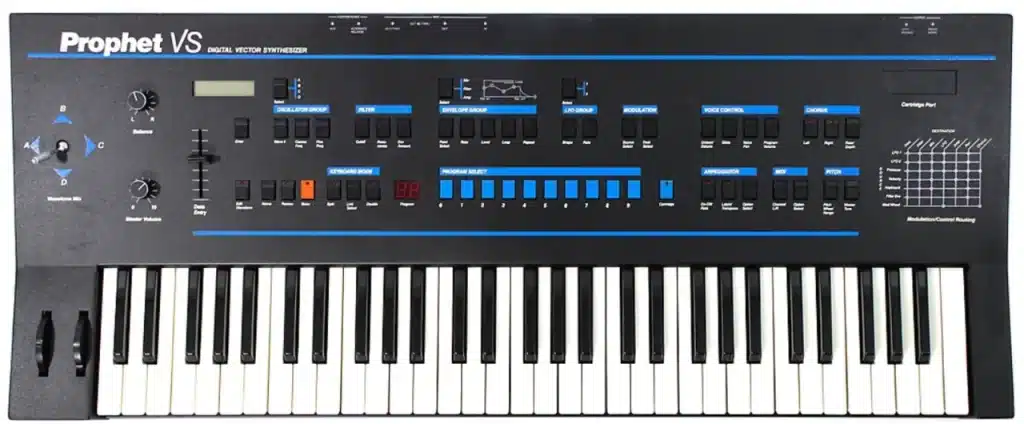
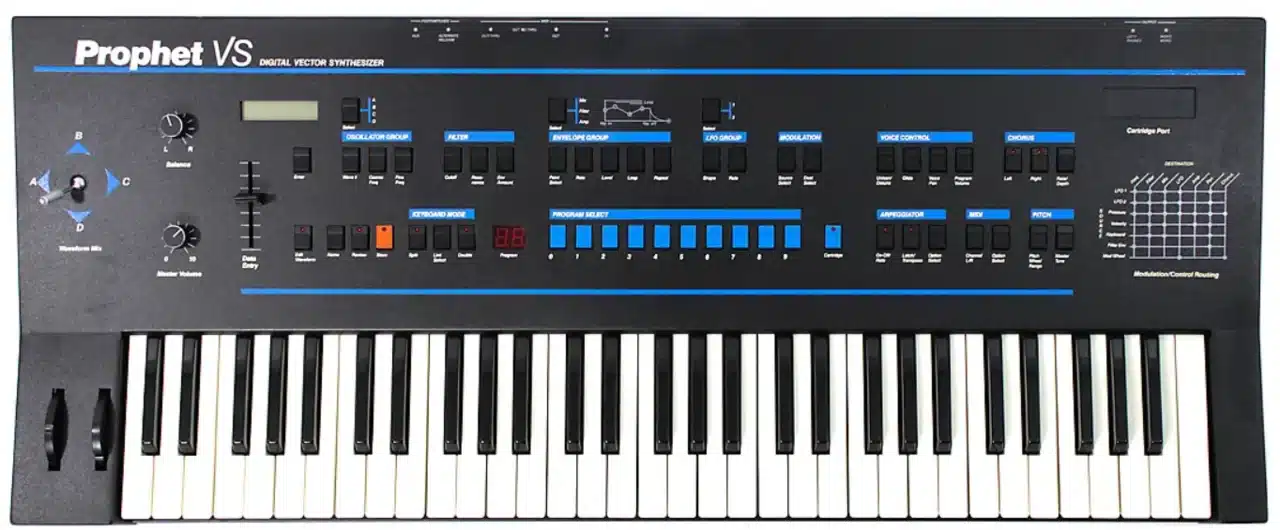
Vector synthesis is a way of making sound by mixing four sources with a joystick. Each source sits on one corner of a diamond. On the Prophet VS, Sound On Sound described the mix as “100% for each of the oscillators at the North, South, East and West settings and 25% each at the centre position” (Sound On Sound, July 1986). Move the stick and the blend shifts. Record that movement, and the sound animates itself.
Sequential Circuits introduced the idea on the Prophet VS in 1986. Electronics & Music Maker explained it as “placing one oscillator at each corner of the diamond-shape through which the joystick moves”, with A, B, C and D on the west, north, east and south corners (E&MM, May 1986). Each corner is an oscillator playing its own waveform. So one hand gesture reshapes the whole timbre. Yamaha and Korg both built on the idea in 1990, and it now lives on in plugins and a compact Behringer.
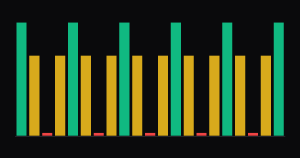
- Vector synthesis mixes four sound sources with a joystick. On the 1986 Prophet VS, each corner gave 100% of one source and the center gave 25% of each.
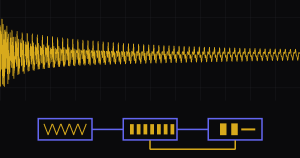
- A looping vector envelope records the stick’s path, so a held pad keeps moving on its own.
- In our test of the 94 Prophet VS factory waves, mixed at the same pitch with aligned cycles, a linear center mix came out a median 4.5 dB quieter than the corners.
- It isn’t wavetable synthesis. All four sources play at once, and mainly their levels change.
How does vector synthesis work?
Vector synthesis turns one two-axis position into four volume settings. Push the stick fully toward a corner and you hear only that source. Center it and all four play at 25%. Yamaha’s TG33 manual describes the same idea: moving toward one element “increases the level of that element while decreasing the level of the others proportionally” (Yamaha TG33 Operating Manual).
The joystick is a four-way mixer
With A on the west corner and C on the east, sideways movement trades A against C. Up and down trades B against D. That’s the whole trick, and it’s why a vector patch can feel alive under your hand in a way a static oscillator mix can’t.
The sources don’t have to be plain waves. On Yamaha’s SY22 and TG33, “Elements A and C are always AWM elements, while B and D are always FM elements” (TG33 manual). So the stick blends samples against FM tones. Yamaha’s vector could also detune: the manual says the 2 or 4 waveforms in a voice can be “blended and detuned in a variety of ways”. On Korg’s Wavestation, each oscillator could play a whole wave sequence, so a single corner could already be moving.
The vector envelope records the stick
A vector envelope stores a path for the stick and replays it on every note. The Prophet VS gave each voice “three five-stage envelopes with looping functions” for wave mix, filter and amplifier (International Musician, August 1986). Designer Chris Meyer says “the original inspiration was the looping envelopes in the Buchla 400” (Chris Meyer, The Story of the Prophet VS).
Yamaha took a different route. Its dynamic vector records up to 50 joystick positions for level and another 50 for detune (Music Technology, April 1990). Each step lasts 10 to 160 ms, so one sweep runs 0.5 to 8.0 seconds (Sound On Sound, June 1990). In software, Logic Pro’s ES2 has a loopable Vector Envelope with up to 16 points that retriggers for each voice (Apple Logic Pro User Guide). Like an ADSR, it holds at a sustain point until you let go. Set a loop point, though, and the section between them repeats. That loop is what keeps a held pad moving.
What we measured: mixing the 94 Prophet VS factory waves
In our test, the halfway point of a two-wave vector mix came out a median 2.6 dB quieter than the Prophet VS waves on their own. The four-way center came out a median 4.5 dB quieter. We analyzed all 94 factory waves from a dump of the VS wave memory: every one of the 4,371 possible pairs and all 3,049,501 four-corner combinations.
The setup was simple. Every source played at the same pitch, with its cycle lined up at the same start point, mixed as a plain weighted sum. That matches a linear reading of the review’s 25% figure. We compared each mix with the average power of its sources. We kept the script and its results, so the figures can be re-run from the same dump. We publish only the derived figures, not the waves.
Why measure this at all? It started with my own Behringer Pro VS Mini. After buying it, I wanted to understand what the joystick was actually doing to the sound, so I dug into vector synthesis properly: the original Prophet VS, its 1986 reviews and, finally, its wave memory. This test is where that led.
Why is there a drop at all? Two unrelated waves at half level each add up to about half the power, a 3 dB dip. Four at a quarter each lose about 6 dB. The VS waves did a little better than that, because many of them are partly in phase with each other. But 15.7% of pairs dipped deeper than 3 dB. And 343 of all 4,371 pairs (7.8%) lost at least one harmonic by 20 dB or more to phase cancellation.
The worst pair was VS waves 62 and 83 (by ROM slot number). Halfway between them, the level fell 9.5 dB and the shared fundamental dropped 16 dB. With the fundamental mostly canceled, the mix got brighter than either wave. Its spectral centroid, the balance point of its harmonics, moved to harmonic 10.0, up from 5.5 and 1.4 at the corners. So a 50/50 blend isn’t always an average of its two sources. It’s rare, though: only 67 pairs (1.5%) came out brighter than both waves.
When it happens, the halfway point is a new, thinner sound.
What does that mean for your patches? If a vector pad sags in the middle, add a little level as the stick heads to the center, or use equal-power fades. Equal-power gains didn’t fully rescue that worst pair, though. It still dipped 6.5 dB. Inverting one wave’s polarity did: the dip shrank from 9.5 dB to 0.5 dB. That isn’t luck. Any dip deeper than 3 dB means the two waves are partly out of phase, so a flip raised the level of all 687 such pairs in our set. Detuning the corners a few cents helps too, because the hole then drifts instead of sitting still.
A short history of vector synthesis
Vector synthesis began at Sequential Circuits, whose Prophet VS sold for £1,895 in the UK in 1986 (Sound On Sound, July 1986). Chris Meyer led the concept, with engineers Josh Jeffe and Tony Dean. Meyer credits his boss Scott Peterson, who “came up with the idea of the joystick to control the waveform mix”. The working name was “Diamond Patch” (Meyer).
The VS had “eight-note polyphony” (Sound On Sound, July 1986) and 128 wave slots, split into “96 ROM waveform” and “32 RAM waveform” locations (E&MM, May 1986). Meyer says Sequential’s John Bowen also helped create the waves. Those 12-bit waves fed Curtis four-pole low-pass filters, which is classic subtractive synthesis after a digital front end. Sound On Sound later put production at around 2,500 keyboards and 900 racks (Sound On Sound, November 2001). In 1990, Brian Eno told the magazine he had “a Prophet VS and an M1” (Sound On Sound, October 1990).
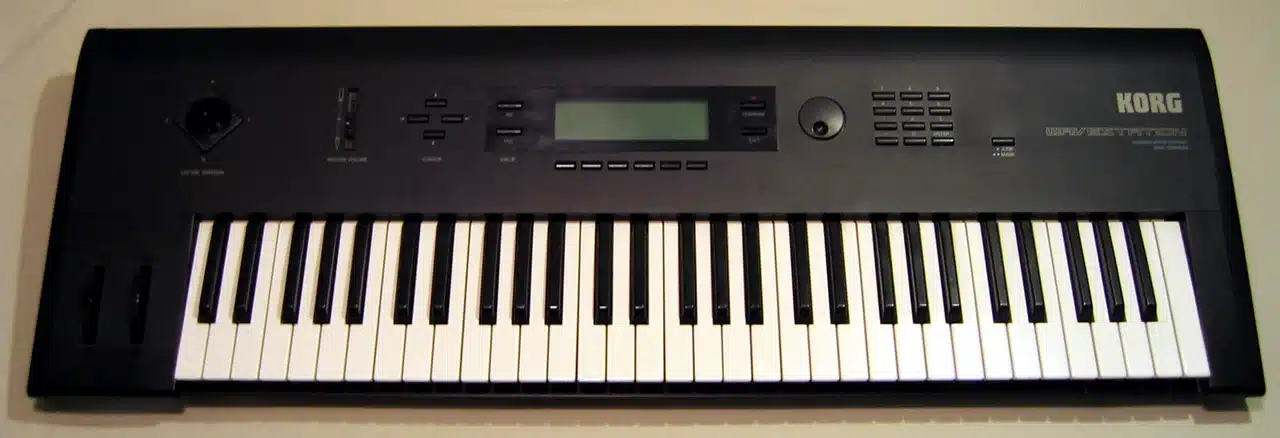
Yamaha bought Sequential in December 1987. In May 1989, Korg set up Korg R&D in California with former Sequential staff, including Dave Smith and John Bowen, and that group went on to build the Wavestation (MIDI Association). Sound On Sound called it a “direct descendant of Sequential’s long-gone VS” (Sound On Sound, August 1990). Meyer himself notes that “neither Josh, Tony, nor myself worked on the follow-ups” at Yamaha or Korg.
Both follow-ups arrived in 1990. The SY22 cost £799 in the UK (Music Technology, April 1990). The TG33 rack followed at £499 with 32-note polyphony (Music Technology, March 1991). Korg’s original Wavestation cost £1,575 and held 365 waves in ROM (Sound On Sound, August 1990). The A/D rack followed in autumn 1991 (Music Technology, April 1992), the EX brought the count past 500 waves (Sound On Sound, January 1992), and the slim SR rack cost £997 (Music Technology, January 1993). Motiv8’s Steve Rodway used one for pads. He said “I chose a combination of Korg Wavestation and Emu Morpheus for pads” (Sound On Sound, June 1996).
Vector synthesis vs wavetable synthesis vs wave sequencing
Vector synthesis changes the levels of two or four sources that all play at once. Sound On Sound put it plainly in 1990: “the technique is about how you vary the dynamic mix of two or four oscillators” (Sound On Sound, August 1990). Wavetable synthesis moves one oscillator through a table of waves instead. Wave sequencing plays waves one after another.
| Method | What changes over time | Sources sounding at once | Classic example |
|---|---|---|---|
| Vector synthesis | The level of each source | 2 or 4 | Prophet VS (1986) |
| Wavetable synthesis | The position in a table of waves | 1 per oscillator | Waldorf Microwave XT |
| Wave sequencing | Which wave plays, step by step | 1 per oscillator, in turn | Korg Wavestation (1990) |
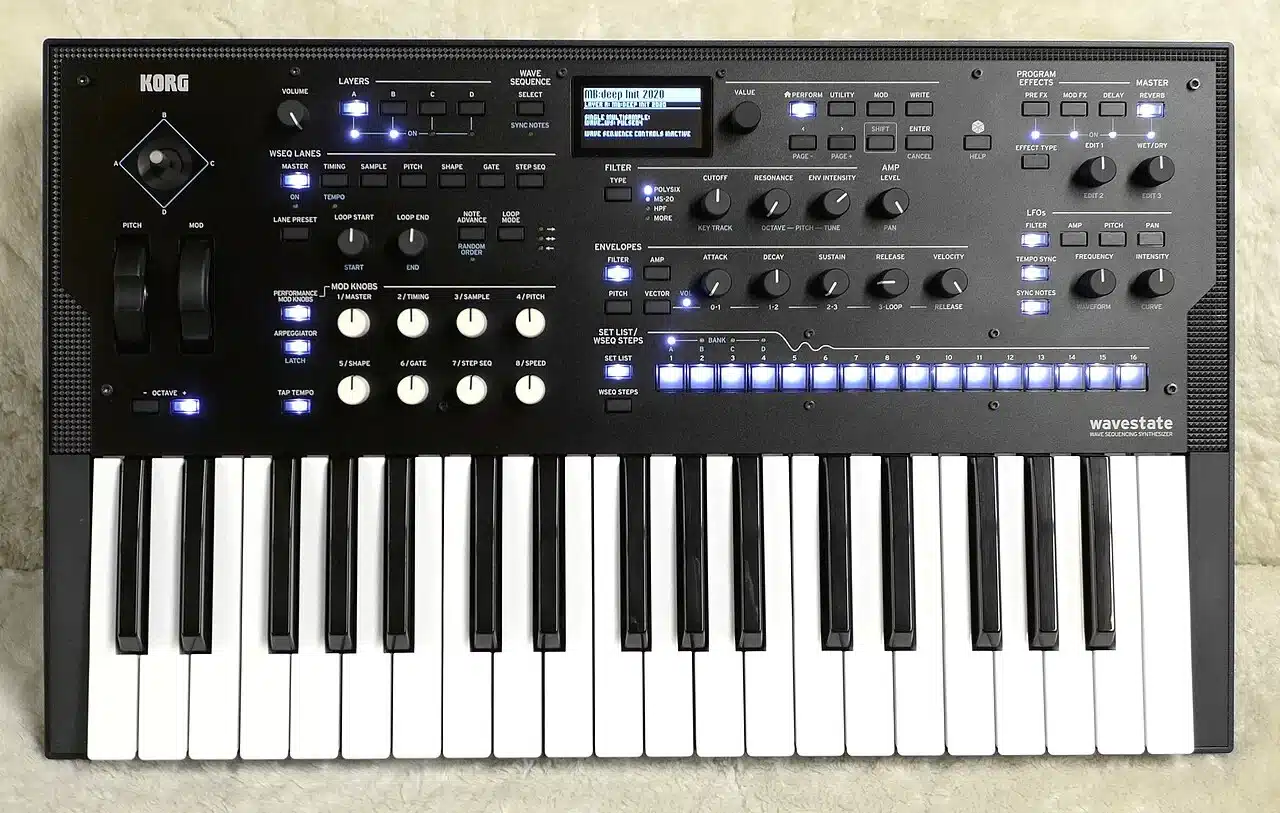
Korg’s manual defines a wave sequence as “a list which programs an oscillator to play specific PCM waves in succession” (Korg Wavestation Owner’s Manual). The two ideas stack well. Korg’s current wavestate keeps both, and Korg says “The Vector Envelope and Joystick mix the individual voices of the four Layers, and can also modulate any other parameters” (Korg). Sending a vector envelope to other targets is a modulation matrix job in most plugins.
Which synths have vector synthesis?
As of October 2026, you can buy vector synthesis new from Korg, Behringer, Arturia and Apple, or find it used on late-1980s and 1990s hardware. One low-cost new option is the Pro VS Mini, a small vector synthesizer from Behringer. It started as a four-voice synth and had a fifth voice via firmware 2.0 by December 2024 (Gearnews, 2024).
| Instrument | Year | Vector detail |
|---|---|---|
| Sequential Prophet VS | 1986 | 8 voices, 4 oscillators, joystick, looping mix envelope |
| Yamaha SY22 / TG33 | 1990 / 1991 | 2 sample + 2 FM elements, 50-step recorded vector |
| Korg Wavestation, A/D, EX, SR | 1990-93 | Joystick, 5-point mix envelope, wave sequences |
| Korg wavestate / mk II | 2020 / 2023 | 64 / 96 stereo voices, joystick and Vector Envelope over 4 layers |
| Behringer Pro VS Mini | 2023 | 5 voices, 4 vector oscillators per voice, 128 waveforms |
| Behringer Victor (Eurorack) | current | 4 vector oscillators, joystick, 128 waveforms |
| Arturia Prophet-VS V (plugin) | current | Over 450 waveforms, joystick, Curtis 3379 filter emulation |
| Korg WAVESTATION (plugin) / iWAVESTATION (iOS) | 2004 / 2016 | Software Wavestation; the iOS app runs as AUv3 since v1.2.0 |
| Apple Logic Pro ES2 | current | Vector Envelope with up to 16 points over the oscillator mix and Planar Pad |
How to do vector synthesis in any synth
You can build vector synthesis in many modern synths that have four oscillators and an XY control. The original recipe is short: one source per corner, 100% at that corner and 25% each at the center (Sound On Sound, 1986). Here’s a version for plugins with a flexible modulation matrix:
- Pick four contrasting sources. Contrast is the point. In our analysis, the VS factory waves ranged from a pure sine to waves centered around the 40th harmonic.
- Map an XY pad. Let each direction favor one source, west for A, north for B, east for C and south for D, with all four equal at the center.
- Record a path. Use a looping multi-point envelope, or two slow LFOs on X and Y. Yamaha’s steps give a sense of scale: a full sweep took 0.5 to 8 seconds.
- Make up the middle. A linear center mix of VS waves sat a median 4.5 dB down in our test. Add a little level as the stick nears the center.
- Listen for holes. If a blend sags or sounds hollow, try inverting one source’s polarity. In our set, a flip raised the level of all 687 pairs that dipped past 3 dB, to a median 2.8 dB down.
- Filter after the mix. The VS ran its blend into Curtis low-pass filters, so one low-pass after the four sources is the classic shape.
- Detune one corner a few cents. Yamaha’s vector could record detune as well as level, and slow drift adds life.
Need corner material? Our free Fizform wavetable generator exports Serum-format tables of 256 frames. Load one into each of four wavetable oscillators, park each at a different frame, and you have four vector corners from one file.
Frequently asked questions
What is vector synthesis in simple terms?
Vector synthesis means mixing four sounds with a joystick. Each sound sits on one corner of a diamond. Push toward a corner to hear mostly that sound. At the center, the 1986 Prophet VS played all four at 25% each. Recording the stick’s movement makes the sound change by itself over time.
Who invented vector synthesis?
Sequential Circuits introduced vector synthesis on the Prophet VS in 1986. Chris Meyer led the concept with engineers Josh Jeffe and Tony Dean, and Scott Peterson suggested the joystick. The working name was “Diamond Patch”. Yamaha and Korg both released their own vector synths in 1990, after Yamaha bought Sequential in 1987.
Is vector synthesis the same as wavetable synthesis?
No. Wavetable synthesis moves one oscillator through a table of waves, so one wave sounds at a time. Vector synthesis plays two or four sources at once and changes their levels. The Prophet VS mixed four oscillators, each playing one of 128 wave slots. Korg’s 2020 wavestate, for example, pairs vector mixing with wave sequencing, not wavetables.
What is the difference between vector synthesis and wave sequencing?
Vector synthesis blends sources that play at the same time. Wave sequencing plays waves one after another. Korg’s 1990 Wavestation combined them: its joystick mixed four oscillators, and each oscillator could run a wave sequence. Sound On Sound counted 365 waves in its ROM to build those sequences from.
Why does my vector patch get quieter in the middle?
A linear mix of unrelated sources loses about 3 dB at a two-way midpoint and about 6 dB at a four-way center. In our analysis of the 94 Prophet VS factory waves (same pitch, aligned cycles), the center ran a median 4.5 dB quieter. Use equal-power fades, or add level near the center.
What is an affordable way to try vector synthesis?
In hardware, Behringer’s Pro VS Mini has four vector oscillators per voice and 128 waveforms, and Behringer hinted at a $99 price before launch. If you already use Logic Pro, its ES2 synth has a Vector Envelope with up to 16 points. Korg also sells iWAVESTATION for iOS. If you’d rather start from the original waves, my Prophet VS Wavetables pack puts all 128 VS wave slots into wavetable form for Serum, Vital and other synths.
Back to Music Production Terms Index Page