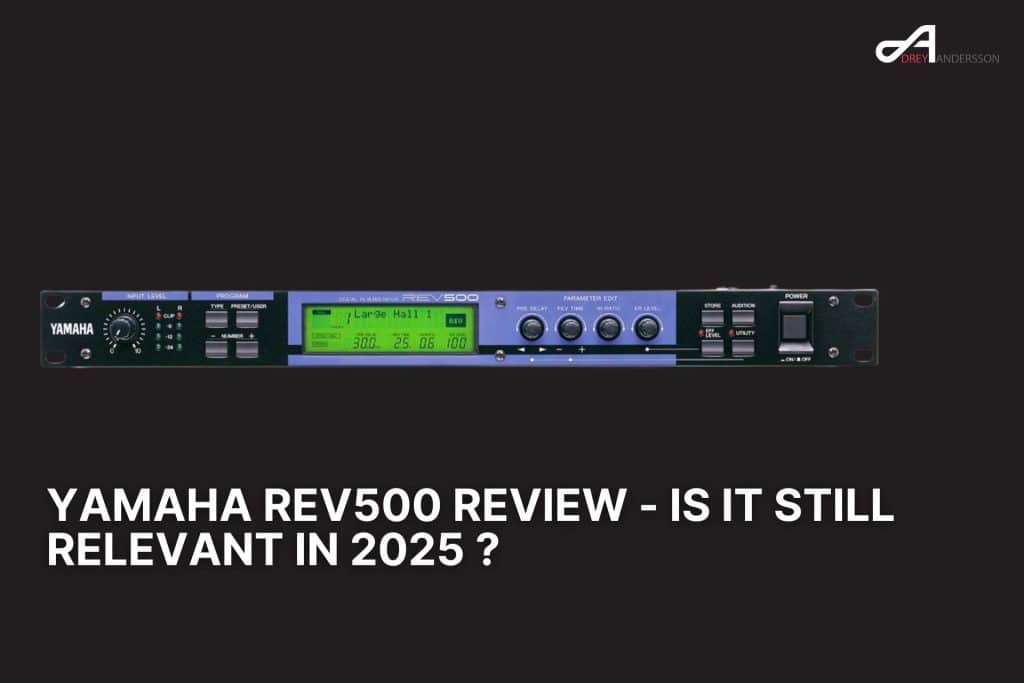
I paid €60 for my Yamaha REV500. You probably can’t. That’s the honest starting point for this review, and it’s the part most REV500 write-ups skip, including my own earlier version of this one.

When I bought mine, I had a rack of cheap analog synths and no way to give them space. The Behringer Model D, a Korg Poly 800, an RSF Kobol: all of them bone dry, all of them going straight into a DAW where I’d wrestle plugin reverbs with a mouse until the idea I started with had evaporated. A 1U rack unit from 1996 fixed that. But the price I paid was a fluke, and pretending otherwise would make this review useless to you.
Key Takeaways
- My €60 was an outlier, not a market price. Reverb’s price guide puts the REV500 at €62 to €152 across 23 sales, and every live listing I found sat at €130 to €169 (Reverb price guide, retrieved July 2026).
- It’s still a bargain at €150. The cheapest modern hardware alternative, the Eventide Space, runs €449 at Thomann (Thomann, 2026).
- The specs hold up: 20-bit converters with 64x oversampling on the A/D, 44.1 kHz, and 96 dB typical dynamic range (Yamaha REV500 manual).
- The real catch is the battery. Yamaha recommends replacing the internal lithium cell every five years. A 1996 unit is roughly six cycles overdue, so ask the seller before you buy.
What is the Yamaha REV500?
The REV500 is a 1U true stereo digital reverb Yamaha built in 1996, which Sound On Sound reviewed at £399 in March 1997 (Sound On Sound, 1997). It carries 20-bit converters, 44.1 kHz sampling, and 100 factory programs, and it was aimed squarely at project studios that wanted Lexicon-adjacent quality without the Lexicon invoice.

True stereo is the spec that matters most here, and it’s routinely misunderstood. A lot of “stereo” reverbs take a mono input, generate one reverb tail, and pan copies of it left and right. The REV500 processes the left and right channels independently, all the way through. Feed it a stereo synth patch with movement already in it and that movement survives the reverb instead of collapsing to the middle.
It also handles L-MONO input, pushing a single mono source through both reverb channels for a natural spread. That’s the mode I use most, since most of my synths are mono out.
The specs that actually matter
Straight from Yamaha’s manual, not from a spec aggregator:
- Converters: 20-bit A/D at 64x oversampling, 20-bit D/A at 8x oversampling
- Sampling rate: 44.1 kHz
- Frequency response: 20 Hz to 20 kHz (+1.0 dB, −2.0 dB)
- Dynamic range: 96 dB typical
- THD: under 0.03% at 1 kHz
- I/O: balanced XLR and 1/4″ phone, switchable +4 dB / −10 dB
- Memory: 100 factory presets plus 100 user memories
That last one is worth pausing on. Nearly every listing and forum post describes the REV500 as “100 presets,” and that undersells it by half. There are 100 more slots waiting for your own programs, and they’re the reason the unit stays interesting after the first week.
One discrepancy for the pedants: Sound On Sound printed the frequency response as ±3 dB, while Yamaha’s own manual says +1.0/−2.0 dB. I’ve gone with the manual.
What does a REV500 actually cost in 2026?
Expect to pay around €150. Reverb’s price guide gives an estimated used value of €62 to €152 based on 23 orders in good-to-mint condition, and when I checked in July 2026, all seven live listings sat between €130 and €169 plus shipping (Reverb price guide, retrieved 16 July 2026). My €60 sits at the very bottom of that range.
Here’s what happened. I found mine on eBay Germany from a seller in Hamburg who was shutting down a recording studio and clearing everything at once. Total damage: €67, made up of €60 for the unit and €7 for shipping. That wasn’t clever negotiating. It was a motivated seller with a deadline, which is a different thing entirely.
Reverb publishes completed sales separately from listings, and that’s where the picture got clearer. Its history logs seven closed transactions going back to December 2024. Not one of them landed below €70. My €60 was cheaper than every documented sale on the platform.
So why does the guide’s range start at €62? Because it includes units in merely “good” condition, and the lowest documented sale, €70 in February 2025, was exactly that. If you want a clean unit with a bright display and working encoders, you’re shopping in the €130 to €169 band. Budget €150 and treat anything under €100 as either a project unit or a stroke of luck.
Prices here are in euros, since I buy in Germany and Reverb served me its EUR listings. If you’re shopping in the US, pull the dollar figures from Reverb’s own price guide rather than converting mine.
Why I bought hardware instead of a plugin
Because the plugin workflow was quietly killing my ideas. This isn’t a fidelity argument, and I want to be careful here: I’m not going to claim a €150 rack unit from 1996 out-resolves a modern algorithmic plugin. It doesn’t. Why put a 1U box in the way, then? Because the argument is about friction, not fidelity.
The software loop went like this. Play the part. Record it dry. Stop. Open the plugin. Push a decay slider with a mouse. Play it back. Decide the pre-delay is wrong. Repeat. Somewhere in that loop the thing I was actually chasing would slip away, and I’d be left auditioning presets instead of playing.
With the REV500 on a send, the reverb is simply there while my hands are on the keys. I turn REV TIME and hear it move. No buffer round-trip sits between the note and the tail, because the signal never re-enters the computer to get processed. That’s not me claiming a millisecond figure, it’s just how a hardware send works.
The other half is MIDI. All 100 programs respond to program change, so my sequencer can flip the reverb between sections without me touching anything. Try automating a plugin’s preset slot mid-song and see how that goes.
If you’re weighing outboard gear against staying in the box more broadly, I’ve written about whether analog gear actually sounds better and about hardware stereo compressors, which run into the same trade-off from a different angle.
How do the 100 presets break down?
Into four banks of 25: HALL, ROOM, PLATE, and SPECIAL (Yamaha REV500 manual). Reverb time runs from 0.3 seconds to a frankly silly 99 seconds (Sound On Sound, 1997). Add the 100 user memories and you’ve got 200 slots total, which is more than I’ve managed to fill in a year.
HALL (1 to 25)
Big spaces. Large Hall 1 is my default for polysynth pads, and the Church programs at 9 and 10 do the cathedral thing convincingly. This is where those absurd decay times start making sense: park a pad in a 20-second hall and you’ve got a drone bed that evolves on its own.
ROOM (26 to 50)
Closer, tighter, more useful than it sounds. Large Room sits well under bass sequences without smearing the low end, which is exactly where most hall programs fall apart. Live Room adds just enough air to make a dry sequence feel played rather than programmed.
PLATE (51 to 75)
The bank I reach for most. Basic Plate at 51 works on almost anything. Beauty Plate at 52 flatters brass and brighter leads, and LA Plate at 53 has that transparent, slightly glassy character that makes synthwave leads sit forward in a mix without needing EQ.
SPECIAL (76 to 100)
Reverb plus something else. Flange Room builds slowly shifting textures, and Rev Tremolo chops the tail rhythmically, which is either a gimmick or exactly what a track needs. Mostly the former, occasionally the latter.
The four encoders that matter
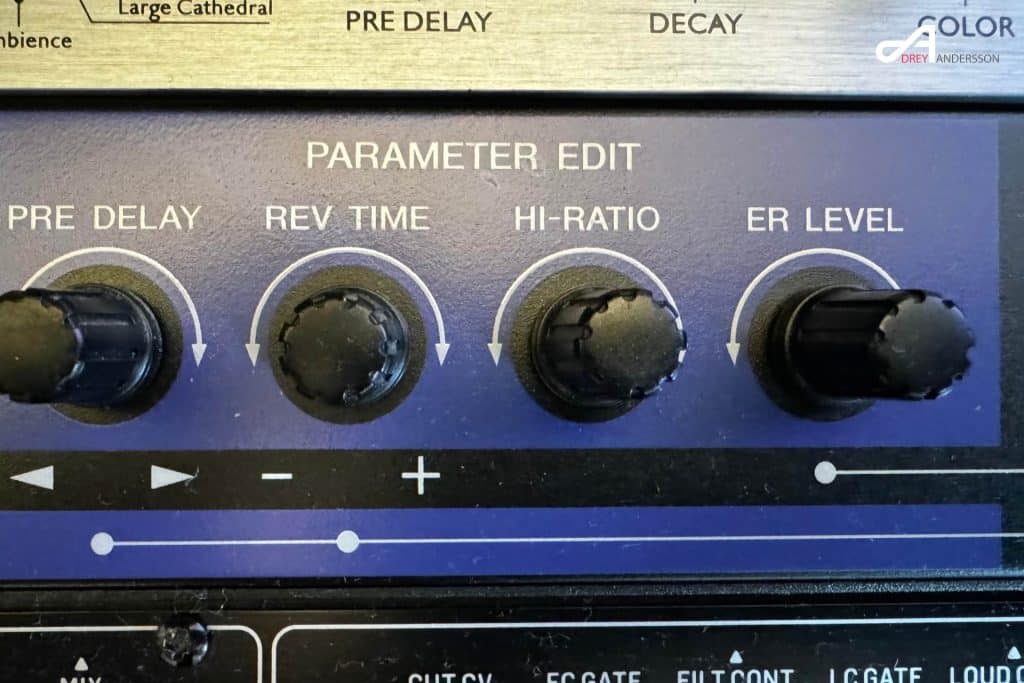
Four rotary PARAMETER EDIT encoders give you direct access to the parameters you’d otherwise be digging through menus for, backed by full MIDI implementation across all 100 programs (Yamaha REV500 manual). No page-turning, no shift-key combinations. Four knobs, four jobs.
- PRE DELAY: how long before the tail arrives. Short keeps a bass line tight, long gives a lead room to breathe before the space opens up.
- REV TIME: 0.3 to 99 seconds. You’ll live between 1 and 4 for most things.
- HI-RATIO: how fast highs decay relative to lows. Pull it down and the tail darkens as it fades, which is what real rooms do.
- ER LEVEL: early reflection level, 0 to 100. The difference between “in a space” and “near a wall.”
The LCD deserves a mention because it does something modern units mostly don’t: it draws the reverb envelope as you turn the knob. You see the shape change while you hear it change. For anyone who learned reverb by reading about it rather than using it, that visual link is genuinely instructive.
Go deeper into the utility menus and you’ll find LO-RATIO for low-frequency decay, HPF and LPF filtering, DIFFUS for spread, plus density and gate threshold on the programs that support them. It’s a deeper unit than the four-knob front panel suggests.
Does a digital reverb suit analog synths?
Better than you’d expect, and the reason is contrast. The REV500’s 96 dB typical dynamic range and 20 Hz to 20 kHz response (+1.0/−2.0 dB) mean it reproduces the full output of an analog synth without ducking or compressing it (Yamaha REV500 manual). What comes back is precise, slightly crystalline, and just clinical enough to cut through analog mush.
Think about what a Model D actually does. It’s warm, it’s thick, and in a busy arrangement it turns to soup fast. Wrap that in a warm, thick, characterful reverb and you’ve doubled down on the problem. The REV500’s late-90s digital precision pulls the opposite direction: it adds space while keeping edges legible.
There’s a fashionable idea that vintage digital gear sounds good because it’s flawed, and I don’t entirely buy it. The REV500 isn’t lo-fi and it isn’t broken. It’s just from an era when Yamaha’s algorithms prioritized clarity over lushness, and that priority happens to suit dry analog synths in 2026 as well as it suited DAT-era vocals in 1997.
My chain runs: synth into a patchbay, out to the REV500, back to the patchbay, into AD conversion, over ADAT to a Focusrite Scarlett 18i20, then to monitors. The balanced TRS outputs and that +4/−10 dB switch mean it drops into a pro-level chain without impedance headaches. If you’re building something similar, my notes on a patchbay versus another converter cover why I route it this way, and the broader analog versus digital synthesizer question gets the same treatment.
Is a 1996 unit still reliable?

Mechanically, yes. Electrically, there’s one thing you must check. Yamaha’s manual states the internal lithium battery preserves user memory with the power off, and that Yamaha “strongly recommends that you have the battery replaced by a qualified Yamaha service center every five years” (Yamaha REV500 manual, p.3). A 1996 unit is now six cycles past due.
That’s the single most important sentence in this review. So what happens when the cell dies? The unit throws LOW BATTERY on the LCD at power-on and your user memories are gone. The 100 factory programs are in ROM and survive, so the unit still works, but everything you programmed yourself evaporates. Yamaha’s own advice is to keep MIDI bulk dumps as backup, which is sound advice for a machine this old regardless.
Ask the seller one question before you pay: when was the battery last replaced? If they don’t know, assume it hasn’t been, and price a service visit into your offer. I got lucky here. The previous owner had replaced mine a few months before selling, which he mentioned unprompted, and that told me more about how the unit had been treated than any photo could.
What to check when buying
In order of how much they’ll cost you:
- Battery history. See above. This is the one that bites.
- LCD clarity. These displays fade with age, and the envelope graphics are half the appeal.
- Encoder response. Turn all four. Dead spots mean dirty encoders.
- Clean audio path. Listen for crackle or dropouts through both channels.
Cosmetics, the original manual, and the box matter far less. Mine arrived near-mint with responsive encoders and a bright display, and the 20-bit converters passed clean, quiet signal with no dropouts. Build quality is genuinely pro: metal chassis, proper connectors, nothing rattling. It weighs 3.5 kg, and it feels it.
REV500 vs modern reverbs in 2026
At around €150, the REV500 costs roughly a third of the cheapest modern hardware reverb worth comparing it to. The Eventide Space runs €449, the Strymon Big Sky €460, the Empress Reverb €529, and the Strymon Big Sky MX €699 (Thomann, July 2026). Even at €169, the top of its used range, it still undercuts the cheapest of them by more than 2.5x.
| Unit | Price | Status | Key trade-off |
|---|---|---|---|
| Yamaha REV500 | ~€150 | Used, 1996 | Battery overdue; no shimmer |
| Eventide Space | €449 | New | 3x the price; pedal format |
| Strymon Big Sky | €460 | New | 3x the price |
| Empress Reverb | €529 | New | 3.5x the price |
| Strymon Big Sky MX | €699 | New | 4.6x the price |
Now the honest half. What do you give up?
Modern units have far more algorithms, most of which you won’t use but some of which you’ll miss. They’re smaller. They come with a warranty and a battery that isn’t three decades old. Strymon and Eventide both offer shimmer and modulated reverbs the REV500 simply cannot do. If those are what you want, no amount of price advantage substitutes.
What the REV500 gives you back: immediate program access without menu diving, visual envelope feedback while you edit, true stereo processing, balanced XLR and TRS I/O with +4/−10 switching, MIDI program change across all 100 programs, and 100 user slots. That’s a professional feature set at a hobbyist price.
Worth noting for anyone cross-shopping vintage racks: the Alesis QuadraVerb lands in similar territory for similar money, with a different character and a multi-effects bent. If you want one box doing reverb, delay, chorus and EQ at once, that’s the one to read about next.
Verdict: who should buy one at €150?
Buy it if you own dry hardware synths and want space without a computer in the loop. At €150 against €449 for the cheapest new hardware alternative (Thomann, 2026), the REV500 is the cheapest credible way to put true stereo reverb on a send. It won’t out-spec a Big Sky MX. It doesn’t need to.
Skip it if you’re mixing entirely in the box, if you need shimmer or heavily modulated reverbs, or if the idea of a 30-year-old lithium battery in your signal chain makes you twitch. Those are all fair reasons, and none of them are a knock on the unit.
Was my earlier verdict, that this thing is a steal at €60, wrong? Not exactly. It’s just not available at €60, and a review that quotes a price nobody else can get isn’t a review, it’s a brag. At the price you’ll actually pay, the answer is still yes, with one asterisk shaped like a battery.
The character match is real, and it’s why the unit stayed in my rack after the novelty faded. Cheap analog synths and late-90s Yamaha digital reverb are both a little imperfect, in opposite directions. Put them together and the flaws cancel instead of compounding.
Frequently asked questions
How much does a Yamaha REV500 cost in 2026?
Reverb’s price guide lists an estimated used value of €62 to €152 based on 23 orders in good-to-mint condition, and live listings in July 2026 ranged from €130 to €169 plus shipping (Reverb price guide, 2026). Budget around €150 for a clean, working unit.
Is the REV500 true stereo?
Yes. It processes left and right channels independently rather than panning copies of a single mono tail, which preserves stereo movement in the source (Yamaha REV500 manual). It also offers an L-MONO mode that spreads a single mono input across both reverb channels.
Does the REV500 need a new battery?
Almost certainly. Yamaha recommends replacing the internal lithium battery every five years through a qualified service center, and these units date to 1996 (Yamaha REV500 manual, p.3). When it fails, LOW BATTERY appears at power-on and user memories are lost. Factory presets are in ROM and survive.
How many presets does the REV500 have?
It ships with 100 factory programs split evenly across HALL, ROOM, PLATE, and SPECIAL banks of 25 each, plus 100 user memory slots for your own edits (Yamaha REV500 manual). That’s 200 slots total, a detail most listings omit.
What did the REV500 cost new?
Sound On Sound reviewed it at £399 in the UK in March 1997 (Sound On Sound, 1997). US pricing from the period isn’t reliably documented, so treat any dollar figure you see quoted for the launch price, including the one I used in an earlier version of this review, with suspicion.