What is additive synthesis?
Additive synthesis builds sound by stacking simple sine waves, one per frequency, until they add up to a rich, complex tone. The idea rests on a theorem the mathematician Joseph Fourier published in 1822: any suitably repeating waveform can be rebuilt from a sum of pure sine waves (Britannica). Stack enough sines, each with its own pitch and volume, and you can build almost any timbre from scratch.
That makes it the mirror image of subtractive synthesis, which starts with a bright, harmonically dense wave and carves it down with filters. Additive starts from silence. Every partial you hear is one you chose to add. The sine wave itself comes straight from an oscillator, and it is the only waveform that carries no harmonics of its own.
- Additive synthesis creates sound by summing sine-wave harmonics, a principle grounded in Fourier’s 1822 theorem.
- Each harmonic has its own frequency and amplitude. A sawtooth wave contains every integer harmonic, falling off at 1/n.
- It powered the Telharmonium (patented 1897) and the Hammond organ (1935) decades before software existed.
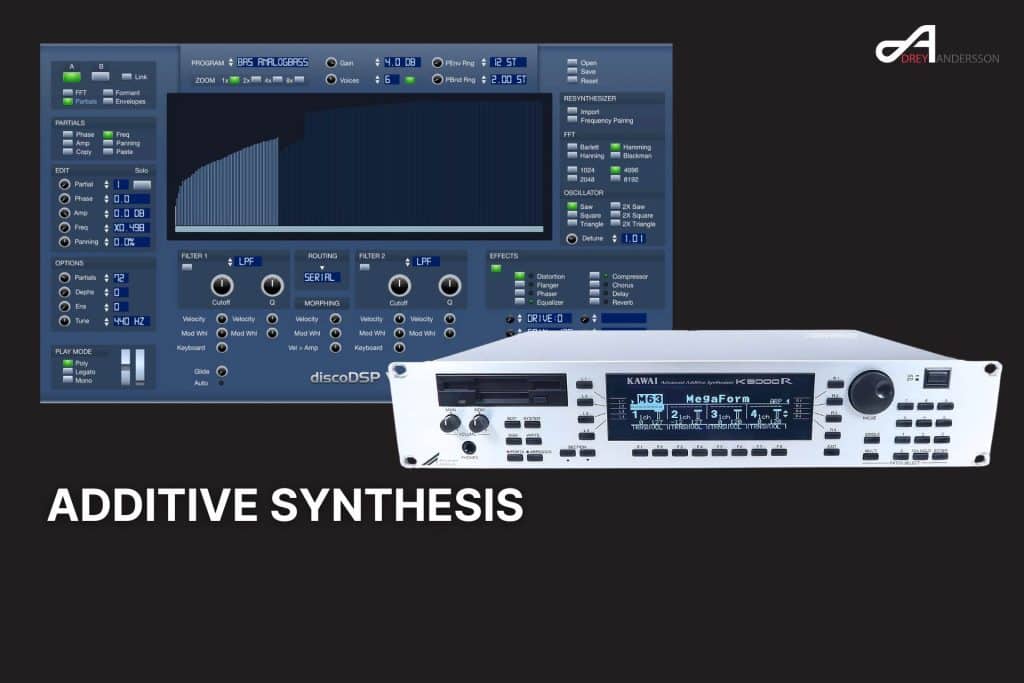
- Modern tools like Native Instruments Razor stack up to 320 partials; the Kawai K5000 offered 64 harmonics per source.
- It trades CPU load and setup time for precise, evolving timbres you cannot filter into existence.
How additive synthesis works: sine waves and harmonics
Every additive patch starts from the sine wave, the purest tone there is, with no overtones at all. A sawtooth wave sits at the opposite end: it contains every integer harmonic, each at an amplitude of 1/n. So the 2nd harmonic is half the height of the fundamental, the 3rd is a third, the 4th a quarter, and so on down the line (University of Illinois, PHYS 406). A square wave follows the same 1/n slope but keeps only the odd harmonics.
Those stacked sines are called partials or harmonics. Three controls shape each one: amplitude sets how loud the partial is, frequency sets its pitch, and phase sets where its cycle begins. Nudge a partial’s phase against its neighbour and you get phase cancellation or reinforcement, which is how additive engines create movement without any filter at all.
Here is the harmonic recipe for a sawtooth, drawn to the 1/n rule. This single chart explains most of what additive synthesis actually does: set the height of each bar, and you have designed a waveform.

Additive vs. subtractive synthesis
The two methods run in opposite directions. Subtractive starts loud and messy, then filters away what you do not want. Additive starts empty and adds only what you do want. The difference shows up in the controls: a classic subtractive patch leans on two or three oscillators and a filter, while the Kawai K5000 hands you 64 harmonics per source to shape individually (Vintage Synth Explorer). More control, more work.
Which one wins? Neither. Subtractive is faster for gritty basses and screaming leads. Additive is better when you need a clean, evolving timbre, like a glassy bell or a slowly morphing pad, that a filter can only fake. Many instruments blend both. Roland’s LA synthesis pairs sampled attacks with synthesized bodies, and plenty of modern synths let you sculpt an additive source and still run it through a filter afterwards.
| Aspect | Additive | Subtractive |
|---|---|---|
| Starting point | Silence, build up sines | A rich wave, cut it down |
| Core tool | Many sine partials | Oscillators plus a filter |
| Best for | Bells, glassy pads, precise timbres | Basses, gritty leads, fast sounds |
| Setup speed | Slower, more parameters | Faster, fewer controls |
| CPU cost | Higher (many oscillators) | Lower |
A short history of additive synthesis
Additive synthesis is older than the synthesizer itself. Thaddeus Cahill patented the Telharmonium in 1897, an electric instrument that mixed tonewheel-generated sine waves into complex tones and streamed them down telephone lines. Only three were ever built. The largest version, the Mark III of around 1906, weighed roughly 200 tons and reportedly cost about $200,000 to construct (Smithsonian Magazine).
Worth separating two facts the internet often mashes together: 1897 is the patent year, and the 200-ton figure belongs to that later Mark III, not the first machine (the Mark I was closer to 7 tons, per Wikipedia). From there the lineage runs through the Hammond organ in the 1930s, the digital RMI Harmonic Synthesizer in 1974, and finally into software. The timeline below traces the whole arc.

The Hammond organ: additive synthesis you can play
The Hammond organ, introduced in 1935 by Laurens Hammond, is additive synthesis you play with your hands. Its tone generator spins 91 tonewheels, and nine drawbars let you mix the fundamental plus eight harmonics in real time (Wikipedia). Pull a drawbar out and you raise that harmonic’s level. Push it in and it fades. That is a live harmonic mixer, decades before anyone called it additive.
This is the clearest hands-on example of the whole method. Each drawbar is one bar from the harmonic chart above, and the organ’s famous tones come from the combinations players settle on. The Hammond proved that additive was not just a lab curiosity. It could be musical, fast, and expressive, which is exactly why it still turns up on records today.
Additive synthesis today: the hardware and the software
Dedicated additive hardware peaked and then quietly faded. The Kawai K5000, released in 1996, was one of the last major additive hardware synths, not one of the first. It landed nearly a decade after Kawai’s own K5 (1987) and more than twenty years after the RMI Harmonic Synthesizer (Vintage Synth Explorer). With 64 harmonics per source and a formant filter on top, it remains a favourite for anyone who wants deep control over a timbre.

Software brought additive back. Native Instruments Razor, released in 2011, is built from up to 320 sine partials, and its filters, reverbs and stereo effects all work by reshaping those partials rather than by traditional subtractive filtering (Sound On Sound). The result is a synth that looks like a light show and sounds unmistakably additive. Because it runs as a VST, there is no 200-ton problem this time.

You will also find additive hiding inside hybrid tools. Serum’s additive draw mode, Arturia Pigments, and various modular oscillators all let you build a waveform partial by partial, then hand it off to a filter or effect. For a producer in 2026, additive is less a separate box and more a technique you reach for when a timbre needs to be exact.
How to build a sound with additive synthesis
A bell is the classic first patch, and it teaches the method fast. Start with a sine at your fundamental, then add partials at non-integer ratios, because a real bell’s overtones are inharmonic rather than neat multiples. Since human hearing tops out around 20 kHz (NIH), there is no point stacking partials above that. You cannot hear them.
From there the workflow is simple to describe and slow to master. Set the level of each harmonic to shape the raw timbre. Give each partial, or each group of partials, its own ADSR envelope so the sound evolves, since high harmonics usually fade faster than the fundamental. Then add modulation for movement.
In my own patches, additive earns its keep on glassy bells and slowly opening pads that a filter simply cannot fake. It is fiddly. It is also the only way to get certain sounds. If you want a full hands-on walkthrough on real hardware, my Kawai K5000 guide goes deep on exactly this.
Frequently asked questions
What is additive synthesis in simple terms?
Additive synthesis creates sound by adding together many simple sine waves, called harmonics or partials. Each sine has its own pitch and volume, and stacking them builds a rich, complex tone. It works because any repeating waveform can be described as a sum of sines, a principle Joseph Fourier established in 1822.
What is the difference between additive and subtractive synthesis?
Additive synthesis builds a sound up from silence by adding sine partials one at a time. Subtractive synthesis does the opposite: it starts with a harmonically rich wave and removes frequencies with a filter. Additive gives more precise control, while subtractive is usually faster for basses and aggressive leads.
Which synths use additive synthesis?
Classic additive hardware includes the Hammond organ, the Kawai K5 (1987) and Kawai K5000 (1996). In software, Native Instruments Razor is fully additive with up to 320 partials, and Xfer Serum includes an additive draw mode. Arturia Pigments and many modular oscillators offer additive engines too.
Was the Kawai K5000 the first additive synthesizer?
No. The Kawai K5000, released in 1996, was one of the last major dedicated additive hardware synths, not the first. Additive instruments go back to the Telharmonium in 1897, the Hammond organ in 1935, and the digital RMI Harmonic Synthesizer in 1974, all long before the K5000.
How does the Hammond organ relate to additive synthesis?
The Hammond organ is a hands-on additive instrument. Its 91 tonewheels generate sine tones, and its nine drawbars let a player mix the fundamental plus eight harmonics live. Pulling a drawbar out raises that harmonic’s volume, which is exactly the harmonic mixing at the heart of additive synthesis.
Why is additive synthesis less common than subtractive?
Additive asks a lot of both the producer and the computer. Building a timbre one partial at a time takes far more parameters and CPU than tweaking a filter, so most hardware favoured subtractive. Software removed the CPU limit, which is why additive tools like Razor have made a strong comeback since 2011.
What is a harmonic in additive synthesis?
A harmonic is a sine wave whose frequency is a whole-number multiple of the fundamental. The 2nd harmonic is twice the fundamental frequency, the 3rd is three times, and so on. In a sawtooth wave, each harmonic’s amplitude follows a 1/n curve, so higher harmonics get progressively quieter.
Back to Music Production Terms Index Page
Back to Music Production Terms Index Page