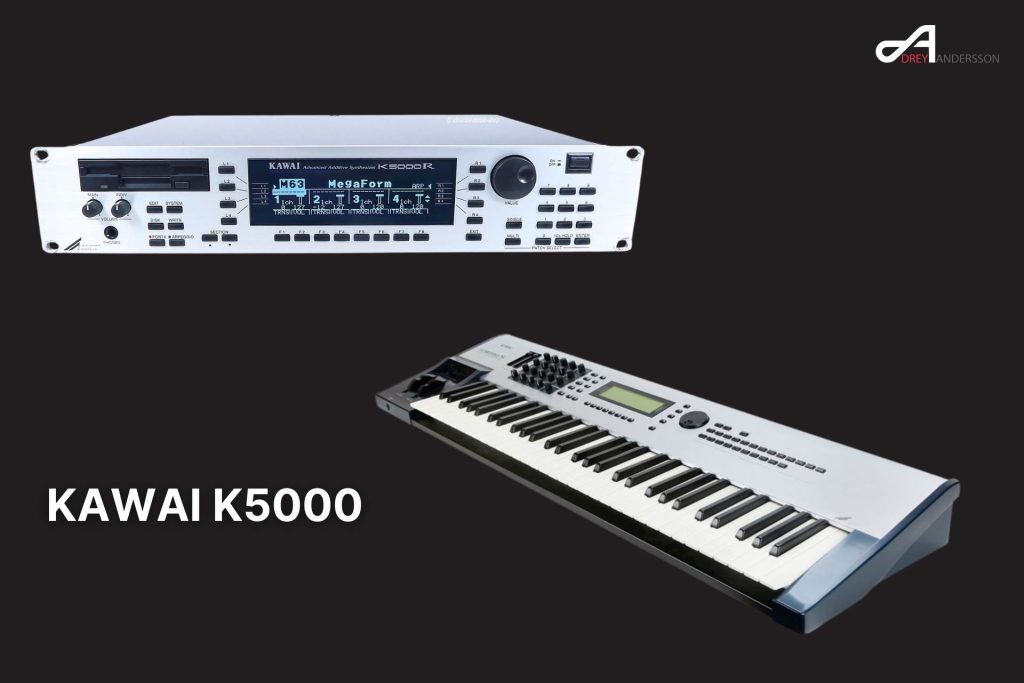
The Kawai K5000 is a digital synthesizer built around additive synthesis, released in 1996 and sold in three variants until production ended in 1999. Kawai called the engine Advanced Additive, and it gives you 64 harmonics per source with a four-stage envelope on every single one (Kawai). Stack up to six sources in a patch and you are drawing timbres harmonic by harmonic, which is a very different job from turning a filter cutoff.
- Three variants: the K5000W workstation (1996), the K5000S synth (1996) and the K5000R rack (1997).
- The rack is the expensive one. Completed sales run USD 1,000 to 1,450, against USD 500 to 850 for the keyboard.
- Kawai’s name for the engine is Advanced Additive. The acronym “AIS” you will see repeated online is not a Kawai term.
- Final OS is 4.04 on the S and R, but 4.03 on the W. Both are still free from Kawai.
- The floppy drive and the LCD backlight are the two parts most likely to be dead on arrival.
What is the Kawai K5000?
It’s an additive synthesizer, which means it builds sound by stacking sine waves rather than filtering a rich waveform down. Each source gives you 64 harmonics, and each of those harmonics carries its own four-stage envelope with looping (Sound On Sound). That is where the K5000’s reputation comes from. Not the raw partial count, but the fact that every partial can move independently over time.
One detail trips people up constantly. A Wave Set actually holds 128 harmonics, split into two groups of 64, so reaching all 128 costs you two of your six sources (Sound On Sound). Kawai’s documentation lists both figures, and the internet has been merging them for twenty years.
On top of the harmonics sits a 128-band formant filter, one band per semitone (Kawai). Most formant filters of the era worked in octaves. This one works in semitones, which is why the K5000 does vocal and speech-like timbres that still sound unusual today. There’s also a “Morf” page that interpolates between the harmonic spectra of four sources, so you can slide from one shape into another.

Which K5000 should you buy?
Depends entirely on whether you want a sequencer or knobs, because no single model has both. Go for the Kawai K5000W and you get a 40-track sequencer plus 64-voice polyphony split across two engines. The K5000S drops the sequencer and the GM section, then adds the 16 macro knobs that make the synth pleasant to program (Kawai). Same synth again in the K5000R, this time in a 2U rack with no front-panel knobs at all, though the optional MCB-1 Macro Control Box adds them back over MIDI.
A note on the specs below. Most K5000 pages quote “341 GM waveforms”, and that has the labels scrambled. Kawai’s own spec sheet lists 341 PCM waveforms, 225 drum samples and a separate 128-sound GM set (Kawai). In other words, 341 counts synth waveforms, not General MIDI ones.
| Spec | K5000W | K5000S | K5000R |
|---|---|---|---|
| Released | 1996 | 1996 | 1997 |
| Format | 61-key workstation | 61-key synth | 2U rack |
| Polyphony | 64 (32 additive + 32 PCM) | 32 additive | 32 additive |
| Multitimbral | 32-part | 4-part | 4-part |
| Sequencer | 40-track, 40,000 notes | None | None |
| Macro knobs | None | 16 (12 fixed + 4 user) | Optional MCB-1 |
| Arpeggiator | No | 40 patterns + 8 user | 40 patterns + 8 user |
| Final OS | 4.03 | 4.04 | 4.04 |
All three share the same effects section: 37 effect types across four processors, plus 11 reverbs and a 7-band graphic EQ. Those resonant filters are worth a caveat too. That famous 24dB/oct self-oscillating character belongs to the ADD bank; PCM and GM banks run a gentler 12dB/oct.
What does a Kawai K5000 cost in 2026?
Between USD 450 and 1,450, and which end you land on depends more on the variant than on condition. Completed sales across Reverb and eBay through mid-2026 put the K5000R at USD 1,000 to 1,450, the K5000S at USD 500 to 850, and the K5000W at USD 450 to 700 (Reverb, observed 20 July 2026). Yes, the rack costs roughly double the keyboard.
Why is the rack dearest when it has fewer features? Scarcity, plainly. Complete K5000R units barely appear on eBay at all, while K5000S keyboards turn over regularly (Reverb transaction history). Kawai also shipped the R in 1997 with firmware that had already been through a revision cycle.
One trap is worth knowing before you set a budget. Asking prices and sold prices have drifted a long way apart on this synth. Live K5000S listings sit around EUR 820 to 1,185, but completed sales cluster nearer EUR 450 to 645 (Reverb). Price your offer off active listings and you’ll overpay by a third. Reverb’s own guide bands are close to useless here, spanning EUR 149 to 1,581 for the K5000S across eleven orders, because a working floppy drive swings the value more than cosmetic condition does.
What breaks on a Kawai K5000?
Four things, and two of them are near-certain on an unserviced unit. The floppy drive is frequently non-functional, which matters because on a stock K5000 it is the main route for getting patches in and out (Tone Tweakers). LCD backlights burn out, and survivors commonly emit a high-pitched whine. Tactile switches fail with age. Any unit still running in 2026 carries an internal battery thirty years past its design life.
On the S and W there’s also a documented aftertouch fault where the keys at the ends of the keybed stop responding to pressure. Worth testing both extremes before you hand over money.
None of it is expensive to fix. An LCD and LED backlight kit runs EUR 113.99 in white, black or blue, and tactile switches are EUR 0.65 each (synth-parts.com), though fitting the display means near-total disassembly plus a small power-supply modification. A K5000-specific floppy emulator sold for USD 87 to 101 in June 2026.
That emulator comes with a gotcha that has cost people an afternoon. A Gotek-type drive boots later than the K5000 expects, so the synth won’t see it during an OS update and the update fails silently. The fix: power the emulator from an external 5V supply and let it come up before you switch the K5000 on (HxC forum). One more firmware quirk in the same family: OS 4.04 with an ME-1 expansion board fitted needs the battery removed before the board is recognised.
Speaking of the ME-1, that’s the one option genuinely worth paying up for. It adds banks E and F, and it’s scarce enough that boards have historically asked a large fraction of a whole K5000’s value, with clone boards seen listing in the mid hundreds. Treat those as observed asking prices rather than a settled market rate, because so few change hands. Either way, a unit with a genuine ME-1 fitted carries a real premium rather than a sentimental one.
The K5000 sound in practice
Glassy, precise, and slightly cold in a way that cuts through a dense mix. That character isn’t mysticism, it falls straight out of the architecture: when every harmonic has its own envelope, the spectrum can shift continuously while the pitch stays put. Filters can only approximate that. It’s the reason K5000 pads keep evolving over thirty seconds instead of settling into a static chord.
Bells and mallets are where it’s most obviously at home, because inharmonic partials are just numbers you type rather than a physical model you fight. Semitone resolution in the formant filter handles the vocal and choral end. Deep ambient drones work well for the same reason the pads do.
What it’s bad at is anything that wants dirt. There’s no analogue grit here, and coaxing a convincing analog-style bass out of it means fighting the instrument’s nature. If you want the workarounds people actually use for that, including two different approaches to faking pulse width modulation, my K5000 tips and tricks guide collects them from the Eat at Joe’s archives.
Who actually used the Kawai K5000?
Very few people, and that’s the honest answer. The K5000 sold poorly against the sample-based workstations it launched alongside, and Wikipedia’s article on it names no artists at all. Any K5000 page presenting a long celebrity roster is padding, and several of the names that circulate do not survive a check against recording dates.
The best-documented user is Aphex Twin, who listed a K5000R on the gear graphic packaged with Syro in 2014 (FACT). Note the model: the rack, not the keyboard. Note also the caveat, because Attack Magazine called that graphic a “disinfographic” and Richard D. James has said it contains errors (Attack Magazine). It’s the strongest evidence available, which tells you something about the state of the evidence.
Beyond that, Paul Hartnoll of Orbital discussed using a K5000 while making The Altogether in Making Music issue 181, May 2001, and Jody Wisternoff shows one in his own 2018 studio tour video. Short list. That’s the whole point: this was a commercial failure that a handful of sound designers quietly loved, and its scarcity today is a direct consequence.
Kawai K5000 patches and soundbanks
Four sources cover almost everything that exists, and three of them are free. Start with Kawai, who still host the factory banks and the OS updates at no charge (Kawai US). Get the OS right first: 4.04 for the S and R, 4.03 for the W. The “OS 3.0 is the latest for the rack” claim you’ll find repeated across the web is simply out of date.
The Eat at Joe’s message board archive, preserved by Jens Groh, is the largest free collection: 14 complete patch banks plus conversion utilities for the .KAA, .KA1 and SysEx formats. Then there’s the Wizoo Guide Kawai K5000 by Dave Bellingham and Peter Gorges, published 1998, which shipped with a floppy. Its WIZOO.KAA bank contains exactly 66 patches, a figure confirmed by a byte-level dump of the file (digitalsynth.net). Gorges also programmed most of the v3.0 factory library, so the book’s patches and the stock sounds share a sensibility.
For commercial banks, LFO.store has several K5000 collections aimed at ambient and cinematic work.
I’ve also pulled together my own collection from various sources over the years, cleaned up and packaged as a single 4.3 MB archive: download the Kawai K5000 Drey Collection. It’s free, there’s no signup, and it saves you the hour of hunting through dead forum links that assembling it originally cost me.

Software alternatives, and the one real lineage
No true emulation has ever been built, by Kawai or anyone else. But there’s a real lineage, and it’s probably already on your machine. Camel Audio’s Cameleon 5000 was explicitly K5000-inspired, which Sound On Sound described as a sort of emulation of the Kawai (Sound On Sound). Camel Audio discontinued it, folded the technology into Alchemy, and Apple then bought the company. Alchemy ships inside Logic Pro today. So its closest living descendant arrived by corporate acquisition rather than by anyone setting out to emulate it.
Two other options are worth your time. Reason’s Spectra Additive ReSynth is explicitly K5000-based, and free. discoDSP Vertigo, at USD 149 for version 5.3.0, is the purest commercial additive synth going, with 512 oscillators per voice and a visual spectral editor that makes the K5000’s menu-diving look medieval (discoDSP).
One thing to be straight about: discoDSP has never marketed Vertigo as a K5000 replacement. Its product page, its KVR listing and Sound On Sound’s review mention Kawai exactly zero times. Recommending it here is my editorial call based on what the engine does, not a claim the vendor makes.
Frequently asked questions
Is the Kawai K5000 worth buying in 2026?
Only if you want to program harmonics by hand. Completed sales run USD 450 to 1,450 depending on variant, and you should budget for a floppy emulator and possibly an LCD kit on top. For pads and bells you could get similar results in software for far less, so buy one for the workflow, not the sound alone.
What is the difference between the K5000S, K5000W and K5000R?
The K5000W is a workstation with a 40-track sequencer, 64-voice polyphony and a General MIDI section. The K5000S drops all of that and adds 16 macro knobs plus an arpeggiator, making it far nicer to program. The K5000R is the same synth as the S in a 2U rack, with knobs available only via the optional MCB-1 box.
What is the latest Kawai K5000 OS version?
It depends on the model. The K5000S and K5000R both run version 4.04, while the K5000W tops out at 4.03. Kawai US still hosts all of them for free. Note that if you have an ME-1 expansion board fitted, OS 4.04 requires you to remove the internal battery before the board is recognised.
Where can you download Kawai K5000 patches?
Kawai hosts the factory banks free. The Eat at Joe’s archive preserved by Jens Groh holds 14 complete banks plus format conversion tools, and the 1998 Wizoo book shipped a floppy carrying exactly 66 patches. LFO.store sells commercial banks. My own compiled collection is a free 4.3 MB download further up this page.
Is there a Kawai K5000 VST or software emulation?
No genuine emulation exists. The closest relative is Apple’s Alchemy in Logic Pro, which descends from Camel Audio’s K5000-inspired Cameleon 5000. Reason’s Spectra Additive ReSynth is explicitly K5000-based and free. For pure additive work, discoDSP Vertigo at USD 149 offers 512 oscillators per voice, though it is not marketed as a Kawai emulation.
Resources
- Kawai official download archive for OS updates and factory banks
- Kawai K5000 Drey Collection, my free compiled patch archive (4.3 MB)
- K5000 tips and tricks guide for programming techniques and known OS bugs
- Additive synthesis explained, if the harmonic stacking above needs more background
- Back to the Music Production Terms index
Back to Music Production Terms Index Page