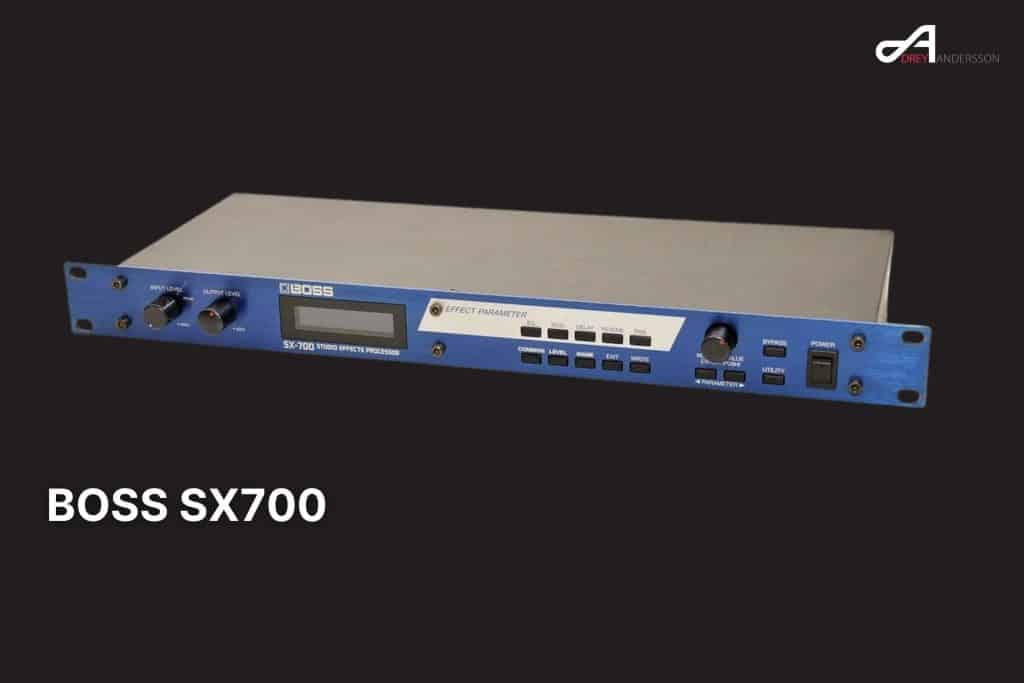
The Boss SX700 is a 1U rack multi-effects processor Roland launched in 1996, and its one genuinely historic trick was putting RSS (Roland Sound Space) 3D audio into a box almost anyone could afford. Until then, that spatial technology lived only in gear costing five figures. I still keep one in my rack, because nothing in software quite replaces what it does. Here’s the full picture: what it is, how it sounds, where it falls short, and whether it’s worth buying now.
Key Takeaways
- The SX700 (1996) sold for under £450, the first Boss/Roland product under £2,000 with a full RSS 3D implementation (Sound on Sound, 1996).
- Reviewer Rob Brady called it “one of the best new products to come on the market in the last five years” and reckoned “RSS alone is worth £419.”
- It runs five effect blocks at once, EQ, modulation, delay, reverb and RSS, with 18-bit/44.1kHz conversion.
- Weak spots: no digital I/O, an external power supply, no vocoder, and reverb tails that don’t match a Lexicon.
- Today it trades for roughly $125 to $175 used (Reverb), making the cheapest RSS box a genuine bargain.
What exactly is the Boss SX700?
The SX700 is a single-rackspace digital multi-effects processor that Roland released under its Boss brand in 1996, built around RSS spatial audio. In its October 1996 review, Sound on Sound called it “one of the best new products to come on the market in the last five years” (Sound on Sound, 1996), which is strong language for a box selling under £450.
Boss built it to replace the discontinued SE50 and SE70 (Sound on Sound, 1996), and it does two jobs. It handles the everyday studio effects you’d expect, EQ, modulation, delay and reverb, and it adds Roland Sound Space, a psychoacoustic system that places a sound anywhere in a 360-degree field. It was the first product from the Boss/Roland stable under £2,000 to carry a full RSS implementation. That’s the whole reason it matters.
What is RSS, and why did putting it in the SX700 matter?
RSS (Roland Sound Space) is Roland’s 3D processing, and the way they built it tells you why it works. Roland suspended an acoustically accurate model of a human head in an anechoic chamber, measured how sound reached microphones in its “ears,” then reverse-engineered those phase and timing cues into maths (Sound on Sound, 1996). That’s a hardware HRTF, the same principle behind modern binaural audio. The catch: it’s strongest on headphones or in the sweet spot between two speakers, and it isn’t very mono-compatible.
The technology wasn’t new in 1996. What was new was the price. Roland first launched RSS around 1991 as a £13,000 four-channel unit (Sound on Sound, 1996). The cut-down RSS-10 rack then brought it to £2,199 in 1996. The SX700 folded the same idea into a box under £450 that same year. That’s the collapse worth remembering, and it’s why a producer on a budget could suddenly do what only post-production houses had done before.
How good does the SX700 actually sound?
Better than its price suggests, with one honest caveat. It uses 18-bit A/D and D/A converters at 44.1kHz, with a 95dB dynamic range on the effect path (105dB bypassed) and a flat 12Hz to 20kHz response (Roland). Those aren’t headline numbers today, but in practice the SX700 is clean and quiet.
The most telling verdict came from the reviewer himself. Rob Brady wrote that in his own blind tests “the SX700 matched the quality of my TDM plug-ins,” giving far pricier processors a hard time justifying themselves (Sound on Sound, 1996). He liked it enough to buy the review unit.
So where’s the catch? The reverbs. Brady found the tails “slightly thin and grainy” on longer settings, not up to the Lexicon PCM80 standard, and I’d agree. If you want a lush dedicated reverb, something like the Yamaha REV500 or a Lexicon does that job better. The SX700’s reverb is fine; its RSS is the reason you buy it.
What effects can the SX700 run at once?
Five blocks, simultaneously: EQ, modulation, delay, reverb and RSS, all live in a single patch, though only one effect from each block at a time (Sound on Sound, 1996). Across those blocks it offers 31 effect algorithms in total. That’s a lot of processing for a 1996 unit at this price, and within the blocks you get real variety.
The modulation section offers 10 types, from chorus and flanging to pitch effects and rotary-speaker emulation. Delay gives you 7 types up to a 1,400ms maximum, with MIDI sync. Reverb covers 8 algorithms, three rooms, two halls, a garage, a plate and a non-linear setting, with decay times reaching 32 seconds. And it stores 256 patches, split evenly between 128 user and 128 factory slots.
The SX700’s four RSS modes
RSS on the SX700 isn’t one effect but four operating modes, each suited to a different job (Sound on Sound, 1996):
- 3D Panner moves a source around the listener in real time, the classic spinning-around-your-head trick.
- Single 3D fixes one source at a chosen point in the 360-degree field.
- Dual 3D positions two independent sources separately.
- Quad 3D handles four sources at once for wider, quadraphonic-style placement.
Want to place a hi-hat slightly behind and above the listener while a pad drifts left to right? This is the box that does it, on normal speakers, no surround rig required.
How does the SX700 compare to other 90s processors?
Against its contemporaries, the SX700 trades outright reverb quality for a feature none of them had. Sound on Sound’s own comparisons put its reverb below the Lexicon PCM80 while rating it a match for anything by Alesis or Digitech (Sound on Sound, 1996). Here’s how a few common reference points stack up.
| Processor | Year | 3D / RSS | Standout strength | Notes |
|---|---|---|---|---|
| Boss SX700 | 1996 | Yes (full RSS) | Affordable 3D placement | Reverb tail not top-tier |
| Alesis QuadraVerb | 1988 | No | Four simultaneous effects | Grittier 16-bit character |
| Lexicon PCM80 | 1994 | No | Benchmark reverb | The reverb SX700 couldn’t match |
| Roland SE-50 | 1991 | No | The SX700’s predecessor | No spatial processing |
Read that table one way and the SX700 loses on reverb. Read it another way and it’s the only row that offers 3D. That’s the trade, and for a lot of electronic producers it’s an easy one.
What are the SX700’s real weaknesses?
A few things hold it back, and it’s worth being straight about them. First, connectivity: it’s analogue only, with no S/PDIF or AES/EBU digital I/O (Robert Ciesla), so it lives in the analogue domain of your setup. Second, it ships with an external power supply, the dedicated Boss BRC-120/230/240 AC-AC 14V adaptor, rather than an internal one, which is one more thing to lose.
Third, there’s no dynamics processing on board, no compressor, limiter or gate, so it won’t replace a channel strip. It also drops the vocoder that made the SE50 and SE70 special, a genuine loss (Sound on Sound, 1996). Routing is fixed to preset signal-path algorithms (19 of them) rather than a free matrix, so you pick a configuration rather than wire blocks freely. None of this is a dealbreaker for its main job. Just know what you’re buying.
Is the Boss SX700 worth buying in 2026?
For most effects, honestly, modern plug-ins sound cleaner and cost nothing extra. Reverb‘s price guide estimates a used value of roughly $125 to $175 (about €115 to €159), with mint or boxed units listing higher. So the question is what that money buys you that software doesn’t.
Two things, really. One is the RSS 3D placement, which no plug-in fully replicates in the same character. The other is deep hardware control: every parameter responds to MIDI SysEx and can be driven by continuous controllers (Sound on Sound, 1996), so you can automate spatial moves from your DAW and record the results. If you make electronic or ambient music and you want movement outside the box, it’s a characterful, cheap way in. If you just need a clean reverb, spend the money elsewhere.
Boss SX700 specifications
| Specification | Detail |
|---|---|
| Released | 1996 (produced 1996 to 1999) |
| Format | 1U rackmount (482 x 197 x 44 mm) |
| A/D & D/A conversion | 18-bit (128x oversampling A/D, 16x D/A) |
| Sampling rate | 44.1 kHz |
| Frequency response | 12 Hz to 20 kHz effect; 5 Hz to 55 kHz direct (-1/+0 dB) |
| Dynamic range | 95 dB effect, 105 dB direct (IHF-A) |
| Nominal I/O level | +4 / -20 dBm (switchable) |
| Total effect algorithms | 31 |
| Simultaneous effect blocks | 5 (EQ, modulation, delay, reverb, RSS) |
| Modulation types | 10 |
| Delay types | 7 (max 1,400 ms) |
| Reverb algorithms | 8 (max decay 32 s) |
| RSS modes | 4 (Panner, Single, Dual, Quad) |
| Signal-path configurations | 19 algorithms |
| Preset memory | 256 (128 user + 128 factory) |
| Digital I/O | None (analogue only) |
| MIDI | Full SysEx control of all parameters |
| Power | External Boss BRC-120/230/240 AC-AC 14 V, 700 mA |
| Weight | 2.0 kg (excluding adaptor) |
Frequently asked questions
What is the Boss SX700 used for?
The SX700 is a 1996 rackmount multi-effects processor used for reverb, delay, modulation and, most distinctively, RSS 3D spatial placement. Producers reach for it to position sounds anywhere in a 360-degree field on ordinary speakers or headphones, alongside everyday studio effects, with five effect blocks running at once.
Does the Boss SX700 really do 3D sound?
Yes. It uses Roland Sound Space (RSS), an HRTF-based system built from measurements of a dummy head in an anechoic chamber, placing audio above, below or around the listener in a 360-degree circle. Reviewer Rob Brady reckoned “RSS alone is worth £419” in 1996. It works best on headphones or in the stereo sweet spot.
How much is a Boss SX700 worth today?
Reverb’s price guide estimates a used value of roughly $125 to $175 (about €115 to €159) as of 2026, based on recent sales, with mint or boxed units listing higher. That still makes the SX700 the cheapest route into genuine RSS 3D processing, since no plug-in fully replicates it.
What are the Boss SX700’s main weaknesses?
Its main limitations are analogue-only connections (no S/PDIF or AES/EBU digital I/O), an external power supply rather than an internal one, and no dynamics processing such as compression. Reviewers also note the reverb tail sounds slightly thin next to a Lexicon. Effect routing follows preset algorithms rather than a free matrix.
Is the Boss SX700 good for modern production?
For most tasks, modern plug-ins sound cleaner. The SX700 earns its place through two things: its unique RSS 3D placement and its deep MIDI control, since every parameter responds to SysEx and continuous controllers. That makes it a characterful, automatable hardware effect for producers who want spatial motion outside the box.
Back to Music Production Terms Index Page