What the Alesis SR-16 is
The Alesis SR-16 is a compact digital drum machine that Alesis launched in 1990, with 233 sampled drum and percussion sounds, 12 velocity-sensitive pads, 16-voice polyphony, two stereo output pairs and MIDI. Alesis still lists it as a current product in 2026. It is also written Alesis SR16, and a search for an SR 16 drum machine means the same unit. On its own, SR-16 also names a rifle, so this page always gives the brand.
This page lists the specs from Alesis’s product page and the SR-16 Reference Manual, explains the patterns, drum sets and MIDI functions, and prints the 50 preset patterns from the label under the unit. It also follows the line from the HR16 to the SR18, and gives the manual, a demo video, and new and used prices that I checked on 10 November 2026.
- 233 sounds, 12 velocity-sensitive pads, 16 voices, Main and Aux stereo outputs, MIDI In and Out/Thru, and two footswitch jacks.
- 50 preset and 50 user patterns, each with an A and a B part and a fill for each, so 400 patterns in all, plus 100 songs of up to 254 steps.
- Launched in the UK in late 1990 at £299 including VAT as the successor to the HR16. The SR18 followed at the NAMM show in January 2008.
- Still sold new: $159 at Sweetwater (backordered on 10 November 2026) and $129 at Thomann’s US store. Used units sold for €70 to €109 on Reverb over the past year.
Alesis SR-16 specs
The table combines the specification list on Alesis’s current SR-16 page with the SR-16 Reference Manual, which Alesis hosts as a PDF. Where sources disagree, the section after the table gives each version.
| Feature | Alesis SR-16 |
|---|---|
| Maker | Alesis (the brand belongs to inMusic today) |
| Released | 1990 |
| Type | Digital sample-playback drum machine with a pattern and song sequencer |
| Sounds | 233 drum and percussion sounds, many both dry and with sampled stereo reverb; 12 at a time from the pads, 120 at a time via MIDI |
| Bit resolution | 16-bit samples, 18-bit converter (Alesis lists 16/18) |
| Polyphony | 16 voices |
| Pads | 12, velocity sensitive: 8 levels from the pads, 127 via MIDI |
| Drum sets (kits) | 50 preset and 50 user |
| Patterns | 50 preset and 50 user, each with A, B and two fills, so 400 in all; 1 to 128 beats long |
| Songs | 100, up to 254 steps each |
| Note memory | 12,000 notes on Alesis’s page (other figures below) |
| Timing resolution | 96 ppq, so 1/384-note steps with quantize off |
| Quantize and swing | Quarter note to 32nd-note triplet, or off; swing 54, 58 or 62 percent |
| Tempo | 20 to 255 BPM, also by tapping |
| Per-pad settings | Sound, volume 00 to 99, 7 pan positions, tuning +3 to -4, Multi, Single, Group 1 or Group 2 trigger mode, Main or Aux output |
| Audio outputs | 4: Main L/R and Aux L/R stereo pairs |
| MIDI | In and Out/Thru; channel 1 to 16 or Omni; MIDI Clock and Song Position Pointer; program changes select drum sets |
| Footswitch jacks | 2: Start/Stop and Count/A/B/Fill |
| Data backup | Cassette tape through a mini-jack, or MIDI SysEx |
| Power | 12 V DC external supply on Alesis’s current page (1990-91 reviews: 9 V AC adaptor) |
| Size and weight | 9.25 x 1.5 x 6.5 in (W x H x D), 2.5 lb on Alesis’s page |
Details that differ between sources
Memory. Alesis’s page gives 12,000 notes. The manual says the SR-16 can typically store over 15,000 events. Sound On Sound’s reviewer found no figure in 1990, measured the free memory after recording a known number of notes, and arrived at around 24,576. Music Technology’s reviewer filled between 96 and 136 patterns of 192 pad hits before the display read Outa Mem Dude, depending on the rhythm.
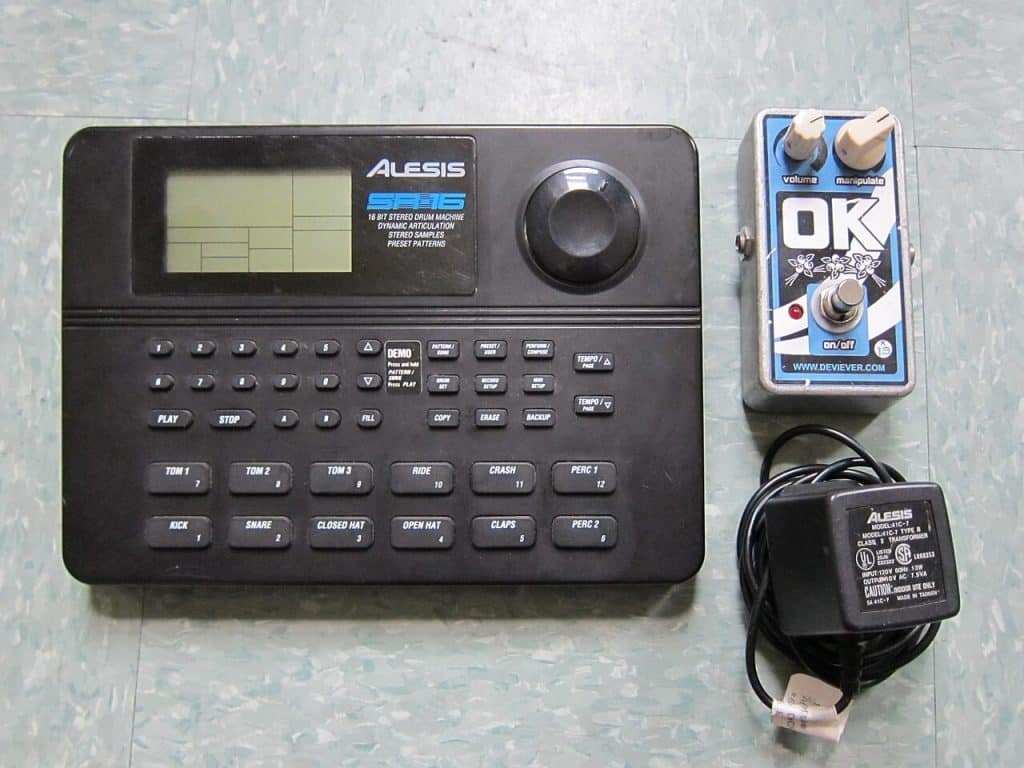
Bit depth. Alesis lists 16/18 for sample and converter resolution, the manual says the sounds were recorded at 16-bit resolution, and the panel in the photo at the top of this page reads 16 BIT STEREO DRUM MACHINE. Sweetwater’s 2026 listing describes a 24-bit sound engine. I found no Alesis document that says so.
Power and headphones. Both 1990 and 1991 reviews describe a 9 V AC adaptor. Alesis’s current page lists a 12 V DC external transformer, and Sweetwater and Thomann say a 12 V supply is in the box. The Rev C manual has both: its setup steps name a 9 V AC jack while its drawing labels the socket 12VDC. Sound On Sound wrote in 1990 that the SR-16 had no headphone output, and Alesis’s spec list names only the 4 audio outputs. Sweetwater and Thomann list a headphone output for the units they sell, and I found no Alesis rear-panel drawing that settles it.
Size, weight, counts and quantize. Alesis gives 2.5 lb, Music Technology 1.5 lb and Thomann 1.1 kg. Sound On Sound counted 52 toms where Music Technology counted 51. Both give 233 sounds in total, but Music Technology’s own counts add up to 232. Music Technology also gave quantize values down to 64th notes, while the manual and Sound On Sound stop at 32nd-note triplets. The 1990 and 1991 reviews describe a MIDI note map limited to user drum sets 40 to 49, while the Rev C manual lets any of five groups of ten user drum sets cover the notes, and I found no source that dates the change.
How the SR-16 works
The SR-16 has two modes that the manual calls Perform, for playback, and Compose, for recording. There is no record button, only Play and Stop, and either mode can be selected while a pattern keeps running. The six function buttons open pages for drum sets, record setup, MIDI setup, copy, erase and backup, and a large knob sets the overall volume.
Sounds and Dynamic Articulation
All 233 sounds are fixed. There is no sampling and no slot for sound cards, a point Music Technology made in its 1991 review. The manual calls them over 230 drum and percussion sounds and leaves the full list to a separate chart that came with the unit.
Music Technology counted 94 stereo samples among the 233 and named the 808 kick and snare among the electronic sounds. Many sounds come in two versions, dry and with stereo reverb sampled into them. The reverb can’t be adjusted, and Sound On Sound estimated that about two-thirds of the 233 are different sounds, the rest being tuned or reverberated versions. Music Technology notes that the toms come in high, mid and low versions.
Dynamic Articulation is Alesis’s name for sounds whose tone changes, not just their level, when a pad is hit harder. Sound On Sound heard it on about seven sounds, among them snares that add rim sound with velocity and a conga that adds slap, and Music Technology noted that the manual doesn’t say which sounds use it. Sound 231, Sample & Hold, picks one of four sounds at random on each hit: two tunings of the 808 cowbell, a woodblock and an agogo bell.
Patterns, fills and recording
Patterns are numbered 00 to 49 in a preset bank and a user bank. Each number holds four parts: two main patterns, A and B, and a fill for each. A fill has the same length, drum set and name as its main pattern. With 50 numbers, the A and B parts and the fills, each bank holds 200 patterns, and the manual counts 400 across both banks. Alesis says the presets were played in by studio drummers rather than programmed and quantized. Factory rhythms can’t be edited directly; they are copied to a free user slot first.
The manual and Sound On Sound both frame the fill system as a tool for the stage. Pressing Fill during A plays the rest of fill A and then moves to B, and the same works from B back to A. Holding Fill past the next downbeat returns to the pattern that was playing instead. Whatever is recorded on a fill’s first step plays on the downbeat after the fill, which places a crash cymbal there without repeating it on every loop of the main pattern. Music Technology noted that Akai’s XR10 had a similar arrangement for its presets, while the SR-16 also gives it to user patterns.
A pattern runs from 1 to 128 beats, with 8 beats as the default. Recording cycles until Stop is pressed, so hi-hat, kick and snare can be layered pass by pass. Quantize runs from quarter notes to 32nd-note triplets; with it off, the timing resolution is 96 steps per beat, or 1/384 of a whole note. Swing can be set to 54, 58 or 62 percent. Other record pages shift a whole pattern or one drum earlier or later, add or remove beats at either end, give the pattern an eight-character name and switch to step editing. Holding a pad and pressing Fill repeats that drum at the current quantize value.
Tempo ranges from 20 to 255 BPM and can be tapped in on the Stop button or on a footswitch in the Count/A/B/Fill jack. A Free Mem page shows how much memory is left as a percentage, and the manual advises saving the data once it falls below about 15 percent.
Drum sets and outputs
A drum set maps one sound to each of the 12 pads. There are 50 preset and 50 user drum sets, and each A and B user pattern can use its own, which also means a pattern has at most 12 sounds. For each pad the drum set stores the volume from 00 to 99, one of seven pan positions and a tuning from +3 to -4. It also sets the output pair and one of four trigger modes. Multi lets repeated hits ring out, Single cuts the previous hit, and pads in Group 1 or Group 2 cut each other off, as open and closed hi-hats do.
The SR-16 plays up to 16 voices at once. When a 17th is needed, it takes the voice that is closest to the end of its decay. Each pad goes to the Main or the Aux stereo pair, so panning two sounds hard left and right on Aux gives two separate outputs, for example for kick and snare. A single plug in one Main jack switches the unit to mono.
Songs
The SR-16 stores 100 songs of up to 254 steps, where a step is an A or B pattern or a fill. Songs can be typed in step by step or recorded in real time: in Compose mode the unit plays and writes down every pattern and fill change as it happens. Each song has one tempo, with no tempo changes inside it. During song playback, holding the Count/A/B/Fill footswitch repeats the current step until it is released, which lets a band stretch a verse or solo on stage.
MIDI and use as a drum module
MIDI runs on one channel from 1 to 16 or in Omni mode. The SR-16 sends and follows MIDI Clock and Song Position Pointer, and it can merge incoming MIDI into its output. Program changes 00 to 49 select the user drum sets, 50 to 99 the preset drum sets, and 100 to 127 user drum sets 00 to 27. In normal use the MIDI notes follow the 12 pads, and Music Technology noted that the note numbers are set globally rather than per drum set.
The Rev C manual adds a Multi-Drumset mode in which a group of ten user drum sets covers MIDI notes 0 to 119. That makes 120 sounds playable at once, which matches the 120 sounds via MIDI in Alesis’s spec list. In this mode the sounds respond to all 127 velocity levels, but patterns can’t be recorded via MIDI. From its own pads the SR-16 has eight velocity levels, and Music Technology reported that it also records only eight levels from MIDI input.
Backup to tape and SysEx
Patterns, songs and drum sets are saved as audio tones to a cassette recorder through a mini-jack, or as MIDI System Exclusive data to a storage device such as the Alesis DataDisk or to a second SR-16. Tape can load everything, one pattern or one song, and has a verify page. SysEx can also send a single drum set or a single pad’s part. Holding Play and Erase while switching on clears the memory, and pressing Fill in the Backup menu shows the software version.
Alesis SR-16 preset patterns
The 50 preset patterns are printed on a label under the unit, each with a default tempo and a suggested tempo range. Music Technology’s 1991 review summed up their styles as rock, hard rock, R&B, funk, blues, rap, techno, reggae, jazz rock, fusion, new age, country, jazz, Latin and ballad. The label also lists country rock, rockabilly, Dixie and polka. Rock has seven patterns, and Latin and Ballad have five each. Default tempos run from 60 BPM for Blues 1 to 140 BPM for Rock 5, Hard Rock 1, Rap 2 and Techno 2.
| No. | Preset pattern | Default tempo | Suggested range |
|---|---|---|---|
| 00 | Rock 1 | 120 BPM | 110 to 130 |
| 01 | Rock 2 | 95 BPM | 80 to 90 |
| 02 | Rock 3 | 130 BPM | 125 to 135 |
| 03 | Rock 4 | 105 BPM | 100 to 110 |
| 04 | Rock 5 | 140 BPM | 135 to 145 |
| 05 | Rock 6 | 95 BPM | 90 to 95 |
| 06 | Rock 7 | 130 BPM | 125 to 135 |
| 07 | Hard Rock 1 | 140 BPM | 135 to 150 |
| 08 | Hard Rock 2 | 120 BPM | 115 to 125 |
| 09 | Hard Rock 3 | 115 BPM | 110 to 130 |
| 10 | R&B 1 | 105 BPM | 100 to 115 |
| 11 | R&B 2 | 125 BPM | 120 to 130 |
| 12 | R&B 3 | 110 BPM | 100 to 120 |
| 13 | Funk 1 | 110 BPM | 105 to 115 |
| 14 | Funk 2 | 110 BPM | 100 to 120 |
| 15 | Blues 1 | 60 BPM | 55 to 70 |
| 16 | Blues 2 | 100 BPM | 95 to 115 |
| 17 | Rap 1 | 110 BPM | 100 to 115 |
| 18 | Rap 2 | 140 BPM | 130 to 145 |
| 19 | Rap 3 | 95 BPM | 90 to 100 |
| 20 | Techno 1 | 120 BPM | 110 to 130 |
| 21 | Techno 2 | 140 BPM | 135 to 150 |
| 22 | Techno 3 | 120 BPM | 120 to 130 |
| 23 | Reggae 1 | 125 BPM | 120 to 130 |
| 24 | Reggae 2 | 135 BPM | 130 to 140 |
| 25 | Jazz Rock 1 | 130 BPM | 120 to 140 |
| 26 | Jazz Rock 2 | 100 BPM | 95 to 110 |
| 27 | Fusion 1 | 130 BPM | 120 to 140 |
| 28 | Fusion 2 | 125 BPM | 115 to 135 |
| 29 | New Age 1 | 75 BPM | 70 to 90 |
| 30 | New Age 2 | 80 BPM | 70 to 90 |
| 31 | Country 1 | 115 BPM | 105 to 130 |
| 32 | Country 2 | 130 BPM | 115 to 140 |
| 33 | Country 3 | 120 BPM | 115 to 135 |
| 34 | Country Rock | 130 BPM | 120 to 140 |
| 35 | Rockabilly | 100 BPM | 95 to 110 |
| 36 | Jazz 1 | 125 BPM | 115 to 130 |
| 37 | Jazz 2 | 110 BPM | 110 to 120 |
| 38 | Dixie | 100 BPM | 90 to 110 |
| 39 | Polka | 135 BPM | 130 to 140 |
| 40 | Latin 1 | 100 BPM | 90 to 110 |
| 41 | Latin 2 | 105 BPM | 95 to 120 |
| 42 | Latin 3 | 130 BPM | 120 to 140 |
| 43 | Latin 4 | 120 BPM | 115 to 130 |
| 44 | Latin 5 | 130 BPM | 120 to 135 |
| 45 | Ballad 1 | 95 BPM | 80 to 110 |
| 46 | Ballad 2 | 90 BPM | 85 to 100 |
| 47 | Ballad 3 | 85 BPM | 80 to 100 |
| 48 | Ballad 4 | 120 BPM | 100 to 130 |
| 49 | Ballad 5 | 100 BPM | 90 to 110 |
History: from the HR16 to the SR18
When Sound On Sound reviewed the SR-16 in December 1990, it placed it in a fast-moving market. By 1988 the Alesis HR16 had offered 49 16-bit drum samples for £499, and in May 1990 Boss had brought out the DR550 with 48 sounds for £199. The review called the SR-16 the replacement for the HR16 and noted that its black case looked so much like the DR550 that, on unboxing, the reviewer took it for a DR550 sent by mistake. The SR-16 is about 40 mm longer.
Sound On Sound’s August 1990 news pages announced the SR-16 with over 100 sounds and expected it from October at £299. Music Technology’s report from the British Music Fair, held at Olympia in July 1990 and printed in its October 1990 issue, said it was scheduled for November, that the unit on show stayed silent, and that its sounds would apparently not be HR16 or HR16B sounds. The finished machine shipped with 233 sounds. Both Sound On Sound in December 1990 and Music Technology in February 1991 reviewed it at £299 including VAT, with Sound Technology plc as the UK distributor. Neither review named a US price, and I found none in a primary source.
At the Frankfurt Musikmesse in 1991, Alesis showed the D4 drum module, which Sound On Sound described as offering over 400 drum sounds drawn largely from the HR16, HR16B and SR-16, for £399. Alesis also showed the Alesis 3630 compressor at the same fair.
Alesis showed the SR18 at the NAMM show in January 2008, and Sound On Sound’s news item called it a beefed-up version of the long-serving SR16. In its January 2009 SR18 review, Sound On Sound noted that the SR-16 had been around for 20 years or so and was still available. That review gave £199 including VAT in the UK and $399 in the US for the SR18. In November 2026, Alesis listed both machines among its five drum machines and multipads.
Alesis SR-16 vs SR-18
The SR18 keeps the 12 velocity-sensitive pads and the two footswitch jacks for Start/Stop and Count/A/B/Fill, and adds sounds, voices, effects and battery power. Sound On Sound’s SR18 review also lists the backlight and a data wheel in place of the SR-16’s volume knob, which moved to the back. Alesis writes the newer model as SR18, while Sweetwater and Google’s related searches write SR-18.
| Alesis SR-16 | Alesis SR18 | |
|---|---|---|
| Introduced | 1990 | NAMM show, January 2008 |
| Sounds | 233 drum and percussion sounds | Over 500 drum and percussion sounds, plus 50 bass sounds (32 MB) |
| Polyphony | 16 voices | 32 voices |
| Pads | 12, velocity sensitive | 12, velocity sensitive |
| Patterns | 50 preset and 50 user, each with A, B and two fills | 100 preset patterns and 100 user locations |
| Effects | None; reverb is sampled into some sounds | Reverb, EQ and compression |
| Display | LCD, not backlit | Backlit LCD |
| Inputs | No audio input (MIDI, footswitch and tape jacks only) | 1/4 in instrument (guitar) input |
| Outputs | Main and Aux stereo pairs | 1/4 in stereo pair, 1/4 in TRS, 1/4 in TRS headphone |
| Power | External supply only | Adapter or six AA batteries |
| Sweetwater, 10 Nov 2026 | $159, backordered | $229 |
Who used the SR-16
Period magazines list the SR-16 in several artists’ equipment. These are equipment lists and interview remarks; none of them ties the SR-16 to a specific record, and I found no primary source that does.
- Larry Heard (Mr Fingers, Fingers Inc): the equipment list in his May 1992 Music Technology interview includes an Alesis SR16, along with an Alesis D4 and an E-mu SP1200.
- A Certain Ratio: the studio and rehearsal room list in Sound On Sound, January 1993 includes an Alesis SR16 next to a Roland TR808 and TB303.
- Inspiral Carpets: keyboard player Clint Boon told Music Technology in January 1993 that the band brought in an SR16 so that drummer Craig Gill could play to “a click made up of drum sounds” on stage, instead of the click from the band’s Ensoniq.
- Rene van der Weyde (TFX): the Dutch producer’s rig list in Music Technology, September 1993 names an Alesis 3630, MEQ230, Quadraverb and SR16.
Related gear
The 1990 and 1991 reviews compared the SR-16 with the Boss DR550, the Roland R5 and R8, the Yamaha RX8, the Akai XR10 and the Cheetah MD16, which sold for the same £299. Inside Alesis, the HR16 came before it, the D4 module drew largely on its sounds and those of the HR16 and HR16B, and the SR18 followed. Other Alesis gear in this glossary is the Alesis 3630 compressor, and the Alesis Quadraverb guide covers the effects unit that TFX’s 1993 rig list names next to the SR16. For sampling drum machines, see the Akai MPC60 and the Boss SP-303. For drum machines with synth parts, see the Yamaha RM1x, the Korg drumlogue and the groovebox entry. The terms sample and loop explain two of the ideas the SR-16 is built on.
SR-16 demo video
The video below is titled Alesis SR-16 Drum Machine: Hear All 50 Preset Beats (At Proper BPM), by the YouTube channel Quest for Gear. Its description says it goes through all 50 factory preset patterns, and it runs 28 minutes 31 seconds.
Alesis SR-16 manual and documentation
Alesis hosts the SR-16 Reference Manual, revision C, as a PDF of 72 pages. Its PDF data says it was created on 2 June 2004, and the last page carries the part number 7-51-1023-C. Its chapters cover record setup, playing and recording patterns, drum sets, song mode, MIDI setup, backup and applications, followed by a MIDI Supplement chapter and a troubleshooting chart. The MIDI Supplement is adapted from AMSCO’s books, among them The Complete Guide to the Alesis HR-16 and MMT-8. Printed page numbers run four lower than the PDF’s. The list of the 233 sounds isn’t in the manual; it came as a separate chart. Alesis’s SR-16 product page carries the current spec list.
The photo at the top of this page is by David McMahon, published on Wikimedia Commons under CC BY-SA 2.0. The preset table above comes from the same photographer’s picture of the underside.
Alesis SR-16 price and availability
The SR-16 is not discontinued. On 10 November 2026, Alesis listed it on its drum machines and multipads page next to the SR18, and new units were on sale. Sweetwater listed it at $159, backordered with delivery estimated for January 2027, and listed the SR18 at $229. Thomann’s US store listed it at $129 and in stock, with US import duties charged on top. In 1990 the UK price was £299 including VAT.
The second-hand market is active too. On the same day, viewed from Berlin, Reverb’s SR-16 page estimated a used value of €70 to €122. Its transaction table lists 7 dated sales.
All 7 sales fall inside Reverb’s estimate. They range from €70 to €109, and the newest was €80 in October 2026. The table doesn’t say which power supply each unit came with.
Frequently asked questions
When did the Alesis SR-16 come out?
Alesis launched the SR-16 in 1990. Sound On Sound’s August 1990 news pages expected it from October at £299, Music Technology’s report from the July 1990 British Music Fair said November, and Sound On Sound reviewed it in its December 1990 issue.
Is the Alesis SR-16 still made?
Alesis still sells it. On 10 November 2026, Alesis listed the SR-16 as a current drum machine next to the SR18. New units were on sale at $159 from Sweetwater, backordered until an estimated January 2027, and at $129 from Thomann’s US store.
How many sounds does the Alesis SR-16 have?
The SR-16 has 233 sounds. Sound On Sound counted 49 kick drums, 59 snares, 19 hi-hats, 12 cymbals, 52 toms and 42 percussion sounds, many offered both dry and with sampled reverb. A pattern plays 12 of them from the pads, and MIDI reaches 120 at once.
How many patterns does the Alesis SR-16 have?
It has 50 preset and 50 user patterns, numbered 00 to 49. Each holds an A and a B main pattern plus a fill for each, so the manual counts 400 patterns in total. Patterns run from 1 to 128 beats, and 100 songs chain them together.
Does the Alesis SR-16 have a headphone output?
Sources disagree. Sound On Sound’s 1990 review said it had none, and Alesis’s current spec list names 4 audio outputs as 2 stereo pairs, with no headphone jack. Sweetwater and Thomann list a headphone output for units sold in 2026. I found no Alesis rear-panel drawing that settles it.
What power supply does the Alesis SR-16 use?
Alesis’s current page lists a 12 V DC external transformer, and Sweetwater and Thomann say a 12 V supply is included. The 1990 and 1991 reviews describe a 9 V AC adaptor, and the Rev C manual mentions both. I found no Alesis statement that explains the difference.
What is the difference between the Alesis SR-16 and SR-18?
The SR18, shown at NAMM in January 2008, has over 500 drum and percussion sounds plus 50 bass sounds, 32 voices, reverb, EQ and compression, a backlit LCD, a guitar input and battery power. The SR-16 has 233 sounds, 16 voices and no effects section.
Can the Alesis SR-16 be used as a MIDI drum module?
Yes. In the manual’s Multi-Drumset mode, a group of ten user drum sets covers MIDI notes 0 to 119, so 120 sounds respond at once with all 127 velocity levels. Patterns can’t be recorded via MIDI in that mode, and program changes select drum sets.
Where can I find the Alesis SR-16 manual?
Alesis hosts the SR-16 Reference Manual, revision C, as a 72-page PDF on its own document server, created in June 2004. It covers record setup, patterns, drum sets, songs, MIDI and tape backup, and ends with a troubleshooting chart. The list of sounds came as a separate chart.
How much is a used Alesis SR-16 worth?
On 10 November 2026, viewed from Berlin, Reverb estimated a used SR-16 at €70 to €122. Its 7 dated sales from November 2025 to October 2026 ranged from €70 to €109, and the newest was €80. New units cost $129 (Thomann, before import duties) to $159 in the US.
Back to Music Production Terms Index Page