What the Oberheim OB-Xa is
The Oberheim OB-Xa is a programmable analog polyphonic synthesizer that Oberheim Electronics of Los Angeles introduced at the turn of 1980 and 1981, with 4, 6 or 8 voices, two oscillators and switchable 2-pole and 4-pole filters per voice, and split and double modes. It has a 61-key keyboard. One Two Testing printed the name as OBX-A in 1982 and Music Technology and Sound On Sound used OBXa, while searches for the Oberheim OB-Xa synthesizer use OB-Xa, OBXa and OB Xa.
This page lists the specs from Oberheim’s own 1982 manuals and explains how the voices, the filters and the programmer work. It places the OB-Xa between the OB-X before it and the OB-8 after it, covers the musicians whose use is on record, and lists the modern instruments built on it, the OB-X8 and the UB-Xa among them. It closes with a demo video, the documentation and dated used prices.
- 4, 6 or 8 voices, each with 2 VCOs, a 2-pole (12 dB per octave) and a 4-pole (24 dB per octave) low-pass filter, two envelopes and a VCA.
- 32 programs on the first units and 120 from software version B of September 1981; later units also store 8 split and 8 double programs.
- Split and Double turn one OB-Xa into two synthesizers with half the voices each, so an 8-voice becomes two 4-voice instruments.
- It followed the OB-X (July 1979 per Sound On Sound) and was followed by the OB-8, whose manual is dated November 1982.
- The Oberheim OB-X8 (2022, $4,999 at launch) and the Behringer UB-Xa (2023, 16 voices) both recreate its voice.
- Reverb’s estimated used value on 10 November 2026: €4,769 to €8,031.
Oberheim OB-Xa specs
The table below follows Oberheim’s specification pages, which describe a unit with 120 programs and the newest software of 1982. Where the owner’s manual and the service manual print different figures, both are given.
| Feature | Oberheim OB-Xa |
|---|---|
| Maker | Oberheim Electronics, Inc., Los Angeles |
| Introduced | December 1980 (owner’s manual) or January 1981 (service manual) |
| Type | Programmable analog polyphonic synthesizer with an onboard microprocessor |
| Voices | 4, 6 or 8, arranged as an Upper and a Lower group of up to four voices |
| Each voice | 2 VCOs, 2 low-pass VCFs (2-pole or 4-pole, selectable), 2 envelope generators, 1 VCA |
| Oscillators | Sawtooth, pulse or both, switchable per oscillator; Osc 1 in octave steps over 4 octaves, Osc 2 in half steps over 5 octaves; sync; filter envelope to Osc 2 pitch |
| Filter | 2-pole at 12 dB per octave or 4-pole at 24 dB per octave, both CEM3320 chips; resonance, envelope amount, keyboard tracking on or off |
| Sound sources into the filter | Osc 1 on or off, Osc 2 off, half (about 5 dB down) or full, noise on or off |
| Envelopes | Two ADSR envelopes per voice, filter and loudness, on CEM3310 chips |
| Modulation | One programmable LFO per voice group at about 0.1 to 20 Hz with sine, square and sample and hold, routed to oscillator pitch, filter and pulse width; a third LFO on the modulation panel |
| Memory | 120 programs plus 8 split and 8 double programs (early units: 32 programs, with 8 locations shared by splits and doubles); 104 factory sound programs |
| Keyboard | 5 octaves, C to C (61 keys), no velocity or aftertouch |
| Keyboard modes | Full, Split and Double, with a programmable split point and transposition for each half |
| Performance panel | Modulation lever and pitch-bend lever (an octave or a whole step, optionally Osc 2 only), transpose up or down an octave |
| Portamento | Polyphonic; linear or quantized, with or without offset, on units after serial number 820818 |
| Outputs | Stereo left and right plus mono, about 1 V peak to peak at about 75 kΩ; no headphone socket |
| Other connections | Cassette interface, 37-pin parallel computer interface, footswitches for sustain, hold and program advance, pedals for filter and vibrato |
| MIDI | None from the factory; MIDI retrofits became available later |
| Power | 90 to 130 or 180 to 240 V AC, 50 W (owner’s manual); 180 to 260 V and 45 W in the service manual |
| Size (W x D x H) | 101.6 x 50.8 x 15.24 cm (40 x 20 x 6 in) |
| Weight | 20.41 kg (45 lb) |
How the OB-Xa works
Oberheim’s manual calls each voice a complete synthesizer: two voltage-controlled oscillators, two voltage-controlled filters, a voltage-controlled amplifier and two envelope generators. The voices sit in two groups of four, the Upper and the Lower voices, and each group has its own control circuitry and its own LFO. An onboard microprocessor scans the keyboard and the front panel and sends the results to both groups. The manual describes the instrument as a complete microcomputer system, with memory, cassette storage and software.
Each oscillator produces a sawtooth, a pulse wave or both, and one knob sets the pulse width of both oscillators, which the LFO can modulate as pulse-width modulation. Oscillator 2 can be synced to Oscillator 1, and the F-Env switch lets the filter envelope raise the pitch of Oscillator 2 by up to an octave. The sound sources reach the filter through on and off switches only: Oscillator 1 on or off, Oscillator 2 at half or full level, and the noise generator on or off. Music Technology’s 1990 retrospective points out the missing level controls for the two oscillators and the noise.
The filter section also changed from the OB-X. According to Oberheim’s OB-X8 user’s guide, the OB-X used a discrete 2-pole state-variable filter derived from the SEM module. The OB-Xa uses a Doug Curtis-designed CEM3320 chip set up as a 2-pole filter to follow the OB-X sound, plus a second CEM3320 wired as a 4-pole, 24 dB per octave filter. The 4-POLE switch chooses between them. The same guide notes that none of the original OB filters self-oscillate. Tom Oberheim put the change in one line in a 2025 interview with Attack Magazine: “When we did the OB-Xa, it was a step up using Curtis chips.”
Two ADSR envelopes per voice drive the filter and the VCA. Oberheim’s OB-X8 guide says all three original OB polysynths used the CEM3310 envelope chip, with a more exponential attack on the OB-X and OB-Xa than on the OB-8. The OB-X and OB-Xa LFOs were analog, with analog control of routing and depth, while the OB-8’s LFO was generated digitally. The OB-Xa’s programmable LFO runs from about 0.1 to 20 Hz with sine, square and sample and hold shapes. The sound itself takes a subtractive path through an analog voice.
The programmer
Programs are recalled with four Group buttons, A to D, and eight Program buttons. Pressing Group buttons together gives 15 groups (A, B, C, D, AB, AC and so on up to ABCD) of 8 programs, which is how the panel reaches 120 programs. One Two Testing’s 1982 review lists all 15 combinations. A recalled program can be edited at once: each knob adds to or subtracts from the stored value rather than jumping to its physical position. Manual mode does the opposite and sets the sound from the actual knob positions. Writing a program means holding Write and choosing a group and a program. A Memory Protect switch on the processor board, set to protect at the factory, blocks writes.
Split and Double
Split and Double divide the voices into the Upper and Lower groups, each with its own program. In Split the halves sit on either side of a split point that can be placed on any key; in Double both play at once, with a Balance knob between them. Each half can be transposed on its own. An 8-voice OB-Xa becomes two 4-voice synthesizers, a 6-voice becomes two 3-voice ones and a 4-voice becomes two 2-voice ones. On 120-program units the memory holds 8 split programs and 8 double programs. Music Technology’s Peter Forrest wrote in 1990 that the splittable keyboard was the big new feature over the OB-X.
Performance panel and portamento
To the left of the keyboard sit two sprung levers instead of wheels: a modulation lever and a pitch-bend lever. The bend range is an octave or, with Narrow on, a whole step, and an Osc 2 Only switch bends only the second oscillator. The panel has its own LFO with sine, sawtooth and square waves, plus transpose switches for an octave up or down. Portamento is polyphonic, so each voice glides on its own. On units after serial number 820818 it can be linear or quantized in half steps, with an optional offset that lets the voices glide at slightly different speeds.
Inside the case
Opening the lid gives access to several controls the panel does not show. Each voice has a pan pot; from the factory, voices 1 to 4 sit hard left and voices 5 to 8 hard right. An eight-position DIP switch turns individual voices off, which also disables the empty voice positions on a 6-voice or 4-voice unit. On units above serial number 814203 the auto-tune removes any voice it cannot tune from the rotation. Oberheim’s OB-X8 guide says the OB-Xa had over 150 trim pots for a technician to calibrate, and the service manual lists 15 trimmers on each voice card.
From OB-X to OB-Xa to OB-8
The OB series began as Oberheim’s answer to the Sequential Circuits Prophet-5, as Oberheim’s OB-X8 guide puts it. Sound On Sound’s Simon Lowther dates the Prophet-5 to 1978 and the OB-X to July 1979, while the OB-Xa’s own 1982 manual says the OB-X was introduced in June 1978. Tom Oberheim told Attack Magazine that he and Jim Cooper designed the OB-X in record time because the Prophet-5 was hurting the company. The OB-X stored 32 programs in four banks of eight, came with four, six or eight voices, and used Curtis chips only for its envelopes.
The OB-Xa followed at the turn of 1980 and 1981. The owner’s manual says December 1980, the service manual January 1981, and Sound On Sound early in 1981. Beyond the split keyboard and the 4-pole filter, it replaced the OB-X’s cross-modulation switch with the filter-envelope sweep of Oscillator 2, moved to Curtis chips throughout, and had three LFOs instead of one: one on the performance panel and one for each voice board. Music Technology credits it with the black panel and blue pinstripes that later Oberheim synths kept. OB-X cassettes load into the first four groups of a 120-program OB-Xa. Moved the other way, an OB-Xa program with F-Env plays on an OB-X as X-Mod, and a 4-pole setting turns into half noise.
| Feature | OB-X | OB-Xa | OB-8 |
|---|---|---|---|
| Introduced | July 1979 per Sound On Sound; June 1978 per the OB-Xa manual | December 1980 or January 1981 | Owner’s manual first edition November 1982 |
| Voices | 4, 6 or 8 | 4, 6 or 8 | 8 only |
| Programs | 32 | 32, then 120 from September 1981 | 120 (108 factory sounds) |
| Filter | Discrete 2-pole, 12 dB per octave, derived from the SEM | CEM3320, 2-pole or 4-pole | CEM3320, 2-pole or 4-pole |
| Osc 2 modulation | Cross-modulation (X-Mod) | Filter envelope to Osc 2 (F-Env) | Filter envelope to Osc 2 |
| Waveforms | Sawtooth and pulse | Sawtooth, pulse or both | Adds triangle, selected by holding both waveform switches |
| LFOs | 1 | 3 | 3 |
| Split and Double | No | Yes, 8 of each on 120-program units | Yes |
| MIDI | No | No (retrofit only) | Factory-fitted on all but early units |
Software versions
The OB-Xa changed during production more than its front panel suggests. The 1982 service manual lists the software history by version letter and starting serial number, and the change from 32 to 120 programs arrived with version B in September 1981. One Two Testing’s November 1982 review describes the 120-program unit as an updated version of the OB-Xa. Later versions brought the new auto-tune and, in February 1982, the digital portamento modes. Later units can play cassettes from the 32-program version, and the manual explains how the older programs map onto the new groups.
| Software | From serial number | Date | Programs | Main change |
|---|---|---|---|---|
| A | 810101 | Jan 1981 | 32 | First release; 32 programs |
| B | 813701 | Sep 1981 | 120 | 120 programs, new cassette interface, piggyback memory board |
| C | 814203 | Oct 1981 | 120 | New auto-tune that switches off a voice it cannot tune |
| F | 814701 | Nov 1981 | 120 | New processor board |
| G | 820818 | Feb 1982 | 120 | Digital portamento with linear, quantized and offset modes |
The OB-8
Music Technology calls the OB-8 Oberheim’s replacement for the OB-Xa; its owner’s manual, written by Daniel Sofer, is dated November 1982. Electronics & Music Maker’s January 1984 review describes the same voice format: 2 VCOs and 2 ADSRs per voice, a selectable 12 or 24 dB low-pass filter and 3 LFOs, with Curtis 3340 oscillators, CEM 3320 filters and CEM 3310 envelopes. New were a second page of hidden parameters reached through the panel, an arpeggiator and a triangle wave, selected by holding both waveform switches. The UK list price in that review was £2,995. Sound On Sound adds that the OB-8 used the same case with less inside, came only as an 8-voice, and had MIDI fitted at the factory on all but the early units.
The Oberheim System: DSX and DMX
The OB-Xa’s rear panel carries a 37-pin Computer Interface, a parallel connection to the processor. Tom Oberheim said in his 2008 Red Bull Music Academy lecture that the company designed this interface for the OB-Xa and then built the DSX, its first polyphonic sequencer, so that synthesizer, sequencer and the DMX drum machine could run together before MIDI existed. Electronics & Music Maker gave the DSX a capacity of 6,000 notes and 16-voice polyphony, able to drive the OB-X, OB-Xa and OB-8. In January 1984 the UK prices were £1,395 for the DSX and £1,995 for the DMX. Music Technology wrote in 1990 that Oberheim adopted MIDI when it appeared in 1983, and that OB-Xas could be retrofitted with it.
Musicians who used the OB-Xa
Eddie Van Halen described in a Guitar World interview, reprinted by Van Halen News Desk in January 2015, how he wrote Jump on a Sequential Circuits Prophet-10 that kept blowing fuses. Then, in his words: “A guy I knew said I should try an Oberheim OB-Xa,” and he bought one. Tom Oberheim included Jump in a medley of recordings he put together for his 2008 lecture, without naming a model.
For Prince, Music Technology’s 1990 retrospective reports that he bought a couple of OB-Xas and a couple of OB-SXs to tour with. Attack Magazine’s 2025 interviewer states that Prince used the OB-Xa on 1999; Tom Oberheim answered that he ran the company then and did not follow the records being made with his instruments. The same Music Technology article names Miles Davis, New Order, Japan, Eurythmics, Thompson Twins, Lenny White and Sting as users of the OB-Xa and members of its family, without saying which model each one played. Attack lists Rush’s Tom Sawyer under the OB-X, not the OB-Xa. Later retrospectives, including Sound On Sound’s in 1998, name more OB-Xa players without a statement from the musician or a period source for each. I found no primary source for the other OB-Xa credits, so they are left out here.
OB-X8, UB-Xa and other recreations
Tom Oberheim recovered the rights to his name in 2019, according to Sound On Sound, and Oberheim now brings products to market with Sequential and the Focusrite group. The OB-X8 was announced in May 2022, shown at Superbooth 2022 and shipped the same year at $4,999. Oberheim says it combines the voice architectures of the OB-X, OB-Xa and OB-8 in one instrument, with discrete SEM and OB-X-lineage oscillators, genuine Curtis filters for the OB-Xa and OB-8 modes, and over 400 factory programs including the full OB-Xa factory set. The OB-X8 guide names co-designer Marcus Ryle among the Oberheim alumni on the project. The keyboard is a Fatar with velocity and aftertouch. A desktop version followed at $3,500, shipping from June 2023.
Behringer’s UB-Xa was released in November 2023 after six years in development, according to SynthAnatomy. It is a 16-voice analog polysynth with two oscillators per voice and a filter switchable between 2-pole and 4-pole. The 61-key keyboard has polyphonic aftertouch, and each of the 512 patch memories holds a 64-step sequence. Its eight Atrophy profiles include OB-Xa and OB-8 settings. SynthAnatomy reports a Cool Audio clone of the CEM3340 oscillator chip, a CEM3320 filter replica and a modulation matrix, and a launch price cut from $1,499 to $1,199 before the first units shipped. Behringer also sells a 16-voice desktop version, the UB-Xa D. In software, Arturia’s OB-Xa V plug-in appeared in 2020; Sound On Sound’s Gordon Reid wrote that it mixes OB-X, OB-Xa and OB-8 features rather than copying the OB-Xa alone.
| Instrument | Maker | Released | Voices | Format | Price at launch |
|---|---|---|---|---|---|
| OB-X8 | Oberheim | Announced May 2022, shipping 2022 | 8 | 61-key keyboard | $4,999 |
| OB-X8 Desktop | Oberheim | Shipping from June 2023 | 8 | Desktop module | $3,500 |
| UB-Xa | Behringer | Released November 2023 | 16 | 61-key keyboard | $1,499, cut to $1,199 before shipping |
| UB-Xa D | Behringer | Not checked | 16 | Desktop module | Not checked |
| OB-Xa V | Arturia | 2020 | Software | Plug-in | Not checked |
Related gear
The OB series answered the Sequential Circuits Prophet-5, and the Sequential Circuits Pro-One from the same maker has its own entry here. For another Behringer analog polysynth, see the Behringer Pro-800 entry. Inside Oberheim, the OB-Xa sits between the OB-X and the OB-8, with the OB-SX as a preset-only relative.
OB-Xa demo video
The video below is RetroSound’s OB-Xa demo, about 11 minutes long, published in October 2023. Its description lists the drum machines used next to the OB-Xa.
OB-Xa manual and documentation
Oberheim Electronics published an Owner’s Manual for the OB-Xa (the third edition is dated April 1982) and a Service Manual (third edition, June 1982, for serial numbers 820818 and above), with a calibration procedure and the software history. The owner’s manual carries the note that reproduction is prohibited without written permission. Scans circulate in public archives, but Oberheim offers no official download, so this page cites them by title and does not link copies. The current Oberheim company publishes the OB-X8 user’s guide, whose chapters on oscillators, filters, envelopes and LFOs describe how the OB-Xa differs from the OB-X and OB-8. The period reviews by One Two Testing (November 1982) and Music Technology (March 1990) are readable on mu:zines.
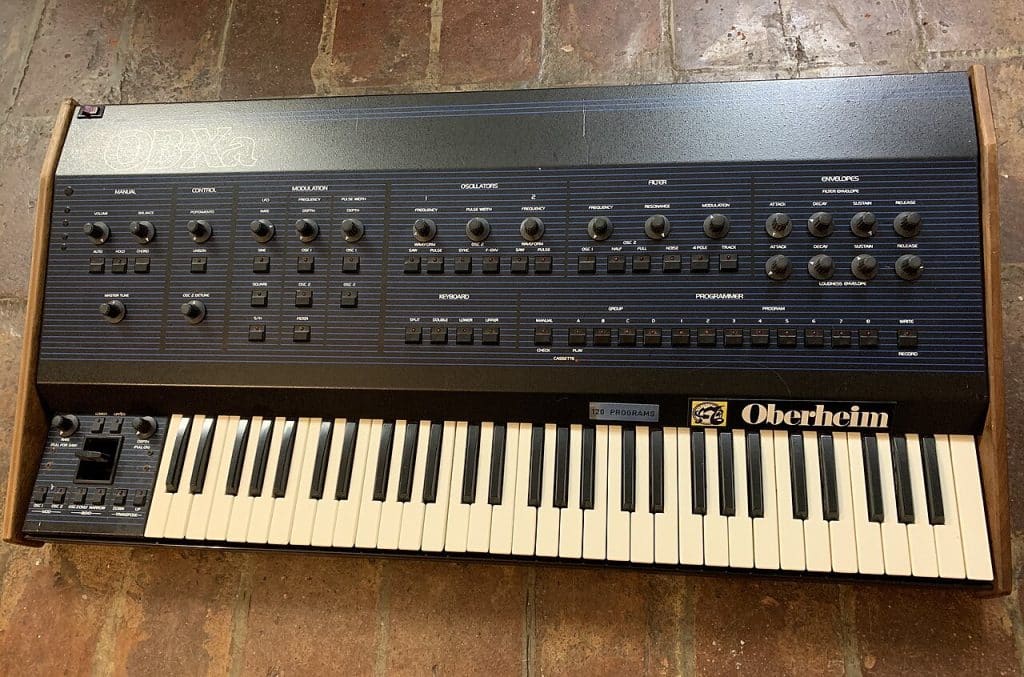
The photo at the top of this page is Oberheim OBX-a Front by Alison Cassidy, Wikimedia Commons, licensed under CC BY-SA 4.0. It shows a unit with the 120 Programs badge.
OB-Xa price and availability
I found no US launch price in an Oberheim document or a dated period source. Sound On Sound’s 1998 retrospective gives a UK launch price of £3,499 for the OB-Xa and dates it 1981 to 1983. One Two Testing printed £3,500 at the end of its November 1982 review of a six-voice unit. Music Technology’s 1990 retrospective recalls about four thousand pounds when new and says a used one should be worth about a tenth of that in 1990. For the OB-8 the January 1984 UK list price was £2,995.
On 10 November 2026, viewed from Berlin, Reverb’s price guide gave an estimated used value of €4,769 to €8,031, based on 11 orders in good to mint condition across all voice versions. Reverb showed 4 listings, asking from €5,893.11 to €13,377.61 plus shipping. Asks are not sales. All 4 listing titles mention MIDI, which the OB-Xa never had from the factory. Reverb’s transaction table lists 7 dated sales from May 2022 to June 2026, and the newest dated sale was €5,500 in June 2026. Two of them, €200 in April 2024 and €1,721.31 in May 2022, sit far below the rest; the table doesn’t say why.
Details that differ between sources
- OB-Xa introduction: December 1980 in the April 1982 owner’s manual, January 1981 in the June 1982 service manual, early 1981 in Sound On Sound. Reverb lists 1981.
- OB-X introduction: June 1978 in the OB-Xa owner’s manual, July 1979 in Sound On Sound.
- Number of LFOs: the owner’s manual specification says 5, the service manual says 3, and Sound On Sound counts 3, one per voice group and one on the performance panel.
- Voice versions: the manuals cover 4, 6 and 8 voices; Sound On Sound mentions a choice of six or eight.
- Power: 180 to 240 V and 50 W in the owner’s manual, 180 to 260 V and 45 W in the service manual.
- Split transposition: the 1982 manuals list transpositions as programmable; Music Technology’s 1990 retrospective calls the split transposition a temporary edit that could not be written to memory.
- Waveform mixing: One Two Testing (1982) and Sound On Sound (2020) describe sawtooth plus pulse on the OB-Xa itself; Sound On Sound (1998) lists mixing sawtooth and pulse among the OB-8 additions. For the OB-8, Electronics & Music Maker says holding both waveform switches selects the triangle.
Frequently asked questions
When did the Oberheim OB-Xa come out?
Oberheim’s April 1982 owner’s manual dates the introduction to December 1980, while the June 1982 service manual says January 1981, the date of the first software version. Sound On Sound wrote early 1981. The OB-8 followed; its owner’s manual is dated November 1982, about two years after the OB-Xa appeared.
How many voices does the OB-Xa have?
The OB-Xa was sold with 4, 6 or 8 voices, each with two oscillators, two filters, two envelopes and a VCA. Unused voice positions are switched off inside. In Split or Double mode the voices divide into two equal halves, so an 8-voice unit plays two 4-voice sounds.
What filter does the OB-Xa use?
Each voice has two low-pass filters built on Curtis CEM3320 chips: a 2-pole filter at 12 dB per octave that follows the sound of the OB-X, and a 4-pole filter at 24 dB per octave. A 4-Pole switch selects one per program. Neither filter self-oscillates, according to Oberheim.
How many programs does the OB-Xa store?
Early units store 32 programs, with 8 locations shared by splits and doubles. Software version B from September 1981 raised this to 120 programs plus 8 split and 8 double programs. The 120 are selected as 15 groups of 8 with the A to D buttons. The factory set holds 104 sound programs.
What is the difference between the OB-X and the OB-Xa?
The OB-Xa added split and double modes, a 4-pole filter next to the 2-pole one, a filter-envelope sweep of Oscillator 2 in place of cross-modulation, three LFOs instead of one, and Curtis chips throughout. The OB-X stored 32 programs; the OB-Xa reached 120 in 1981.
What is the difference between the OB-Xa and the OB-8?
The OB-8 keeps the voice format of 2 VCOs, 2 envelopes and a 12 or 24 dB filter, but comes only as an 8-voice. It adds a second page of hidden parameters, an arpeggiator and a triangle wave, uses a digital LFO, and most units have MIDI. Its UK price in 1984 was 2,995 pounds.
Does the Oberheim OB-Xa have MIDI?
No. The OB-Xa predates MIDI, which appeared in 1983, and links to other Oberheim gear through a 37-pin parallel computer interface. MIDI retrofits became available later, and all 4 OB-Xa listings on Reverb in November 2026 mention MIDI in their titles.
Who used the Oberheim OB-Xa?
Eddie Van Halen said in a Guitar World interview that he moved from a Prophet-10 to an OB-Xa to get the sound of Jump. Music Technology reported in 1990 that Prince bought a couple of OB-Xas to tour with. Later retrospectives name more players without giving a source for each.
What are the modern versions of the OB-Xa?
Oberheim’s own OB-X8 of 2022 combines OB-X, OB-Xa and OB-8 voices with Curtis filters and cost $4,999 at launch. Behringer’s UB-Xa of 2023 is a 16-voice recreation with OB-Xa and OB-8 profiles, launched at $1,199. Arturia’s OB-Xa V is a 2020 software version.
How much is an Oberheim OB-Xa worth?
On 10 November 2026 Reverb estimated the used value at 4,769 to 8,031 euros, based on 11 orders. Its 4 listings asked 5,893.11 to 13,377.61 euros plus shipping. The newest dated sale was 5,500 euros in June 2026. Prices exclude shipping and tax, and asking prices are not sales.
Back to Music Production Terms Index Page