What the Kurzweil K2500 is
The Kurzweil K2500 is a 76-key digital synthesizer workstation with 48-note polyphony, 8 MB of 16-bit sample ROM and Kurzweil’s VAST synthesis engine, released in January 1996 after the K2500R rack version of April 1995. It doubled the polyphony of the K2000 and keeps its operating system in Flash ROM, so updates load from floppy disk.
The K2500X is the 88-key version with a weighted piano action, and the K2500R is the three-space rack. This page covers the specs of all three, what changed from the K2000, the KDFX effects option, sampling and memory, the operating system versions, all seven models, the manuals and dated used prices.
- 48 notes, setups of up to eight zones, 8 MB of ROM expandable to 28 MB, and up to 128 MB of optional sample RAM.
- The K2500 has 76 semi-weighted keys and the K2500X 88 weighted keys. Both add eight sliders and two ribbons. The K2500R has the same outputs and no keys.
- KDFX, released in May 1998, adds five effects processors on a daughterboard. Units with it run version 4 or later.
- Sound On Sound listed the K2500R at £2,999 in October 1995, and the K2500 and K2500X at £3,499 and £3,799 in April 1996.
- On 9 November 2026 Reverb showed no used-price estimate for any K2500 model. Its K2500R table held six sales from €540 to €1,200.
Kurzweil K2500 specs
Most figures come from chapter 13 of Kurzweil’s K2500 Reference Guide. The three models share one engine and one set of rear-panel outputs, so the table only splits where the keyboards and the rack differ.
| Feature | K2500 and K2500X (keyboards) | K2500R (rack) |
|---|---|---|
| Began shipping | January 1996 | April 1995 |
| Keys | K2500: 76, semi-weighted. K2500X: 88, weighted piano action | None |
| Polyphony | 48 notes, dynamic voice allocation | Same |
| Setups | Up to 8 zones on 8 MIDI channels | 3 zones at launch, 8 from version 2.13 |
| Factory memory | 199 programs, 100 setups | Same |
| User memory | 240K battery-backed program RAM, expandable to 1256K | Same |
| Sample ROM | 8 MB, 16-bit; up to 28 MB with option blocks | Same |
| Sample RAM | Optional, up to 128 MB in SIMMs | Same |
| Synthesis | VAST: 31 algorithms, up to 3 programmable DSP functions per voice | Same |
| Filters | Low-pass, high-pass, all-pass, band-pass, notch, with programmable resonance | Same |
| Effects | One stereo multi-effects processor on the Mix outputs; KDFX optional from May 1998 | Same |
| Bandwidth | 20 kHz maximum | Same |
| Audio outputs | Stereo Mix pair plus 8 outputs, as four pairs or eight singles, with insert capability; headphones | Same |
| Digital audio | AES/EBU and optical I/O; Sound On Sound says the AES/EBU output comes with the sampling option and that KDFX alone adds an AES/EBU Mix output | Same |
| MIDI | In, Thru, Out; Thru can be switched to a second Out | Same |
| SCSI | 2 ports | Same |
| Storage | 3.5 inch DD or HD floppy, DOS format; optional internal hard disk | Same |
| Pressure | Sends channel pressure; receives channel and poly pressure | Receives channel and poly pressure |
| Panel controllers | 8 sliders, 2 ribbons, pitch and mod wheels, 2 programmable switches | None |
| Pedal inputs | 4 switch pedals, 2 continuous pedals, breath controller | Not listed in my sources |
| Display | 240 x 64 pixels, backlit | Same |
| Processor | 25 MHz Motorola 68340, per Sound On Sound | Same |
| Size | K2500: 121.4 x 45.1 x 12.2 cm. K2500X: 137.9 x 45.1 x 12.2 cm | 43 x 35.4 x 13 cm, without rack brackets |
| Weight | K2500: 25.2 kg (55.5 lb). K2500X: 32.7 kg (72 lb) | 11.2 kg (24.65 lb) |
| Power | 100, 120, 220 or 240 V selectable; 1.0 A at 120 V | Same |
The Reference Guide lists 8 SIMM sockets, which describes early units. Kurzweil’s SIMM sheet says boards from revision K onward take up to two 72-pin SIMMs instead, with the same 128 MB maximum. Chapter 13 of the guide lists 199 factory programs, while the guide’s own program list in chapter 2, Sound On Sound and Sweetwater count 200.
K2500 vs K2000
The K2500 keeps the K2000’s VAST engine and object structure, so most differences are about capacity, control and how the system is updated. Sound On Sound’s October 1995 review found few operating differences between the K2500R and a K2000 running version 3 software.
| Feature | K2000 | K2500 |
|---|---|---|
| Polyphony | 24 notes | 48 notes |
| Setup zones | 3 | 3 at launch, 8 from version 2 |
| Drum channels | 1 at launch, 8 with version 3 and the P/RAM option | Channels 1 to 7 always, plus an eighth |
| Sample ROM maximum | 24 MB | 28 MB |
| Sample RAM maximum | 64 MB | 128 MB |
| Program RAM | 128K, about 750K with P/RAM | 240K, 1256K with P/RAM |
| Operating system | On chips, updated by a service center | In Flash ROM, updated from floppy |
| Keyboard | 61 keys | 76 keys (K2500) or 88 (K2500X) |
| Keyboard model outputs and SCSI | 6 audio jacks, 1 SCSI port | 10 audio jacks, 2 SCSI ports |
| Largest internal drive | 760 MB (rack, 1993) | 1 GB |
Kurzweil’s product history says programs and samples move between the two series in both directions. Some keymaps and the drum samples changed, so Kurzweil supplied a K2000 compatibility disk at launch, and its download page still offers K25TOK2K, a file that contains all K2000 objects. Its FAQ adds that a K2000 needs version 3.87 to load a program saved on a K2500 with KDFX, and that the KDFX settings are then ignored.
Kurzweil K2500X and K2500R: what each version changes
Sound On Sound’s April 1996 review describes the K2500 and K2500X as essentially identical apart from the keyboard: 76 semi-weighted keys against 88 fully weighted keys. The extra keys add 16.5 cm of width and 7.5 kg of weight. Sweetwater’s winter 1996 newsletter reported that both keyboards were shipping in limited numbers.
The K2500R came first, in April 1995 with version 1.0. Unlike the K2000 pair, the rack and the keyboards have the same Mix pair, eight separate outputs and two SCSI ports. The rack had three-zone setups until version 2.13. Sound On Sound noted in April 1996 that a software update gave rack owners the eight-zone setups and the arpeggiator of the keyboards.
Each form also came with the sampling option fitted: the K2500S, K2500XS and K2500RS. Kurzweil’s top model, the K2500XAES, was a K2500X with every option installed, a CD-ROM drive and library, and two DMTi digital interfaces. It won a TEC award in 1999.
Controllers on the keyboard models
Kurzweil’s product history says the keyboards have master controller features beyond its PC88 controller keyboard. Sound On Sound’s April 1996 review lists them:
- Sliders: eight programmable sliders. They send MIDI controllers, act as volume or pan faders for MIDI channels 1 to 8 or 9 to 16 in Mixdown mode, or send their own controller assignments in MIDI Faders mode. A row of buttons above them mutes or solos setup zones.
- Ribbons: a small ribbon in front of the wheels sends position and pressure separately. A long ribbon behind the keys can be split into three sections, so the two ribbons give five control sources.
- Pedals and breath: inputs for up to four switch pedals, two continuous pedals and a breath controller.
- Other controls: pitch and mod wheels, two programmable switches, channel aftertouch, and, per Sound On Sound’s March 1996 preview, dedicated start, stop and record buttons for the sequencer.
- Arpeggiator: an arpeggiator that each setup zone can use or ignore, with latch on MIDI controller 119.
From version 2, a control setup decides what these controllers do outside Setup mode. Zone 1 of the chosen setup applies to every program. Reverb parts sellers title Fatar TP/10 replacement keys for the K2500X, and my Fatar keybed guide lists the same action. The Kurzweil documents I read don’t name the keybed, so I treat the TP/10 as unconfirmed.
How VAST works on the K2500
VAST, short for Variable Architecture Synthesis Technology, works the same way as on the K2000. A sample is mapped into a keymap, the keymap runs through one of 31 algorithms to become a layer, layers make a program, and programs combine in a setup. Sound On Sound counts 60 DSP functions to place in those algorithms. My K2000 entry covers the algorithm blocks in more detail.
Kurzweil’s own counts look different. The Reference Guide says up to 3 programmable DSP functions per voice, while the Performance Guide says the signal passes through the five DSP functions that make up the algorithm. I read this as the same rule as on the K2000, where the first stage sets pitch and the last sets amplitude, but that reconciliation is my reading.
Polyphony, layers and drum channels
The Performance Guide calls the layer the K2500’s basic unit of polyphony: each layer takes one of the 48 voices per note, and a stereo keymap takes two. Its own example is a two-layer stereo program, which uses 4 voices per note and plays 12 notes. By the same rule, three mono layers play 16 notes, which is my arithmetic. Sound On Sound adds that oscillators generated by the DSP functions don’t use polyphony. Sweetwater’s figure of 192 oscillators matches 48 voices times four oscillators per voice.
A normal program holds up to 3 layers. A program on a drum channel can hold 32, and a drum channel can play any program. Sound On Sound’s October 1995 review says MIDI channels 1 to 7 can always use these 32-layer programs, plus an eighth channel set on the Master page, and credits the 68340 processor for it.
KB3 organ mode
Version 2.52 added KB3 mode, which Kurzweil describes as a physical model of a drawbar tonewheel organ, a form of physical modeling. Its oscillators run all the time, like the tonewheels of a real organ, so Kurzweil’s FAQ says most KB3 programs take about 40 of the 48 voices as soon as they are selected.
Sound set and ROM blocks
Sound On Sound described the 8 MB base ROM as essentially the K2000’s samples, some of them adjusted, with a new set of drum samples and a new program layout. Three option blocks take it to 28 MB: Orchestral, Contemporary and a 4 MB stereo piano. Sound On Sound’s April 1996 price list says the daughter board that carries the piano block is needed to use both of the other blocks. Sweetwater noted in 1996 that the keyboards shipped with a disk of more than 1,000 additional programs.
Effects: the standard processor and KDFX
As shipped, the K2500 has one stereo multi-effects processor. Sound On Sound’s October 1995 review names it the Digitech 256 effects chip and notes that it works globally: audio assigned to the group A outputs gets the effect, and other outputs stay dry.
KDFX, released in May 1998, adds a separate effects system on a daughterboard fitted by a service center. Sound On Sound’s January 1999 review says it came with version 4.04 of the operating system and describes a 24-bit processing layer between the program outputs and the physical outputs. That layer holds five processors in a structure Kurzweil calls a Studio.
- Processing budget: the four insert buses share 4 processing allocation units, or PAUs. Simple algorithms need 1 PAU and complex ones up to 4, so a 2-PAU effect leaves room for only two 1-PAU effects on the other buses. The Aux bus has its own 3 PAUs.
- Library: Sound On Sound counted 108 algorithms and over 250 FX Presets, from reverbs, delays and compressors to rotary speaker, ring modulator and wave shaper effects.
- Control: a program or setup can hold up to 18 FXMods, which link effect parameters to MIDI controllers, LFOs, envelopes or tempo.
- Digital outputs: KDFX adds four digital output pairs on a proprietary KDS connector, and all digital outputs can run at 20 bits. The original Digitech effects still work alongside it.
The second version of KDFX first appeared in version 4.76 beta and officially in 5.0. Its release notes add effects chaining, up to four effects in a row on one bus, plus 26 new algorithms, 93 presets and 20 Studios. K2500 owners also got 3 rotary speaker algorithms, 87 more presets and 29 more Studios that K2600 owners already had. Kurzweil’s vocoder file for the K2500 needs both KDFX and the sampling option; my vocoder entry explains the technique.
Sampling, memory and Live Mode
The K2500 plays samples from RAM without the sampling option. Samples load from disk, through MIDI Sample Dump or over SCSI with SMDI, and the sample editor works on them. The option adds recording, and the S models and the K2500XAES have it fitted from the factory.
- Inputs: low-impedance XLR and high-impedance stereo quarter-inch analog inputs, plus optical and electrical digital inputs.
- Rates: 29.4, 32, 44.1 or 48 kHz. Kurzweil gives a flat response to about 14 and 15 kHz for the two lower rates and to 20 kHz for the two higher ones.
- Transposition: playback tops out at 96 kHz, so a sample made at 48 kHz can be transposed up one octave and a sample made at 29.4 kHz about 21 semitones. There is no limit downward.
- Triggers: the audio input also works as a two-channel drum trigger.
| Sample RAM | 29.4 kHz | 32 kHz | 44.1 kHz | 48 kHz |
|---|---|---|---|---|
| 2 x 1 MB, mono | 35 | 32 | 23 | 21 |
| 2 x 1 MB, stereo | 17 | 16 | 11 | 10 |
| 2 x 4 MB, mono | 140 | 128 | 92 | 84 |
| 2 x 4 MB, stereo | 70 | 64 | 46 | 42 |
| 2 x 16 MB, mono | 560 | 512 | 368 | 336 |
| 2 x 16 MB, stereo | 280 | 256 | 184 | 168 |
Kurzweil’s chart stops at 32 MB. Four times its 368 seconds gives about 24:32 of mono at 44.1 kHz for a full 128 MB, which is my arithmetic. Kurzweil’s 4.21B release notes say 128 MB allows over 25 track minutes at 44.1 kHz, in line with the guide’s figure of about 12 seconds per megabyte. Kurzweil’s SIMM sheet says early units take up to eight 30-pin SIMMs of 1, 4 or 16 MB in adjacent pairs, while units with a revision K or later mother board take up to two 72-pin SIMMs. A Z as the seventh character of the serial number marks the later board, and Kurzweil says SIMMs should be fitted by a service center.
Program RAM starts at 240K and reaches 1256K with the P/RAM option. The Reference Guide lists Akai S1000 disk compatibility, and Sound On Sound’s 1995 preview adds Roland and Ensoniq libraries and AIFF and WAV files.
Version 2.80 added Live Mode, which feeds the sampling inputs straight into VAST, and KDFX on units that have it, as if the signal were a sample. Sound On Sound notes that it needs the sampling option. Kurzweil’s product history credits version 4.32 with RAM tracks, which record samples while a sequence plays and place them in it, while the 5.01 release notes list the feature under version 4.21B. The DMTi, a one-unit rack interface that began shipping in November 1996, converts the K2500’s digital outputs to ADAT, DA-88 and AES/EBU formats. Sound On Sound listed it at £1,073 for the DA-88 and AES/EBU versions and £1,330 for the ADAT version in January 1999.
The sequencer and operating system versions
The onboard sequencer has 32 tracks. Sound On Sound’s 1995 preview says the K2500R reads and writes Standard MIDI Files in Type 0, and Kurzweil’s FAQ says saving Type 1 files needs version 2.52 or later.
| Version | Date | What changed |
|---|---|---|
| 1.0 | April 1995 | Launch version, on the K2500R |
| 2.08 | January 1996 | Shipped with the keyboards; setups grow from 3 to 8 zones |
| 2.13 | No date given | 8-zone setups on the rack |
| 2.31 | No date given | Support for the KDS digital output option and the DMTi, per the 3.02 notes; the product history calls it a bug-fix release |
| 2.52 | No date given | KB3 organ mode |
| 2.80 | No date given | Live Mode; the 3.02 release notes also list ISO 9660 CD support here |
| 2.96 | No date given | ISO 9660 CD-ROM support per the product history; improved ISO 9660 support per the 3.02 notes |
| 2.98 | No date given | Disk partitioning, on units without KDFX |
| 3.02 | No date given | Last version for units without KDFX on Kurzweil’s site; its notes call it not yet officially released |
| 4.0 | May 1998, with KDFX | First version for units with KDFX |
| 4.21B | No date given | RAM tracks, vocoder, keyboard naming, arpeggiator and song sync, per the 5.01 release notes |
| 4.32 | No date given | RAM tracks, per the product history |
| 4.44 | No date given | Disk partitioning, on units with KDFX |
| 4.76 beta | No date given | Second version of KDFX, with effects chaining |
| 5.0 | No date given | Official release of the second KDFX version |
| 5.01 | No date given | Two bug fixes; the last version for units with KDFX on Kurzweil’s site |
Kurzweil’s site keeps two branches. Units without KDFX end at version 3.02, units with KDFX at 5.01. The 5.01 notes describe the update: copy the file to a DOS floppy, press Exit while the K2500 shows its start-up message, and choose Install System in the boot loader. An update from a SCSI disk only works if the disk is 1 GB or smaller. Some updates also need new object files, which Kurzweil offers for the base ROM and for the common ROM-block combinations.
Kurzweil K2500 history and models
Kurzweil released the K2000 in December 1991. Its product history calls the K2500 series the next step in VAST, with the Kurzweil K2500R rack shipping in April 1995 and the keyboards in January 1996. Sound On Sound previewed the rack in September 1995 and reviewed it a month later. It previewed the keyboard in March 1996 and reviewed both keyboards in April.
| Model | Form | What it is | Began shipping |
|---|---|---|---|
| K2500R | Three-space rack | Rack version of the K2500 | April 1995 |
| K2500 | 76 keys | Semi-weighted action | January 1996 |
| K2500X | 88 keys | Weighted piano action | January 1996 |
| K2500RS | Three-space rack | K2500R with the sampling option | No date given |
| K2500S | 76 keys | K2500 with the sampling option | No date given |
| K2500XS | 88 keys | K2500X with the sampling option | No date given |
| K2500XAES | 88 keys | K2500X with every option, a CD-ROM drive, CD-ROM library and two DMTi units, in a metallic silver case with wood-veneer end caps | No date given |
Kurzweil says the K2500R was nominated for a TEC award in 1995, the K2500 keyboard won one in 1996 and the K2500XAES won one in 1999. KDFX followed in May 1998, and the company discontinued the K2500 series in December 2000.
Launch prices in the UK, all including VAT, come from Sound On Sound: £2,999 for the K2500R in October 1995, and £3,499 for the K2500 and £3,799 for the K2500X in April 1996. The same April list prices the sampling option at £675, the P/RAM expansion at £399, and each ROM block, including the daughter board with the piano block, at £175. In the US, Sweetwater’s summer 1995 newsletter gave the K2500R a list price of $4,175, and its late summer issue a retail price of $3,495. Its winter 1996 issue listed the K2500 at $4,960 and the K2500X at $5,820.
Successors
Kurzweil designed the K2600 as the K2500’s replacement. It began shipping in October 1999, with the stereo piano block and KDFX included, redesigned circuit boards, balanced analog outputs, more battery-backed RAM and room for two more ROM blocks, again in seven models. Related entries on this site include the Kurzweil PC1X, the Yamaha A3000 sampler and the Korg N364 workstation.
Kurzweil K2500 demo videos
The first video plays factory presets on a K2500R without effects. The second is part 1 of a K2500 Series training video.
K2500 manuals and documentation
Kurzweil keeps a K2500 support page for what it calls a discontinued model, with an FAQ and free downloads:
- The K2500 Performance Guide, a 7.1 MB download, the 1996 edition of the owner’s manual.
- The K2500 Reference Guide, 3.3 MB, with the specifications, MIDI chart and program lists.
- The KDFX User’s Guide, its version 2 supplement and the KDFX algorithm reference.
- Addenda for KB3 mode, Live Mode and disk partitioning, and the SIMM specification sheet.
- Operating system files: version 3.02 for units without KDFX and version 5.01 for units with it, each with release notes.
Kurzweil’s product history is a short text file with dates, models and version notes for both the K2000 and K2500 series.
K2500 price and availability
The K2500 series ended in 2000, so instruments now sell used. On 9 November 2026, viewed from Berlin, Reverb had no price-guide page for the 76-key K2500, and its K2500R, K2500RS and K2500X pages all showed no used-price estimate. The K2500R table held six sales from €540 to €1,200 between August 2022 and March 2024. The K2500RS table held seven sales from €250 to €1,450 between May 2023 and February 2025.
These rows are thin evidence. The newest K2500R sale is from March 2024, and neither table says whether a unit had KDFX, ROM blocks or sample RAM fitted, which changes what was sold.
The same day, Reverb’s marketplace showed 77 results for the K2500. Going by their titles, only three distinct listings were complete instruments: a K2500X AES with case at €3,200 in France, a K2500R at €1,377.50 in Estonia and a K2500X at €701.02 in the UK. The rest were parts and add-ons, such as replacement keys, display boards and USB floppy emulators, which I haven’t tested. A US Google search showed four shopping entries, none of which I opened, asking $699.99 to $899.99 for a K2500, K2500X, K2500XS and K2500S. Those are asks, not sales, and these numbers age quickly.
Frequently asked questions
When did the Kurzweil K2500 come out?
Kurzweil’s product history says the K2500R rack began shipping in April 1995 and the K2500 and K2500X keyboards in January 1996. Sound On Sound reviewed the rack in October 1995 and both keyboards in April 1996. Kurzweil discontinued the whole K2500 series in December 2000.
What is the difference between the K2500, K2500X and K2500R?
The K2500 has 76 semi-weighted keys and the K2500X 88 weighted keys, with eight sliders and two ribbons on both. The K2500R is a three-space rack with the same engine, outputs and two SCSI ports. Models ending in S add the sampling option.
How is the K2500 different from the K2000?
The K2500 doubles polyphony from 24 to 48 notes and raises the maximums to 28 MB of ROM and 128 MB of sample RAM. Setups grew from 3 to 8 zones, and the operating system sits in Flash ROM, so updates load from floppy instead of new chips.
How much polyphony does the Kurzweil K2500 have?
It plays 48 notes with dynamic voice allocation. Each layer takes one voice per note, or two with a stereo keymap, so a two-layer stereo program plays 12 notes. Most KB3 organ programs take about 40 voices, according to Kurzweil’s FAQ.
What is KDFX on the K2500?
KDFX is an effects daughterboard released in May 1998 and fitted by a service center. It adds five processors, four insert buses and an Aux bus, with 108 algorithms according to Sound On Sound in 1999. Units with KDFX run version 4 or later of the operating system.
How much sample memory can a K2500 hold?
Up to 128 MB of sample RAM, in up to eight 30-pin SIMMs on early units or up to two 72-pin SIMMs on boards from revision K onward. Kurzweil says a service center should fit them, and its chart lists 368 seconds of mono at 44.1 kHz for 32 MB.
Does the K2500 have a built-in sampler?
The K2500S, K2500XS and K2500RS have the sampling option fitted from the factory, and Kurzweil’s product history says the K2500XAES comes with all options installed. Other units with sample RAM fitted play samples loaded from disk, MIDI or SCSI. The option records at 29.4, 32, 44.1 or 48 kHz from analog or digital inputs.
Where can I find the Kurzweil K2500 manual?
Kurzweil’s K2500 support page offers the Performance Guide as a 7.1 MB download and the Reference Guide as a 3.3 MB download. The same page has the KDFX guides, the KB3 and Live Mode addenda, and operating system files up to version 5.01.
How much is a used Kurzweil K2500 worth?
On 9 November 2026, Reverb showed no price estimate for any K2500 model. Its K2500R table held six sales from €540 to €1,200 between 2022 and 2024, excluding shipping and tax. Options such as KDFX and ROM blocks change what a unit is.
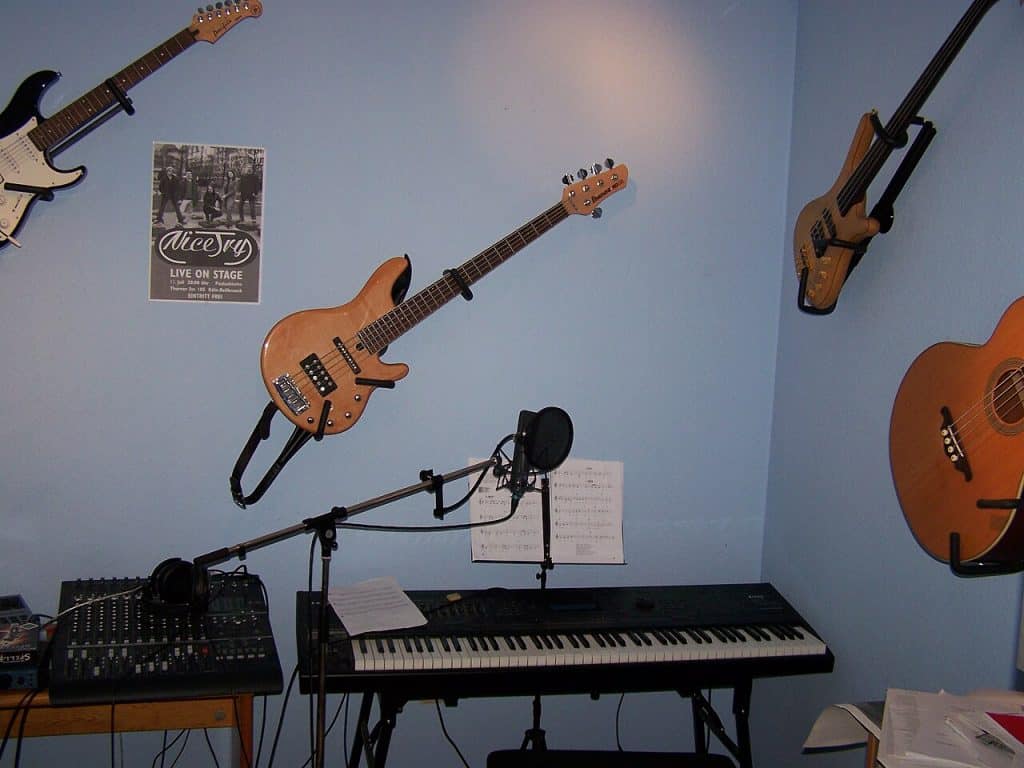
Photo at the top of this page: a K2500X on a stand in a home studio, by Marcus Ilgner, Wikimedia Commons, CC BY 2.0.
Back to Music Production Terms Index Page