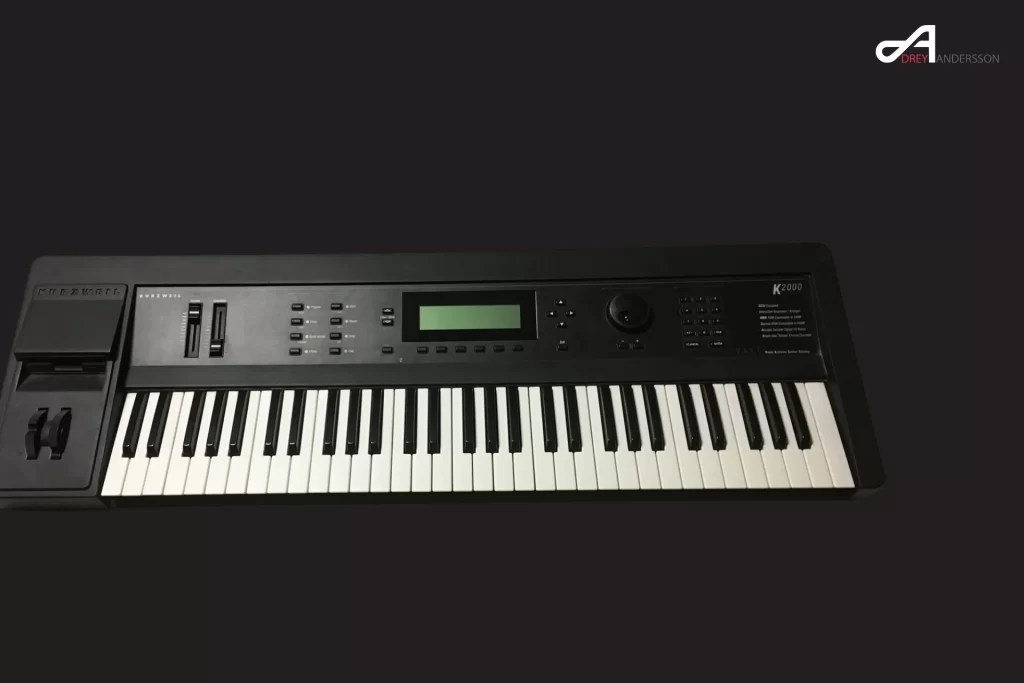
What the Kurzweil K2000 is
The Kurzweil K2000 is a 61-key digital synthesizer with 24-note polyphony and 8 MB of 16-bit sample ROM, released in December 1991 as the first Kurzweil instrument to use Variable Architecture Synthesis Technology, or VAST. Each layer of a sound runs through one of 31 selectable signal paths, so filters, oscillators and nonlinear functions can change from layer to layer.
The K2000R is the rack version, released in October 1992 with the same engine, more outputs and a second SCSI port. Later models added factory sampling, more ROM and a lower price. This page covers the specs of both versions, how VAST and the memory are organized, the operating system versions, all eight models, the manuals and dated used prices.
- 24 notes, 16 parts, 8 MB ROM expandable to 24 MB, and up to 64 MB of optional sample RAM.
- The K2000R has ten audio jacks against six, two SCSI ports against one, and no keys. Music Technology listed both at £2,769 in February 1993.
- VAST offers 31 algorithms of up to five stages. The first stage is pitch and the last sets final amplitude, which leaves up to three stages to assign.
- The sequencer started as a scratchpad. Version 3 made it a 32-track sequencer in August 1994, and the last OS was 3.87 in November 1999.
- Reverb’s estimated used value on 4 November 2026 was €71 to €619 for the keyboard and €345 to €618 for the rack.
Kurzweil K2000 specs
These figures describe the original hardware, mostly from Kurzweil’s January 1993 service manual. Some were later changed by software or options, so the table marks launch and version 3 sequencer figures separately.
| Feature | K2000 (keyboard) | K2000R (rack) |
|---|---|---|
| Released | December 1991 | October 1992 |
| Keyboard | 61 keys, spring-return synth action, with velocity, release velocity and channel pressure | None; receives channel and poly pressure over MIDI |
| Polyphony | 24 notes, dynamic allocation | Same |
| Multitimbrality | 16 parts | Same |
| Factory memory | 199 programs, 100 setups (1993 spec) | Same |
| User memory | 128 KB battery-backed program RAM, about 750 KB with the P/RAM option | Same |
| Sample ROM | 8 MB, 16-bit; up to 24 MB with two 8 MB blocks | Same |
| Sample RAM | Optional, up to 64 MB in four 30-pin SIMM sockets; not battery-backed | Same |
| Synthesis | VAST: 31 algorithms, up to 3 programmable DSP functions per voice | Same |
| Filters | Low-pass, high-pass, all-pass, band-pass, notch, with programmable resonance | Same |
| Effects | One global multi-effects processor, 47 presets, on the Mix outputs | Same |
| D/A and bandwidth | 18-bit converters; 20 kHz maximum bandwidth | Same |
| Audio outputs | 6 jacks: Mix, A, B (4 routable) | 10 jacks: Mix, A, B, C, D (8 routable) |
| MIDI | In, Thru, Out | Same |
| SCSI | 1 port | 2 ports |
| Internal hard disk | Optional, up to 240 MB in 1993 | Optional, up to 760 MB in 1993 |
| Floppy drive | 3.5 inch DD or HD, MS-DOS format | Same |
| Sequencer at launch | 15,000-note scratchpad, 768 ppqn per Music Technology, plays MIDI Type 0 files | Same |
| Sequencer from v3 | Up to 32 tracks, 768 ppq internal | Same |
| Display | 240 x 64 backlit LCD | Same |
| Cooling fan | Optional | Standard |
| Size | 104 x 34.1 x 10.5 cm | 43 x 35.4 x 13 cm, without rack brackets |
| Weight | 11.8 kg (26 lb) | 10 kg (22 lb) |
The keyboard sends mono pressure and receives poly pressure, so polyphonic aftertouch has to come from another controller. Setups transmit on three MIDI channels with separate controller assignments. A Reverb seller lists Fatar TP/9S replacement keys for the K2000 and several other synths, and my Fatar keybed guide lists the same action. The service manual itself only says spring-return synth action, so I treat the TP/9S as unconfirmed.
Why some documents say 48 notes and 128 MB
The Musician’s Guide on Kurzweil’s site is a 1999 edition written around the K2vx. Its introduction says 48-note polyphony, eight SIMM sockets and 128 MB of sample RAM, while its own specification chapter says 24 notes, four sockets and 64 MB. Kurzweil’s FAQ, the 1993 service manual and every period review I read give 24 notes and 64 MB. Sound On Sound gives 48 voices and 128 MB for the later K2500R, so the introduction reads to me like text shared with K2500 documents. That last part is my inference, not something Kurzweil states.
Kurzweil K2000R: what the rack version changes
The K2000R is a three-space module that arrived in October 1992. Both versions then started shipping with version 1.3. Music Technology’s February 1993 review lists the practical differences: four more audio outputs, a second SCSI connector, room for a larger internal drive (760 MB against 240 MB at the time) and a cooling fan fitted as standard, which is an extra on the keyboard. It adds that both versions sold for the same £2,769 in the UK.
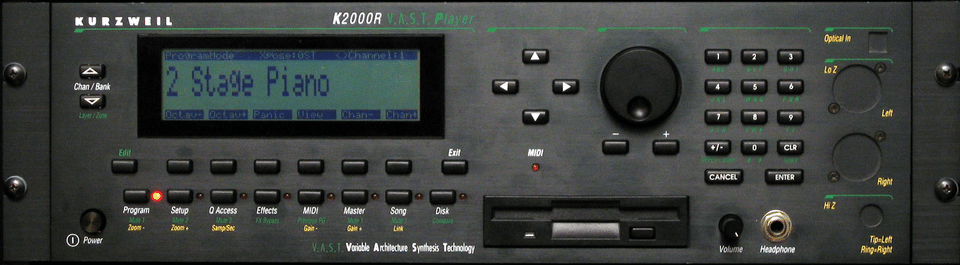
The rack has no keys, so it needs a MIDI controller. The Musician’s Guide describes a quick check without one: hold Cancel on the keypad and press another keypad button to hear notes. The rack also takes its own sampling board, the SMP-R, covered below.
How the outputs behave
Kurzweil’s FAQ explains the routing. The keyboard has six jacks and four routable outputs, the rack ten jacks and eight routable outputs. Every signal comes out of the Mix pair until a cable goes into a separate output, which then takes that signal out of the Mix, much like a normalled patchbay. The effects processor is fed by routing to output A, but its result only appears on the Mix pair. Plugging into the A jacks therefore removes the effects, and Kurzweil describes wiring Mix, B, C and D as the typical setup. On both versions, the separate outputs also work as insert points for external processors.
How VAST works
VAST treats synthesis as a choice of signal path. A sample is mapped into a keymap, and that keymap runs through an algorithm to become a layer. The guide calls each of the 31 algorithms a preset signal path: you can’t rewire one, but you can pick a different algorithm for each layer and assign functions to its stages.
Sources count the stages differently, and I read them as describing the same thing. Music Technology says up to five DSP functions and the service manual says up to three programmable functions per voice. Sound On Sound’s 1992 review says pitch and amp blocks can’t be varied, and the guide says the first block is pitch and the last sets final amplitude. That leaves up to three stages for other functions, though the reconciliation is my reading. Algorithm 1 shows it simply, with pitch, one assignable block and amp. Its middle block can be a high-frequency stimulator, parametric EQ, steep resonant bass filter, 4-pole low-pass, 4-pole high-pass, twin-peaks band-pass or double notch. Some algorithms split the signal into two paths.
- Filters and EQ: Sound On Sound counts 17 filter types, plus parametric, bass and treble EQ. Filters can be run as plain subtractive synthesis on a sample.
- Oscillators: sine, sawtooth and square waves generated by the engine rather than sampled. They can replace the sample, add to it for additive tones, or feed ring modulation in split algorithms.
- Nonlinear functions: high-frequency stimulator, distortion, clipping low-pass, pulse-width modulation, three kinds of shaper and a function called Wrap.
Music Technology reported how Kurzweil framed this: a filter gives subtractive synthesis, an added waveform gives additive, and a sampled attack with a synthesized tail gives something like LA synthesis, the method behind Roland’s D-50.
Control sources
Each algorithm block has its own edit page with its own modulation inputs. That reads to me as per-block routing and not one central modulation matrix. Music Technology lists MIDI controllers, three programmable envelopes, two LFOs, two ASRs (simple envelopes), a square wave synced to MIDI clock and four Functions. A Function, or FUN, takes two control sources and combines them through one of 50 equations. Sound On Sound’s 1992 review counts 14 LFO shapes, and the later guide’s table lists 26 entries, made of 13 shapes in plain and positive forms. Parameters read in real units, such as cutoff in hertz and times in seconds.
Polyphony and layers
Kurzweil’s FAQ says each layer uses one voice per note, or two with a stereo sample. A program can hold three layers, so three layers of mono samples play 8 notes out of the 24. Drum programs are the exception, with up to 32 layers. At launch one MIDI channel could be a drum channel. Version 3 allows eight, provided the P/RAM option is installed, and the layers don’t have to be drums.
Waveforms generated by a DSP function don’t use polyphony. The FAQ counts up to four oscillators per layer, which is where the 96 oscillators in advertisements come from: 4 x 24.
Base ROM and expansion blocks
The base ROM mixes multisampled instruments with raw material for synthesis. Over a third of the 175 keymaps in the 1993 list are single-cycle waveforms, and another group holds attack transients.
Two 8 MB blocks take the ROM to 24 MB. The Orchestral block adds winds, brass and strings, and the Contemporary block adds ethnic percussion, electronic and processed drums, electric guitars and synthesizer waveforms, among others. Music Technology lists a separate board, the RMB-K, for installing extra sample ROM. Sound On Sound’s 1998 review also lists a 4 MB Stereo Grand Piano block. The K2vx and K2000VP base ROM has newly recorded drums, and Kurzweil supplies conversion files for moving material between models because some keymaps changed.
Effects
The effects section is a single global processor licensed from DigiTech, the same engine as its DSP 256XL according to Music Technology. It has 47 preset effects and room for up to 80 of your own, and each program or setup can call its own effect. Music Technology’s 1993 box describes 27 configurations of up to three effects plus a mixer, and its 1992 review notes that not every combination exists. Sound On Sound’s 1992 list of 26 effect algorithms includes EQ, chorus and delay, and chorus, delay and room reverb. Its 1998 review says up to four effects in series.
Sampling and memory
The K2000 was a sample player from the start: samples load into optional RAM from floppy, SCSI or MIDI Sample Dump. The sampling option added recording in 1993. It comes as the SMP-K for the keyboard and the SMP-R for the rack, and it was sold with version 2 software. The K2000S, K2000RS and K2vxS have it fitted from the factory.
- Inputs: a stereo quarter-inch analog jack, an XLR digital input switchable between AES/EBU and S/PDIF, and an optical input. The SMP-R adds a pair of XLR analog inputs on the front panel.
- Rates: 29.4, 32, 44.1 or 48 kHz from analog sources. Digital sources set their own rate.
- Digital output: normally copies the stereo mix. While sampling, it carries the analog input instead, so the unit can act as an A/D converter.
- Editing: Music Technology’s box has 23 entries, among them Reverse, Crossfade Loop, Pitch Shift and Time Warp, which is the K2000’s offline form of time stretching. Sound On Sound notes that the K2000 has no release loops.
- ROM samples: these can be trimmed non-destructively but can’t be dumped, moved to RAM or processed with the DSP functions.
| Sample RAM | Mono, 44.1 kHz | Stereo, 44.1 kHz | Mono, 48 kHz | Stereo, 48 kHz |
|---|---|---|---|---|
| 512 KB | 0:05 | 0:02 | 0:05 | 0:02 |
| 2 MB | 0:23 | 0:11 | 0:21 | 0:10 |
| 8 MB | 1:28 | 0:44 | 1:20 | 0:40 |
| 16 MB | 3:04 | 1:28 | 2:48 | 1:20 |
| 32 MB | 6:08 | 2:56 | 5:36 | 2:40 |
Kurzweil’s table stops at 32 MB. Doubling its 6:08 gives about 12:16 of mono at 44.1 kHz for a full 64 MB, which is my arithmetic and not a printed figure. SIMMs must be 30-pin, non-composite, 8-bit and 120 ns or faster, in sizes of 1, 4 or 16 MB, fitted in matched pairs by a service center.
Sample RAM is empty at every power-on. Programs, setups and songs stay in battery-backed program RAM, which runs from three AA batteries and which Kurzweil says lasts up to two years on fresh alkalines. That split is why SCSI mattered on this machine: Music Technology pointed out that the sample memory needed a fast way to load.
Other samplers’ libraries load directly. Launch units already read Akai S1000 disks, without keymaps. Version 2 reads Akai S900, S950 and S1000 disks, Ensoniq EPS and EPS-16 Plus disks, and Roland S750 and S770 SCSI disks. Version 3 adds Akai S3000 SCSI disks and AIFF and WAVE files, along with drives of up to 2 GB.
The sequencer and operating system versions
Sound On Sound called the original Song mode a scratchpad. It held 15,000 notes on a single multichannel track with overdub, and it played MIDI Type 0 files. Version 3 replaced that with linear, pattern and step recording, 16 pattern tracks plus 16 linear tracks for 32 in total, input and groove quantize, an event list, and on-screen volume and pan controls. Timing is 768 ppq internally, shown as 480 ppq. The supplement says the free-memory readout in Song mode peaks at 186K with P/RAM and 30K without it.
| Version | Date | What changed |
|---|---|---|
| 1.0 | December 1991 | Launch version, with a scratchpad sequencer |
| 1.3 | October 1992 | 200 new ROM programs, 100 new setups and 15 new Quick Access banks; loads Akai S1000 and Ensoniq EPS16 Plus samples and keymaps; SMDI over SCSI |
| 2.07 or 2.08J | With the sampling option, reviewed mid-1993 | Sampling page, graphic sample editor, offline DSP, reads Akai, Ensoniq and Roland disks |
| 3.01 | August 1994 | Full sequencer, Mix page, object-level disk operations |
| 3.18 | February 1995 | Smaller enhancements |
| 3.54 | April 1997 | More enhancements, including wider SCSI compatibility |
| 3.87 | November 1999 | Final version, adds ISO 9660 CD-ROM support and other enhancements |
The K2000 keeps its operating system on chips, so an update means swapping them. Kurzweil’s FAQ says K2000 and K2vx owners must buy an update and have it installed by a service center, and Sound On Sound quoted provisional UK upgrade prices of up to £499 for version 3. On 4 November 2026, third-party sellers on Reverb listed 3.87 chip sets at €38.77 to €72.11. They also listed USB floppy emulator kits, which I haven’t tested.
Kurzweil K2000 history and models
Kurzweil’s first instrument, the K250, ran from 1984 to 1989, and the 1000 and 1200 series followed from 1987. Music Technology reported in 1993 that the company had failed in 1990, that the name survived as a product line of Young Chang, and that the design team was still in Waltham, Massachusetts. The same review calls the K2000 the first Kurzweil with resonant filters and effects. The October 1992 rack and the sampling option followed the keyboard, and the Orchestral block was reviewed by June 1994. The K2000VP and K2000VPR replaced the K2000, K2000S, K2000R and K2000RS.
| Model | Form | What it is | Began shipping |
|---|---|---|---|
| K2000 | 61 keys | Base model | December 1991 |
| K2000R | Three-space rack | Rack version of the K2000 | October 1992 |
| K2000S | 61 keys | K2000 with the sampling option and 2 MB sample RAM | No date given |
| K2000RS | Three-space rack | Rack version of the K2000S | No date given |
| K2vx | 61 keys | Both ROM blocks and P/RAM installed, 600 preset programs, new panel graphic | March 1996 |
| K2vxS | 61 keys | K2vx with the sampling option and 2 MB sample RAM | No date given |
| K2000VP | 61 keys | K2000 with v3.54 and 2 MB sample RAM, sampling option not included | 1997 |
| K2000VPR | Rack | Rack version of the K2000VP | 1997 |
Sound On Sound’s Craig Anderton traced the design’s parts to earlier instruments: onboard effects to Ensoniq, modulation to the Oberheim Xpander, sampled transients to Roland’s LA synthesis, and expansion to Peavey.
Prices moved a lot over the decade. Music Technology listed £2,699.99 in July 1992 and £2,769 in February 1993, with the sampling upgrade at £893.99. A 1997 Sweetwater newsletter gives the K2000’s US list price as $2,995 and the K2000VP’s as $1,995. Sound On Sound’s September 1998 review lists the K2000VP at £1,617, and the sampling option at £577.
Kurzweil says the K2000RS won a TEC award from Mix magazine. The company discontinued the K2000 line in the summer of 2000.
Successors
The K2500 followed in April 1995 as a rack, then as a keyboard in January 1996. Sound On Sound’s preview gives it 48 voices, 60 DSP functions in 31 algorithms, a 25 MHz Motorola 68340 CPU, up to 128 MB of sample RAM and an operating system updated from floppy. K2000 programs carry over with a compatibility disk. Kurzweil designed the K2600 as the K2500’s replacement. In 2025, MusicRadar reported the K2061 and K2088 as available to order and described them as a modern update of the K2000. Kurzweil’s K2061 page says VAST was born in the K2000 series and lists 256 voices. Related entries on this site include the Kurzweil PC1X and two 1990s samplers, the Yamaha A3000 and the Akai MPC3000.
Who used it
A few uses are documented in detail. Sound On Sound’s 1994 report on Pink Floyd’s tour says Jon Carin’s rig used two K2000 racks and keyboards with 64 MB each to carry samples, and that Rick Wright played a K2000 keyboard and another Kurzweil rack. Jimmy Tamborello told Song Exploder that almost everything on The Postal Service’s album came from one K2000. Music Technology says its own review unit had been sold to New Order. Vintage Synth Explorer also lists Robert Miles, Jean Michel Jarre, Depeche Mode, Tori Amos, Stevie Wonder, Nine Inch Nails, Massive Attack, Vangelis and Tangerine Dream, which I haven’t checked one by one.
Kurzweil K2000 demo videos
The first video runs through presets on an upgraded keyboard. The second covers VAST programming on the K series.
K2000 manuals and documentation
Kurzweil keeps a K2000 support page for what it calls a discontinued model, with an FAQ and downloads. Four documents cover most questions:
- The K2000 Series Musician’s Guide, 530 pages, a 1999 edition worded around the K2vx. See the note above about its introduction.
- The K2000 Musician’s Guide Supplement, 234 pages, Ninth Edition, November 2000, which covers sampling, versions 2 and 3 and the ROM blocks. I read a ManualsLib copy. The file Kurzweil labels V3 Supplement holds chapters 20 to 32 and the appendices of the manual instead, according to its own README.
- The K2vx Reference Guide, with that model’s program and setup lists.
- The K2000/K2000R service manual, 133 pages, on ManualsLib, with specs, diagnostics, parts lists and schematics.
Kurzweil’s product history is a short text file that lists dates and model differences.
K2000 price and availability
The K2000 line ended in 2000, so instruments now sell used. On 4 November 2026, Reverb’s price guide, viewed from Berlin, estimated €71 to €619 for the K2000 from 17 orders and €345 to €618 for the K2000R from 18 orders, in good to like-new condition. Neither page had a live listing that day. The newest rack sale was €550 on 10 August 2026.
Three keyboard sales at €19 to €30 sit far below the others and below the band’s €71 floor. Reverb marks all three as excellent, but the table doesn’t say what was sold, so I can’t say they were complete instruments. Reverb doesn’t explain how it sets the band, and the table shows only seven of the 17 orders. Options also change what a unit is: the rows don’t separate sampling boards, ROM blocks or OS versions.
The Google Shopping blocks in a US search on the same day showed 12 entries, none of which I opened. Eight asked $560.45 to $999 across K2000, K2000S, rackmount K2000 and K2000RS titles, and four other Reverb entries asked $10 to $250. Reverb’s marketplace showed a K2000S V3 at €931.28 and an €830 listing titled K2000 v2 Orchestral Rom, which may be a complete instrument. The rest of its 44 results were parts, chips or add-ons. Those are asks, not sales, and these numbers age quickly.
Frequently asked questions
When did the Kurzweil K2000 come out?
Kurzweil’s product history says the K2000 was released in December 1991 and the K2000R rack in October 1992. Sound On Sound reviewed the keyboard in March 1992. Kurzweil discontinued the whole K2000 product line in the summer of 2000.
What is the difference between the K2000 and the K2000R?
The K2000R is a three-space rack module with no keys. It has ten audio jacks instead of six, two SCSI ports instead of one, and a cooling fan as standard. Music Technology listed both at the same £2,769 UK price in February 1993.
How much polyphony does the Kurzweil K2000 have?
It plays 24 notes with dynamic voice allocation across 16 parts. Each active layer takes one voice per note, or two with a stereo sample, so a program with three mono layers plays 8 notes. The 48-note line in Kurzweil’s online Musician’s Guide conflicts with that guide’s own specification chapter.
What does VAST stand for?
VAST stands for Variable Architecture Synthesis Technology. Each layer of a program uses one of 31 algorithms, which are signal paths of up to five stages. The first stage is pitch and the last sets final amplitude, so up to 3 stages take filters, oscillators, EQ or nonlinear functions.
Does the K2000 have a built-in sampler?
Not as standard. The K2000S, K2000RS and K2vxS include the sampling option and 2 MB of sample RAM from the factory. Other K2000 models can add an SMP-K or SMP-R board, which records at 29.4, 32, 44.1 or 48 kHz.
How much sample memory can a K2000 hold?
It holds up to 64 MB of sample RAM in four 30-pin SIMM sockets, fitted in pairs. That memory is not battery-backed, so samples reload from floppy or SCSI after power-off. Kurzweil lists about 6:08 of mono at 44.1 kHz for 32 MB.
Can the K2000 read Akai or Roland sample disks?
Yes. Version 2 software reads Akai S900, S950 and S1000 disks, Ensoniq EPS and EPS-16 Plus disks, and Roland S750 and S770 SCSI disks. Version 3 adds support for Akai S3000 SCSI disks, plus AIFF and WAVE files.
Where can I find the Kurzweil K2000 manual?
Kurzweil’s K2000 support page offers the Musician’s Guide as a 2 MB download, along with the K2vx Reference Guide. The 234-page Musician’s Guide Supplement and the 133-page service manual, which covers both keyboard and rack, can be read on ManualsLib.
How much is a used Kurzweil K2000 worth?
On 4 November 2026, Reverb’s price guide, viewed from Berlin, estimated €71 to €619 for the keyboard from 17 orders and €345 to €618 for the K2000R from 18 orders. Those figures exclude shipping and tax, and they change often.
Photo at the top of this page: Matt Perry, Wikimedia Commons, CC BY 2.5.
Back to Music Production Terms Index Page