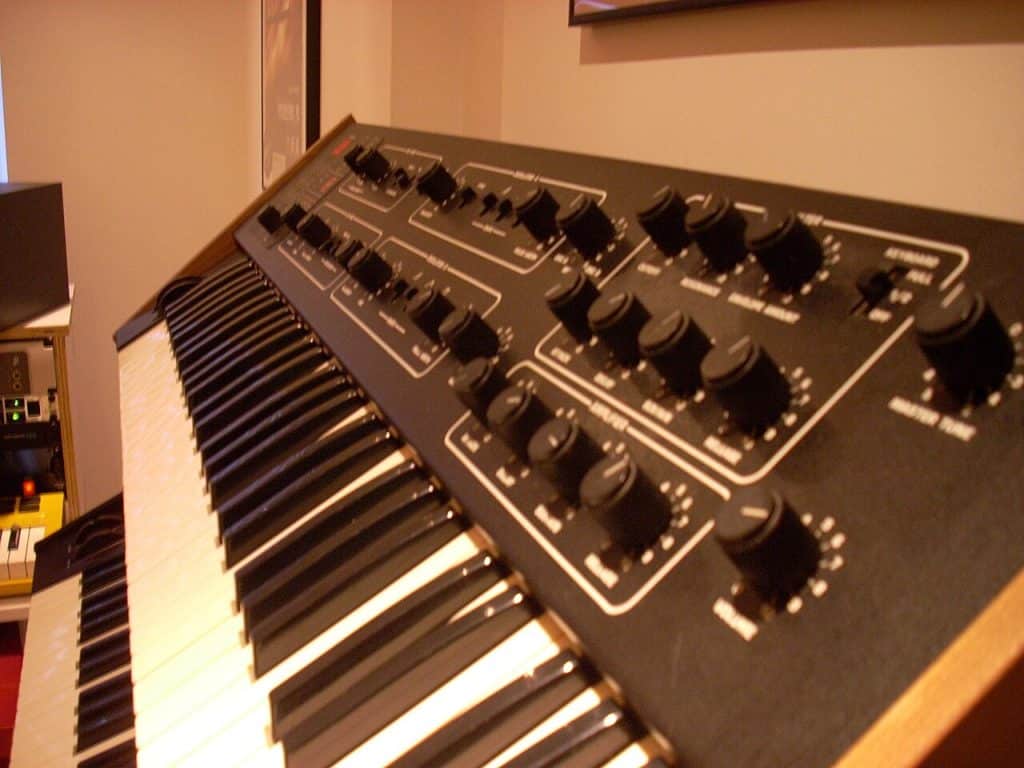
What the Sequential Circuits Prophet-600 is
The Sequential Circuits Prophet-600 is a six-voice programmable analog polyphonic synthesizer that Sequential Circuits began selling in December 1982, with two oscillators per voice, 100 program memories and a MIDI interface. Sound On Sound called it the first commercially available instrument with MIDI sockets. Searches spell it Sequential Circuits Prophet 600, Prophet-600 and prophet600, and Sequential’s own manual also calls it the Model 600.
This entry lists the specs from Sequential’s 1982 and 1983 manuals and the period reviews, explains how a Z80 processor runs an analog voice, and sets out what was first about its MIDI and when. It also covers the open-source GliGli replacement firmware and Imogen’s v2022 continuation, Behringer’s Pro-800 recreation, the musicians on record, period prices and dated used prices.
- 6 voices with 2 CEM3340 oscillators each, one CEM3372 filter-and-VCA chip per voice, 100 programs, a 2-bank sequencer and an arpeggiator.
- Released in December 1982 with MIDI In and Out, about eight months before the MIDI 1.0 specification of 5 August 1983.
- Its first MIDI was Omni mode only, sending on channel 1; later units reached modes 1 and 3 and 16 channels.
- A Prophet-600 and a Roland Jupiter-6 formed the first public MIDI link between two brands, at Winter NAMM in January 1983.
- The GliGli firmware (GPL v3 source, first released in 2013) swaps the Z80 for a Teensy++ board; Imogen maintains its v2022 line.
- Reverb’s used estimate on 12 November 2026: €1,188 to €1,464.
Prophet-600 specs
The table follows Sequential’s Operation Manual CM600A of December 1982 and Technical Manual TM600A of July 1983, both by Stanley Jungleib. Where those manuals leave a figure out, the period reviews fill it in, and the caption says which one.
| Feature | Sequential Circuits Prophet-600 |
|---|---|
| Maker | Sequential Circuits, Inc. (SCI) |
| On sale | From December 1982; discontinued in 1985 according to Music Technology (1990) |
| Type | Programmable analog polyphonic synthesizer under Z80A microprocessor control |
| Voices | 6, each with 2 VCOs (12 oscillators in total) |
| Oscillators | CEM3340; sawtooth, triangle and pulse, switchable in any combination; 4 octaves in semitone steps; fine tune on Osc B; hard sync of Osc A to Osc B |
| Filter and VCA | One CEM3372 per voice holds the mixer, a 24 dB per octave low-pass filter and the VCA; keyboard tracking off, half or full; the filter self-oscillates at high resonance |
| Envelopes | Two ADSR envelopes per voice (filter and amplifier), calculated by the Z80 rather than built from analog parts; attack, decay and release up to about 9 seconds |
| LFO | One, triangle or square, to oscillator frequency, pulse width or filter cutoff; no sawtooth |
| Poly-Mod | Filter envelope and Osc B as modulation sources for Osc A pitch and the filter cutoff |
| Noise source | None |
| Memory | 100 programs, kept by a battery with a 10-year life; cassette interface for programs and sequences |
| Sequencer | Real-time polyphonic, two banks (SEQ 1 and SEQ 2) sharing about 400 notes |
| Arpeggiator | Up/Down or Assign; can follow an external clock through the footswitch jack |
| Unison | Three modes: Normal (all 12 oscillators on one note), Chord Track and Single Voice |
| Glide | Polyphonic |
| Keyboard | 5 octaves, C to C (61 keys); no velocity, no aftertouch, no split |
| Wheels | Pitch (up to a major third, 4 semitones, either way) and modulation |
| MIDI | In and Out on 5-pin DIN; at launch Omni mode only, sending on channel 1; program change, wheel data and a SysEx program dump |
| Other connections | Mono audio out (wired to drive both sides of stereo headphones), footswitch or trigger in, filter CV in, cassette in and out; no CV or gate jacks |
| Size | 37.5 x 12 x 4 in (95 x 30 x 10 cm), per E&MM |
How the Prophet-600 works
Each of the six voices has two oscillators, OSC A and OSC B, built on the Curtis CEM3340 chip. Both offer sawtooth, triangle and pulse waves, which can be switched in together or one at a time, and the pulse width of each is set by a knob and can be swept by the LFO as pulse-width modulation. A sync switch locks OSC A to OSC B. The two oscillators meet in a mixer and then a 24 dB per octave low-pass filter. On the Prophet-600 the mixer, the filter and the VCA share one Curtis CEM3372 chip per voice, a part that Electronics & Music Maker described as new in its 1983 review.
The control side is where the design departs from the Prophet-5. The Operation Manual says the analog envelope generators and the LFO were replaced entirely by computer functions. A Z80A processor running at 4 MHz calculates both ADSR envelopes for every voice and the LFO, then writes the results through sample and hold circuits as control voltages. Gordon Reid explained the cycle in Music Technology in 1990: every 200th of a second the Z80 works out the envelopes, the LFO and the glide, updates the LEDs, reads one wheel and checks one, and only one, panel knob. He noted that small knob movements step from value to value as a result.
Poly-Mod takes two sources inside each voice, the filter envelope and OSC B, and sends them to OSC A pitch, the filter cutoff or both. With sync switched on, Poly-Mod sweeps of OSC A give the rich timbre changes the E&MM review describes. The single LFO offers triangle and square only and reaches oscillator frequency, pulse width or filter cutoff, with a programmable initial amount on top of the mod wheel. There is no noise source. The whole voice is a subtractive analog path, and the manual notes that the Prophet synthesizers are often called digital-analog hybrids.
Programs, sequencer and arpeggiator
The 100 programs are chosen on a membrane keypad with a two-digit LED display. All knob and switch settings except the wheels are stored, and a battery with a 10-year life keeps them with the power off. A cassette interface saves all 100 programs at once, a group of 10, or both sequences. The real-time polyphonic sequencer records what is played into two banks, SEQ 1 and SEQ 2, which share a limit of about 400 notes, so a long second sequence takes notes from the first. The arpeggiator plays held notes Up/Down or in the order played (Assign), and with the Speed knob fully down it follows a clock fed into the footswitch jack.
Unison, glide and the keyboard
The manual lists three unison modes. Normal Unison puts all 12 oscillators on the lowest key held, Chord Track latches a held chord and moves it as a block from single keys, and Single Voice Unison uses one voice per note. Glide is polyphonic, and because the six voices take new notes in rotation, the manual warns that the glide path is hard to predict. The 61-key keyboard has no velocity and no aftertouch, and Music Technology noted there is no split. Electronics & Music Maker also missed an A-440 tuning reference.
Prophet-600 MIDI: what was first, and when
The Prophet-600 is often called the first synthesizer with MIDI, and the sources support a narrower version of that. Sequential’s own Operation Manual, issued in December 1982, opens its MIDI section with the claim that the instrument is “the first commercial synthesizer available with the Musical Instrument Digital Interface (MIDI)”. Electronics & Music Maker reported the claim as the company’s in April 1983: “SCI say that this is the first commercial synthesiser with MIDI.” Martin Russ wrote in Sound On Sound in 1992 that the first commercially available instrument with MIDI sockets was the Prophet-600, released in December 1982. Simon Trask’s 1990 Music Technology interview with Dave Smith opens with the same date.
Other period writers drew the line more loosely. One Two Testing’s 1984 timeline lists the Roland JP6, the SCI Prophet-600 and the Yamaha DX series together among the first instruments made with a MIDI interface. Dave Crombie wrote in Music Technology in 1988 that Sequential, along with Roland, was one of the first companies to build MIDI instruments, while One Two Testing’s 1985 company report named the Prophet-600 the first on the market. So the precise statement is this: the Prophet-600 was the first instrument on sale with MIDI, and it shipped before MIDI 1.0 was agreed.
| Date | Event | Source |
|---|---|---|
| Autumn 1981 | Dave Smith and Chet Wood of SCI present the Universal Synthesizer Interface (USI) at the Audio Engineering Society convention | Sound On Sound 1992; Electronic Soundmaker 1983 |
| January 1982 | Manufacturers meet at the NAMM convention in Anaheim, California | Sound On Sound 1992 |
| October 1982 | Bob Moog announces MIDI in his column in Keyboard magazine | Sound On Sound 1992 (the MIDI Association also says November) |
| December 1982 | The Prophet-600 is released with MIDI sockets; its Operation Manual is issued | Sound On Sound 1992; Music Technology 1990; Operation Manual |
| January 1983 | SCI publishes The Complete SCI MIDI | Sound On Sound 1992 |
| 21 to 23 January 1983 | Winter NAMM, Anaheim: a Prophet-600 is connected to a Roland Jupiter-6 | The MIDI Association; Sequential |
| June 1983 | NAMM: a Yamaha DX7 and a Prophet-600 are connected, with problems from different readings of the draft | Sound On Sound 1992 |
| 5 August 1983 | SCI, Roland, Yamaha, Korg and Kawai agree MIDI Specification 1.0 in Japan | Sound On Sound 1992 |
The first public link between two makers followed a month after the release. At Winter NAMM in Anaheim, 21 to 23 January 1983, a Prophet-600 was connected to a Roland Jupiter-6, according to both the MIDI Association and Sequential. In the MIDI Association’s account, Sequential sound designer John Bowen recalled that the team had tested the Prophet-600 against another Prophet-600 but had no idea whether it would work with the Jupiter-6. The MIDI Association itself calls the idea that this one demonstration made MIDI an overnight success far from what happened.
What the 1982 MIDI could do
The first Prophet-600 MIDI predates the 1.0 specification of 5 August 1983, and it shows. The manual says the instrument powers up in Omni mode and transmits keyboard and control data on channel 1, with no Poly or Mono mode. Program changes cover 00 to 99, the pitch and mod wheels can be linked between two units, and a System Exclusive program dump carries 16 bytes of program data under SCI’s manufacturer ID 01. Incoming MIDI is not echoed to MIDI Out. Sound On Sound adds that SCI used the pitch-bend message but also designated controller 0 as pitch bend, and put the mod wheel on controller 1.
Later units went further. Music Technology wrote in 1990 that by the time the Prophet-600 was discontinued in 1985 it offered modes 1 and 3, 16 channels, program, dump and mod wheel data. Updates were possible, it added, for early units with serial numbers below 424. When a DX7 and a Prophet-600 were finally connected at the June 1983 NAMM show, Sound On Sound reports problems caused by different readings of the proposed specification. Sequential’s older Prophet-5 and Prophet-10 got MIDI only later, through the Model 841 retrofit kit named in a 1984 Sequential advertising feature.
History of the Prophet-600
When the Prophet-600 appeared, Sequential’s synthesizer line was the Prophet-5 of 1978, the 10-voice, two-manual Prophet 10 and the monophonic Pro-One. Mike Beecher’s review in Electronics & Music Maker introduced the newcomer as the low-cost alternative to the Prophet-5, and Sequential’s own manual says it sounds basically like a Prophet-5 at less than half its price. One Two Testing saw it working at the Frankfurt trade fair in its December 1982 issue and expected a UK price of around £1,500. In the US, E&MM’s America column put the suggested list price at $1,995 in April 1983. The review unit E&MM tested in April 1983 had been shipped from Holland, and the manual gives Sequential addresses in both California and Mijdrecht in the Netherlands.
The number 600 had been used before. Sequential’s own 50-year history, which dates the company’s founding to 1974, says the Model 600, Dave Smith’s first music product, was a 16-step analog sequencer. The synthesizer’s manuals also carry the name Model 600.
Gordon Reid’s 1990 retrospective dates the launch to 1982 and the end of production to 1985. He gives the original recommended UK price as £1,650 with a street price of £1,395 and puts it in direct competition with the Yamaha DX7 at that figure. The Prophet-600, he adds, had been out of production for some time when Sequential folded in autumn 1987. By 1990, he wrote, used units had risen from about £250 to about £400.
| When | UK price | Source |
|---|---|---|
| December 1982 | About £1,500 (expected) | One Two Testing |
| April 1983 | £1,625 including VAT | Electronics & Music Maker |
| December 1983 | £1,395 to £1,595 (shop price) | Electronic Soundmaker & Computer Music |
| May 1984 | £1,495 | E&MM MIDI Product Guide |
| 1990, looking back | £1,650 recommended, £1,395 street | Music Technology |
Musicians who used the Prophet-600
Only uses reported in dated magazine articles from the 1980s are listed here. Electronics & Music Maker introduced Roger O’Donnell, then a keyboard player with the Thompson Twins, in March 1984 as having used the Prophet-600 as his only live keyboard for the past year. That interview ran inside a Sequential advertising feature, so it is the musician’s account printed by the maker. E&MM’s report of the 9 July 1983 concert at Selhurst Park describes the Thompson Twins’ support set on a stage stocked with Prophet 600s, an OB-Xa and Simmons drums. The Oberheim OB-Xa entry covers that instrument.
Level 42 used it in the studio. Keyboard player Mike Lindup told E&MM in July 1985 that pairing a DX7 and a Prophet-600 over MIDI had worked well on the band’s new recordings. Recording engineer Nick Froome listed a Prophet 600 among the instruments MIDI’d together on the Lessons In Love session, produced by Wally Badarou, in International Musician in July 1986. In December 1984 Tangerine Dream named a Prophet 600 alongside a Jupiter 8, a PPG, a DX7 and a Prophet 5 in their current setup.
GliGli firmware and Imogen’s v2022
One modification has its own project pages, source code and user manual: an open-source replacement for the processor and its software. Around 2013 the developer GliGli reverse-engineered the original Z80 firmware and wrote a new one for a Teensy++ 2.0 board, a small Atmel-based microcontroller board that fits the 40-pin Z80 socket after slight modification. GliGli’s project page calls it a CPU and firmware remake for the Prophet-600 and dates the first public version to 26 February 2013. The source code is licensed under the GNU General Public License 3.0, while GliGli’s compiled binaries are free for non-commercial use only. Imogen’s user manual adds that some Prophet-600s have the Z80 soldered to the board, and those need a socket fitted first.
The user manual compares the two processors: the Z80 runs at 4 MHz and the Teensy’s Atmel chip at 16 MHz. Patches no longer rely on a battery, and patches made on the original Z80 firmware still load. Its feature list includes faster envelopes in slow and fast ranges with linear and exponential shapes, velocity control of amplitude and filter from an external MIDI keyboard, MIDI CC for every sound parameter, and 100 patch slots.
| Version | Date | Maintainer | What it brought |
|---|---|---|---|
| Alpha | 26 February 2013 | GliGli | First public version |
| Stable 2.0 | 2014 | GliGli | MIDI out and SysEx patch dumps, arpeggiator sync to MIDI clock, unison detune, a vibrato separate from the LFO, a new assigner |
| 2.1 RC3 | 5 September 2015 | GliGli | Release candidate, never formally published |
| v2022.1 | 26 September 2022 (developed September 2021 to March 2022) | Imogen (image-et-son) | New envelope shapes, a switchable SCI or GliGli panel layout, MIDI local off, patch management over MIDI |
| Repository update | 17 November 2025 | GliGli | Patches stored on an external 24LC512 EEPROM, so reflashing the Teensy over USB keeps them |
Development moved on after GliGli’s 2.1 RC3 of 2015. The developer known as Imogen (image-et-son) forked the project in November 2021, and GliGli’s project page now says version 2022 is maintained by Imogen. Imogen’s download page gives v2022.1 of 26 September 2022 as the latest release, as a MIDI SysEx file or as a hex file for the Teensy over USB, and states that the firmware does not run without the Teensy++ hardware. Imogen’s user manual notes that PJRC has stopped making the Teensy++ 2.0 board. GliGli’s own repository was active again in November 2025 with external EEPROM storage for patches. Both projects state the GPL v3 licence for the source; this page links only to the project pages, not to file downloads.
Behringer Pro-800 and reissue status
Behringer presents its Pro-800 as a Prophet-600 recreation. Behringer’s product page calls it an 8-voice synthesizer and an authentic reproduction of the Prophet 600, with two 3340 oscillators per voice, Poly Mod, 400 program memories, USB MIDI and an 80 HP Eurorack width, played from a MIDI keyboard or a computer. Sequential’s current site lists the Prophet-5 under Classics Reissued, and on 12 November 2026 it showed no Prophet-600 reissue.
Related gear
The Prophet-5 is the instrument the period reviews compared the Prophet-600 with, and its MIDI arrived later through the Model 841 retrofit. The Sequential Circuits Pro-One was the monophonic synthesizer in Sequential’s line when the Prophet-600 appeared. The Roland Jupiter-6 was the partner in the first public MIDI connection, and Electronic Soundmaker noted in December 1983 that the Prophet-600 sat close to it in price. E&MM’s May 1984 guide priced the Jupiter 6 at £1,995 against £1,495 for the Prophet-600. Music Technology called the Yamaha DX7 its direct competitor at £1,395, in years it described as dominated by the DX series. The Behringer Pro-800 is a current recreation.
Prophet-600 demo video
RetroSound’s demo from January 2010 walks through the voice section, the oscillators, the filter, sync and filter FM, and plays some of the channel’s own sounds. It runs just under 10 minutes.
Prophet-600 manual and documentation
Sequential published two manuals, both written by Stanley Jungleib: the Prophet-600 Synthesizer Operation Manual (CM600A, issued December 1982) and the Technical Manual (TM600A, July 1983). The Technical Manual covers serial numbers from 0001 and notes that units 0001 to 0113 need a modification check. Both carry Sequential’s copyright notice against copying, and I found no copy on Sequential’s current site, so this page cites them by title and does not link copies. The Technical Manual refers programmers to Sequential’s separate document, The Complete SCI MIDI. For the replacement firmware, Imogen’s v2022 user manual is offered on the project’s own page.
The photo at the top of this page is SCI Prophet 600 (right angled) by M Maeghan Donovan, from Wikimedia Commons, licensed CC BY 2.0.
Prophet-600 price and availability
The Prophet-600 is out of production, so prices come from the used market. When I checked on 12 November 2026, Reverb’s price guide gave an estimated used range of €1,188 to €1,464, based on 14 orders of units in good to mint condition and excluding shipping and tax. The product page showed no current listings. Viewed from Berlin, Reverb shows prices in euros.
The page lists 7 dated sales, from January 2022 to November 2025, between €1,250 and €1,699. Three of them, €1,699 in June 2024, €1,650 in January 2024 and €1,500 in January 2022, sit above the estimated range, and the newest dated sale was €1,402.50 in November 2025. Reverb does not say which units carried the GliGli upgrade, so the chart cannot separate stock and modified instruments.
Details that differ between sources
- UK price: Electronics & Music Maker printed £1,625 including VAT in April 1983; Music Technology gave the original recommended price as £1,650 in 1990.
- Price against the Prophet-5: Sequential’s 1982 manual says less than half the price of a Prophet-5; Music Technology wrote in 1990 that in 1982 UK Prophet-600s cost more than Prophet-5s.
- Ship date: Sound On Sound and Music Technology give December 1982. The MIDI Association’s transcription of the preliminary manual reads December 1983, while the same page dates that manual to December 1982, so 1983 looks like a slip.
- Moog’s MIDI announcement: Sound On Sound and the transcribed preliminary manual say October 1982; the MIDI Association’s own text says a November 1982 article in Keyboard.
- Who was first: Sound On Sound (1992), Music Technology (1990) and One Two Testing (1985) name the Prophet-600 alone; One Two Testing’s 1984 timeline lists it with the Roland JP6 and the Yamaha DX series.
Frequently asked questions
Was the Prophet-600 the first synthesizer with MIDI?
It was the first instrument on sale with MIDI. Sound On Sound named it the first commercially available instrument with MIDI sockets, released in December 1982. That was about eight months before MIDI 1.0 was agreed on 5 August 1983. At launch it ran in Omni mode only and sent on channel 1.
When was the Prophet-600 released?
Sequential began selling the Prophet-600 in December 1982, the month its Operation Manual was issued. Electronics & Music Maker reviewed it in April 1983. Music Technology wrote in 1990 that it was discontinued in 1985, two years before Sequential itself folded in autumn 1987.
How many voices and oscillators does the Prophet-600 have?
The Prophet-600 has 6 voices, each with 2 Curtis CEM3340 oscillators, so 12 oscillators in total. Each voice also has one CEM3372 chip holding the mixer, a 24 dB per octave low-pass filter and the VCA. A Z80A processor at 4 MHz calculates the envelopes and the LFO.
What was the first MIDI connection between two brands?
At Winter NAMM in Anaheim, 21 to 23 January 1983, a Prophet-600 was connected to a Roland Jupiter-6, according to the MIDI Association and Sequential. Sequential had tested the Prophet-600’s MIDI only against another Prophet-600 beforehand, and a DX7 joined the Prophet-600 at the June 1983 NAMM show.
What MIDI does the Prophet-600 support?
At launch it sent on channel 1 in Omni mode, with note data, program changes from 00 to 99, pitch and mod wheel data and a 16-byte SysEx program dump. Music Technology wrote that by 1985 it offered modes 1 and 3 and 16 channels, with updates for serial numbers below 424.
What is the GliGli firmware for the Prophet-600?
It is an open-source replacement for the original Z80 processor and firmware, first released by GliGli on 26 February 2013. A modified Teensy++ 2.0 board at 16 MHz goes into the Z80 socket. The source code is under the GPL v3, and GliGli’s compiled binaries are free for non-commercial use.
Who maintains the Prophet-600 firmware upgrade now?
GliGli’s project page says version 2022 is now maintained by the developer known as Imogen (image-et-son). Imogen’s latest release is v2022.1 of 26 September 2022, as SysEx or a Teensy hex file. GliGli’s own repository added external EEPROM patch storage in November 2025.
Is there a modern Prophet-600 clone?
Behringer calls its Pro-800 an authentic reproduction of the Prophet 600. It has 8 voices instead of 6, two 3340 oscillators per voice, 400 program memories and USB MIDI, in an 80 HP Eurorack width. On 12 November 2026 Sequential’s site showed no Prophet-600 reissue.
How much did the Prophet-600 cost new?
UK magazines printed £1,625 including VAT in April 1983, shop prices of £1,395 to £1,595 in December 1983 and £1,495 in May 1984. Music Technology later gave a £1,650 recommended price. For the US, E&MM’s America column of April 1983 reported a suggested list price of $1,995.
What does a used Prophet-600 cost?
On 12 November 2026 Reverb estimated a used Prophet-600 at €1,188 to €1,464, based on 14 orders in good to mint condition. Its 7 dated sales from 2022 to 2025 ranged from €1,250 to €1,699, and the product page showed no listings that day.
Back to Music Production Terms Index Page