What the ARP 2500 is
The ARP 2500 is a modular analog synthesizer that ARP Instruments of Newton, Massachusetts introduced in 1970, built from plug-in Series 1000 modules in wooden cabinets and patched with sliding matrix switches instead of patch cords. It was ARP’s first product, before the ARP 2600 and the Odyssey.
This page on the ARP 2500 synthesizer collects its specs from ARP’s own brochure and from Sound On Sound’s 1996 retrospective, explains the matrix-switch patching and the modular system, and lists every module, keyboard and cabinet that ARP’s brochure prices. It also covers the history, the Close Encounters of the Third Kind appearance, the musicians documented using it, the modern recreations, demo videos and what a 2500 costs today.
- Each 2500 was assembled to order from a cabinet, keyboards and Series 1000 modules. ARP’s brochure prices 15 modules, five keyboards and three cabinets, and its six sample systems cost from $7,180 to $19,820.
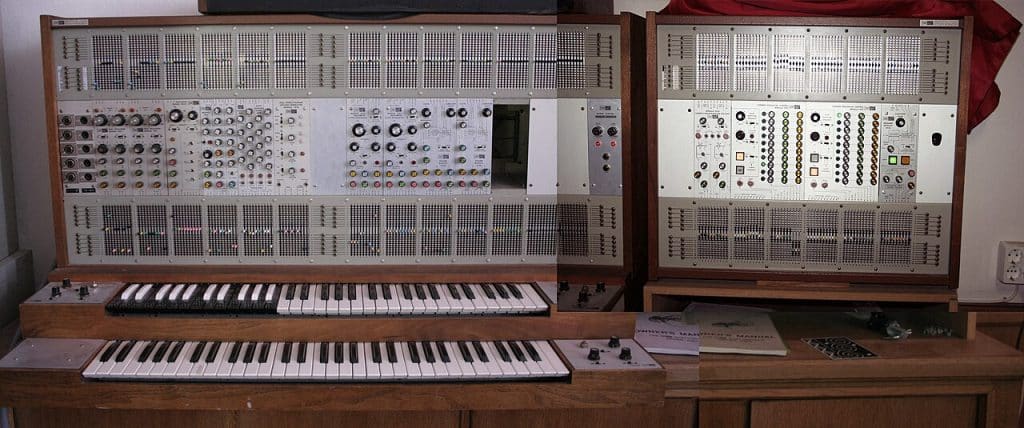
- Rows of sliding matrix switches above and below the modules connect them over 20 horizontal buses, so the 2500 needs no patch cords.
- The 2515 main cabinet holds 15 modules and each wing cabinet 8. Sound On Sound estimated total production at probably as low as 100 systems.
- ARP supplied a complete 2500 and an operator for the 1977 film Close Encounters of the Third Kind.
- No maker has reissued the 2500. Behringer sells Eurorack modules based on its circuits, CMS sells original-format modules for old cabinets, and Cherry Audio’s VM2500 software cost $49 on 12 November 2026.
ARP 2500 specs
Because every 2500 was built to order, its specification depends on the modules fitted. The table combines ARP’s brochure with Sound On Sound’s 1996 retrospective, written by Robert Alexander, who owned a 2500.
| Feature | ARP 2500 |
|---|---|
| Maker | ARP Instruments, Inc., 320 Needham Street, Newton, Massachusetts |
| Introduced | 1970; Sound International says it was completed in May 1970 |
| Type | Modular analog synthesizer, assembled to order from stock cabinets, keyboards and Series 1000 function modules |
| Cabinets | 2515 Studio Cabinet, 15 module positions; 2508 Studio Wing Cabinet, 8 positions; 2508P Portable Wing Cabinet, 8 positions; a triple cabinet, model 2524, of which very few were made |
| Patching | Matrix switches above and below the modules: groups of 10 sliders, each set to one of 20 horizontal bus lines (on very early cabinets only above) |
| Oscillators | 1004 and 1023 modules with sine, triangle, square, sawtooth and pulse outputs; .03 Hz to 16 kHz over 10 octaves in the manual’s specification |
| Filters | 1006 Filtamp with a low-pass filter; 1047 Multimode Filter/Resonator with high-pass, low-pass, band-pass and band-reject |
| Sequencer | 1027: 10 positions with three rows of 10 knobs (30 preset voltages), internal clock 20 to 400 clocks per minute |
| Keyboards | 3000 series with 5 octaves (3001, 3002, 3112, 3212, 3221, 3222) and the 4-octave portable 3604; split models have two independent sections |
| Three-cabinet system | Three cabinets with 31 module positions (15 + 8 + 8, power control modules included) and two 61-note keyboards |
| Production | Probably as low as 100 systems, maybe no more than 12 sold in the UK (Sound On Sound estimate, 1996) |
Release date, production run and source conflicts
The 2500 dates from 1970. Sound International’s 1979 history of ARP says the huge studio synthesiser was completed in May 1970, Sound On Sound says it was designed in 1969 and commercially launched in 1970, and Korg’s ARP history page lists it under 1970. ARP’s own newsletter, ARPeggio in December 1975, said a two-voice keyboard system was introduced in 1970 on the 2500. Music Technology’s A-Z of Analogue from August 1993 adds that the instrument was originally called Tonus, while an article on the Alan R. Pearlman Foundation’s site says Tonus was the name Pearlman first gave his company before changing it to ARP.
The end of production is less certain. CMS, a workshop that restores 2500 systems, says ARP discontinued the 2500 in 1976. EMEAPP’s page on its own 2500 and the interview site 15 Questions give 1970 to 1981 instead, and 1981 is the year Korg’s history says ARP closed. I found no ARP document that dates the end of production.
There are no ARP sales figures that I could find. Sound On Sound estimated in 1996 that total production was probably as low as 100 worldwide and that maybe no more than 12 were sold in the UK.
How the ARP 2500 matrix-switch patching works
Earlier studio synthesizers routed signals between modules with patch cords. Sound International’s history says ARP replaced them on the 2500 with a matrix patching system of slider switches above and below the racked modules. It credits David Friend, ARP’s president by 1979, with calling this design philosophy human engineering.
Sound On Sound describes the layout in detail. On each of the 2500’s cabinets, above and below the function modules, there are matrix switches of 10 x 20 switch positions; on very early models they were only above the modules. The switches of each module come in groups of 10 sliders. Each slider moves up or down to line up with any one of 20 horizontal lines, and the spaces between the points are off positions. The 20 lines act as buses that make an electrical connection along the entire length of the cabinet, so in their simplest form the matrix points patch the output of one module to the input of another.
For a full three-cabinet system Sound On Sound counted a possible 9,600 matrix points. ARP’s brochure says the matrix gives a clear color-coded visual representation of signal flow and lists gold plated switch contacts among its build features. For comparison, the glossary entries on the patchbay and the modulation matrix cover other ways of routing signals.
Two users have described the matrix themselves. In an interview published by eContact!, an interviewer described patch cords, his co-host corrected him, and the composer Eliane Radigue added: “It was matrix switches.” She said this makes a patch easier to read. In 2023 the producer David Baron told 15 Questions that patching on the sliding matrix panels is very quick and can send a source to several destinations. The switches are also why the 2500 is hard to rebuild today: CMS says it isn’t making new 2500 cabinets, partly because the matrix switches are unavailable.
ARP 2500 modules, keyboards and cabinets
ARP’s brochure explains that each 2500 was assembled to the customer’s specifications from stock cabinets, keyboards and Series 1000 function modules. Installing an extra module takes just a few minutes, according to the brochure, and owners could rearrange the modules later. The table lists every item the brochure prices. The brochure is undated, and it also prices the ARP Odyssey at $1,295 and the ARP 2600 at $2,790.
| Model | Brochure description | Price |
|---|---|---|
| 1001 | Blank panel | $10 |
| 1003 | Dual Exponential Envelope Generator | $390 |
| 1004p | Voltage Controlled Oscillator | $450 |
| 1004t | Voltage Controlled Oscillator, inverted outputs | $490 |
| 1005 | Modamp (balanced modulator, VCA, switching) | $590 |
| 1006 | Filtamp (mixer, low-pass VCF, VCA) | $420 |
| 1016 | Dual Noise/Random Voltage Source | $380 |
| 1023 | Dual Voltage Controlled Oscillator | $890 |
| 1027 | Ten-Position Sequencer | $890 |
| 1033 | Dual Delayed Exponential Envelope Generator | $430 |
| 1036 | Dual Sample & Hold/Random Voltage Generator | $540 |
| 1045 | Voltage Controlled Voice (VCO, VCF, VCA, two envelopes) | $1,150 |
| 1046 | Quad Exponential Envelope Generator | $810 |
| 1047 | Multimode Filter/Resonator | $540 |
| 1050 | Mix/Sequencer | $690 |
| 1002 | Power supply | Included in the cabinet price |
| 3604 | Keyboard: Portable one voice, 4 octaves | $600 |
| 3001 | Keyboard: One voice, 5 octaves | $700 |
| 3002 | Keyboard: Two voice, 5 octaves | $750 |
| 3212 | Keyboard: Three voice split, 5 octaves | $850 |
| 3222 | Keyboard: Four voice split, 5 octaves | $950 |
| 2515 | Cabinet: Studio Cabinet, 15 module positions | $1,990 |
| 2508 | Cabinet: Studio Wing Cabinet, 8 module positions | $1,190 |
| 2508P | Cabinet: Portable Wing Cabinet, 8 module positions | $1,340 |
Oscillators and tuning
The 1004p oscillator offers five simultaneous waveform outputs, sine, triangle, square, sawtooth and pulse, with FM and PWM and a built-in waveform mixer. The 1004t adds inverted waveform outputs, and the 1023 holds two such oscillators. Sound On Sound quotes the manual’s specification as .03 Hz to 16 kHz, voltage-controlled over 10 octaves, and calls it a rather optimistic set of figures.
Korg’s ARP history page says ARP made a highly stable oscillator a priority. An article on the Alan R. Pearlman Foundation’s site, republished from the music historian Hayim Kobi, quotes Pearlman on his approach: in Bob Moog’s design the exponential and logarithmic functions sat in different locations at different temperatures and drifted apart. “It was much easier to simply put them at the same chip,” Pearlman said. Sound On Sound wrote in 1996 that Moog’s 921-series oscillators tended to overheat and drift, and that the ARP did not have this problem.
Filters, amplifiers, envelopes and noise
The 1006 Filtamp combines a mixer, a voltage-controlled low-pass filter and a voltage-controlled amplifier. CMS describes that filter as a 24 dB low-pass ladder filter. The 1047 Multimode Filter/Resonator has high-pass, low-pass, band-pass and band-reject outputs, with voltage-controlled center frequency and resonance. The 1005 Modamp pairs a balanced modulator with a VCA and switching circuitry.
Envelopes come in the 1003 dual, 1033 dual delayed and 1046 quad envelope generators, and CMS calls the 1003’s two envelopes ADSR types. The 1016 provides two noise sources and slow random voltages (see noise generators), and the 1036 adds sample and hold. The 1045 Voltage Controlled Voice puts a VCO, a VCF, a VCA and two envelope generators in one module, which the brochure suggests using as a preset voice.
Sequencer and keyboards
The 1027 Clocked Sequential Control Module is a ten-position sequencer with 30 preset voltages. Sound On Sound explains that it sends a 10-step sequence to three outputs, so up to 30 notes can be sequenced in three groups. Its internal clock runs from 20 to 400 clocks per minute, and a reset button cuts the sequence short. The 1050 Mix/Sequencer combines a sequencer, a mixer and an analog gate.
The 3000-series keyboards follow a code. The first digit, 3, means keyboard. The second gives the number of black octaves, low octaves whose keys are reversed in colour, and the last two digits give the voices of the black and white sections. The 3001, 3002, 3112, 3212, 3221 and 3222 were made, and on the last four the two sections are completely independent. The brochure prices five keyboards from $600 to $950, all with variable tuning, tone interval and portamento.
ARP 2500 original price
ARP’s brochure shows what a working system cost by pricing six sample systems. The smallest is a portable wing with a 4-octave keyboard; the largest is a main cabinet, two wings and two keyboards. Music Technology’s 1993 guide gives the original price as $2300 – $8500, without saying which configurations it means.
History of the ARP 2500
ARP Instruments was founded in 1969. Korg’s history names Alan R. Pearlman as a founder, with co-founders including Lewis G. Pollock and David Friend, and Music Technology’s guide says Pearlman had worked on the Gemini and Apollo space projects, designing amplifiers. Its first product was the 2500, which Music Technology calls massive.
Korg says the 2500 became a hit as a research tool for universities. ARP’s brochure prints endorsements from Milton Babbitt of Princeton University, Gerald Shapiro of Brown University and Robert Morris of Yale University, and says ARP’s applications engineers had helped design and install over 250 electronic music studios from Jerusalem to Honolulu. Each synthesizer came with a 138-page textbook. Sound On Sound wrote that most of the 2500s sold ended up in university science departments. In April 1974 ARPeggio reported that Philips, owner of Deutsche Grammophon, had bought ARP 2500s for all its major studios and had made over 60 albums with them.
The ARP 2600 followed in 1971, according to Sound International. Music Technology called it essentially a slimmed-down 2500 in 1988. Another ARP instrument has its own entry here, the ARP Omni. Korg’s history says ARP closed in 1981, Korg revived the brand in 2015 with the Odyssey, and the ARP 2600 was reissued in 2020.
The ARP 2500 in Close Encounters of the Third Kind
In April 1977 ARPeggio wrote that ARP had supplied a complete ARP 2500 system and a skilled operator to appear in the upcoming Columbia Pictures film Close Encounters of the Third Kind, in which the ARP plays a significant role as a communications tool. Music Technology described the 2500 in 1988 as seen conversing with the alien mother ship at the end of the film, and in 1993 placed it in the climactic mothership scene.
The article on the Alan R. Pearlman Foundation’s site names the operator as Phil Dodds, ARP Instruments’ VP of engineering, and notes that the 2500 became famous in it with the simplest sequence of five notes. Korg’s history page also lists the 1977 film appearance.
Musicians who used the ARP 2500
The accounts below come from the players’ own interviews or from ARP’s reports at the time, and each names its source.
Pete Townshend. ARPeggio reported in April 1974 that The Who’s album Quadrophenia features Townshend’s synthesizer tracks with his ARP 2600 and ARP 2500, with a photo captioned Peter Townshend and his ARP 2500. In June 1975 it wrote that he made the film soundtrack of Tommy with the aid of his ARP 2500 and ARP 2600. ARP’s brochure quotes him on his system, which plays six notes at once and holds 20 sets of preset control voltages. These are ARP’s promotional reports. CMS says it has restored 2500s for Townshend and for Vince Clarke.
David Hentschel. The same June 1975 issue credits Hentschel with the synthesizer sounds in Funeral for a Friend, the opening track of Elton John’s Goodbye Yellow Brick Road. It also says he produced, arranged and performed Startling Music, a Ring O’ Records release built from Ringo Starr’s album Ringo, on the ARP 2500. The Foundation’s article quotes Hentschel, the sound engineer on Goodbye Yellow Brick Road, saying that its producer Gus Dudgeon couldn’t get clearance for the 20th Century Fox music overture he wanted as the album’s introduction, and asked Hentschel to write an arrangement to segue into the song instead.
Jerry Goldsmith. ARPeggio reported in 1976 that the film composer used his 2500 system for the Logan’s Run score.
Eliane Radigue. In the eContact! interview the French composer said she got her ARP in 1970, that she had worked with it for 25 years at that point, and that she named it Jules. In Electronic Beats in October 2012 she said she had been living with her ARP for more than forty years.
Vince Clarke. Music Technology’s June 1993 tour of Vince Clarke’s studio lists an ARP 2500 next to his ARP 2600 among the modular systems stacked there.
David Baron. 15 Questions’ November 2023 interview with the producer notes that his LP The ARP 2500 was due on 17 November 2023 on Here & Now.
ARP’s brochure also prints endorsements from Hugo Montenegro and Roger Powell. For other names in later lists, such as Wendy Carlos and Jean-Michel Jarre in Music Technology’s 1993 guide, I didn’t find their own accounts, so they aren’t covered here.
Is there an ARP 2500 reissue? Recreations and clones
No maker has reissued the ARP 2500. Korg, which revived the ARP brand in 2015, has reissued the Odyssey and the 2600. On 12 November 2026 Korg’s US synthesizer list showed ARP 2600 and Odyssey models but no 2500, and I found no announcement of one. What exists instead are modules and software modelled on it.
Behringer 2500 series. Behringer sells Eurorack modules named after the original model numbers. Its 1047 page calls the module an authentic reproduction of the original System 2500 circuitry that fits a standard Eurorack case, and describes a 12 dB per octave state variable filter. Its 1027 is an 8-position step sequencer with three CV channels, where ARP’s 1027 has 10 positions. As Eurorack modules they are patched with cables, not matrix switches. Behringer’s pages show no prices, and I didn’t compare retailers.
CMS original-format modules. CMS sells new 1000 series modules designed to fit original ARP 2000 and 2500 cabinets. On its page, updated on 28 July 2026, its reproduction of the 1045 Voltage Controlled Voice is listed at $3,499 and out of stock, and its new 1034 module with three oscillators at $2,999 as a limited edition. CMS isn’t making cabinets at present.
Cherry Audio VM2500. The VM2500 Collection for Cherry Audio’s Voltage Modular platform recreates all 18 modules originally produced for the 2500, made with the designer Mark Barton. It replaces the matrix switches with standard CV jacks and cost $49 on 12 November 2026.
A public original. In May 2024 Synthtopia reported that the Alan R. Pearlman Foundation had restored a 2508 wing cabinet, with work by Phil Cirocco of Cirocco Music Systems, and made it available to the public at The Record Co. in Boston.
ARP 2500 demo videos
In the first video, Hans Kulk of Willem Twee Studios in the Netherlands introduces the 2500 at the studio. The second is a demo by Zak Leever on a system that, according to the video description, Rob Rosen of Rosen Sound, a synth repair shop in Los Angeles, restored for a client.
ARP 2500 manuals and documentation
ARP shipped each synthesizer with a 138-page textbook. Sound On Sound wrote that the manual explains what synthesis is but does not explain how to go about making a sound on the 2500. CMS says there never was a service manual published for the ARP 2500. I didn’t read the owner’s manual and found no official download of it.
ARP’s 2500 brochure and its ARPeggio newsletters are on the Internet Archive, and the magazine articles cited here are on mu:zines. The photo at the top of this page is ARP 2500 (extra large) by Rosa Menkman, Wikimedia Commons, licensed under CC BY 2.0. It shows a main cabinet with two keyboards and a wing cabinet.
ARP 2500 price and availability
The ARP 2500 is discontinued and only sells secondhand. In 1993 Music Technology gave a target price of £6000, or £8000 with wings. In 1996 Sound On Sound estimated that a 2500 would cost somewhere in the region of £15,000, perhaps even as high as £20,000 for a system with wings and a full complement of modules and keyboards.
On 12 November 2026, viewed from Berlin, Reverb had no price-guide entry for the ARP 2500, so it gave no used estimate. A marketplace search returned 47 results, but none of the listings shown was a complete system. They were mostly parts and matrix switch boards, plus an ARP 2500 owner’s manual asking €590. I found no dated sale price for a complete 2500, and asks are not sales.
Related gear and terms
For the basics behind the 2500, see analog synthesizers, subtractive synthesis and sound synthesis.
Frequently asked questions
When did the ARP 2500 come out?
In 1970. Sound International’s 1979 history says it was completed in May 1970, and Sound On Sound says it was designed in 1969 and launched in 1970. The end date is disputed: the restorer CMS says ARP discontinued it in 1976, while other sources give 1981, the year ARP closed.
How does the ARP 2500 matrix patching work?
Above and below the modules sit rows of sliding switches. Each module has groups of 10 sliders, and each slider can be set to one of 20 horizontal bus lines that run the length of the cabinet. Sliders on the same line are connected, which patches one module’s output to another’s input without cords.
How many ARP 2500s were made?
ARP published no figure that I found. Sound On Sound estimated in 1996 that total production was probably as low as 100 systems worldwide, and that maybe no more than 12 were sold in the UK. Systems with wing cabinets and the three-cabinet model 2524 are the least common configurations.
What modules does the ARP 2500 have?
ARP’s brochure prices 15 Series 1000 modules, including the 1004 and 1023 oscillators, the 1006 Filtamp, the 1047 Multimode Filter, envelope generators, noise, sample and hold, the 1045 voice module and the 1027 and 1050 sequencers. Sound On Sound lists 18 module types in total.
How much did an ARP 2500 cost new?
ARP’s undated brochure prices the 2515 main cabinet at $1,990, keyboards from $600 to $950 and function modules from $380 to $1,150, plus a $10 blank panel. Its six sample systems cost from $7,180 to $19,820. Music Technology’s 1993 guide gives the original price as $2300 – $8500.
Was the ARP 2500 in Close Encounters of the Third Kind?
Yes. ARP’s newsletter wrote in April 1977 that ARP had supplied a complete 2500 system and a skilled operator for the film, released in 1977. An article on the Alan R. Pearlman Foundation’s site names the operator as Phil Dodds, ARP’s VP of engineering, seen with the 2500 as the UFOs are about to arrive.
Who used the ARP 2500?
ARP’s newsletter reported Pete Townshend’s 2500 on Quadrophenia in 1974 and on the Tommy soundtrack in 1975, credited David Hentschel with the synthesizer sounds in Elton John’s Funeral for a Friend, and named Jerry Goldsmith’s Logan’s Run score in 1976. Eliane Radigue said she got hers in 1970 and worked with it for decades.
Is there an ARP 2500 reissue or clone?
There is no reissue. Behringer sells 2500 series Eurorack modules based on the original circuits, CMS sells new modules that fit original 2500 cabinets, and Cherry Audio’s VM2500 software recreates all 18 modules for $49 on 12 November 2026. Korg, which revived the ARP brand in 2015, has reissued the 2600 and Odyssey but not the 2500.
What is the difference between the ARP 2500 and the ARP 2600?
The 2500 of 1970 is a large modular system built to order from Series 1000 modules and patched with matrix switches. The 2600 of 1971 is a smaller, pre-patched synthesizer, which Music Technology called essentially a slimmed-down 2500 in 1988. Korg reissued the 2600 in 2020.
How much is an ARP 2500 worth today?
On 12 November 2026 Reverb had no price-guide estimate and no complete system among the listings shown. Sound On Sound put a 2500 at about £15,000 in 1996, perhaps £20,000 with wings, and Music Technology’s 1993 target price was £6000. I found no recent dated sale.
Back to Music Production Terms Index Page