What is sound synthesis?
Sound synthesis is the art of making a sound electronically instead of recording it from an acoustic source. A synthesizer generates a raw signal, shapes its tone, and controls how its volume and brightness change over time. The method it uses to build that tone is its type of synthesis: subtractive, FM, wavetable, granular and so on.
This page is the hub for my glossary entries on synthesis. Each type below gets a short summary, a classic instrument and a source, then a link to the full entry where one exists. FM, phase distortion, ring modulation, spectral and West Coast synthesis don’t have their own entries yet. If you’re new to the topic, read the building blocks first, because almost every method reuses them.
- Every synth combines a sound source (an oscillator, samples or a model) with ways to shape it (filters, envelopes, modulation).
- The type of synthesis is the way the tone is built: by removing harmonics (subtractive), adding them (additive), modulating one oscillator with another (FM), playing back recordings (sample-based), simulating physics (physical modeling) and more.
- The comparison table below covers 15 types, each with a principle, a classic instrument, its year and typical sounds.
- From the dates in my sources, 7 of the 15 classic instruments in that table date from the 1980s.
- Theory often came long before the hardware: 10 years from Chowning’s FM paper to the DX7, 39 years from Gabor’s sound quantum to real-time granular synthesis.
The building blocks every synth shares
Before the types make sense, it helps to know the parts they are built from. A synth starts with a sound source. On most instruments that is an oscillator producing a repeating waveform such as a sawtooth wave or a pulse wave whose width can move with pulse-width modulation. Others start from noise or from a recorded sample.
Then comes shaping. A filter, for example a low-pass or a band-pass filter, changes the tone. An amplifier, usually a VCA, sets the volume. An envelope such as an ADSR moves either of them over the life of a note, and a modulation matrix lets one source steer many destinations.
Bob Moog set out the idea that ties these parts together in his 1964 paper on voltage-controlled modules, which he presented at the Audio Engineering Society convention (Bob Moog Foundation). In his words, “The salient variable of each module is proportional to a control voltage” (quoted by the MIDI Association). Pitch, brightness and volume all became things one module could turn up or down on another. Most of the types below still work that way, even when the modules are lines of code.
Types of synthesis: the 15 main methods compared
There is no official list of synthesis types, and makers love to coin new names for old ideas. The 15 below are the ones you will meet in manuals, reviews and plugin menus. Some are close relatives: vector synthesis grew out of wavetable work, and LA synthesis mixes samples with subtractive shaping. The table gives each one a single classic instrument and its year, dated by the cited sources. It is not always the first instrument of its kind.
| Type | Principle | Classic instrument (year) | Typical sounds | Sources |
|---|---|---|---|---|
| Subtractive | Start with a bright waveform, then filter harmonics away | Moog Minimoog (1970) | Brass, plucked strings, drums (each a Synth Secrets chapter) | Sound On Sound, Moog Foundation |
| Additive | Build the tone by adding sine-wave harmonics | Kawai K5000W (1996/97) | Broad harmonic sweeps, organ tones | CCRMA, CCRMA, Sound On Sound |
| FM | One oscillator modulates another’s frequency at audio rate | Yamaha DX7 (1983) | Brass, woodwinds, percussive sounds | CCRMA, Yamaha |
| Phase distortion | Read a sine wave at uneven speed to bend it toward brighter shapes | Casio CZ-101 (1984/85) | Brass, strings, electric pianos, metallic tones | E&MM, IM&RW |
| Wavetable | Step or sweep through a table of stored single-cycle waves | PPG Wave 2 (1981) | Sweet to harsh digital tones | Sound On Sound, Seib, Sound On Sound |
| Vector | Mix four sound sources with a joystick | Sequential Prophet VS (1986) | Sounds morphing between four sources | Sound On Sound, IM&RW |
| LA (Linear Arithmetic) | Short PCM attack samples layered with synthesized tones | Roland D-50 (1987) | Breathy pads, organs, sampled attacks | Roland, Sound On Sound |
| Sample-based (rompler) | Play back recorded samples instead of oscillators | Korg M1 (1988) | Natural sounds played from a keyboard | Sound On Sound, Korg, Vogel, Yamaha |
| Granular | Build sound from thousands of tiny grains | Truax’s real-time system (1986) | Layered grain textures | Truax |
| Physical modeling | Simulate the physics of a string, tube or membrane | Yamaha VL1 (1994) | Wind instruments, plucked strings | Yamaha, Karplus |
| Formant | Shape spectral peaks like the human vocal tract | Yamaha FS1R (1998) | Vowels and consonants | Sound On Sound, IRCAM |
| Virtual analog | DSP code that models analog oscillators and filters | Clavia Nord Lead (1995) | Analog-style sounds from DSP | Sound On Sound, Nord |
| Ring and amplitude modulation | Multiply two signals to get sum and difference frequencies | EMS VCS3 (1969) | Bell-like, metallic and robotic tones | Hass, Sound On Sound, Hinton, Sound On Sound, CCRMA |
| Spectral / resynthesis | Analyze a sound into frequency data, edit it, rebuild it | Camel Audio Alchemy (2008/09) | Resynthesized and morphed samples | Sethares, Sound On Sound |
| West Coast | Complex oscillators, wavefolding and low-pass gates instead of a big filter | Buchla 100 (1963) | Raspy, gnarly folded tones | Buchla, Doepfer, Sound On Sound |
Subtractive synthesis
Subtractive synthesis starts with a bright, harmonically rich waveform and filters part of it away. Gordon Reid’s Synth Secrets series in Sound On Sound describes it as the method “wherein you attenuate or remove harmonics from harmonically rich waveforms to create new sounds” (Sound On Sound, May 1999). In 1970 the Minimoog put it into a portable keyboard (Bob Moog Foundation).
My subtractive synthesis entry covers the filter types, envelopes and patching in depth.
Additive synthesis
Additive synthesis works the other way round: it builds a tone from sine waves, one harmonic at a time. Paul Wiffen put it simply in his Kawai K5000W review: “you add together the harmonics you want to create the required sound” (Sound On Sound, January 1997). The roots go back a long way. Julius O. Smith at Stanford’s CCRMA calls the Hammond organ “conceptually an additive synthesis device” and notes that “it was clearly influenced by the Telharmonium” (CCRMA). Additive synthesis also “was one of the first computer-music synthesis methods” (CCRMA).
The classic hardware example is the Kawai K5000, where “each Source gives you 64 harmonics to play with” (Sound On Sound). More detail, including resynthesis, is in my additive synthesis entry.
FM synthesis
FM (frequency modulation) synthesis uses one oscillator to wobble the pitch of another so fast that you no longer hear vibrato, only a new and often bright timbre. John Chowning found it at Stanford: “Chowning discovered the frequency modulation synthesis (FM) algorithm in 1967”, and in 1973 “Stanford University licensed the FM synthesis patent to Yamaha in Japan” (CCRMA; other sources date the licence a year or two later). His paper appeared in the Journal of the Audio Engineering Society the same year, promising “a means of great simplicity to control the spectral components and their evolution in time” (CCRMA, JAES 21(7), 1973).
Yamaha’s own history dates the turning point to “the release of the Yamaha DX7 in 1983” and lists the sounds FM made possible: “modeled brass tones, woodwinds, percussive objects and much more” (Yamaha). The DX7 “quickly became the best-selling synthesizer of all time”, in the words of another Yamaha article (Yamaha).
Phase distortion synthesis
Phase distortion is Casio’s method, made famous by the CZ-101. It reads a sine wave out of memory at an uneven speed, which bends it toward brighter shapes. Electronics & Music Maker explained it in January 1985, starting from the fact that “a perfect sinewave consists of its fundamental frequency and nothing else”. The bent wave “tends towards a sawtooth wave, as the difference in readout speed is increased” (E&MM, Paul Wiffen). International Musician described “a unique system of tone generation which they call Phase Distortion” and heard “rich brass and strings, delicate electric pianos, vicious metallic sounds” (IM&RW, February 1985).
Wavetable synthesis
A wavetable synth stores a set of single-cycle waveforms and lets you step or sweep through them while a note plays. Sound On Sound explains that the waves are “digitally created and stored in a ‘look-up table’ that is accessed by a front-panel control” (Sound On Sound, February 2006). Wolfgang Palm pioneered it at PPG, whose Wavecomputer 360 of the late 1970s “was the first synthesizer to use this new technology” (Sound On Sound, 2022). On the PPG Wave, 64 waves combine into one wavetable (Sound On Sound). The Wave 2 followed in 1981 (Hermann Seib’s PPG history), PPG closed in 1987, and in 1989 the Waldorf Microwave picked it up (Sound On Sound). Its successor has its own entry, the Waldorf Microwave XT.
Modern soft synths took the idea much further. Xfer describes Serum as “a wavetable synthesizer with a truly high-quality sound” (Xfer Records), and it’s the synth I use most for saw-based sounds. My wavetable synthesis entry goes into frames, morphing and table design.
Vector synthesis
Vector synthesis mixes four sound sources with a joystick. Sound On Sound sums it up: “First pioneered by Dave Smith in his Prophet VS, vector synthesis typically uses four oscillators”, which the player morphs between “using real-time controllers such as a joystick” (Sound On Sound). International Musician reviewed the Prophet VS in August 1986 (IM&RW), and Korg’s Wavestation carried the idea on: “Released in 1990, the WAVESTATION is a synthesizer with an advanced vector synthesis system” (Korg). Sequential itself calls vector synthesis “a more flexible and performable evolution of wavetable technology” (Sequential). The full story is in my vector synthesis entry.
LA synthesis (Linear Arithmetic)
LA synthesis is Roland’s name for layering short sampled attacks with synthesized tones. Roland says: “Making its debut in 1987, the D-50 was the first fully digital synthesizer from Roland.” Tadao Kikumoto, Roland’s technical R&D leader on the D-50, explains that the D-50 “adopted granular PCM in the initial part” of each sound and then used digital processing “using an analog subtractive method” for the rest (Roland). A 1997 Sound On Sound retro review singled out “the short attack samples, such as trumpet spits and flute chiffs” and “the breathy, tinkly pads and the cheesy organs” (Sound On Sound). See my entries on LA synthesis and the Roland D-50.
Sample-based synthesis and romplers
Sample-based synths play back recordings instead of generating waveforms. The Sound On Sound glossary defines a ROMpler as a device that “uses audio samples instead of oscillators for sound generation” (Sound On Sound). The Fairlight CMI “was, in 1979, the first commercially available digital sampling instrument”, designed by Peter Vogel and Kim Ryrie (Peter Vogel Instruments). Korg’s M1 followed: “In 1988 KORG released the legendary M1” (Korg). Yamaha’s history describes the M1 as “a completely sample-based instrument with effects and a sequencer”.
The basics of working with recordings are in my sample entry. For two later sample-based keyboards, see the Kurzweil K2000 and the Korg N364.
Granular synthesis
Granular synthesis builds sound from tiny fragments called grains, often many per second. Barry Truax defines it as a method that “is based on the production of a high density of small acoustic events called ‘grains'”, and traces it to “Dennis Gabor’s idea (proposed in 1947) of the quantum of sound” (Simon Fraser University). Iannis Xenakis wrote that “All sound is an integration of grains, of elementary sonic particles, of sonic quanta”, and first sketched the idea with Analogique B in 1959 (A Xenakis Dictionary).
Curtis Roads ran the first digital version: “I managed to test the first implementation of digital granular synthesis in December 1974” (Roads, mdwPress). Truax made it real-time in 1986, and his piece Riverrun ran “usually with very high densities (100-2000 grains/sec)” (Truax). My granular synthesis entry covers grain size, density and spray.
Physical modeling synthesis
Physical modeling calculates how a real instrument vibrates instead of playing back what it sounds like. Yamaha describes the models as “a blown tube, a plucked string, a struck membrane” and notes that the method “first came to market with the 1994 release of the Yamaha VL1” (Yamaha). An earlier, very cheap model came from Kevin Karplus and Alex Strong. Karplus writes: “In about 1979, Alex Strong and I developed a technique” for “producing moderately realistic plucked string sounds with almost no computation”, published in Computer Music Journal in 1983 (Karplus, UC Santa Cruz).
The physical modeling instruments I’ve used myself are Applied Acoustics Systems’ Chromaphone and Strum. My physical modeling synthesis entry includes a Karplus-Strong tuning test.
Formant synthesis
Formant synthesis shapes the resonant peaks that make a voice sound like a voice. At IRCAM, Xavier Rodet’s CHANT project produced the 1984 formant-wave-function (FOF) paper “Time-domain Formant-wave Function Synthesis”. The project’s own paper is titled “From the Synthesis of the Singing Voice to Synthesis in General” (IRCAM OpenMusic manual). Yamaha’s FS1R put the idea into hardware as “a new, potentially very powerful technology called Formant Shaping Synthesis” (Sound On Sound, December 1998). Its voiced operators “mimic the larynx”, and “the unvoiced Operators allow the FS1R to imitate consonants”.
The vocoder is a close cousin: it copies the formants of a real voice onto a synth instead of generating them. “The Vocoder was invented by Homer Dudley in the mid-30’s”, as Wendy Carlos notes. See my formant synthesis entry for vowel tables and filters.
Virtual analog synthesis
Virtual analog is digital code that imitates analog oscillators and filters. Sound On Sound calls the Clavia Nord Lead “a digital synth that ‘did’ analogue synthesis” and says that, “Released in 1995, the Nord Lead was the original Virtual Analogue synth” (Sound On Sound, 2014). Nord confirms: “In 1995 Clavia released its first synthesizer, the Nord Lead” (Nord).
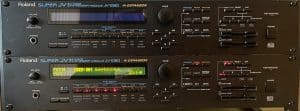
One famous virtual analog sound is the supersaw from “the Roland JP-8000 synthesizer, released in 1996” (Roland), which stacks “seven sawtooth oscillators using only one voice of polyphony” (Roland JP-8000 notes). My virtual analog entry includes an aliasing test.
Ring modulation and amplitude modulation
Ring modulation multiplies two signals. Jeffrey Hass’s Indiana University text describes it: the output is “simply the sum and difference between all frequency components of the two inputs”, “without the original input frequency components, which are canceled out in the process”. With amplitude modulation the carrier survives, so “we always hear the carrier” (Hass, Introduction to Computer Music). Because the new frequencies rarely line up with the harmonic series, “ring modulation can be used to create bell-like tones” (Sound On Sound).
For the original Dalek voices, CCRMA’s course notes say “the original 1963 effect used EQ to boost the mid-range of the actor’s voice” and then “subjected it to ring modulation with a 30 Hz sine wave”. They add that “Their voices were further processed electronically by Brian Hodgson at the BBC Radiophonic Workshop.” The same notes record that “In 1970, Stockhausen took up live processing with ring modulators again in Mantra” (CCRMA). EMS built one into the VCS3, which was “a great success at the time of its launch in 1969” (Sound On Sound; ring modulator on its Board B per Hinton Instruments). Its relative the frequency shifter keeps only one side: “frequency shifting is often called single-sideband ring modulation” (Sound On Sound).
Spectral synthesis and resynthesis
Spectral synthesis analyzes a sound into its frequency content, lets you edit that data, and rebuilds the sound from it. The tool underneath is often the phase vocoder, which “is a variation on the short-time Fourier transform” (William Sethares, University of Wisconsin). Flanagan and Golden published it at Bell Labs in 1966 as “a convenient method for compressing or expanding the time scale of a signal” (Bell System Technical Journal). Sethares adds that “It is ideal for use in applications such as time-stretching”, which links it to time-stretching.
Camel Audio’s Alchemy is one resynthesis instrument: its additive mode “analyses imported samples or multisampled sets into multiple harmonics that evolve over time”, and its spectral mode splits sounds into “a set of ‘spectral bins'” (Sound On Sound, April 2009).
West Coast synthesis
West Coast synthesis is the Buchla tradition: complex oscillators, wavefolding and low-pass gates, rather than a bright oscillator through one big filter. Buchla’s own history says Don Buchla “created the 100 series Modular Electronic Music System (1963)” and points to “his frequent use of complex waveshaping oscillators” (Buchla USA). Doepfer credits him with the low-pass gate, a “combination of Low Pass filter (LP) and VCA” in which “the sound becomes more dull as the loudness decreases” (Doepfer). Morton Subotnick’s Silver Apples of the Moon was “Written in 1967 using the Buchla modular synthesizer” (Subotnick).
The key sound shaper here is the wavefolder. Sound On Sound’s Music Easel review notes that “The Complex Oscillator and its wavefolding are key elements” of that instrument’s sound (Sound On Sound). See my entries on wavefolding and the more general waveshaper.
A timeline of synthesis
I put 23 dated milestones from my sources on one axis. Together with the table, they show how many of the classic instruments arrived within one decade. Of the 15 classic instruments in the table, 2 come from the 1960s, 1 from the 1970s, 7 from the 1980s, 4 from the 1990s and 1 from the 2000s. The 1980s rows are FM, phase distortion, wavetable, vector, LA, sample-based and granular synthesis, all with digital sound generation.
The second pattern is the gap between theory and a working instrument. For each method I took one dated paper or proposal from my sources (not necessarily the first) and the classic instrument from the table, and counted the years between them.
Subtractive synthesis moved fastest, 6 years from Moog’s AES modules to the Minimoog. FM took 10 years from Chowning’s paper to the DX7, physical modeling 11 from the Karplus-Strong paper to the VL1, and formant synthesis 14 from Rodet’s FOF paper to the FS1R. Granular synthesis waited longest: 39 years from Gabor’s quantum to Truax’s real-time system. The pattern I read from this is that the slow ones needed far more computing per voice, so they waited for fast digital hardware. That is my reading of the dates, not a claim from the sources.
Which type of synthesis should you learn first?
I’d start with subtractive synthesis. That’s an opinion, but it has a practical reason: its oscillator, filter and envelope show up inside almost every other type. Roland’s own account of LA synthesis describes subtractive processing after the sampled attack, and virtual analog is subtractive synthesis in code. Once those controls feel natural, wavetable is the easiest next step, because it swaps the static oscillator for a moving one and leaves the rest of the patch alone.
After that, pick by sound. FM and phase distortion are good for brass, electric pianos and metallic tones; ring modulation adds bells. Granular and spectral synthesis suit textures and stretched sound. Physical modeling and formant synthesis are for convincing acoustic or vocal character. For the wider craft of turning these tools into finished patches, see my sound design entry.
Frequently asked questions
What are the main types of synthesis?
The main types are subtractive, additive, FM, phase distortion, wavetable, vector, LA, sample-based, granular, physical modeling, formant, virtual analog, ring modulation, spectral and West Coast synthesis. That makes 15 in my comparison table. Many synths combine two of them, for example sampled attacks with subtractive shaping on the 1987 Roland D-50.
Which type of synthesis is best for beginners?
I recommend subtractive synthesis first. Its oscillator, filter and envelope reappear in most other methods, and virtual analog synths such as the 1995 Nord Lead use the same controls in digital form. After that, wavetable synthesis is an easy next step, because it only replaces the static oscillator with a moving one.
Who invented FM synthesis?
John Chowning discovered FM synthesis at Stanford in 1967 and published it in the Journal of the Audio Engineering Society in 1973. Stanford licensed the patent to Yamaha, which released the DX7 in 1983. According to Yamaha, the DX7 quickly became the best-selling synthesizer of all time.
What is the difference between a sampler and a synthesizer?
A synthesizer generates its tone with oscillators or a model, while a sampler plays back recordings. A rompler sits in between: it is a synth that uses stored samples instead of oscillators. Peter Vogel Instruments calls the 1979 Fairlight CMI the first commercially available digital sampling instrument, and the 1988 Korg M1 was completely sample-based.
What is the difference between wavetable and vector synthesis?
Wavetable synthesis moves through a table of stored waveforms, such as the 64 waves of a PPG wavetable. Vector synthesis mixes four sound sources with a joystick, as on the Sequential Prophet VS, reviewed in 1986. Sequential calls vector synthesis an evolution of wavetable technology, and Korg’s 1990 Wavestation kept the joystick.
Is virtual analog synthesis real analog?
No. Virtual analog synths are digital instruments whose code models analog oscillators and filters. Sound On Sound names the Clavia Nord Lead, released in 1995, as the original. The Roland JP-8000 followed in 1996 and added the supersaw: seven sawtooth oscillators using only one voice of polyphony.
Back to Music Production Terms Index Page