What is a vocoder?
A vocoder is an audio effect that makes one sound speak with the shape of another. It splits a voice into frequency bands, measures how loud each band is from moment to moment, and applies those levels to the same bands of a second sound, usually a synth. The result is the familiar robot voice: the pitch and tone come from the synth, the words come from the voice.
The voice is called the modulator and the synth the carrier. The name is short for “voice coder”, as Wendy Carlos explains on her vocoder page, and it started out as a telephone technology at Bell Labs, not as a music effect. It is also not the same thing as a talk box, which I compare further down. One more name clash: a phase vocoder is a different tool, used for time-stretching and pitch-shifting.
- A vocoder has two inputs. The modulator (a voice) controls a set of filters; the carrier (a synth or noise) is what you hear through them.
- It works with two matched banks of band-pass filters and one envelope follower per band. More bands give a more detailed copy of the voice.
- In my numpy test, the match between the vocoded output and the real vowel shape rose from 0.42 at 4 bands to 0.76 at 16 and only reached 0.79 at 32, while vowel identification kept improving up to 32 bands.
- A plain synth carrier turns “s” sounds into buzz. A voiced/unvoiced switch that swaps in noise made it noise-like again in my test.
- A talk box shapes the sound acoustically in your mouth through a tube. A vocoder does the shaping electronically.
How a vocoder works
A vocoder is two filter banks joined by envelope followers. Apple’s Logic Pro manual puts it plainly: “The speech analyzer and synthesizer features of a vocoder are two bandpass filter banks” (Apple, Vocoder basics). The signal path looks like this:
- Analysis. The voice runs through the first bank. Each filter passes one slice of the spectrum, low to high.
- Envelope following. An envelope follower on each slice turns its level into a slowly moving control signal. A vowel like “ee” has energy low down and again around 2-3 kHz, so those followers rise while the ones in between stay low.
- Synthesis. The carrier runs through a second bank tuned to the same frequencies. Each control signal sets the volume of its matching carrier band, which is the job a VCA did in analog units.
- Sum. The carrier bands are mixed back together. What comes out has the carrier’s pitch and the voice’s spectral outline, its formants.
Because the carrier supplies all the actual frequencies, it has to be rich in them. Ableton’s manual says you’ll get the best results “if your synthesizer sound is bright and rich in harmonics” and suggests: “Try sawtooth-based patches to improve the intelligibility of the voice.” (Ableton Live 12 Manual, Vocoder). That is why sawtooth and string sounds are the classic choice. Dudley himself wrote in 1939 that “any sound rich in harmonics can be used: an automobile horn, an airplane roar, an organ” (H. Dudley, “The Vocoder”, Bell Laboratories Record, December 1939).
The controls you will meet on most vocoders
- Bands. The number of filters per bank. Apple notes that “The more bands a vocoder offers, the more precisely the original sound character is reproduced.” The next section tests how many you actually need.
- Attack and release. How fast each envelope follower reacts, much like the times on an ADSR envelope. Apple’s EVOC 20 manual says “Release values of around 8 to 10 milliseconds are useful starting points.” and warns that very short release times give “rough, grainy vocoder sounds” (Apple, EVOC 20 PS analysis controls).
- Formant shift. Moves the synthesis bank up or down against the analysis bank, so the voice sounds smaller or bigger. Apple: “Move all bands in the synthesis filter bank up or down the frequency spectrum.” (Apple, EVOC formant filter).
- Unvoiced / sibilance. Consonants such as “s”, “f” and “t” are noise, not pitched sound, and a synth carrier can’t reproduce them. Logic’s EVOC 20 PS “includes an Unvoiced/Voiced detector for this specific purpose”, which “substitutes the corresponding portions in the synthesis signal with noise” (Apple, U/V detection). In Ableton, “The Unvoiced knob adjusts the volume of an additional noise generator”. Dudley’s own design already made “a voiced/unvoiced decision”, as Julius O. Smith describes it (CCRMA Stanford, Dudley’s Channel Vocoder).
- Enhance. Ableton’s Enhance button gives “a brighter sound by normalizing the spectrum and dynamics of the carrier”. I tested a version of this too.
How many bands does a vocoder need? My test
For understandable words, very few. For a clear vowel colour on a synth, more than you might think. I built a small channel vocoder in numpy to check this, because band counts on real products range from 5 to 100 and the manuals rarely say what the difference buys.
The setup. The modulator was ten synthetic vowels. I built each from a pulse wave through three formant filters, set to the classic Peterson and Barney (1952) averages for male speakers (table via Princeton COS 325), at two voice pitches, 120 and 210 Hz.
The carrier was a band-limited sawtooth at four notes (D2, A2, F#3 and D#4) plus an A major chord. The vocoder had 4, 8, 10, 16, 20 or 32 bands spread evenly on a log scale from 100 Hz to 8 kHz, with 2nd-order band-pass filters and 30 Hz envelope followers. For every output I read the spectral outline off its partials and compared it with the true vowel shape, after removing the overall tilt. Two scores came out of that: the correlation with the true shape (1.0 would be perfect), and whether the output was closer to the right vowel than to the other nine.
- 4 and 8 bands are coarse. With 4 bands each filter is 1.6 octaves wide, wider than the gap between the second and third formant in every vowel I used. The vowel was matched 0.5 times out of 10 on average at 4 bands, below the 1 in 10 you would get by guessing. For scale, the unprocessed vowels scored 10 of 10 (low voice) and 9 of 10 (high voice).
- For vowel matches, the big step is 10 to 16 bands: from 2.6 to 5.4 of 10. The shape score climbed steadily from 4 to 16 bands (0.61 to 0.76 over the last step).
- Above 20 bands the shape score levels off, vowel matches don’t. 32 bands scored 0.79 against 0.78 for 20, but vowel identification still rose from 5.8 to 7.0 of 10. For comparison, Image-Line notes that “Many ‘classic’ vocoder effects from the past use 8-16 bands.” (FL Studio manual, Vocodex).
- A high carrier note keeps it lower. At 32 bands the D2 carrier got 10 of 10 vowels right for the low voice and A2 got 9, the D#4 carrier only 5. Probably because a note at 311 Hz has only three partials below 1 kHz to show where the formants sit. The chord scored about the same as its root note alone (8 vs 9 of 10 for the low voice).
- Carrier whitening helps a little, at low band counts. Bringing every carrier band to the same level first (my stand-in for an Enhance-style control) raised the 4-band score from 0.42 to 0.49 and the 8-band score from 0.57 to 0.64, but changed little at 32 bands.
As a sanity check I ran the 16-band test at a fixed -1 and a fixed -20 dBFS and got identical scores, which a vocoder with linear envelope followers must give. That says nothing about a voice whose level changes inside a phrase, which is why compressing the voice still helps (see the settings below).
What this test does not measure. It is a signal match, not a listening test, and it uses steady vowels without consonants or a sentence around them. Real speech is much more forgiving. In a 1995 study in Science, Robert Shannon’s team found “high speech recognition performance was obtained with only three bands of modulated noise” (Shannon et al., 1995). Listeners got the words from how the band levels moved over time. Their carrier was also noise, which fills every band; a saw only has its partials. So a few bands can be enough to be understood, while in my signal test a saw carrier needed about 16 bands before most vowels were matched.
Why vocoders turn “s” into buzz
An “s” is hiss, not a pitched sound. A vocoder can only pass on frequencies the carrier already contains, so with a sawtooth carrier the hiss comes out as a dense comb of saw harmonics instead of noise. As Craig Anderton puts it, “an ‘S’ sound contains lots of high frequencies” (Sound On Sound, talk box vs vocoder), and the carrier has to supply them.
I measured it with the same 16-band vocoder. My test “s” was noise filtered to 4-9 kHz. On a spectral-flatness scale measured from 4 to 8 kHz, where it scored 0.58 (white noise scores about 0.55), the vocoded “s” scored between 0.002 and 0.021 depending on the carrier note, so it was tonal rather than noisy. Adding a simple voiced/unvoiced switch, which hands the carrier over to noise whenever the voice has more energy above 4 kHz than below, raised it to 0.32, noise-like again. The switch caught the “s” all the time and never fired on any of the 20 vowels. A softer “sh”, which I filtered lower, to 2.2-6 kHz, only triggered it 70% of the time. That is the case for a detector with an adjustable threshold, or for simply blending in some noise.
A short history of the vocoder
Homer Dudley and Bell Labs. The channel vocoder was “developed starting in October of 1928 at AT&T Bell Laboratories” (CCRMA). Dudley’s patent, U.S. 2,151,091 “Signal transmission”, was filed on 30 October 1935 and granted on 21 March 1939 (Google Patents). Its first stated object was “to reduce the frequency range required for the transmission of signals”: a way to send telephone speech in less bandwidth. His December 1939 article describes ten spectrum-analysing channels. The machine people heard at the 1939 World’s Fair was a different device, the Voder, which Dudley calls “an offshoot of a more extensive system”, the vocoder.
SIGSALY, 1943. The vocoder’s first big job was secret. SIGSALY, the Allied secure telephone link, used “a vocoder-based system”, and a conference “on 15 July 1943, marked the official start of SIGSALY service”. It had twelve channels: ten measured the power of the voice in its frequency bands, two carried pitch and voicing (J. V. Boone and R. R. Peterson, NSA Center for Cryptologic History, archived copy).
Music, from the early 1970s. Wendy Carlos’s vocoded Beethoven for A Clockwork Orange was recorded before she was hired for the film: “the main vocoded portions were done BEFORE getting assigned to do the film” (wendycarlos.com). The module list of her Moog modular, captioned “Wendy’s Moog Synthesizer in 1979”, includes a custom vocoder with “10 pairs of 912 envelope followers and 902 VCAs for vocoding each of ten channels” (wendycarlos.com, photos). Kraftwerk’s vocoder, a Barth Musicoder that “had been customised for Schneider”, was first used on “Ananas Symphonie”, the closing track of Ralf und Florian (1973) (The Quietus). Harald Bode designed one too; Carlos describes Moog’s 16-band model as similar to “dear Harald Bode’s design”. Bode is also the Bode of the Bode-Moog frequency shifter (Bode and Moog, JAES 1972).
The late-1970s boom. Within a few years several makers had one:
- EMS Vocoder 5000, released in 1976 with 22 band-pass filters, according to Gearnews’ history of EMS.
- Sennheiser VSM 201, “originally based on military speech encryption technology” and “adapted for musical use in the late 1970s”. Sennheiser says “only around 50 units of the VSM 201 were ever produced” (Sennheiser). Herbie Hancock’s Sunlight, released 1 June 1978, made “creative use of the newly invented Sennheiser Vocoder” (herbiehancock.com).
- Moog 16 Channel Vocoder, introduced in 1978 with 16 bands from 50 to 5,080 Hz (MusicRadar).
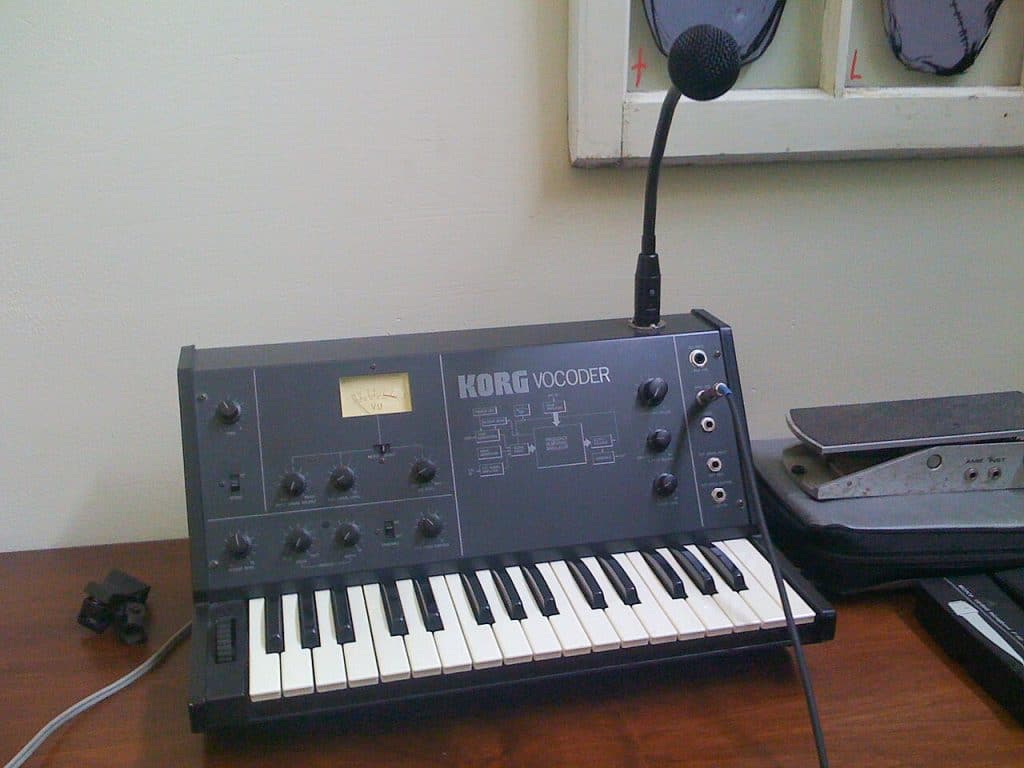
- Korg VC-10, from Korg’s MS-series era, which “looked like an MS10 with a microphone growing out of its top panel” (Sound On Sound, History of Korg).
- Roland VP-330 Vocoder Plus, announced in 1979 (Sound On Sound), Roland’s first vocoder and “a 10-band vocoder” (Roland UK). Laurie Anderson’s lyrics on “O Superman” (1981) “were sung through the Roland VP-330 Vocoder Plus” (Roland Articles; also MusicRadar).
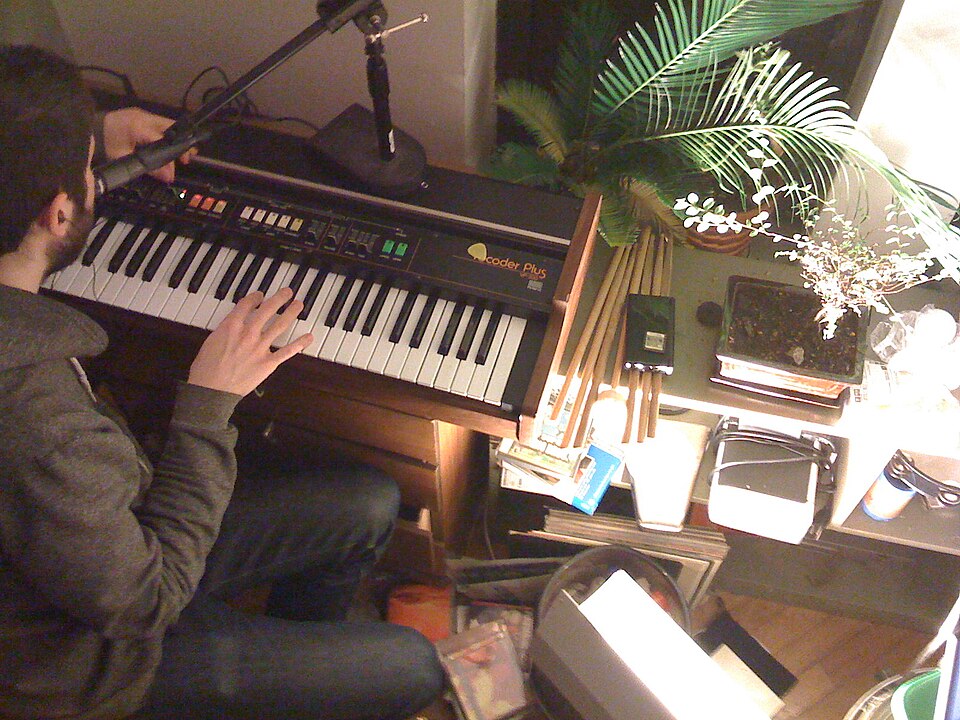
Pop was already using it. One well-known example is the vocoded line at the end of ELO’s “Mr. Blue Sky”, which MusicRadar calls “a witty finishing touch”. Later, affordable synths put one in a small keyboard: Korg’s microKORG has “an eight-band vocoder (the sixteen filters are used in pairs)” (Korg). The band counts, side by side:
Vocoder vs talk box
A talk box and a vocoder both make an instrument talk, but the talk box does it with your mouth and the vocoder does it with circuits. In Craig Anderton’s words, “A ‘talk box’ is an electromechanical device that produces talking instrument sounds”. A driver sends the instrument up a tube, and “the mouth acts like a mechanical filter for the acoustic signal coming in from the tube”. A microphone then picks up the result. Modern vocoders, he writes, “create ‘talking instrument’ effects through purely electronic means” (Sound On Sound). Wendy Carlos makes the same point about the talk box’s ancestors: “very different in execution and principle (physical, not electronic)”.
Input: Microphone (modulator) + a harmonically rich carrier
Shaping: Voice and carrier stay separate until the bands are applied
Example: Laurie Anderson, “O Superman” (VP-330)
Input: The instrument’s sound, through the tube
Shaping: Your mouth shapes the sound; a microphone picks it up
Example: Roger Troutman and Zapp
Roger Troutman’s sound with Zapp is a talk box. As The Paris Review describes it, the box “delivers sound from a source, like an electric guitar or a synth”, and the player “shapes the sound by mouthing lyrics” (The Paris Review). “O Superman” is a vocoder. My talk box entry covers the tube side in detail.
Vocoder hardware and software today
Logic Pro, Ableton Live (except the Intro and Lite editions), FL Studio and Bitwig Studio all ship a vocoder with the DAW, and there are dedicated plugins and hardware units on top. I took each number below from the maker’s own page or manual on 8 November 2026.
| Type | Vocoder | What the maker states | Source |
|---|---|---|---|
| Logic Pro (DAW) | EVOC 20 PolySynth | Up to 20 bands; voice in via sidechain; U/V detector | Apple |
| Ableton Live (DAW) | Vocoder | Noise, External, Modulator or Pitch Tracking carrier; Enhance; Unvoiced. Not in the Intro and Lite editions | Ableton |
| FL Studio (DAW) | Vocodex | 5 to 100 bands | Image-Line |
| Bitwig Studio (DAW) | Vocoder | 8 to 80 bands per section | Bitwig |
| Audacity (free editor) | Vocoder effect | Default 40 bands; white-noise carrier built in | Audacity manual |
| Plugin | TAL-Vocoder | 11 bands, vintage style; paid (80 USD list) | TAL Software |
| Plugin | Arturia Vocoder V | 16 bands, 50 to 5,080 Hz, modelled on Moog’s 16-band vocoder | Arturia |
| Plugin | Waves OVox | Vocal resynthesis with vocoder and talk box effects | Waves |
| Hardware synth | Korg microKORG / microKORG S | 8-band vocoder with Formant Shift | Korg |
| Hardware keytar | Korg RK-100S 2 | 16-band vocoder, Formant Shift and Hold | Korg |
| Hardware synth | Korg microKORG2 | Vocoder with 4 voices; band count not stated | Korg |
| Voice transformer | Roland VT-4 | Vocoder modes Advanced, VP, Talk Box and Spell Toy | Roland |
| Eurorack module | Behringer VC16 | 16-band vocoder module | Behringer |
Two more vocoders sit inside gear I have written about. The Korg MS2000 has a 16-channel vocoder (see my Korg MS2000 entry), and the Boss SE-50 multi-effects unit has a vocoder algorithm, number 16 (see my Boss SE-50 entry).
Two current hardware units bring back the late-analog sound. Roland describes its VP-03 as “a miniature version of the VP-330 Vocoder Plus” (Roland). Behringer’s VC340 is sold as an “Authentic analog Vocoder” with strings and human-voice sections; Behringer does not give its band count (Behringer).
How to use a vocoder: settings that work
Most bad vocoder results come from the carrier, not the vocoder. These starting points come from the manuals above and from my test.
- Use a bright, sustained carrier. A saw pad, a string patch or a buzzy chord. Apple’s rule: “The synthesis signal must be constantly sustained, without breaks.” (Apple, Enhance speech intelligibility). If the carrier stops, the vocoder goes silent, because as Sound On Sound notes “there must be sound present at both the modulator and carrier inputs to produce any output” (Sound On Sound, Versatile Vocoding). If you don’t want to play the notes, Ableton’s Pitch Tracking carrier is “a monophonic oscillator, which tunes itself to the pitch of the modulator”.
- Keep the carrier low to mid. In my test a D2 or A2 carrier let more vowels be identified at 32 bands than a D#4 (311 Hz) one (10 and 9 of 10 against 5 for the low voice). A chord did about as well as its root note.
- Compress the voice. Apple: “You should therefore compress the analysis signal in most cases.” (Apple, EVOC 20 level and frequency tips). Steady levels give steady articulation. A compressor before the vocoder is the easy fix.
- Boost the voice’s top end. Apple suggests “a simple shelving filter should be sufficient to boost the high-mid and treble range”. Use any EQ on the modulator.
- Pick the band count by goal. Apple says a good compromise between precision and “resource usage is around 10 to 15 bands” for EVOC 20, and Sound On Sound agrees that “Low to moderate band counts work well”. My test favoured 16 or more when the vowel colour matters, with gains up to 32. Go down to 8-11 for a vintage, blurred sound.
- Turn on unvoiced or noise. Bring in the Unvoiced control, or layer some noise into the carrier, so “s” and “t” survive.
- Release around 8-10 ms to begin with, then lengthen it for a smoother, more legato vocal.
- Make sure the two spectra overlap. Sound On Sound’s rule of thumb: “you cannot vocode a bass with a mosquito: the sounds must overlap in frequency to some extent”. It doesn’t have to be a voice, either. Apple suggests a drum loop as the modulator to shape a string sound, which is a good sound design trick for rhythmic pads.
Frequently asked questions
What does a vocoder do?
A vocoder is an audio effect that splits a voice into frequency bands, measures how loud each band is and applies those levels to the same bands of a second sound, usually a synth. The synth then speaks with the vowels and rhythm of the voice. Homer Dudley began developing it at Bell Labs in 1928.
How does a vocoder work?
The voice (the modulator) and the synth (the carrier) each pass through a matched bank of band-pass filters. An envelope follower on every voice band tracks its level and turns the matching carrier band up or down. Mixed back together, the carrier bands rebuild the outline of the voice. Many classic units used 8 to 16 bands.
What is the difference between a vocoder and a talk box?
A talk box is acoustic: a driver pushes the instrument’s sound up a tube into the player’s mouth, the mouth shapes it, and a microphone picks it up. A vocoder does the shaping electronically with filter banks and no tube. Zapp’s Roger Troutman played a talk box; Laurie Anderson’s 1981 “O Superman” used a Roland VP-330 vocoder.
How many bands does a vocoder need?
For understandable words, very few: in a 1995 Science study, listeners recognised speech well with only three bands of modulated noise. For clear vowel colour on a synth, more bands help. In my own test with a saw carrier, the match with the true vowel shape rose from 0.42 at 4 bands to 0.76 at 16 and 0.79 at 32.
Who invented the vocoder?
Homer Dudley of Bell Telephone Laboratories. Work started in October 1928, and his patent, U.S. 2,151,091, was filed in 1935 and granted on 21 March 1939. The goal was to send telephone speech in less bandwidth, not music. Musicians such as Wendy Carlos and Kraftwerk took it up in the early 1970s.
Which DAWs have a built-in vocoder?
Logic Pro has EVOC 20 PolySynth with up to 20 bands. Ableton Live has Vocoder, though not in the Intro and Lite editions. FL Studio has Vocodex with 5 to 100 bands, and Bitwig Studio has a Vocoder with 8 to 80 bands per section. The free Audacity editor also includes a vocoder effect.
Back to Music Production Terms Index Page