What is time stretching?
Time stretching changes how long a piece of audio lasts without changing its pitch. A drum loop recorded at 90 BPM can play at 100 BPM and stay in tune. In 2016, a review by Jonathan Driedger and Meinard Müller defined it as “speeding up or slowing down an audio signal’s playback speed without changing its pitch” (Applied Sciences, 2016).
Researchers call it time-scale modification, or TSM. Its mirror image is pitch shifting, which changes the pitch and keeps the length. The same review says pitch shifting “can be seen as the dual problem to TSM”, and most tools do both with the same engine.
Why is it hard? Because the obvious method doesn’t work. Play a recording faster and the pitch rises with it, exactly like a turntable at the wrong speed. Every time-stretch algorithm is a trick for pulling those two things apart. I’ll walk through how the tricks work, where they came from, and which mode to pick in your DAW.
- Time stretching changes tempo or length while keeping pitch; varispeed changes both at once.
- No algorithm wins on everything. In my own test, stretching audio to 1.25 times its length (20% slower), WSOLA kept drum hits clean but left about 10% of a chord’s energy off-pitch, while a large-window phase vocoder kept the chord clean but smeared the hits.
- Match the mode to the material: beat modes for drums, monophonic modes for vocals, polyphonic modes for mixes.
Time stretching vs pitch shifting vs varispeed
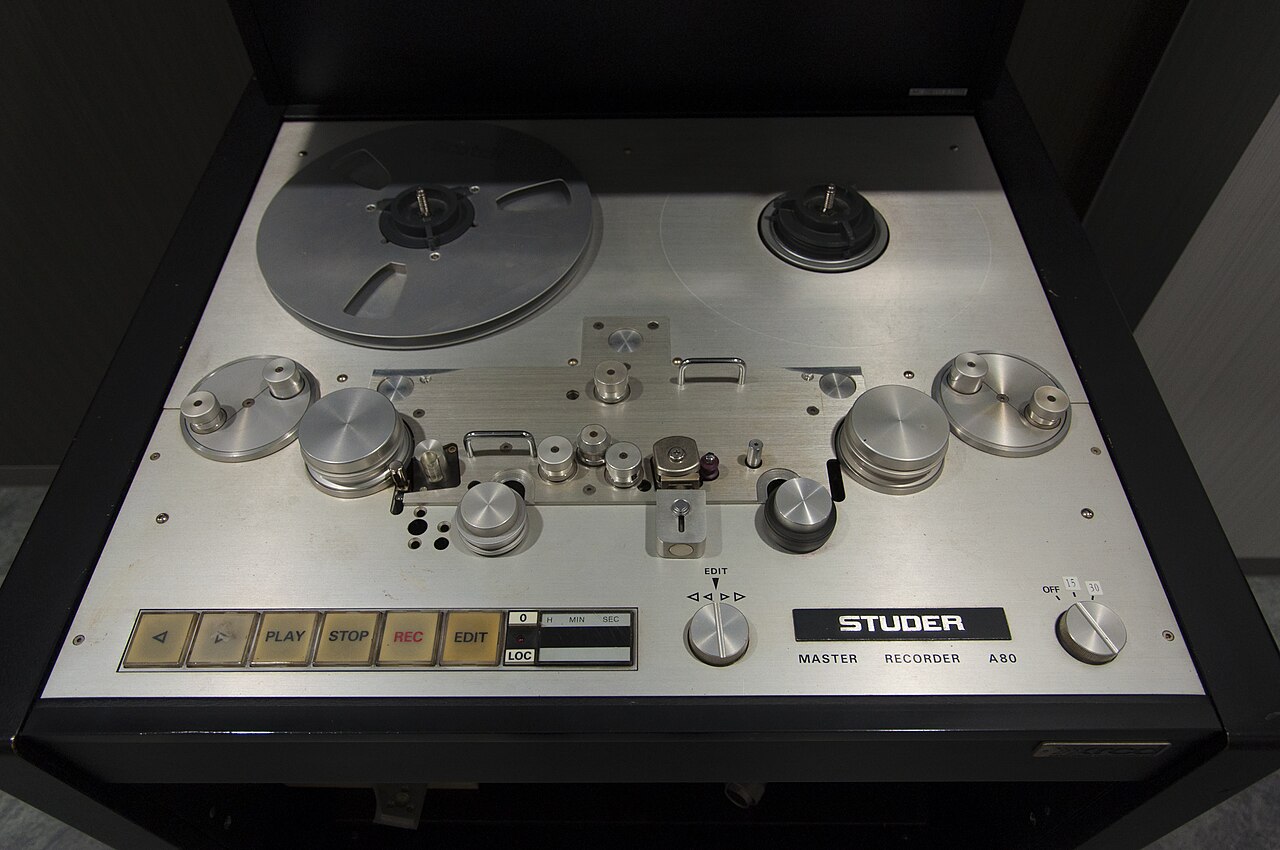
Driedger and Müller’s review spells out the core problem: “resampling a given signal and playing it back at the original sampling rate changes the length and the pitch of the signal at the same time”. That’s varispeed. Tape machines, turntables and old samplers all work this way. Time stretching and pitch shifting are the two ways of breaking that link.
Ableton’s Live 12 manual puts varispeed in one line: “if you double the speed, the pitch goes up by an octave” (Ableton, Live 12 Reference Manual, Audio Clips, Tempo, and Warping). Smaller tempo changes cost less, but the pitch moves more than you might think. I worked out how far a few common tempo jumps move the pitch when you don’t stretch:
- 85 to 95 BPM: up 1.93 semitones
- 90 to 100 BPM: up 1.82 semitones
- 120 to 128 BPM: up 1.12 semitones
- 170 to 174 BPM: up 0.40 semitones
- A 33 1/3 rpm record played at 45 rpm: up 5.2 semitones
The formula is 12 times the base-2 log of the speed ratio. Even 0.4 of a semitone puts your sample audibly out of tune with the rest of the track, which is why stretching exists at all.
Pitch shifting has its own famous side effect. Shift a voice up several semitones and the formants move with it. The review calls the result “sometimes referred to as the chipmunk effect”. Formant-preserving modes such as Complex Pro in Live or e3 Mono in FL Studio exist to stop that. For the vowel side of the story, see formant synthesis.
How does time stretching work?
Almost every method chops the audio into short overlapping frames, then spaces them further apart or closer together. Typical frame lengths fall “in the range of 50 to 100 milliseconds”, according to Driedger and Müller’s review. The methods differ in how they glue the frames back together, and that choice decides which artifacts you hear.
Time domain: OLA, SOLA and WSOLA
The simplest approach just overlaps the frames at a new spacing. It’s called overlap-add, or OLA. On a sustained tone, the waveforms don’t line up where frames meet, so you get what the review calls “phase jump artifacts”. SOLA, short for synchronized overlap-add, fixed this in 1985 by nudging each frame until it matched its neighbor (Roucos and Wilgus, ICASSP 1985). WSOLA, or waveform-similarity overlap-add, refined the idea in 1993 (Verhelst and Roelands, ICASSP 1993).
Time-domain methods keep drum hits sharp, because they copy real chunks of waveform. Their weak spot is the opposite. When a frame containing a hit gets repeated, “the transient is duplicated and can be heard two times in quick succession”. That’s the flam you hear on badly stretched drums. Ableton’s manual describes its Warp Modes as granular techniques that work “by repeating or omitting segments of the audio”. It’s the same idea as granular synthesis, aimed at a different goal.
Frequency domain: the phase vocoder
The phase vocoder breaks each frame into sine waves, then rebuilds them at the new spacing. It’s older than most people think. James Flanagan and Roger Golden of Bell Labs described it in November 1966 and called it “a convenient method for compressing or expanding the time scale of a signal” (Bell System Technical Journal, 1966). Their use case wasn’t music. They pitched time compression for auditory “speed-reading” by listeners with impaired sight. Michael Portnoff showed in 1976 how to run it with the fast Fourier transform (FFT), the form software still uses (IEEE Transactions on Acoustics, Speech, and Signal Processing, 1976).
The phase vocoder handles chords and pads well, but it has a signature flaw. In 1997, Jean Laroche and Mark Dolson wrote that the result often “sounds as if it had been recorded in a small room” (IEEE WASPAA, 1997). The trade calls that phasiness. Their 1999 paper added phase locking to reduce it. Transients smear as well, because a hit gets spread across the whole analysis window.
Hybrids and slicing
Modern engines mix both families. The open-source Rubber Band Library describes itself as “a block-based phase vocoder with phase resets on percussive transients” (Breakfast Quay, Rubber Band Library technical notes). In other words, it treats the hits differently from the tones. Research systems go further and split a signal into harmonic and percussive parts before stretching each one (Driedger, Müller and Ewert, IEEE Signal Processing Letters, 2014).
Slicing avoids stretching altogether. Propellerhead launched ReCycle in 1994. Instead of stretching, it found each drum hit and cut the loop into slices that could be re-timed to any tempo (MusicRadar, Blast from the past: Propellerhead ReCycle, July 2019). Logic’s Slicing mode and FL Studio’s Slice map still work this way.
My test: why no single algorithm wins
I tested six textbook setups on October 7, 2026. Stretching to 1.25 times the length (20% slower), WSOLA left drum hits as sharp as the input but put about 10% of a chord’s energy off the true notes. A phase vocoder with an 8,192-point FFT got the chord down to 0.014% off-pitch, but smeared each hit to about 49 ms.
I built two synthetic test signals in Python at 44.1 kHz. The first is four drum hits with an instant attack. The second is a sustained A minor chord with six harmonics per note. Because I made them, I know exactly what a perfect stretch should sound like.
I stretched both to 1.25 times their length (20% slower), to twice their length, and to 0.8 times their length to compare speeding up. I measured pre-echo, which is drum energy leaking in before each hit, and off-pitch energy, which is chord energy that isn’t on a true harmonic. These are plain textbook versions, not the commercial engines in your DAW, so read the pattern, not the exact numbers.
What the numbers show
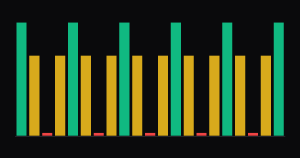
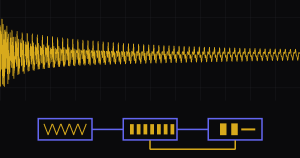
Read the chart top to bottom and the pattern is plain. The time-domain methods and the small-FFT vocoder don’t leak a drum hit backwards at this ratio. But they make a mess of the chord. As the FFT grows, the chord gets cleaner and the drums get worse. With the 2,048-point FFT, a 46 ms window at 44.1 kHz, the attack took about 23 ms to rise. With 8,192 points, a 186 ms window, it took about 49 ms. The input took about 2 ms.
The 512-point vocoder is the instructive failure. Its 12 ms window is small enough to keep drums tight, but too coarse to tell neighboring notes of the chord apart, so about half the chord’s energy lands between the notes. And varispeed? It’s the only perfect result in the chart, apart from the small detail that everything is almost four semitones flat.
No single method wins, which is why every serious DAW gives you several modes instead of one. It also explains the hybrid engines: detect the transients, treat them in the time domain, and hand the tones to a phase vocoder.
Where did time stretching come from?
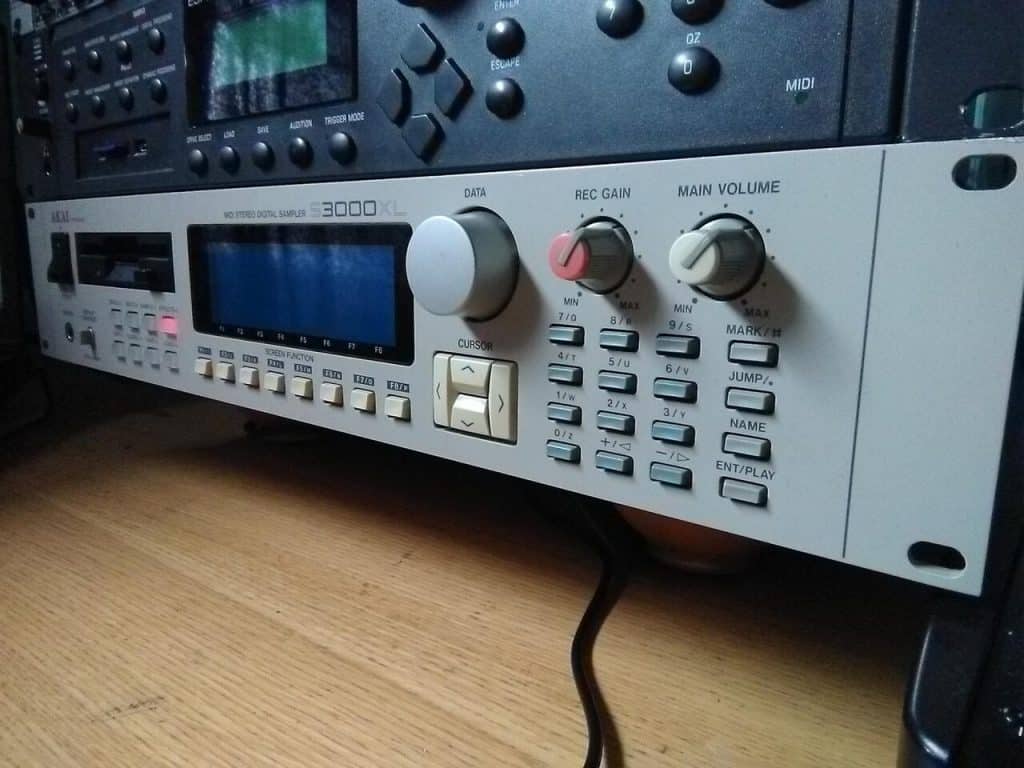
Digital time stretching grew out of speech research, starting with the 1966 phase vocoder paper, and reached musicians through hardware samplers in the late 1980s. Tape machines could do it mechanically too: Logic’s Tempophone mode “emulates the effect of an historical tape-based time-stretching device known as a tempophone” (Apple, Logic Pro User Guide). In December 1988, Music Technology reported that “Akai’s new S950 sampler comes with time-stretching implemented”, while the flagship S1000 still lacked it (Simon Trask, Music Technology, December 1988).
Before samplers could stretch, there was pitch shifting. Sound On Sound called the 1975 Eventide H910 “the first device that could take an incoming audio signal and repitch it at will” (Sam Inglis, Sound On Sound, September 2003). Sampler stretching came later and slowly. By July 1989, Sound On Sound reported that S1000 Timestretch was “available as a free update to any S1000 owner who requests it”. It ran offline, and “The maximum stretch available is a staggering 1000%” (Sound On Sound, July 1989, via mu:zines).
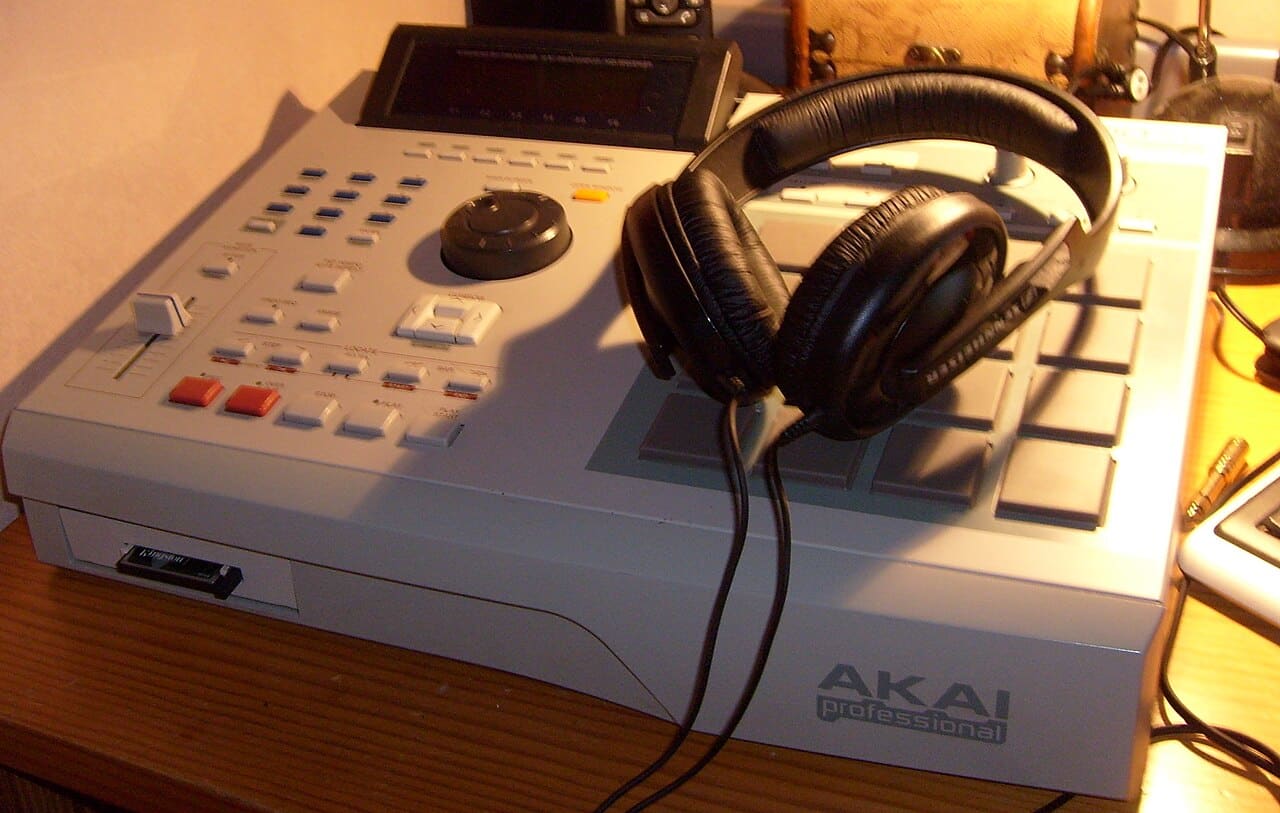
Not every early stretch sounded good. In 1997, Sound On Sound found the Yamaha A3000‘s offline stretch “distinctly flammy-sounding, even at the best setting” (Sound On Sound, July 1997). Groove producers had to wait longer still. Reviewing the MPC2000XL in December 1999, Sound On Sound wrote “now at last there is a percussion sampler which offers time-stretching” (Paul Wiffen, Sound On Sound, December 1999). The full family tree is in my history of the Akai MPC.
Producers also heard the artifacts as a sound in their own right. Writing about Goldie’s “Terminator” in 2013, Complex described a move “from a sampling utility into a revolutionary new sound effect”. The tool was an Eventide Harmonizer, not an Akai, pushed on the “Funky Drummer” break (Complex, March 2013).
Real-time stretching in software
On the computer, software made it real-time. Sound On Sound praised Sonic Foundry Acid in November 1998 for “real-time tempo and pitch adjustment” of loops (Sound On Sound, November 1998). Ableton Live followed. MusicRadar dates it plainly: “Live launched on 30 October 2001” (MusicRadar, October 2021). Live co-creator Robert Henke told the same piece that his Monolake partner Gerhard Behles had a head start: “Gerhard had experience with time-stretching audio; he wrote his master thesis about it”.
Which time-stretch mode should you use?
Every major DAW in 2026 offers several stretch modes, and the manuals recommend them by material. Apple’s Logic Pro guide says its Polyphonic mode “time stretches material based on a process called phase vocoding” and points it at chords and full mixes (Apple, Logic Pro User Guide, Flex Time algorithms). Drums get transient-aware or slicing modes instead. In Pro Tools the feature is called Elastic Audio; in Logic it’s Flex Time, set per track.
| Material | Ableton Live 12 (Warp) | Logic Pro (Flex Time) | Pro Tools (Elastic Audio) | FL Studio | Bitwig Studio |
|---|---|---|---|---|---|
| Drums and loops | Beats | Slicing | Rhythmic | Slice stretch | Elastique or Slice |
| Vocals, bass, solo lines | Tones | Monophonic | Monophonic | e3 Mono | Elastique Solo |
| Pads and textures | Texture | Polyphonic | Polyphonic | e3 Generic | Elastique Eco |
| Full mixes | Complex, Complex Pro | Polyphonic | Polyphonic, X-Form | e3 Generic | Elastique Pro |
| Tape-style (pitch follows speed) | Re-Pitch | Speed | Varispeed | Resample | Repitch |
Mode names from each maker’s current manual (Ableton, Apple, Avid, Image-Line, Bitwig), checked October 7, 2026. Where a manual names no use, the pick is mine (Bitwig full mixes, FL Studio pads and mixes). FL Studio’s e3 modes render offline; Pro Tools’ X-Form also requires rendering.
Cubase splits its presets into élastique and Standard families, and REAPER lists élastique, Rubber Band and SoundTouch side by side. Many of these engines come from one supplier. zplane licenses its élastique engine to FL Studio, Cubase, Studio One and the Akai MPC, among others (zplane, élastique licensing page). Ableton CEO Gerhard Behles has said Live’s Complex mode came from licensing élastique for Live 5 (zplane interview with Gerhard Behles).
Time stretching on hardware
If you work dawless, the same choices show up with different names. Akai’s MPC software 3.6 offers Super, Pro Ten and Repitch warp modes (MPC Live III User Guide 3.6). Akai says Super “offers high-quality FFT-based time stretching and pitch shifting in MPC standalone mode” (Akai Professional, MPC Pro Pack support article). My Akai MPC Live III post covers that machine.
Elektron’s Octatrack MKII has two algorithms, NORMAL and BEAT, and the Roland SP-404MKII keeps the pitch steady while it syncs tempo when Vinyl Mode is set to No. Cheap boxes stretch too, with mixed results. Sound On Sound found the Teenage Engineering EP-133’s stretch “a bit ropey” in February 2024, with a “distinctly Akai S-series grainy stretch” in one mode (Simon Sherbourne, Sound On Sound, February 2024). Even boutique builds add it now: the SinTH2 has a stretch mode in development.
How far can you stretch before it sounds bad?
There’s no fixed limit, but quality falls with the ratio. Steinberg’s Cubase documentation puts it as a rule of thumb: “smaller changes in pitch or duration cause less degradation” (Steinberg, Cubase Pro 12 Operation Manual, limitations). Even Rubber Band’s maker admits “No time-stretcher is entirely transparent” (Breakfast Quay, Why Rubber Band?).
My test agrees. Going from 1.25x to 2x, the 2,048-point vocoder’s off-pitch energy rose from 0.55% to 2.3%. Its drum pre-echo jumped from -27.7 dB to -3.1 dB, close to as loud as the hit itself. At 2x, the 8,192-point version put more drum energy in the 45 ms window ending 15 ms before each hit than in the hit itself.
Direction matters too. Sound On Sound noted in 2011 that “slowing down is much harder than speeding up” (Sound On Sound, September 2011). My vocoder drum numbers point the same way. Speeding up to 0.8 of the length, the 2,048-point vocoder’s pre-echo was -31.4 dB against -27.7 dB for the matching slow-down, and its smear was about 17 ms against 23 ms. The time-domain methods barely changed.
Small ratios aren’t free either. Laroche and Dolson wrote in their 1999 paper that “Transient smearing occurs even with modification factors that are close to one”. So here’s how I’d keep stretches clean:
- Stretch stems separately, so drums and tonal parts each get their own mode.
- Pick the mode by material, using the table above, instead of leaving it on the default.
- Keep ratios small where you can. Record or choose loops near the project tempo.
- For big jumps, try the render-only modes (X-Form, FL Studio’s e3 modes, MPC’s Flatten Elastique). They’re slower but cleaner.
- For drums that won’t behave, slice them instead of stretching.
Extreme stretching as an effect
At the far end, stretching stops being repair work and becomes sound design. Paulstretch, by Nasca Octavian Paul, says it’s “suitable only for extreme sound stretching of the audio (like 50x)” (Paulstretch project page, via the Wayback Machine). It keeps each frame’s spectrum and throws away the phases, which turns any recording into a drifting pad. In August 2010, NPR covered “U Smile 800 Percent Slower”, a 35-minute stretch of a Justin Bieber song. Its creator told NPR: “I didn’t use a phase vocoder; I used a program called paulStretch.” (NPR All Songs Considered, August 2010).
Frequently asked questions
What is time stretching in music?
Time stretching changes the length or tempo of audio without changing its pitch. It lets a 90 BPM loop play at 100 BPM and stay in key. Without it, that 10 BPM jump would raise the pitch by 1.82 semitones, the way a faster turntable does. Every major DAW and many modern samplers include it.
Does time stretching change the pitch?
No, that’s the point of it. Time stretching keeps the pitch and changes the length. The mode that changes both is varispeed, called Re-Pitch in Ableton Live, where doubling the speed raises the pitch by 12 semitones, one octave. Pitch shifting is the reverse case: new pitch, same length. Most engines do both.
What is the best time stretching algorithm?
None wins on everything. In my test, stretching to 1.25 times the length, WSOLA kept drum attacks sharp but put about 10% of a chord’s energy off-pitch, while a large phase vocoder cut that to 0.014% but smeared the hits. Choose by material: beat modes for drums, monophonic modes for vocals, polyphonic modes for mixes.
What is Paulstretch?
Paulstretch is a free program by Nasca Octavian Paul built for extreme stretches, such as 50 times the original length. It keeps each frame’s spectrum and randomizes the phases, so any sound becomes a smooth, drifting texture. It drew wide attention in August 2010, when NPR covered a 35-minute version of Justin Bieber’s “U Smile”.
Did the Akai S1000 have time stretching?
Not at launch. In December 1988, Music Technology noted that the cheaper Akai S950 already had time stretching while the S1000 didn’t. By July 1989, Akai offered S1000 Timestretch as a free update on disk or chip. It worked offline and could stretch a sample up to 1000%.
The bottom line
Time stretching is the art of changing tempo without touching pitch, and every method pays for it somewhere. Time-domain methods protect drum hits and blur chords. Phase vocoders protect chords and blur hits. Modern hybrids split the difference by treating transients separately.
- Varispeed links speed and pitch; stretching and pitch shifting break that link.
- In my test, no single method was clean on both drums and chords at 1.25x.
- Pick the mode by material, keep ratios small, and slice drums that won’t stretch cleanly.
Want to see the same grain idea used to make sounds instead of fixing them? Read my entry on granular synthesis.
Back to Music Production Terms Index Page