What the Korg MS2000 is
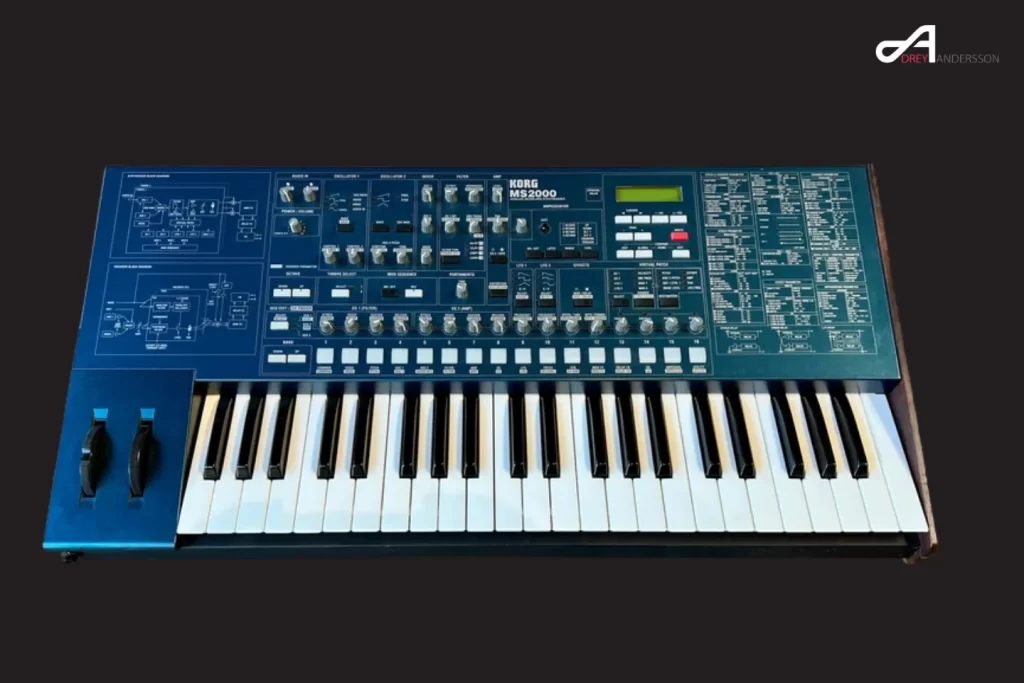
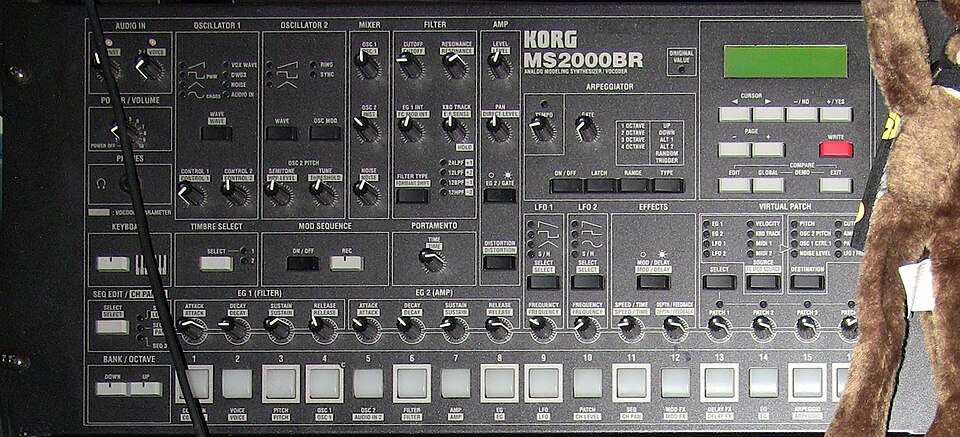
The Korg MS2000 is a 44-key analog modeling synthesizer released in 2000, with four voices, two timbres per program and 128 program memories. Korg sold the same engine as the MS2000R rack module, and in 2003 as the black MS2000B and MS2000BR with a new factory sound set. The name is also written MS-2000 or MS 2000.
This page lists the specs from Korg’s Owner’s Manual, explains the sound engine, the Mod Sequence, the vocoder and the arpeggiator, and sorts out the four model names. It also covers the microKORG link, the ms2000r-emu software emulation from autumn 2026, the manuals and dated used prices.
- Four voices, two timbres, two oscillators plus noise per timbre, and eight oscillator 1 algorithms, including 64 DWGS waves, a system Korg used on the DW-8000.
- A 16-channel vocoder, a six-type arpeggiator and a Mod Sequence of three 16-step rows per timbre.
- Sound On Sound listed the MS2000 at £699 and the MS2000R at £599 in May 2000. The black MS2000B and MS2000BR came in 2003.
- Korg hasn’t released an MS2000 plugin. The free, unofficial ms2000r-emu runs the rack’s own firmware and needs dumps from your own unit.
- On 8 November 2026, viewed from Berlin, Reverb estimated €289 to €749 for a used MS2000.
Korg MS2000 specs
Korg printed one specification page for the keyboard and the rack, so most rows read the same.
| Feature | MS2000 (keyboard) | MS2000R (rack) |
|---|---|---|
| Released | 2000 | 2000 |
| Synthesis | Analog modeling | Same |
| Polyphony | 4 voices | Same |
| Timbres | 2, in Split or Dual mode | Same |
| Oscillators per timbre | 2 plus a noise generator | Same |
| Oscillator 1 | 8 algorithms: Saw, Pulse, Triangle, Sine with cross modulation, Vox Wave, DWGS (64 waves), Noise, Audio In | Same |
| Oscillator 2 | Saw, Square, Triangle, with Ring, Sync or both | Same |
| Filter | -24 or -12 dB/oct low-pass, -12 dB/oct band-pass, -12 dB/oct high-pass | Same |
| Envelopes and LFOs | 2 ADSR envelopes and 2 LFOs per timbre | Same |
| Virtual Patch | 4 routings per timbre | Same |
| Mod Sequence | 3 sequences of up to 16 steps per timbre | Same |
| Vocoder | 16 channels, 4 voices, level and pan per channel, Formant Shift | Same |
| Effects | Modulation (3 types), delay (3 types), two-band EQ | Same |
| Arpeggiator | 6 types | Same |
| Programs | 128: banks A to H, 16 each | Same |
| Keyboard | 44 notes, no aftertouch | None; 16 program keys can play notes |
| Audio inputs | Audio In 1 (line), Audio In 2 with mic/line switch | Same |
| Outputs | L/Mono, R, headphones | Same |
| Pedal inputs | Assignable pedal, assignable switch | Same |
| MIDI | In, Out, Thru | Same |
| Display | 16 x 2 character LCD with backlight | Same |
| Power | DC 9 V, 8 W, from an AC adapter | Same |
| Size (W x D x H) | 737.8 x 371.3 x 147.7 mm | 482.0 x 233.2 x 87.1 mm, five rack spaces |
| Weight | 7.1 kg | 2.8 kg |
The manual lists four optional pedals: the EXP-2 expression pedal, the XVP-10 expression and volume pedal, the PS-1 pedal switch and the DS-1H damper pedal. There is no separate power switch. The POWER/VOLUME knob turns the unit on and clicks off at its lowest position.
MS2000, MS2000R, MS2000B and MS2000BR
Four model names cover one engine. Sound On Sound reviewed the keyboard and the rack together in May 2000 and called the rack virtually identical in features and operation. In March 2003 Korg showed black versions of both at Musikmesse, in its 40th anniversary year, with new programs aimed at dance music.
| Model | Form | Finish | Introduced | UK price (SOS, May 2000) | Notes |
|---|---|---|---|---|---|
| MS2000 | 44-key keyboard | Blue top panel, wooden end cheeks | 2000 | £699 | Owner’s Manual and System Updater 1.07 on Korg’s page |
| MS2000R | Rack module | Blue | 2000 | £599 | Program keys double as a simple keyboard |
| MS2000B | 44-key keyboard | Black | 2003 | Not found | New factory programs, removable gooseneck microphone |
| MS2000BR | Rack module | Black | 2003 | Not found | New factory programs |
The Korg MS2000R’s sockets face upward when it is mounted, so Sound On Sound advised leaving at least 1U free above it. Its 16 program keys can play notes for auditioning sounds, which Vintage Synth Explorer describes as 16 keys with no velocity. Korg’s download pages for the MS2000B and MS2000BR list an Owner’s Manual Addendum rather than a full manual, and no System Updater.
Details that differ between sources
Korg’s manual counts eight oscillator 1 algorithms, with Audio In as the eighth. Sound On Sound counted seven waveforms and described the audio input separately. Korg’s specification calls the MS2000R a five-space rack unit, while Sound On Sound called it 4U high. Korg lists the keyboard with no aftertouch, Sound On Sound found that it responds to aftertouch received over MIDI, and the Wikipedia spec box says yes, assigned through Virtual Patch. Wikipedia also dates the line 2000 to 2004, and Korg only marks all four models as sold out.
How the MS2000 makes its sound
The MS2000 is a virtual analog instrument. It computes in software the signal path of an analog subtractive synthesizer. A program is either a synth program, with one timbre (Single) or two (Split or Dual), or a vocoder program. In a two-timbre program the four voices are shared, for example two and two, or one and three.
Oscillators
Oscillator 1 offers eight algorithms, and two knobs, Control 1 and Control 2, change what each one does:
- Saw: a sawtooth whose shape Control 1 changes, with LFO1 modulation on Control 2.
- Pulse: Control 1 sets the pulse width, and Control 2 adds pulse width modulation from LFO1.
- Triangle: a triangle wave that Control 1 bends toward a higher pitch.
- Sine: oscillator 2 frequency-modulates a sine, which Korg calls cross modulation.
- Vox Wave: simulates a waveform like human vocal cords and keeps its spectrum when pitch changes.
- DWGS: 64 waves made by harmonic additive synthesis, from the Digital Waveform Generator System of Korg’s DW-8000. Number 35, Endless, simulates an endless scale.
- Noise: white noise through its own resonant low-pass filter.
- Audio In: the signal from Audio In 1 or 2, which lets the MS2000 work as an effect processor.
Oscillator 2 offers sawtooth, square and triangle, with ring modulation, sync, or both at once. Sound On Sound noted its 8-octave tuning range. A separate noise generator feeds the mixer too.
Filter, amp, envelopes and LFOs
The filter offers -24 and -12 dB/oct low-pass, a -12 dB/oct band-pass and a -12 dB/oct high-pass, and Sound On Sound found that it can self-oscillate. EG1 drives the cutoff and EG2 the amp, both four-stage ADSR envelopes. The amp section adds a distortion switch and pan. Each timbre has two LFOs with four waveforms each. LFO1 modulates oscillator 1 at a depth set by Control 2, and LFO2 gives vibrato from the mod wheel.
Virtual Patch
Virtual Patch is a simple modulation matrix with four routings per timbre and a depth knob for each. Sound On Sound listed eight sources: both EGs, both LFOs, velocity, keyboard tracking and two MIDI controllers assigned globally. It listed eight destinations: pitch, oscillator 2 pitch, oscillator 1 Control 1, noise level, filter cutoff, amp level, pan and LFO2 frequency.
Mod Sequence
The Mod Sequence is a step sequencer with up to three rows per timbre and up to 16 steps per row. The 16 knobs above the keyboard set the step values, or the Motion Rec function records knob moves into the steps. A row can change pitch by up to 24 semitones, change step length, or change almost any parameter that has its own knob. Length, direction (forward, reverse or both), one-shot or loop, and timing are set for the whole sequence. Sound On Sound reported that the sequence data isn’t sent over MIDI. The arpeggiator and the Mod Sequence can run together, synced to MIDI clock.
Arpeggiator
The arpeggiator has six types: Up, Down, Alt1, Alt2, Random and Trigger. Alt1 plays the top and bottom notes once per cycle, and Alt2 plays them twice. Trigger repeats the held chord. It covers 1 to 4 octaves, at tempos of 20 to 300, with a gate time of 0 to 100 percent. In a two-timbre program it can play either timbre or both.
Vocoder
A vocoder program sends a carrier, from oscillator 1, noise or Audio In 1, through 16 band-pass filters whose levels follow a second set of 16 filters that analyze Audio In 2. That input has a mic/line switch for a microphone. Sound On Sound gave the 16 bands as 125 Hz to 5 kHz, with fixed analysis filters, and an overall range of 65 Hz to 8.1 kHz once the synthesis filters are shifted with the cutoff control. Formant Shift moves the synthesis filters one or two octaves up or down. In a vocoder program oscillator 2, Virtual Patch and the Mod Sequence are off, and the sequence knobs set the level and pan of the 16 bands. The review also says the bands were chosen with reference to vocoders by EMS, Sennheiser, Roland and Korg’s own VC10.
Effects, EQ and MIDI
Every program has a modulation effect (Chorus/Flanger, Ensemble or Phaser), then a delay (Stereo, Cross or L/R), then a two-band EQ. The low band runs from 40 Hz to 1 kHz and the high band from 1 to 18 kHz, each with 12 dB of cut or boost. The routing is fixed. The delay can follow the tempo. Knob moves are sent as MIDI controllers, so Sound On Sound pointed out that the panel can control other synths and software. Programs and other data in memory can be sent as MIDI System Exclusive and saved on another MIDI device.
Inside the MS2000R
The documentation of the ms2000r-emu project names the parts it emulates. An H8S/2350 main processor runs the firmware, a DSP56362 produces the sound, and an AK4522 codec handles the audio inputs and outputs. The firmware and written programs sit in 1 MB of flash memory (MBM29LV800BA), and the 16 x 2 LCD has its own character ROM. The same documentation counts 32 knobs on the MS2000R’s panel. I haven’t opened a unit or checked these parts against a Korg service manual.
Korg MS2000 history and the microKORG
Sound On Sound’s May 2000 review, by Derek Johnson, described the MS2000 as Korg’s first instrument to copy the look of its older analog synths as well as their sound. The name points back to the MS-20, the sloping panel and blue top recall the early 1980s Mono/Poly, and the DWGS oscillator revives the Digital Waveform Generator System of the DW-8000. The review placed it among the Roland JP-8000 and JP-8080, Novation Supernova, Yamaha AN1x, Quasimidi Sirius, Clavia Nord Lead, and Korg’s own Prophecy and Z1.
The microKORG came next, and Sound On Sound reviewed it in January 2003. The review says Korg used the MS2000 as its starting point, and it priced the smaller synth at £399. It keeps the two-timbre structure, the vocoder and the arpeggiator in a body that runs on six AA batteries, but its two timbres can’t be played on separate MIDI channels. The black MS2000B and MS2000BR followed in March 2003.
Other Korg entries on this site cover the Korg N364 workstation and the drumlogue. For the wider background, see my article on analog vs digital synthesizers.
MS2000 software emulation: ms2000r-emu
As of 8 November 2026, Korg hasn’t released an MS2000 plugin, and Wikipedia’s list of Korg Collection instruments has no MS2000. The related official plugin is the microKORG, which Korg Collection 4 added in November 2022, with the microKORG’s vocoder. The MS2000 emulation that circulated in autumn 2026 is an unofficial open-source project called ms2000r-emu.
- Makers: Tamás Bársony, known as Tuth, who owns the hardware and tested the emulation by ear against it. The project’s credits say the code was written by Claude, Anthropic’s AI, in that collaboration. The DSP emulation is the dsp56300 library by The Usual Suspects from the gearmulator project.
- Release: the first public release, v0.9.0, came out on 30 September 2026. Version 0.9.9 followed on 8 November 2026, the day I checked, as the tenth release.
- Price and license: free, under the GPL-3.0 license.
- Formats: a standalone app with the full MS2000R front panel, and a VST3 instrument. The release downloads are for 64-bit Windows 10 and 11. The source also builds on macOS with an Audio Unit, and as a headless program without a panel on Linux, but v0.9.9 includes no macOS binaries.
- Method: it re-implements none of the synth engine. An emulated H8S/2350 runs the MS2000R’s own firmware, and an emulated DSP56362 runs Korg’s own DSP code. The README lists programs, the vocoder, the arpeggiator, the Mod Sequence and the demo songs as running.
- Files not included: no firmware or ROM is included. The 1 MB flash image must come from your own MS2000 or MS2000R, read over MIDI with a Windows tool in the release, and the project’s documentation warns against using that tool on an MS2000B or MS2000BR. The README also lists the DSP56362 boot ROM as required and not included, and like the flash image it says these files must be dumped from your own hardware. Without the boot ROM there is no sound.
- Status with Korg: the project states that it isn’t affiliated with or endorsed by Korg.
On 19 October 2026 MatrixSynth shared a video by Autodafe of the standalone emulator playing all 10 factory demo songs, and Sonic State reported the project the next day. At least one re-packaged build also appeared: a YouTube video by Sergio Frias from 17 October 2026, with 36,833 views when I checked, points to his own plugin build of the project. On 8 November 2026 the main repository showed 126 stars and 23 forks, and GitHub counted 3,487 downloads across the ten release files. The emulator needs a CPU with AVX2, and the plugin exposes 59 controls to a VST host for automation. I haven’t run it, and this page links to none of its download pages.
Korg MS2000 demo video
This video, published in April 2025 before the emulator existed, plays the MS2000 without commentary.
Korg’s manual gives the shortcut for the built-in demo songs: hold EXIT, then hold GLOBAL for about one second.
MS2000 manuals and downloads
Korg keeps a download page for each model, marks all four as sold out, and shows a License Agreement on the page of each file I opened. The MS2000 and MS2000R pages include:
- Owner’s Manual, a 4.1 MB PDF. ManualsLib shows the 83-page manual, which covers both models.
- Easy Start Guide, a 2.1 MB PDF, and FAQ’s, a 770.7 KB PDF.
- MIDI Implementation as a 120.0 KB text file.
- System Updater 1.07 for Windows, 393.1 KB.
- 64 Free Synth Sounds and 128 Free Synth Sounds, plus Korg templates, Logic environment and Free MIDI definition files.
The MS2000B and MS2000BR pages list a 109.6 KB Owner’s Manual Addendum, the same guide, FAQ and MIDI files and the sound sets, without the Owner’s Manual itself.
MS2000 price and availability
Korg lists all four models as sold out, so they now sell used. On 8 November 2026, viewed from Berlin, Reverb showed an estimated range for three of them, based on its own orders in good to mint condition.
The MS2000B page showed no estimate that day. A US Google Shopping block for korg ms2000 on the same day showed eight entries from $269.79 to $650, seven of them marked pre-owned. I opened none of them. These are asks, not sales, and they change quickly. For comparison, the May 2000 UK prices were £699 and £599 including VAT.
Frequently asked questions
When did the Korg MS2000 come out?
Korg released the MS2000 keyboard and the MS2000R rack in 2000. Sound On Sound reviewed both in its May 2000 issue, and the built-in demo songs carry a 2000 copyright. The black MS2000B and MS2000BR followed in 2003, shown at Musikmesse in Korg’s 40th anniversary year.
What is the difference between the MS2000, MS2000R, MS2000B and MS2000BR?
The MS2000 is the 44-key keyboard, and the MS2000R is the rack module with the same engine and 16 program keys instead of a keyboard. The MS2000B and MS2000BR from 2003 are black versions with a new factory sound set, and the MS2000B comes with a gooseneck vocoder microphone.
How many voices does the Korg MS2000 have?
It has four voices. A program can give all 4 to one timbre, or layer or split two timbres that share them, for example two and two or one and three. Vocoder programs are also four-voice. Each timbre has two oscillators plus a noise generator.
Does the Korg MS2000 have a vocoder?
Yes. A vocoder program uses two sets of 16 band-pass filters: one analyzes the signal at Audio In 2, usually a microphone, and the other filters the carrier from oscillator 1, noise or Audio In 1. Each of the 16 bands has its own level and pan, and Formant Shift moves the bands.
Does the Korg MS2000 have aftertouch?
Korg’s specifications list the 44-note keyboard with no aftertouch. Sound On Sound found that it doesn’t send aftertouch but responds to aftertouch received over MIDI, and Wikipedia says it is assigned through Virtual Patch. The MS2000R has no keyboard and plays from MIDI or its 16 program keys.
Is there a Korg MS2000 VST or software emulation?
Not from Korg. The free, unofficial ms2000r-emu project, first released on 30 September 2026, runs the MS2000R’s own firmware and DSP code as a standalone app and a VST3 plugin for Windows. It needs firmware read from your own unit and isn’t endorsed by Korg.
Is the microKORG the same as the MS2000?
No, but they are related. Sound On Sound’s January 2003 review says Korg used the MS2000 as the microKORG’s starting point, with two timbres, a vocoder and an arpeggiator. The microKORG is smaller, runs on six AA batteries, and can’t play its two timbres on separate MIDI channels.
Where can I find the Korg MS2000 manual?
Korg’s MS2000 and MS2000R download pages list the Owner’s Manual as a 4.1 MB PDF, plus an Easy Start Guide, FAQ and MIDI implementation; the file pages I opened each showed a License Agreement first. The MS2000B and MS2000BR pages list an Owner’s Manual Addendum. ManualsLib shows the 83-page manual.
How much is a used Korg MS2000 worth?
On 8 November 2026, viewed from Berlin, Reverb estimated €289 to €749 for an MS2000 from 21 orders and €278 to €470 for an MS2000R from 30 orders, before shipping and tax. A US Google Shopping block that day showed asks from $269.79 to $650.
Back to Music Production Terms Index Page