What the Korg N364 is
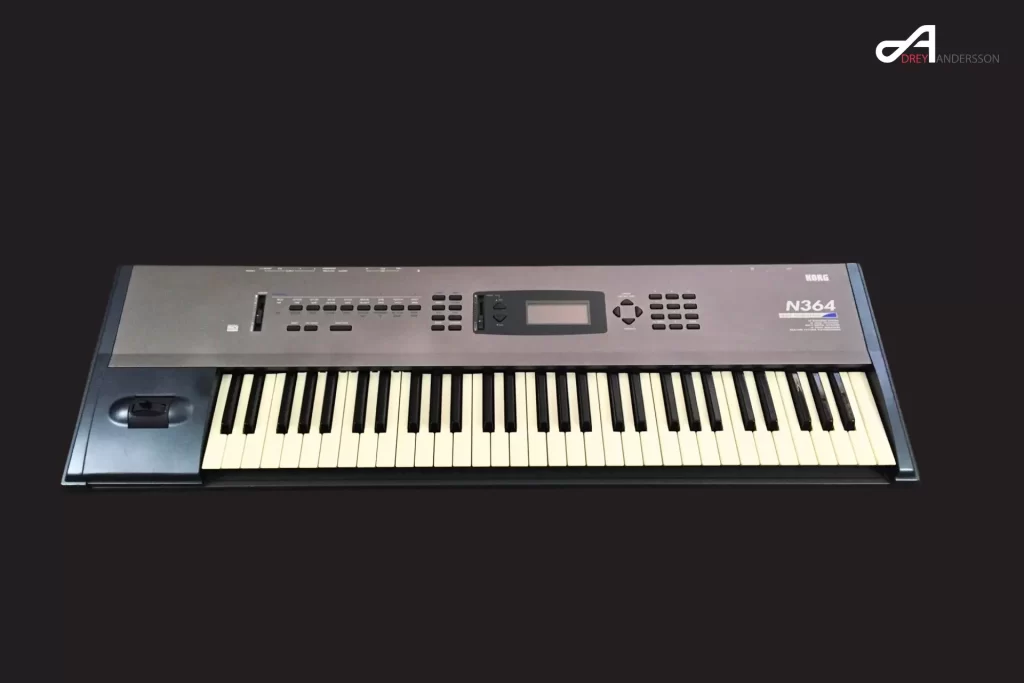
The Korg N364 is a 61-key music workstation released in 1996, with 64-voice polyphony, 16-part multitimbrality and 8 MB of PCM ROM running Korg’s AI2 synthesis. The Korg N264 is the same instrument with 76 keys. Both pair a sound engine Korg had already used in the X-series with a 16-track sequencer, a floppy drive, an arpeggiator and a new mode called Realtime Pattern Play and Record, or RPPR.
This page gives the specs of both models from Korg’s own manuals, then covers the sound engine, RPPR, the sequencer and what the service manual shows inside. It also places the N-series between the X3 and the N1 family, and lists the manuals and dated used prices.
- 64 voices in Single mode, 32 in Double mode, 16 parts, and 8 MB of ROM with 430 multisounds and 215 drum sounds.
- 536 programs plus 400 combinations make the often-quoted 936.
- The N264 has 15 more keys and is 212.4 mm wider and 1.8 kg heavier. Sound On Sound listed the N364 at £1,299 and the N264 at £1,499 in 1996.
- The sequencer holds 32,000 events across 10 songs and 100 patterns, and RPPR plays patterns from 60 keys.
- On 4 November 2026, Reverb showed no used estimate for either model. The newest sales it listed were €709 for the N364 and €588.90 for the N264.
Korg N364 specs and N264 differences
The two models share one specification page in Korg’s Reference Guide, so most rows below read the same.
| Feature | N364 | N264 |
|---|---|---|
| Released | 1996 | 1996 |
| Keyboard | 61 keys, velocity and aftertouch | 76 keys, velocity and aftertouch |
| Notes transmitted over MIDI | 24 to 108 | 16 to 115 |
| Synthesis | AI2 (Advanced Integrated) | Same |
| Polyphony | Single mode: 64 voices, 64 oscillators. Double mode: 32 voices, 64 oscillators. Dynamic allocation | Same |
| Multitimbrality | 16 parts | Same |
| PCM ROM | 8 MB: 430 multisounds, 215 drum sounds | Same |
| Programs | 536: 200 RAM, 336 ROM | Same |
| Combinations | 400: 200 RAM, 200 ROM | Same |
| Drum kits | 16: 4 user, 12 ROM | Same |
| Effects | 2 digital multi-effects processors, 47 types | Same |
| Sequencer | 16 tracks, 10 songs, 100 patterns, 32,000 events | Same |
| Arpeggiator | 5 types: Up, Down, Alt1, Alt2, Random | Same |
| RPPR | 10 pattern sets, 60 keys per set | Same |
| Audio outputs | 1/L/Mono, 2/R, 3, 4, and headphones, all 1/4 inch | Same |
| Pedal inputs | Assignable pedal, damper pedal | Same |
| MIDI | In, Out, Thru | Same |
| Floppy drive | 3.5 inch 2DD or 2HD, MS-DOS 720 KB and 1.44 MB format | Same |
| Display | Custom LCD with backlight | Same |
| Power consumption | 12 W | Same |
| Size (W x D x H) | 1076.4 x 338.3 x 106.1 mm | 1288.8 x 338.3 x 106.1 mm |
| Weight | 10.9 kg | 12.7 kg |
The Reference Guide lists five optional pedals: the PS-1 and PS-2 switches, the DS-1 damper, the EXP-2 expression pedal and the XVP-10 expression and volume pedal.
What differs between the N364 and the N264
- Keys and size: 61 against 76 keys, 1076.4 against 1288.8 mm wide, and 10.9 against 12.7 kg. Depth and height match.
- MIDI note range: the N364 transmits notes 24 to 108 and the N264 notes 16 to 115. Both recognize 0 to 127.
- RPPR keys: patterns sit on C#2 to C7 on both. The N364 stops playback with C2. The N264 stops it with E1 to C2, and its keys above C7 play normal notes.
- UK price: £1,299 against £1,499 in Sound On Sound’s October 1996 review.
- Service code: the service manual labels the N364 X-511 and the N264 X-512.
Korg’s Basic Guide says data moves between the two by floppy or MIDI dump and can be used as it is.
Details that differ between sources
The count of 936 only works as a total: 536 programs and 400 combinations, and 400 of those 936 are RAM locations you can overwrite. Some listings give 12 effect algorithms and others 47. Korg’s guide reconciles them by saying the 47 effects are based on 12 primary effects. Syntaur dates both models to 1997, while Sound On Sound reviewed a pre-release N364 in October 1996. The Reference Guide prints 12 W, and Korg product text copied on Synthmania prints 11 W. Vintage Synth Explorer says the LCD isn’t backlit, while Korg’s specifications say it is. Sound On Sound calls the GM bank editable, while Korg’s guide lists it as read-only ROM.
How AI2 synthesis works on the N364
AI2 is Korg’s name for a sample-based engine. A program starts from a multisound, a PCM sample in ROM, and shapes it with the blocks that subtractive synthesis would use on a raw waveform. Sound On Sound’s N364 review says the sound generation is identical to the later X-series and describes this version of AI2 as lacking the wave-shaping of the older 01/W, which relates to what a waveshaper does.
Each program runs in one of three oscillator modes:
- Single: one oscillator per note, 64-note polyphony.
- Double: two oscillators per note with different multisounds, 32-note polyphony. Each oscillator has its own VDF, VDA, pitch modulation, VDF envelope and VDA envelope, and the two share the pitch envelope and VDF modulation.
- Drums: a drum kit replaces the multisound. Each kit holds 60 indexes, and each index sets a drum sound, its note and level.
The filter has no real resonance. Sound On Sound’s X5DR review says the engine has a Colour parameter instead, and that review covers the module with the same 430 multisounds. The VDF modulation page offers triangle, two sawtooth directions, two square shapes and random, with speed, intensity, delay and keyboard sync. Separate edit pages cover the envelopes, velocity, keyboard tracking, aftertouch and the joystick.
What the 8 MB of ROM holds
Sound On Sound counted the X5DR’s waveforms against the X5: the first 340 multisounds and 164 drum sounds are shared, and the other 90 and 51 were added, which gives 430 and 215. Korg’s compatibility notes fit that count, because the X3 and X3R can’t play multisound 340 or above. The voice list mixes instruments with raw material: Saw, Square, Ramp, three pulse widths and Sine sit at numbers 330 to 337, next to names like VS 102, DWGS E.P. and, at 340, M1 Piano.
Programs, combinations and banks
Banks A and B are RAM, with 100 programs and 100 combinations each. Banks C and D are ROM with the same counts, and bank GM is ROM with 136 programs: 128 for General MIDI and 8 ROM drum kits. A combination holds eight timbres, each with a program, MIDI channel, key window and velocity window, which allows layers, splits and velocity switching. Sound On Sound noted that the display shows the programs of timbres 1 to 4 or 5 to 8, not all eight at once.
Effects and outputs
The two processors offer 47 effects: numbers 1 to 37 are single effects, 38 and 39 serial, and 40 to 47 parallel. The parallel types allow up to four effects at once. Korg counts nine reverbs among them, from Hall to Spring, and the Reference Guide also details delays, chorus, flanger, exciter, distortion, phaser, rotary speaker, tremolo and parametric EQ. Each program, combination and song stores its own settings, and a program inside a combination or song loses its own effects.
Signals travel on four buses, A to D, through one of six effect placements to the four outputs. To send a sequencer track to outputs 3 or 4 dry, Korg’s FAQ sets the placement to Parallel Sub, sets both effects to number 00, turns the track’s pan off, and then uses Send C and Send D as the levels for those outputs.
MIDI bank changes
Both models can act as a 16-part tone generator for an external sequencer. The chart shows controllers for modulation, volume, pan, effect sends, envelope times and brightness, and Korg’s FAQ gives these bank values:
| Bank | CC 0 | CC 32 | Program change |
|---|---|---|---|
| A | 0 | 0 | 0 to 99 |
| B | 0 | 1 | 0 to 99 |
| C | 0 | 2 | 0 to 99 |
| D | 0 | 3 | 0 to 99 |
| GM | 56 | 0 | 1 to 128 |
| GM drums | 62 | 0 | Not listed |
Inside the N364 and N264
Korg’s 20-page service manual covers both models. Its block diagram names a V55PI CPU and two chips labelled TGL2 as tone generators. The PCM ROM is labelled 16 Mbit x 4, which matches the 8 MB in the specs. Two TDA1305 converters feed the four outputs, and a separate subprocessor reads the keyboard, joystick, switches and value slider. Sound On Sound’s shorthand was two X3s in one, though it noted that the ROM is 1.33 times the X3’s and the sequencer capacity is unchanged. I read this diagram from a scan and haven’t compared it with an X3 service manual.
The same diagram labels the keyboard Fatar TP/9 for both 61 and 76 keys, with a separate aftertouch board, and the N264 parts list has a matching 76TP9 entry. My Fatar keybed guide lists the TP/9S, old version, unweighted, for both models. Vintage Synth Explorer calls the keys semi-weighted, which I can’t confirm from Korg’s documents. Sound On Sound’s review reports the action as light and shallow.
Internal memory is backed up by a battery, listed as a CR2032 in the N264 parts list. Syntaur offers 48 parts for the N364 and 47 for the N264, including displays, joystick parts and contact strips.
RPPR, the arpeggiator and the sequencer
Realtime Pattern Play and Record
RPPR assigns a sequencer pattern to a key, and pressing the key plays it. Each of the 10 pattern sets covers the 60 keys from C#2 to C7, and several keys can run at once, so drums, bass and other parts can start and stop separately. Every key also names the track whose settings its pattern uses. The result can be recorded into a song, and playback goes to the internal sound engine and MIDI Out together.
Sound On Sound reported that with the internal clock, key presses that come early or late are pulled into time. Korg’s RPPR article describes three trigger behaviors: play once, loop, or play while the key is held. Vintage Synth Explorer calls the N364 Korg’s first keyboard with the function, and Korg’s guide confirms that the X2, X3 and X3R don’t have it.
Korg’s RPPR demo tables name nine pattern sets: Funk, 90’s Soul, J-Dance and Jazz in the preload, and Pop Rock, Hard Rock, Latin, 70’s Disco and Euro in a file on the floppy. The demo songs are Music Lab by Taiki Imaizumi, MissionMan by John Lehmkuhl and Ghost Page by Shige Kawagoe.
Arpeggiator
The arpeggiator has five types: Up, Down, Alt1, Alt2 and Random. Alt1 sounds the top and bottom notes once per cycle, and Alt2 sounds them twice. It covers 1 to 4 octaves, with Sort, Gate and Sync parameters, and it works from program, combination or sequencer mode.
Sequencer and floppy disk
The sequencer holds 32,000 events across all songs and patterns, and one track or pattern can use up to 16,000 of them. A track runs to 999 measures and a pattern to 99, with a base resolution of 48 or 96 PPQN. Recording works in real time or step time, and a tempo track handles tempo changes. EXT tracks drive other MIDI gear, and song 9 can be set to General MIDI use. Data stays in memory at power-off, which Sound On Sound put down to static RAM. It also found the capacity unchanged from the X3 and noted that the Trinity offered 80,000 events.
The floppy stores programs, combinations, drum kits, global settings, sequences, pattern sets and MIDI data. It reads and writes Standard MIDI Files in formats 0 and 1. The included disk holds PCG, SNG and PST files, including the factory data and initialized versions. X2, X3 and X3R data loads directly, though Korg says it may behave differently on the other model. Going the other way, those models can’t play multisounds above their own range or take pattern sets. Programs from the i1, i2, i3 and i4S load into bank A, and i5S and i5M data isn’t compatible.
Neither model has a sampler or a card slot. Sound On Sound compared that with the M1’s PCM data cards and the expansion boards of Roland’s XP-50. New sounds arrive as patch data on floppy or over MIDI. Third-party USB floppy emulators are listed for both models, and I haven’t tested them.
Korg N364 history and the N1 family
Sound On Sound’s Gordon Reid traced the line in his review. The M1 arrived in 1988 with AI synthesis, and the 01/W brought AI2 in 1991. The 32-voice X3 followed in 1993. He called the 05R/W an X3 module and the X5 an 05R/W with a keyboard. The X5D and X5DR then doubled the polyphony to 64. He described the N364 as the keyboard version of the X5DR with the X3’s disk drive and sequencer put back, and he noted its four outputs. He reads the name as 64 voices and a 3 or 2 for keyboard size, and reports a rumor that N meant Next Generation.
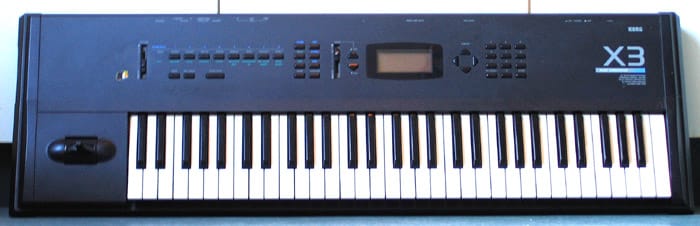
| Model | Reviewed or announced | Form | Voices | PCM ROM | Multisounds + drum samples | Onboard sequencer |
|---|---|---|---|---|---|---|
| X3 | 1993, per SOS | Keyboard | 32 | 6 MB | 340 + 164 | Yes |
| X5 | January 1995 | Keyboard | 32 | 6 MB | 340 + 164 | No |
| X5DR | May 1995 | Half-rack module | 64 | 8 MB | 430 + 215 | No |
| N364 | October 1996 | 61 keys | 64 | 8 MB | 430 + 215 | Yes |
| N264 | October 1996 | 76 keys | 64 | 8 MB | 430 + 215 | Yes |
| NS5R | February 1997 | Half-rack module | 64 | 12 MB | 527 + 286 | No |
| N5 | March 1998 | 61 keys | 64 | 12 MB | 528 + 286 | No |
| N1 | March 1998 | 88 weighted keys | 64 | 18 MB | 563 + 286 | No |
| N1R | December 1998 | 1U rack | 64 | 18 MB | Not in the review | No |
The N name then continued on later models. Sound On Sound’s NS5R review says its user interface is what principally makes that module more than a sequencer-less repackaging of the N364. It has 12 MB of ROM, 32 parts and stereo outputs only. Korg’s March 1998 announcement gave the N5 a US list price of $1,099 and the N1 $2,099. Both have 1,269 programs and 402 combinations, 32-channel operation and an arpeggiator with 20 patterns. Sound On Sound says the N5 is not just an N364 without the sequencer and disk drive, and that Korg addressed the filter’s limits with an effect called Resonant Filter. The N1 has extra ROM and two more outputs, and the N1R puts the same 18 MB in a 1U rack.
Other hardware entries on this site include the Yamaha SY77, the Yamaha TG77 and the Akai MPC3000. For a recent Korg entry, see the drumlogue. Vintage Synth Explorer names Tuomas Holopainen of Nightwish as a user of this line, which I haven’t checked further.
Korg N364 demo videos
The first video plays the three factory demo songs. The second is a longer video on the N364 from the Gearfacts channel.
N364 manuals and documentation
Korg keeps download pages for the N364 and the N264, marks both models as sold out, and asks you to accept a license agreement on each file’s page. The N364 page lists:
- N364 Basic Guide, a 3.6 MB PDF, tutorial style, with voice lists. It’s also on ManualsLib.
- N364 Reference Guide, an 8.9 MB PDF, with all parameters, the specs and the MIDI data format. ManualsLib has the 237-page scan.
- N364 FAQs, a 630.6 KB PDF with combination, tempo, bank and output routing notes.
- Factory Preload Data as a 154.6 KB ZIP, and Factory Preload RPPR Data as a 505.7 KB Windows EXE or 486 KB Mac SEA.
Both models share these guides. The Basic Guide PDF has no text layer, so searching inside it finds nothing. The page also offers OMS patch names for Mac. The service manual isn’t on Korg’s page, but ManualsLib has it.
N364 price and availability
Korg lists both models as sold out, so instruments now sell used. On 4 November 2026, viewed from Berlin, Reverb’s pages for the N364 and N264 both said no used estimate was available. Their transaction tables still list dated sales. I read 19 N364 rows back to April 2021, and more may exist. The N264 table has 7 rows.
The €65 N364 sale from June 2024 sits far below the others, and the table doesn’t say what was sold, so I can’t say it was a complete instrument. Reverb’s table lists that row as excellent. Conditions in the charted rows run from good to excellent, and the tables exclude shipping and tax.
Asks on the same day were higher at the top. Reverb’s N364 search showed eight listings titled as instruments, at €430 to €1,379.68. Its N264 search showed three at €439 to €1,149 among the results I read. A US Google Shopping block that day showed N364 entries at $990 to $1,480, plus a custom-colored unit at $2,499 and a $120 entry titled Design Blue. Its N264 entries ran from $499.99 to $750, one of them for parts. I opened none of those. USB floppy emulators for these models were listed at €90.02 to €325.53. These are asks, not sales, and they change quickly.
Frequently asked questions
When did the Korg N364 come out?
Korg released the N364 and N264 in 1996. Sound On Sound reviewed a pre-release N364 in its October 1996 issue, and the guide’s factory data carries a 1996 copyright. Syntaur’s parts catalog says 1997. Korg’s support pages now mark both models as sold out.
What is the difference between the Korg N364 and N264?
The N364 has 61 keys and the N264 has 76, which makes the N264 212.4 mm wider and 1.8 kg heavier. Sound engine, memory, sequencer and outputs match, and data moves between them. Sound On Sound listed them at £1,299 and £1,499 in the UK.
How many voices does the Korg N364 have?
It has 64 voices in Single mode, with one oscillator per note, and 32 voices in Double mode, with two oscillators per note. Voices are allocated dynamically across up to 16 parts. A combination layers or splits up to eight programs, so it can use polyphony quickly.
What does RPPR mean on the Korg N364?
RPPR stands for Realtime Pattern Play and Record. It assigns a sequencer pattern to each of 60 keys, from C#2 to C7, in 10 stored sets. Pressing a key plays its pattern, several keys can run together, and the result can be recorded into a song.
What synthesis does the Korg N364 use?
It uses Korg’s AI2 synthesis, a sample-based method. A program plays one or two of 430 multisounds from 8 MB of ROM through a Variable Digital Filter and a Variable Digital Amplifier, each with envelopes and modulation. The filter has no true resonance, according to Sound On Sound’s review of the X5DR, which has the same 430 multisounds.
Does the Korg N364 have a sampler or expansion slot?
No. It has 8 MB of fixed PCM ROM, no sampling input and no card slot. New programs, combinations and songs load through its 3.5 inch floppy drive or over MIDI. Korg’s factory data is still offered as a 154.6 KB download.
Can the Korg N364 load Korg X3 sounds?
Yes. Korg’s Basic Guide says the N264 and N364 exchange data with the X2, X3 and X3R by floppy or MIDI dump, though some settings may behave differently. Going back, the X3 and X3R can’t play multisounds from number 340 up, and pattern sets don’t transfer.
Where can I find the Korg N364 manual?
Korg’s N364 download page offers the Basic Guide as a 3.6 MB PDF and the Reference Guide as an 8.9 MB PDF, after you accept its license terms. ManualsLib also shows the 237-page Reference Guide and the 20-page service manual, which covers both models.
How much is a used Korg N364 worth?
On 4 November 2026, viewed from Berlin, Reverb gave no used estimate. Its newest N364 sale was €709 in December 2025, and instrument listings asked €430 to €1,379.68. Its newest N264 sale was €588.90 in June 2026. Those figures change often, and the sale figures exclude shipping and tax.
Back to Music Production Terms Index Page