What the Akai MPC3000 is
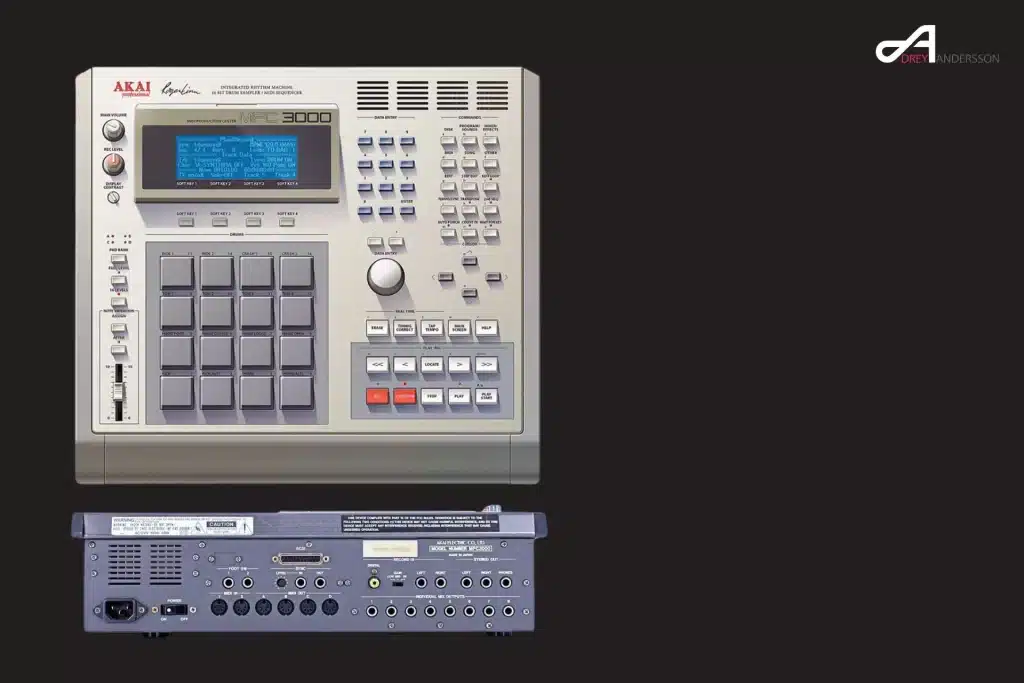
The Akai MPC3000 is a 16-bit sampling drum machine and 99-track MIDI sequencer that Akai released in 1994, the last MPC to carry Roger Linn’s name. It followed the 12-bit MPC60 and MPC60 II with CD-rate stereo sampling, 32 voices and a resonant filter on every voice, and it kept the 16 pads and the swing control of the earlier machines.
J Dilla’s limited edition unit is now in the Smithsonian’s collection. Since September 2026 a new wave of independent software has appeared for classic MPCs, and 32 years after launch the MPC3000 has an operating system that adds waveform editing. This page covers its specs, memory, timing, history, firmware and dated prices.
- 16-bit, 44.1 kHz, 32 voices, 16 pads, 99 sequences and 75,000 notes at 96 ppq.
- Akai specified 16 MB of sound memory. Some machines run 32 MB, which the sound chip’s address bus allows, and two of the five US listings I checked show it.
- Swing runs from 50 to 75 %, and on 1/16 notes neighbouring settings often land on the same tick.
- Vailixi 3.50 is a third-party EPROM replacement. 3K PLUS 1.0, demoed on 30 October 2026, loads from floppy and adds waveform editing and Lazy Chop.
- Reverb’s estimated used value was €1,790 to €4,691 on 4 November 2026.
Akai MPC3000 specs
These figures come from Akai’s own manual, cross-checked against the two launch reviews. Akai and both launch reviews list the eight individual outputs as standard equipment. You can read the full MPC3000 manual on ManualsLib, including its appendix for the version 3.1 software update.
| Feature | Akai MPC3000 |
|---|---|
| Type | Sampling drum machine and MIDI sequencer |
| Introduced | 1994 |
| Sampling | 16-bit linear, 44.1 kHz, mono or stereo, 20 Hz to 20 kHz |
| Sound memory | 2 MB standard (21.9 s mono), 16 MB official maximum (188.3 s mono) |
| Voices | 32 |
| Filter | 12 dB per octave resonant lowpass per voice, with envelope |
| Effects | Three delays, 1 to 1486 ms |
| Sounds and programs | 128 sounds in memory, 24 programs, 64 assignments per program |
| Pads | 16 velocity and pressure sensitive pads, 4 banks |
| Sequencer | 99 sequences, 99 tracks each, 75,000 notes, 96 ppq, tempo steps of 0.1 BPM |
| Song mode | 20 songs, 250 steps each |
| MIDI | 2 mergeable inputs, 4 independent outputs (64 channels), no hardware Thru |
| Sync | MIDI Time Code, MIDI clock, FSK 24, 1/4-note clicks; reading SMPTE needs the I-0055 chip |
| Audio outputs | Stereo mix plus 8 individual outputs, headphones |
| Audio inputs | Stereo analog; S/PDIF digital input at 44.1 kHz only; no digital output |
| Storage | 3.5 inch HD floppy (1.44 MB), 25-pin SCSI |
| Display | 320 characters, 240 x 64 dot LCD |
| CPU | NEC V53 at 16 MHz |
| Options | EXM3008 8 MB memory board, SIMM sockets, I-0055 SMPTE chip, IB-CRT VGA output |
| Size and weight | 440 x 121 x 405 mm, 9 kg |
Period reviews list a few limits. There is no sample looping, which Sound On Sound put down to its role as a drum sampler. The Mix tried playing a tuned cowbell across a keyboard and had to build the map note by note. Sound On Sound noted that the machine can randomly play or skip the last 20 ms or so of a sample, which the manual also mentions. And samples and sequences live in RAM, so anything unsaved is gone at power-off.
Sound memory: 16 MB official, 32 MB on upgraded machines
Akai’s official ceiling is 16 MB. The manual describes how you get there: one connector holds a 2 MB board from the factory, which you can swap for the 8 MB EXM3008, and two SIMM sockets take a matched pair of 1 MB or 4 MB modules. The biggest combination is 8 + 8 = 16 MB.
Listings and references now commonly quote 32 MB, and Vintage Synth Explorer gives 2 to 32 MB. The MAME driver describes the sound chip’s wave bus as 16 bits wide with 24 address bits, or 32 MiB of sample space. The Vailixi notes also list a fix so that 32 MB machines can record across all of it, and date the underlying bug back to system 3.00.
The manual figure Sound On Sound quotes for the MPC2000XL gives a fair idea of the time involved: 378.6 seconds of mono at 32 MB, in the same 16-bit, 44.1 kHz format. 3K PLUS was built and tested on a roughly 32 MB machine.
MPC3000 swing and timing
Swing on the MPC3000 is the percentage of time given to the first note of each pair, set from 50 to 75 %, and stock software offers it on 1/8 and 1/16 notes only. Akai’s manual calls 66 % a “technically perfect swing”, suggests 54 % at 100 BPM to loosen 1/16 hi-hats, and describes 62 % as more relaxed than a triplet feel.
The sequencer works in ticks at 96 per quarter note, so a swung note has to land on a whole tick. A pair of 16ths spans 48 ticks. That gives one tick per roughly 2.08 % of swing, and assuming 1 % steps, the 26 settings share only 13 positions.
An MPC2000 mod project documents one example. MPC2000 Mods ships an MPC3000 swing option, and its documentation says that at 1/16 and 66 %, the second note lands on tick 32 on the MPC3000 and on tick 31 on a stock MPC2000. At 100 BPM that’s a 6.25 ms difference. The exact value is 31.68. Rounding to the nearest tick fits that example, and so does rounding up; the documentation doesn’t give the rule.
If round-to-nearest holds across the range, which I’ve assumed here and not measured, 62 % and 63 % play identically on 1/16 notes because both land on tick 30. Rounding up would separate them. The Alchemist told an Aulart masterclass that those are the two numbers he leans on, though MusicRadar says he favours later models such as the MPC 2500. A 1/8 pair spans 96 ticks. Under the same rule, and assuming 1 % steps, the 26 settings land on 25 different ticks. The only two that share one are again 62 and 63, both on tick 60.
The other approach is turning quantize off. Vox’s video on J Dilla explains that he did exactly that on his MPC3000.
History and lineage
Akai and Roger Linn’s first MPC, the MPC60, arrived in 1988, followed by the MPC60 II in 1991 and the MPC3000 in 1994, according to MusicRadar’s history of the line and Sonic State’s Linn interview. Sound On Sound’s 1997 review of the MPC2000 names those three as the units that carried Linn’s name and notes that the 2000 was the first without his signature. For the full run of models, see my history of the Akai MPC.
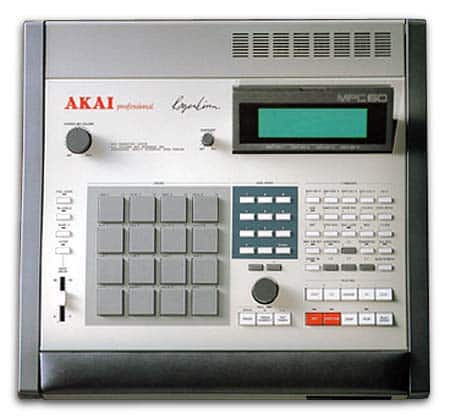
The Mix noted the confusion for anyone expecting an MPC60 Mk III. Its seasoned MPC60 user struggled with the renamed sound menus, because Akai had moved the terminology towards its S1000 and S3000 samplers. The 3000 loads their samples, though not their programs. The same user was struck by how clean it sounded. At launch the 3000 also dropped the metronome output, MIDI Sample Dump and the standard SMPTE reader, and both reviewers objected to paying extra for SMPTE.
| MPC60 (1988) | MPC3000 (1994) | MPC2000XL (1999) | |
|---|---|---|---|
| Sample format | 12-bit non-linear, 40 kHz | 16-bit linear, 44.1 kHz | 16-bit, 44.1 kHz |
| Standard memory | 750 KB (13.1 s) | 2 MB (21.9 s mono) | 2 MB (21.9 s mono) |
| Official maximum | 1.5 MB (26.2 s) | 16 MB (188.3 s mono) | 32 MB (378.6 s mono) |
| Voices | 16 | 32 | 32 |
| Note capacity | 60,000 | 75,000 | 300,000 |
| SCSI | No | Yes, 25-pin | Yes, 50-pin |
| Sample looping | No | No | Yes (added on the MPC2000) |
| Roger Linn’s name on it | Yes | Yes | No |
| UK price at review | £2,999 inc VAT | £2,799 inc VAT | £300 below the MPC2000 |
The MPC3000 LE is a later variant in black, with a gold plaque carrying an edition number. Smithsonian Magazine reported in 2014 that J Dilla’s mother, Maureen Yancey, donated his LE and his custom Minimoog Voyager to the National Museum of African American History and Culture, whose catalogue record gives the plaque as edition 0449. Reverb’s catalogue dates the LE 1999 to 2001. I couldn’t find an Akai document stating how many were made, or showing any change to the sound engine.
Vintage Synth Explorer’s user list includes Dr. Dre, DJ Quick, Jean-Michel Jarre and The Crystal Method. MusicRadar adds DJ Shadow, who brought in a 3000 for his UNKLE work, and house producer Ian Pooley, who still builds his studio around one.
MPC3000 firmware: Vailixi, 3K PLUS and the 2026 wave
The MPC3000 keeps its operating system on EPROM chips. Vailixi replaces those chips, while 3K PLUS loads from floppy and writes nothing to them.
Vailixi 3.50, the EPROM route
The older third-party route is Vailixi 3.50 from Mansell Labs, sold as a set of EPROM chips that replace the originals. Its notes list swing on many more note values, 1/128 and 1/192 timing resolutions, a Copy Zone to Sound function, sample editing while the sequencer runs and a compression option. They also add 32 MB single-file sample saves, hybrid SCSI partitions readable by a computer, and fixes for bugs dating back to system 3.00. The current retailer page is a vendor listing and the only detailed record I could open, so treat the wording as the seller’s.
3K PLUS, the floppy route
3K PLUS comes from Clevedon Road, which its site describes as P-Money’s workshop for independent audio software, based in Auckland, New Zealand. Clevedon Road lists waveform editing as new, and the 1994 review of software 3.0 describes no waveform display. The demo below shows trimming and chopping by eye on the machine’s LCD.
| 3K PLUS 1.0 | As stated by the maker on 4 November 2026 |
|---|---|
| New features | Waveform editing, Lazy Chop, mute groups, track mutes, input monitoring, apply one pad’s settings to every pad, data-wheel file naming, screen mirroring over MIDI with a free companion app |
| Works with | MPC3000 with 3.08, 3.11, 3.12 or Vailixi 3.50 EPROMs, one OS file for all four |
| Loading | From floppy as STARTUP.SYS or a Gotek / FlashFloppy image, about 50 seconds. Nothing is written to the EPROMs, and removing the disk and restarting returns to the previous OS |
| Not supported | SCSI-only machines |
| Testing | Built and tested on a machine with Vailixi 3.50 and about 32 MB. The 3.08, 3.11 and 3.12 EPROM versions have been tested in emulation, and the maker asks for hardware reports |
| File behaviour | Mute groups are saved in PGM and APS files, and stock systems load those files and ignore the groups |
| Trade-offs | Compress sound replaces MIDI Sample Dump in the menu, and Input Thru reserves 16 KB of sound memory |
| Price | US$39 launch week, US$49 standard, tax added at checkout |
| Status | Independent software, not made or endorsed by Akai, used at your own risk |
What the launch reviews raised
Several of these features line up with points in the first reviews. David Mellor’s 1994 review suggested Akai add a way to cut up a long sample. Vailixi’s Copy Zone to Sound later did this by marking a zone, and Lazy Chop in 3K PLUS does it from the pads.
| What the launch reviews raised | What later software did |
|---|---|
| Stop key that also stops long samples (SOS 1994) | Vailixi 3.50: a system option named SND playback stops on STOP |
| A way to cut a long sample into pieces (SOS 1994) | Vailixi 3.50: Copy Zone to Sound. 3K PLUS: Lazy Chop, tapping pads to mark slices and build a drum program |
| MIDI filing, promised for later software (The Mix 1995) | Akai version 3.1: Standard MIDI File save and load |
| MIDI Sample Dump, absent at launch (The Mix 1995) | 3K PLUS says Compress sound replaces MIDI Sample Dump at Program/Sounds > 9, which implies later systems had it. I couldn’t confirm which version added it |
The wider firmware wave
Custom firmware for MPCs isn’t new, since JJOS has served the MPC1000 and MPC2500 for years. The pace rose sharply in 2026. Dubspot’s October roundup ties the rush to AI coding agents absorbing the reverse-engineering work, and it found most of the active repos were only weeks old. That’s the same scene I covered on the M-Vave FM-1 and in my guide to open-source synths.
- 2KXL PLUS 1.3.2 (7 October 2026, US$49) is Clevedon Road’s sister OS for the MPC2000XL only, based on Akai OS 1.20.
- MPC2000 Mods by vubeatz, at version 2.1 when I checked, patches the original Akai OS for the MPC2000 and 2000XL, including that MPC3000 swing rounding. Source for 8 of its mods is on GitHub.
- Open500 patches a small loader into MPC500 OS 1.31, then loads add-ons from the card.
Emulation sits next to all of this. MAME has a driver for the MPC3000, and two plugin projects build on MAME: Autodafe’s free Vintage Emulator Studio, which lists the MPC3000 among 40-plus machines, and MPC3K-VST, a source project for VST3 and AU whose README says it boots OS 3.12. Neither includes the firmware, so you supply your own ROM files. The MAME source I read still flags its MPC3000 driver as not working, and I haven’t tested either plugin.
Synth Anatomy, citing a retailer leak, described the 2026 MPC Sample as inspired by the MPC60 and MPC3000. It also reports that Akai plans to open the MPC Sample to community firmware, though I found no published code when I checked on 4 November 2026. Current MPCs I’ve written about include the MPC Live III and the MPC Live II in a mobile setup. For the wider category, see groovebox and dawless.
MPC3000 price and availability
The MPC3000 is long discontinued, so every unit is used. The Mix listed it at £2,799 including VAT in June 1995. I found no reliable US launch price.
On 4 November 2026, the Reverb price guide, viewed from Berlin, estimated a used value of €1,790 to €4,691. Asking prices in the US on the same day were $3,500 for a serviced standard unit and $5,499 for one with 32 MB on eBay, and $5,482 to $7,999 for LE models across eBay and Reverb. Those are asks, not sales, and they aren’t like-for-like, because condition, memory and installed OS differ. These numbers age quickly, so check again before relying on them.
Frequently asked questions
When did the Akai MPC3000 come out?
Akai introduced the MPC3000 in 1994. Sound On Sound reviewed a pre-production unit running software 3.0 in October 1994, and The Mix reviewed it in June 1995. A 1997 Sound On Sound review names it as the last of three MPCs that carried Roger Linn’s name, because the MPC2000 dropped his signature.
How much sample memory can an MPC3000 hold?
Akai specified 2 MB as standard and 16 MB as the maximum, which gives 188.3 seconds of mono sampling at 44.1 kHz. Some machines run 32 MB, as two of five US listings showed on 4 November 2026. The sound chip’s address bus covers that range.
What is the difference between the MPC3000 and the MPC3000 LE?
The standard MPC3000 is beige, while the LE has a black finish and a gold plaque with an edition number. J Dilla’s, now in the Smithsonian’s collection, is number 0449. Reverb’s catalogue dates the model 1999 to 2001. I found no Akai document that states how many were made or lists any change to the sound engine.
What is 3K PLUS for the MPC3000?
3K PLUS is an independent operating system for the MPC3000 from Clevedon Road, P-Money’s workshop in New Zealand. Version 1.0 adds waveform editing, Lazy Chop, mute groups and track mutes. It loads from floppy or Gotek and leaves the EPROMs alone. On 4 November 2026 it cost US$39 at launch-week pricing, US$49 standard.
Does 3K PLUS need a floppy drive?
Yes. 3K PLUS needs a working floppy drive or a Gotek, and SCSI-only machines aren’t supported. One OS file covers EPROM versions 3.08, 3.11, 3.12 and Vailixi 3.50. The maker built it on a Vailixi machine, has tested the three Akai versions in emulation, and asks for hardware reports.
What is Vailixi OS 3.50?
Vailixi 3.50 is a third-party MPC3000 operating system from Mansell Labs, sold as replacement EPROM chips. The vendor’s notes list swing on more note values, a Copy Zone to Sound function, samples up to 32 MB saved as one file, and fixes for bugs present since system 3.00.
How many voices and outputs does the MPC3000 have?
The MPC3000 plays 32 simultaneous voices, each with a 12 dB per octave resonant lowpass filter. It has 10 analog outputs, made up of the stereo mix and 8 individual outputs, plus two MIDI inputs and four MIDI outputs. There is an S/PDIF digital input but no digital output.
Can you run the MPC3000 as a plugin?
Two plugin projects exist, both built on MAME. Autodafe’s free Vintage Emulator Studio lists it among more than 40 machines, and MPC3K-VST is a source project for VST3 and AU whose README says it boots OS 3.12. Neither includes the firmware. The MAME source I read still flags its MPC3000 driver as not working, and I haven’t tested either.
Back to Music Production Terms Index Page