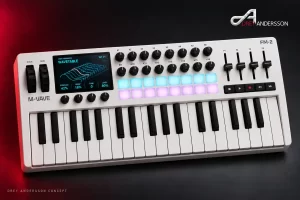
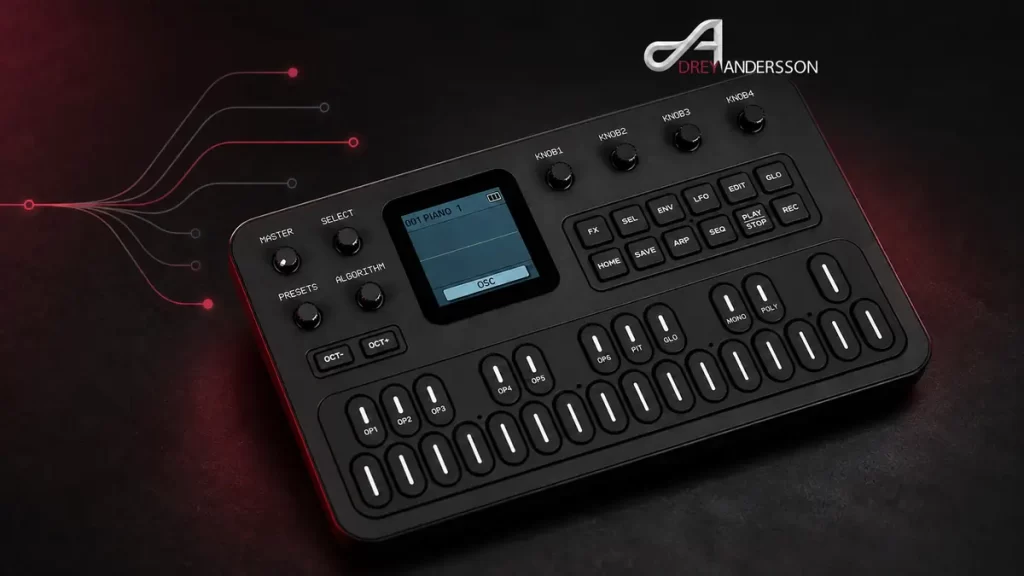
As of 4 November 2026, the M-VAVE FM-1 has seven major custom firmwares you can install: SLOOP, Felucca, FM-1+VA, X0X, Jangada, Groove OS and FoMni (formerly OMNI). Behind them grows a second tier of forks (Felucca and SLOOP alone have 260), a patch for the stock firmware, and a few projects you can’t flash yet. My pick for the best FM-1 firmware is a tie: SLOOP and Felucca both score 79 out of 100. Choose SLOOP for playing live, and Felucca for sound design and recording. If you’d rather keep M-VAVE’s own code running, Baud Girl’s FM-1+VA (77) is the safest free choice.
The scene started in late September and still moves fast. Synth Anatomy counted “two new custom firmware versions (Baud Girl and Felucca) in just one week” by 4 October (Synth Anatomy, Groove OS article). By 6 October there were seven, and between 7 and 9 October Felucca alone shipped ten more releases. This guide ranks the seven, explains how to install and remove them, and tells you what to do if your FM-1 stops booting. I first published it on 7 October. Every version number and score below was re-checked against the developers’ own pages on 10 and 22 October, and again on 4 November 2026.
In short
- Best overall: SLOOP 2.8.5 and Felucca 1.8.1, both free and open source, tied on 79. The Felucca boot bug from my first version was fixed on 7 October.
- Lowest risk: FM-1+VA (free) or Groove OS 1.4.1 ($29). Both patch M-VAVE’s V15 instead of replacing it. Groove OS 2.0 doesn’t, so it dropped in my ranking.
- New since 22 October: some recent FM-1 units have a different flash chip that some firmwares don’t recognise yet, so saves can vanish at switch-off. Details in the box below and in the safety section.
- 27 releases shipped across four GitHub repos in about three and a half days, then 24 more from 6 to 9 October. Re-check versions before you flash.
- Back up first. The FM-1 has one flash bank and no recovery button.
Which M-VAVE FM-1 custom firmware is best?
In my ranking, re-checked on 4 November 2026, SLOOP and Felucca share first place with 79 out of 100. FM-1+VA follows on 77, then X0X on 74, and Jangada and Groove OS on 67. SLOOP and Felucca win on features: SLOOP has 12 engines plus a piano-roll editor, Felucca had 13 when I counted them at 1.6.1, and both are free and open source. FM-1+VA is the pick if you want the least risk for free, because it modifies stock V15 instead of replacing it. Here’s the full list, with each firmware’s best use.
| # | Firmware | Best for | Version (4 Nov 2026) | Price | Score |
|---|---|---|---|---|---|
| 1 | SLOOP (3dSam) | Free live-jamming groovebox | 2.8.5 | Free, GPL-3.0 | 79 |
| 2 | Felucca (Hügelton) | Sound design and USB audio | 1.8.1 (1.8.2 beta) | Free, GPL-3.0 | 79 |
| 3 | FM-1+VA (Baud Girl) | Keeping it an FM synth, but better | Version 102 | Free, closed source | 77 |
| 4 | X0X (Charles Vestal) | Acid, 909, 808 and breaks | 1.2.0 | Free, GPL-3.0 | 74 |
| 5 | Jangada (zednaked) | Drones and dark superwaves | 1.0.1 | Free, GPL-3.0 | 67 |
| 6 | Groove OS (Peter Gombos) | Sampling groovebox | 2.0 (1.4.1 still offered) | $29 one-time | 67 |
| 7 | FoMni (Charles Vestal) | Omnichord-style strumming | 0.4 | Free, GPL-3.0 | 66 |
- A new flash chip. Some recent FM-1 units carry a UC25HQ80 flash chip, according to The Firmware Hub, and firmwares that only know the old one can lose your saves at switch-off and refuse updates. SLOOP 2.8.5 and Melodee 1.6 recognise it, and Felucca does in its 1.8.2 beta. See the chip section before you buy or flash a new unit.
- Groove OS 2.0 isn’t a V15 mod any more. The 2.0 release on 30 October adds sampling, but its manual says it’s built new rather than patched onto M-VAVE’s firmware. 1.4.1 is still offered as the V15 mod.
- Scores: only Groove OS moved, from 74 to 67: risk 5 to 3, features 4 to 5. That puts it sixth behind Jangada, because ties go to the free option. SLOOP stays ahead of Felucca on the tie-break, by 736 GitHub stars to 650.
- Versions: SLOOP 2.8 to 2.8.5, Felucca 1.6.1 to 1.8.1, X0X 1.1.0 to 1.2.0, Groove OS 1.4 to 2.0, Melodee 1.4.5 to 1.6.1, fm1-emu 0.2.0 to 0.4.0. FM-1+VA 102, Jangada 1.0.1 and FoMni 0.4 haven’t changed.
- M-VAVE: FM1 Open is still on V14 from 19 October, now with 301 GitHub stars, and I still haven’t run or scored it. M-VAVE’s download page now offers stock V16, not V15.
- Still open: SLOOP reports #185 and #186 from 20 October.
- M-VAVE joined in. On 13 October the company published FM1 Open, its own open-source firmware with a browser workbench and an SDK: eight tracks, a DX7-style FM engine, samples, and 303-, 808-, PSG- and pluck-style engines. V12 shipped on 14 October and V14 on 19 October. The app source is GPL-3.0 with a linking exception; the SDK binaries come under separate terms. It already has 208 GitHub stars. I haven’t run it yet, so it isn’t scored here.
- Stock V16. M-VAVE’s own firmware went to V16 on 21 October: eight voices, patterns up to 64 steps and 128 effect presets, according to the release note. Every installer in this guide was written against V15, and I haven’t tested any of them on a unit that shipped with V16.
- One emulator for all of them. Joakim Eriksson’s fm1-emu (12 October, v0.2.0 on 19 October) emulates the FM-1’s chip, screen, keys and knobs, so every firmware here runs unchanged in your browser, natively, or as an AU/VST3 plugin. Try before you flash.
- Versions moved on every row: Felucca 1.5 to 1.6.1, SLOOP 2.5 to 2.8, FM-1+VA 97 to 102, Groove OS 1.2.1 to 1.4 (plus a 2.0 sampling beta), X0X 0.10.3-beta to 1.1.0 (out of beta), FoMni 0.3.2 to 0.4, Jangada 0.9.2 alpha to 1.0.1 (out of alpha), Melodee 0.13.1 to 1.4.5.
- Scores: X0X 71 to 74 and Jangada 64 to 67, both for leaving beta and alpha. Nothing else moved. SLOOP overtook Felucca on GitHub stars (604 to 566), so the tie-break now lists SLOOP first.
- Safety: Melodee 1.3.0 and 1.3.1 left some units on a black screen (fixed in 1.3.2 the next day), SLOOP 2.7 could crash and restart (fixed in 2.7.1 the same day), and two SLOOP reports from 20 October are still open. All in the safety section below.
- A hub worth bookmarking: aroum/fm1-custom-fw keeps a directory of every firmware, docs, SysEx tools and a flasher.
The wider picture has moved too. Since this scene took off, Behringer and Polyend have published open code and Akai is reported to be following. On 4 November 2026 I checked which open-source synths and samplers are really open, including M-VAVE’s own FM1 Open.
How I scored them
I scored each firmware from 1 to 5 on five criteria, then weighted them. Risk to your unit counts 30%, features 25%, maturity 15%, install and rollback 15%, and cost and openness 15%. Each score is divided by 5 and multiplied by its weight, and the five results add up to the total. Ties go to the free option first. Felucca and SLOOP are both free, so that tie goes to the project with more GitHub stars. On 10 October that was Felucca, by 362 to 356; on 4 November it is SLOOP, by 736 to 650. Treat them as joint winners.
For risk, 5 means a V15 patch that can also boot stock without reflashing, and 4 a V15 patch. A 3 means a replacement with a rescue mode or a package check before it erases anything, a documented hardware run and no open boot issue, and 2 a replacement still in alpha. I haven’t flashed any of the seven ranked firmwares myself. Every score comes from the developers’ documentation, release notes and issue trackers.
I re-scored all seven on 10 October against the new releases. Felucca’s risk went from 2 to 3 because its boot bug is fixed. SLOOP and Jangada went to 5 for features, and FoMni gained on risk, maturity and rollback. Nothing else moved. That’s why FM-1+VA, my first pick on 7 October, is now third.
On 22 October I re-scored again. X0X moved to 3 for maturity after 1.0 and 1.1 left beta, and Jangada to 2 after 1.0 left alpha. SLOOP keeps its 3 for risk: of the two reports from 20 October, one is a Windows loader stall that M-UPGRADE resolves, and the other is a brand-new unit that went dark before SLOOP had written anything, which its developer traces to the stock side. Both are in the safety section.
On 4 November I re-scored once more, and only Groove OS moved. Version 2.0 replaces the firmware instead of patching V15, so its risk goes from 5 to 3 under the rule above, and sampling takes its features from 4 to 5. That gives 67, down from 74. It ties Jangada, and the free option goes first. Groove OS 1.4.1 is still a V15 mod with the old safety properties, but I score the current release, because that’s what the install page gives you by default. Scored alone, 1.4.1 would keep its 74. The new flash chip doesn’t change any score yet. The Firmware Hub says affected units aren’t damaged, and support is changing from one release to the next.
| Firmware | Risk (30%) | Features (25%) | Maturity (15%) | Install + rollback (15%) | Cost + openness (15%) |
|---|---|---|---|---|---|
| Felucca | 3 | 5 | 3 | 4 | 5 |
| SLOOP | 3 | 5 | 3 | 4 | 5 |
| FM-1+VA | 4 | 4 | 3 | 5 | 3 |
| Groove OS 2.0 | 3 | 5 | 3 | 4 | 1 |
| X0X | 3 | 4 | 3 | 4 | 5 |
| FoMni | 3 | 3 | 2 | 4 | 5 |
| Jangada | 2 | 5 | 2 | 3 | 5 |
Why does FM-1+VA get a 4 for risk and Felucca only a 3? FM-1+VA and Groove OS 1.4.1 patch M-VAVE’s own V15 firmware, so M-VAVE’s code, including the stock FM engine, keeps running underneath. Felucca, SLOOP, X0X, FoMni, Jangada and Groove OS 2.0 replace the whole application. That gives you more freedom, but it also puts more new code between you and a working synth.
What is FM-1 custom firmware, and why did it appear so fast?
FM-1 custom firmware is third-party software that replaces or patches the official M-VAVE operating system on the $60 to $80 pocket FM synth. It appeared fast because the FM-1 accepts updates as USB-MIDI SysEx checked only by a CRC-16 checksum, with no cryptographic signature (ip2k, Lunar Modulator docs). The only version check sits in the updater app, not in the synth, so a file with a new version number installs. Until late September 2026, the only M-VAVE FM-1 firmware was M-VAVE’s own.
Underneath, the FM-1 runs a JieLi AC791N chip with 1 MB of flash. Its stock sound engine is a port of Google’s msfa, the same core that powers Dexed (AL-255, FM-1-RE). So developers who already knew Dexed could read it. M-VAVE’s specs list 6 operators, 32 algorithms, 128 presets and up to 12 voices (M-VAVE FM-1 product page). If you’re new to the method itself, my Yamaha SY77 entry covers how a six-operator FM engine builds a sound.
From zero to seven firmwares in ten days, and what came next
- 26 September: Baud Girl publishes FM-1_083, the first public FM-1+VA build.
- 27 September: czietz releases a small binary patch for stock V15.
- 28 September: Synth Anatomy and Piano & Synth cover FM-1+VA. It’s the earliest press coverage I found.
- 2 to 3 October: Groove OS 1.0 is released, and Felucca appears. Felucca’s source goes public with 0.8-beta.
- 4 October: SLOOP 2.0, X0X 0.1-beta and Jangada 0.1-alpha ship. Synth Anatomy announces Groove OS.
- 5 October: Felucca 1.0 lands with 13 engines.
- 6 October: SLOOP 2.3, X0X 0.10.1-beta, FM-1+VA 096, Felucca 1.0.3, Jangada 0.5 and OMNI 0.1 all ship on the same day.
- 7 October: Felucca 1.0.3.1 fixes the boot bug behind issue #61. SLOOP 2.4 adds six-operator FM that plays DX7 patches. OMNI is renamed FoMni.
- 8 October: Melodee 0.13 adds a Prophet-5 engine, and Felucca 1.1.5 adds parameter locks.
- 9 October: Felucca 1.5, SLOOP 2.5, FM-1+VA Version 97, Groove OS 1.2 and Jangada 0.9 ship.
- 13 October: M-VAVE publishes FM1 Open, its own open-source firmware and SDK. Jangada 1.0 leaves alpha, Felucca 1.6 ships.
- 15 to 16 October: X0X 1.1 leaves beta, Groove OS 1.4, FoMni 0.4 and SLOOP 2.7 (both cores) ship, and fm1-emu runs every firmware in the browser.
- 19 to 21 October: FM1 Open V14, FM-1+VA 102, SLOOP 2.8, Groove OS 2.0 beta and M-VAVE’s stock V16.
- 28 October to 4 November: Felucca 1.7.0, Groove OS 2.0, X0X 1.2.0 and Melodee 1.6 ship, and SLOOP 2.8.5 and Felucca 1.8.2 beta add the newer flash chip.
Search demand followed the code. In my Google Trends pull, worldwide interest in “fm-1 firmware” climbed from almost nothing on 25 September to 45% of the FM-1’s own peak on 5 October. On 5 October, people searched for the firmware nearly half as often as for the synth itself.
The 7 major FM-1 custom firmwares, ranked
All seven install from a Chrome or Edge browser over USB, and most were written for stock V15 on the unit first. As of 4 November 2026, one is a free mod of M-VAVE’s own code (FM-1+VA), one is a $29 paid groovebox that’s built new since 2.0 (Groove OS), and five are free, open-source replacements under GPL-3.0. Here’s what each one does, who it’s for, and its known issues.
1. SLOOP by 3dSam: best free groovebox
SLOOP turns the FM-1 into a four-part groovebox built for playing live. You get three synth parts and a drum machine, with 16 sounds on the white keys. Hold a function button, and the keys and knobs switch jobs: FX, EDIT, ARP, SEQ, SEL, GLO or SAVE. Recording follows your playing with no click required.
SLOOP 2.5 shipped on 9 October 2026 with 12 engines and 153 sounds, including a sampled Steinway grand (SLOOP on GitHub). Version 2.4 added six-operator FM that imports DX7 patches, and 2.5 added physical models (guitars, sitar, bells, hand drums) and a noise engine. Since 2.4 you also get parameter locks, micro timing, fills and the sequencer on MIDI out. The drum side has 37 kits, kits built from your own samples in four user slots, and since 2.5 a drum synth in the web editor for designing your own. Version 2.5 also added MIDI CCs and 48 kHz USB audio, so you can record it straight into a phone. It kept moving after that: 2.6 (11 October) added eleven more punch-in effects and an effect on every track, 2.7 (16 October) runs the sound on both of the FM-1’s processor cores, and 2.8 (21 October) adds a piano-roll NOTES editor for the synth tracks. Version 2.8.4 (30 October) fixes distortion at the end of notes and sets the UNISON level right, and 2.8.5 (4 November) recognises the newer flash chip (SLOOP releases). With 736 GitHub stars on 4 November, up from 604 on 22 October, it’s the most-starred FM-1 project in this guide.
- Best for: jamming loops without a computer, for free.
- Price: free, GPL-3.0-only.
- Install: isod89.github.io/sloop-fm1. If an install gets interrupted, press Install again and it finishes.
- Safety nets: hold OCT- while switching on for SLOOP USB RESCUE. The installer checks the package by SHA-256, and the update loader checks it again before it starts.
- Rollback: save a backup in the editor, then use M-VAVE’s M-UPGRADE with the official V16, which is the route SLOOP’s README now gives. If M-UPGRADE doesn’t list the FM-1, the README points to Clipper’s installer page and its “Return to the official firmware”.
- Watch out: Bluetooth MIDI isn’t supported, and two reports from 20 October involve the Windows installer (see the safety section). Version 2.3 can’t read projects saved by 2.4 or newer, so save a backup in the editor before you go back.
2. Felucca by Hügelton: best for sound design
Felucca is the engine room of the whole scene, and since my 10 October re-check it shares first place. Leo Kuroshita’s firmware replaces the stock app with a four-track, multi-engine synth. Most open-source FM-1 firmwares grew out of its code. On 10 October 2026 it was the most-starred FM-1 project on GitHub, with 362 stars; by 4 November it had 650, behind SLOOP’s 736.
Felucca 1.5 has 13 engines: ANALOG, FM6, PHASE, LOFI, SAMPLE, VOICE, TRIO, WHEEL, GRAIN, PHYS, NOISE, SLICE and DRUM (Felucca on GitHub). FM6 is a six-operator, Dexed-based engine with 32 algorithms, and since 1.4 you can edit all six operators on the FM-1 itself. GRAIN brings granular synthesis to a pocket synth that costs $60 to $80. Each track also gets a four-slot modulation matrix, and the four tracks share 8 voices.
Three days of releases added a lot. Version 1.1.5 brought parameter locks, a metronome with count-in, MIDI CCs, and an FM-1 that starts where you left it. Version 1.4 added songs with a lane per track, a HALL reverb and LFO sync. Felucca 1.5, released 9 October 2026, puts an insert effect with a dry/wet mix on every track and adds MIDI learn on the device. It also gives the ANALOG filter band-pass and high-pass modes, plus velocity per step (Felucca 1.5 release notes). Felucca 1.6 (13 October) added your own UI colours, a piano roll that follows the play position and conditional steps in the sequencer. Version 1.6.1 (14 October) makes the updater check the package’s size on the FM-1 before anything is erased, and offers the FM-1’s second core as an opt-in beta that stays off unless you switch it on (Felucca 1.6.1 release notes). Felucca 1.7.0 (28 October) moved the hardware layer into its own repository and fixed external MIDI clock drift (Felucca 1.7.0 release notes). The README now names 1.8.1 as the stable release, and 1.8.2 beta (4 November) adds the newer flash chip, with testing on that hardware still pending.
The DAW tools are still the best here. Felucca shows up as a driverless stereo USB audio input at 44.1 or 48 kHz, takes MIDI over USB and TRS, and syncs to internal, USB or TRS clock. Its web editor has a six-operator patch editor, sample upload, full backup and restore, and the web installer has a “Return to official V15” button. You can also try Felucca in your browser first.
- Best for: sound designers and anyone who wants to record the FM-1 straight into a DAW.
- Price: free, GPL-3.0-only.
- Install: hugelton.github.io/Felucca or
tools/fm1_install.py. Since 1.1.5, the update loader checks the whole package before it erases anything. - Rollback: “Return to official V15” in the web installer, which backs everything up first, or M-UPGRADE since 1.7.0, which can erase projects and the FM6 voice bank.
- Watch out: projects saved by 1.5 don’t open on 1.4.1 or older, and projects saved by 1.4 or newer don’t open on 1.1.5.x. So back up before you downgrade. The full backup still leaves out the FM6 voice bank, so keep your .syx file. If USB audio doesn’t appear on macOS 13 to 15, check that MENU, USB SERIAL is set to OFF.
The bug that held Felucca back in my first ranking is fixed. In issue #61, a unit updated from 0.9-beta to 1.0.1 got stuck on a black screen in boot mode. The cause was a divide by zero while converting an old 0.9 project at start-up. Felucca 1.0.3.1 fixed it on 7 October 2026, and the issue is closed (Felucca 1.0.3.1 release notes). If your unit is already stuck there, see the recovery steps below.
Synth Anatomy’s first Felucca write-up warned plainly: “It can brick the hardware.” (Synth Anatomy). That warning covers every replacement firmware on this list, not just Felucca.
3. FM-1+VA by Baud Girl: safest free option
FM-1+VA keeps the FM-1 an FM synth and fixes what’s annoying about it. Baud Girl is Madeline’s workshop label, and she builds on the stock engine instead of throwing it away. On top of it she adds a virtual analog engine with BLEP oscillators and a ZDF filter (LP12, LP24, BP and HP). Its Super mode stacks seven detuned oscillators, much like a classic supersaw.
Version 96, released 6 October 2026, added a third engine: 8-Bit, with 15 waves, a duty sequence and 31 arpeggio shapes. Version 97 followed on 9 October with MIDI clock out over USB and Bluetooth, so two FM-1s can play in time with no cable between them, and Version 102 (19 October) leans into the 8-Bit engine with fast arpeggios and square-wave melodies (Baud Girl release notes). Patterns now run up to 64 steps, against 16 on stock, and each step can hold a chord of up to nine notes. You also get real-time recording, tie and slide, per-step ratchets and chance, a Bitcrush effect, knob banks and a browser Device Manager. Hold HOME and turn a knob, and you can change what any of the four knobs controls, even mid-performance.
FM-1+VA even fixed a stock bug. In Version 93, Baud Girl found that the operator mutes were swapped (OP1 silenced OP6), in M-VAVE’s firmware as well as hers.
- Best for: anyone who bought the FM-1 for FM and wants more of it, with the least risk among the free options.
- Price: free, with tips through Ko-fi. Closed source. The open-source plan was reported by the press on 28 September, but baudgirl.com doesn’t state it today.
- Install: baudgirl.com/work/FM-1+VA/install, Chrome or Edge, “under a minute”. It refuses files whose boot region doesn’t match M-VAVE’s, which is a good safety check.
- Rollback: load M-VAVE’s
FM-1.fwscon the same page. - Watch out: on Version 93 or older, M-UPGRADE shows “Checksum error” and can’t find the FM-1. Update to Version 94 or newer before you try M-UPGRADE. The VA preset pack overwrites presets 113 to 128, and the 8-Bit pack overwrites 97 to 112. With a filter on, an FM preset plays 9 to 12 notes, and VA with Tri or Square plays up to 8. Baud Girl also says she hasn’t tested what happens if an install stops halfway.
4. X0X by Charles Vestal: best for acid and techno
X0X is ReBirth in your pocket. It packs a 909, an 808, two 303s (each with its own TB-3PO line generator) and a breakbeat generator. On 4 October, the first two betas hadn’t run on a real FM-1. By 6 October it had reached 0.10.1-beta, its eleventh release in about 43 hours (X0X on GitHub). The two releases since, up to 0.10.3-beta on 8 October, were small display tweaks. X0X then left beta: 1.0.8 and 1.0.9 (14 and 15 October) added a backup page that saves your project to a file and puts it back, and 1.1.0 (15 October) makes X0X work with a screen reader over USB. Version 1.2.0 (1 November) adds tap tempo, MIDI CC in and out, and a new ROOM reverb (X0X releases).
The 909 comes from 9W9, with samples from ER-99. The 808 comes from 8W8, and the 303s use Open303 with Devilfish-style ranges. You get 16 patterns per part, song mode, recorded knob moves, reverb and tape-delay sends, and a bus compressor with kick pump. Version 0.9 added USB audio and DAW clock, and 0.10 added stereo pan, ping-pong delay and TRS MIDI in. Breaks don’t ship with it, so you upload your own. If you’re mixing the results, my guide on how to mix 808s applies directly.
- Best for: acid, techno and big beat.
- Price: free, GPL-3.0-only.
- Install: charlesvestal.github.io/fm1-x0x/install, or try the browser emulator first.
- Rollback: “Back to the stock firmware” at the bottom of the web installer, or M-UPGRADE.
- Watch out: a brightness setting in 0.7 to 0.9-beta could freeze the FM-1. Version 0.10 removed it, and installing 0.10 unsticks a frozen unit. So install 0.10 or newer. After two failed starts, X0X boots into a safe mode. The project’s own pre-hardware estimate put the worst-case CPU load around 103%, so heavy patterns may trigger its overload guard.
5. Jangada by zednaked: best for drones
Jangada is a darker Felucca fork from Brazil, and since 1.0 it’s out of alpha. The feature table in Thiago Gonçalves’s README lists 13 engines, including six-operator FM, physical models and noise (Jangada on GitHub). Its ANALOG engine has a superwave mode stacking up to six detuned copies and, since 0.6, a Moog-style ladder filter. Version 0.5 added evolving drones that keep going after you let go.
Since then it has shipped nine more pre-releases in three days. Version 0.6 brought two FM6 banks of 32 voices, 0.7 parameter locks, micro timing and fills, and 0.8 per-voice saturation and four live macros. Version 0.9 added a per-track insert effect and MIDI learn. Version 1.0 (13 October) was the first release not marked pre-release and brought 49 factory beats, one per kit, and the latest is 1.0.1 from 16 October, which lets a DAW or mixer keep a track’s whole sound with the song (Jangada releases). It ships 145 factory presets, plus five drum kits of its own next to 32 synthesised ones.
- Best for: ambient, industrial and drone players.
- Price: free, GPL-3.0-only.
- Install: zednaked.github.io/jangada. Felucca’s installer no longer finds a unit running Jangada, so use this one.
- Safety net: hold OCT- at power-on, or fail two boots, for JANGADA USB RESCUE.
- Rollback: the web installer (it backs up first),
./instalar-linux.sh --original, or M-UPGRADE. - Watch out: 1.0 and 1.0.1 are the first releases not marked pre-release; everything before them was. A backup made on 0.9 won’t restore on 0.8.2.
6. Groove OS by Peter Gombos: the sampling groovebox
Groove OS is the only paid option, and with 2.0 it changed what it is. Up to 1.4, Gombos described it as a mod of M-VAVE’s V15. His manual now says 2.0 is “firmware built new for the FM-1, not a mod on top of M-VAVE’s V15”, and “There are no M-VAVE screens underneath it.” (Groove OS manual). So the argument that made it my safest groovebox doesn’t apply to the current release. A small protected starter runs first on every start. If Groove OS can’t start, the screen says GROOVE OS RESCUE and waits for the install page. Holding OCT- and OCT+ at power-on no longer gives you a stock FM-1: on 2.0 it puts the unit in the chip’s USB download mode, with a dark screen and an install page that can’t see it, and the manual treats that as a last resort.
What 2.0 (30 October) gives you for that is sampling on the FM-1 alone: record from the input, including your phone, then chop the sound and play it on the keys (groove-os.com). If low risk matters more to you than sampling, choose 1.4 (latest build 1.4.1, 24 October), which the install page still offers under “Go back to 1.4”. It can’t play 2.0’s sample tracks, but its own manual still calls it a mod of V15: the FM engine, MIDI, Bluetooth and updater stay M-VAVE’s, and holding OCT- and OCT+ at power-on runs the FM-1 as stock until the next power cycle.
On the 1.x line you get eight tracks, and each loops its own length of 1 to 8 bars. You get 64 steps with up to 4 notes per step, plus a PERFORM page with 8 mutes, 11 scenes, 8 punch-ins and 4 throws, and up to 20 notes play at once, 12 FM plus 8 VA. Banks A to D start with the FM-1’s 128 stock sounds, next to 16 VA presets and 3 built-in drum kits. On top of that come 11 free sound packs, each with a drum kit and 24 sounds. Version 1.2 (9 October) made the keys play the moment you press them and added those packs, and 1.2.1 (10 October) keeps the controls quick with big songs. Version 1.4 (15 October) puts your own drum sounds on the kit pads with six starter kits and locks to an external clock without drift (Groove OS release notes). The 1.x line also patches three stock faults: detune that’s too wide, fast LFOs that run too slow, and a note that hangs after a velocity-0 note-on.
- Best for: people who want a groovebox that samples without a computer. Choose 1.4.1 if you’d rather have the lowest risk to the FM sound.
- Price: $29 once through Stripe, with 1.4 and 2.x updates included. Later major versions aren’t. Proprietary.
- Install: groove-os.com/install, which opens once you’ve bought it, about 3 minutes, and longer from stock, with a SHA-256-checked download. It installs over V15, V16 or 1.4. Try it first in the browser emulator.
- Rollback: the same page puts 1.4 or M-VAVE’s V15 or V16 back. Going to M-VAVE’s firmware erases your Groove projects from the FM-1, so the page saves them to your computer first. You supply M-VAVE’s file, and M-VAVE now offers only V16.
- Note: Groove OS says it has two engines, FM and VA, plus drum kits. Synth Anatomy’s write-up counted four.
7. FoMni by Charles Vestal: an Omnichord on the FM-1
FoMni is the most playful firmware on this list. Charles Vestal released it as OMNI on 6 October 2026 and renamed it FoMni in version 0.2 the next day (FoMni on GitHub). The 16 white keys become a strum plate and the 11 black keys become chord buttons, with the OM-84’s ten rhythms. Version 0.2 added a stereo plate reverb, and 0.3 picks chords from a MIDI keyboard on channel 2 and syncs the rhythm to MIDI clock. The current version is 0.4 from 15 October, which adds the same screen-reader support as X0X and lets the installer return a unit to stock from M-VAVE’s FM1 Open firmware as well. It’s built on the Felucca platform by way of X0X, and it has its own web installer and browser emulator. It’s free and GPL-3.0-only. Since my first version, its README has added a way back: the web installer can put M-VAVE’s firmware back, and an FM-1 that keeps crashing starts in a safe mode.
The FM-1 firmware family tree
Almost every open-source FM-1 firmware traces back to Felucca. As of 10 October 2026, Felucca and SLOOP alone had 92 direct GitHub forks, up from 51 four days earlier. By 4 November they had 260. FM-1+VA and Groove OS 1.x take the other path and hook into M-VAVE’s V15 instead. Knowing which family a firmware belongs to tells you how risky it is and how you’ll get back to stock.
FM-1 forks and patches worth knowing
Below the main seven sits a second tier of forks, and it keeps growing. As of 10 October 2026, at least twelve of them add something real, and eight of those can be installed today. The FM-1 Firmware Hub, a one-click install page, now lists dozens of open-source firmwares, but it says plainly that it doesn’t test the ones it didn’t write (FM-1 Firmware Hub). One patch is the smallest mod of all: czietz’s changes four things in stock V15 and leaves the rest alone. Most of these projects are weeks old, so treat them as experiments. I refreshed this table’s version column on 4 November 2026. A GitHub search for FM-1 firmware now returns 128 repositories created since 22 October, so this list is far from complete.
| Fork or patch | Based on | What it adds | Version | Licence |
|---|---|---|---|---|
| Melodee (Kerem Kilic) | Felucca 1.0 | Prophet-5 and Casio CZ-1 engines next to FM6, 70 scales including microtonal ones, USB audio that records four separate mono tracks | 1.6.1 | GPL-3.0 |
| sloopDX (Sven Trogus) | SLOOP | One engine only: a DX7 core checked against Dexed, plus FM drums, 256 user voices and patterns up to 128 steps | 4.0.1 | GPL-3.0 |
| zp12 (Sven Trogus) | SLOOP, with sloopDX effects | A 12-bit sampling drum machine: 32 pads at 26 kHz, 11 loops on the black keys, sampling from the browser | 2.1 | GPL-3.0 |
| ORBIT (dspaudio) | SLOOP (with 2.5 merged) | An event-tape workflow and OP-1-inspired screens on top of SLOOP’s engines | 1.0.1B | GPL-3.0 |
| Hortator (DEADACTIVE) | Felucca | A drum machine: eight drum tracks with 808, 909 and Plaits-style models, up to 64 steps and Grids | drum-v1.0.1 | GPL-3.0 |
| ChoralRoot FM-1 (Quixotic7) | Felucca | A Telepathic Orchid-style chord instrument: one hand plays roots, the other shapes chords, with a looper | v0.29.2 | GPL-3.0 |
| FiMba-1 (jadamsowers) | FoMni | A physically modelled kalimba with mbira-style patterns | 0.6.1 beta | GPL-3.0 |
| FuMi-1 (cartesive) | FoMni | A Suiko ST-50 shigin conductor: a koto and twelve more instruments on six-operator FM | 1.1.0 | GPL-3.0 |
| SLOOP ALG (shaw-core) | SLOOP 2.2 | 16 engines incl. VA, Karplus-Strong, pluck, additive, an approximate DX7 (2 voices per track) | ALG-04 test | No licence file |
| Felucca [Salt] (Chance Roth) | Felucca 0.9 | TRS sustain, bend and mod, clock with Start/Stop/Continue, 20 palettes, browser Studio | 0.9-salt14 beta | GPL-3.0 |
| Visual FM / Floyd (renebohne) | SLOOP | Operator strips and envelope heatmaps for the 4-op engine, key LEDs, then a “Floyd” 4-op FM engine | 2.2-visual-fm, own 2.4 | GPL-3.0 |
| Felucca S49 Edition (1bitfromdend) | Felucca 1.0.2 | Remote control from an NI Kontrol S49 MK3. You build the file yourself with GitHub Actions | No release | No licence file |
| fm1-firmware-patcher (czietz) | Stock V15 | Dexed-accurate detune, ignores aftertouch vibrato, blue scope, green FX cursor | Sept 2026 | Unlicense |
Four of these deserve a closer look. Melodee is the pick if you want to record four separate tracks into your DAW over USB. Since 0.13 it also plays Prophet-5 programs: all 200 of Sequential’s Rev 4 factory programs are built in, and the web editor imports Prophet-5 .syx files (Melodee 0.13 release notes). Melodee is the one firmware I’ve run on my own FM-1. I loaded real Prophet-5 Rev 4 SysEx patches into its PROPHET engine and tested them against u-he’s Repro-5. It’s not on par with the analog original, but a lot of the patches sounded great.
sloopDX “turns the FM-1 into what it says on the box”, as Trogus puts it, and its README now says it has been installed and played on a real FM-1. zp12, by the same developer, is the one to try if you want a gritty 12-bit sampling drum machine. czietz’s patcher is for people who only want stock fixed. Its author considers the changes “quite low risk”. There’s a catch, though: M-UPGRADE treats patched V15 as identical to stock, so you have to downgrade to V14 first.
You may also find repos named Felucca or SLOOP that are plain copies. christiangmoore4/Felucca and majnikool/sloop-fm1 add nothing, so skip them. Dinghy, also by Trogus, is a starting point for developers: it plays a sine wave and leaves the rest to you.
Which FM-1 firmwares can’t you install yet?
A few of the most ambitious FM-1 projects still aren’t flashable. The best known is ip2k’s Lunar Modulator, with 52 GitHub stars. Its README describes a modular, multi-engine groovebox, yet it states plainly: “Lunar firmware is not installed on an FM-1 yet.” (Lunar Modulator). For now it runs in a browser simulator only.
- SLICE64-FM: a four-track SID, FM and sampler tracker. Only its web editor is public so far.
- fm1-doom and fm1-nes (Keitark): a Doom port and an NES-player developer kit. They’re fun, but they aren’t instruments.
Two projects from my first version have moved on. ChoralRoot now installs from its own web page (see the forks table), and the B-Boy Pocket Sampler repository is no longer online.
27 FM-1 firmware releases in three and a half days
The pace is extreme. Between 3 and 6 October 2026, Felucca, SLOOP, X0X and Jangada shipped 27 GitHub releases in three days and eleven hours. X0X alone released every 3.3 hours on median. It didn’t slow down after that: from the evening of 6 October to 9 October, the same four repos shipped 24 more, ten from Felucca and nine from Jangada. So any version number you read, including mine, may be stale by tonight.
Community attention is just as lopsided. Two projects hold most of the GitHub stars, and both grew by more than 30% in four days. The FM-1 subreddit, r/MVaveFM1, ran at about 31 posts a day from 3 to 6 October, and at least four threads in two days were about bricked units.
How do you install custom firmware on the M-VAVE FM-1?
Every FM-1 custom firmware installs the same basic way: a Chrome or Edge browser, a USB data cable and a web installer page. Baud Girl’s installer finishes in under a minute, and Groove OS’s in about 3 minutes. Before any of that, your FM-1 should be on official M-VAVE firmware. Most installers were written for V15, released on 30 July 2026, and I haven’t tested them on V16.
- Back up anything you care about. Use the firmware’s own backup tool: Felucca’s web editor, Groove OS’s .groove export, or SLOOP’s editor backup.
- Get the FM-1 on official firmware first. Download M-UPGRADE for Windows or macOS and the
FM-1.fwscfile from M-VAVE’s download page. That page now offers V16, not V15. Groove OS accepts both, so with any other firmware, check whether its installer takes V16 first. If it needs V15, The Firmware Hub’s “Back to official V15” still serves M-VAVE’s own file. On the unit, V15 reports itself as FM-1_015. - Charge the battery. A unit that powers off mid-flash is the worst case.
- Use a real data cable, plugged straight in. Skip hubs. Close any other app that might hold the FM-1’s MIDI port, such as a DAW or another browser tab.
- Open the installer in Chrome or Edge. Safari has no Web MIDI, and Baud Girl’s page only supports Chrome and Edge.
- Install, then wait. Don’t unplug until the page says it’s done.
Do you have to use a browser? No. Felucca, SLOOP, X0X, FoMni, Melodee and sloopDX also install from a terminal with fm1_install.py, which needs the Python packages mido and python-rtmidi. If you want to hear a firmware first, the browser emulators for Felucca, Groove OS, X0X, FoMni and Jangada cost nothing and risk nothing, and since 16 October Joakim Eriksson’s fm1-emu runs every one of them, SLOOP included, from a single page.
How do you go back to the stock FM-1 firmware?
All seven major FM-1 firmwares now document a way back to M-VAVE’s firmware, and each one does it differently. The key rule from the community’s firmware-switching guide is to treat stock V15 as the middle point between replacement firmwares (Benny Sparra, switching firmware guide). Going Felucca to stock to SLOOP is safer than jumping between them directly. That guide was written for Felucca 0.9-beta and SLOOP 2.2, so check each firmware’s current notes too. The FM-1 Firmware Hub can also put V15 back from the same page it installs from. M-VAVE’s own site now offers only V16, and the Hub’s V15 is M-VAVE’s file, served unchanged and checked byte for byte.
| Firmware | How to return to stock | Back up first |
|---|---|---|
| Felucca | “Return to official V15” in the web installer, or M-UPGRADE | Full backup in the web editor, plus your FM6 bank .syx |
| SLOOP | M-UPGRADE with the official V16 | Backup in the web editor |
| FM-1+VA | Install M-VAVE’s FM-1.fwsc from Baud Girl’s install page | Nothing required. VA and 8-Bit presets won’t play on stock |
| Groove OS | Same install page puts V15, V16 or 1.4 back. On 1.x only, hold OCT- and OCT+ at power-on for a temporary stock boot | The page saves projects to your computer first. They’re erased from the FM-1 |
| X0X | Web installer restores V15. On a Mac, tools/fm1_rescue.sh | Anything you want to keep |
| FoMni | Web installer puts M-VAVE’s firmware back | Anything you want to keep |
| Jangada | Web installer, ./instalar-linux.sh –original, or M-UPGRADE | The web installer backs up first |
| czietz patch | Downgrade to V14, then install stock V15 with M-UPGRADE | Nothing |
One trap catches FM-1+VA users. Up to Version 93, M-UPGRADE fails with “Checksum error” and can’t see the unit. So update to Version 94 or newer, or use Baud Girl’s own page to go back.
Is FM-1 custom firmware safe?
It’s a calculated risk, and the hardware leaves no margin for error. The FM-1 has a single application flash bank, no test pads and no recovery button (ip2k hardware notes). AL-255, who reverse-engineered the update protocol, puts it bluntly: “The update protocol is not a demonstrated recovery mechanism.” (AL-255).
Real problems have happened, though fewer than the forum noise suggests. Felucca issue #61, the black screen after an update from 0.9-beta, was real. Felucca 1.0.3.1 fixed it on 7 October, and SLOOP and Jangada took over its divide-by-zero safeguard. X0X’s brightness freeze was real and is fixed. Felucca 1.1.5’s SCREEN OFF setting could leave a unit unresponsive until a power cycle, and 1.1.5.1 fixed it hours later. Melodee 1.3.0 and 1.3.1 (12 October) left some units on a black screen that identified as WL82 UBOOT1.00, because they retuned the system clock at every start; 1.3.2 stopped that the next day and 1.3.4 removed the setting altogether (Melodee releases). SLOOP 2.7’s two-core mode could end in a red FELUCCA CRASH screen and a restart, and 2.7.1 fixed it the same day. Two SLOOP reports from 20 October are still open as I write: #186, a return to stock that stalls at “Verify 75” on Windows, which the developer traces to Chrome’s WebUSB losing the device as it re-enumerates (M-UPGRADE is the way back), and #185, a brand-new unit that went dark after “Verify 2”, before SLOOP had written anything; the developer points at the stock side, and a community unbricking guide got a similar unit back. Felucca 1.6.1 now checks the package’s size on the FM-1 before anything is erased. Two well-known “rollback doesn’t work” reports, Felucca #32 and SLOOP #8, were closed the same day after the reporter blamed their own computer: a MIDI port held open by another app, or a Mozilla browser. Felucca #63, about parameters moving on their own, turned out to be recorded knob motion.
There’s also the question of how this code was written. Piano & Synth’s Andy Merrett notes that “the majority, if not all, of these firmware updates have used AI at least partially” (Piano & Synth, 5 October 2026). Synth Anatomy called it “the wave of vibe-coded custom firmwares” (Synth Anatomy, SLOOP article). That says nothing about quality on its own. It does mean none of this code has had months of real-world use yet.
So here’s the practical rule. Every flash writes the same single bank, so every install carries the same write risk. What the V15 patches lower is the risk of a firmware that won’t start afterwards, because M-VAVE’s own code keeps running underneath. If you want the lowest chance of ending up in boot mode, stay with FM-1+VA or Groove OS 1.4.1. czietz’s patch is small, but it needs two flashes because of the V14 detour.
Why does my FM-1 say “flash error”? The newer flash chip
Your FM-1 probably has the newer flash chip, and your firmware doesn’t know it yet. Sven Trogus of The Firmware Hub reports that units sold recently, mostly through AliExpress, carry a UC25HQ80 chip (flash ID 0xB36014) instead of the Puya P25Q80 (0x856014). It has the same 1 MiB size and uses the same commands. A firmware that only knows the old chip treats it as unknown, so saves stay in RAM and vanish when you switch off, and its update loader can refuse to install. The Hub says the unit itself is fine, and its advice if an update stops after 0 requests is to hold OCT- while switching on, use its “Back to official V15” option, then install a firmware that knows the chip. M-Flasher shows the flash ID in download mode, if you want to check, but only read the ID. Its developer warns that one of these units didn’t start after m-bootloader was installed, and the cause isn’t known yet. One open report also says a rescue script refuses these units, so some recovery tools may not work on them.
| Firmware | Newer flash chip, on 4 November 2026 |
|---|---|
| SLOOP | Recognised since 2.8.5 (README) |
| Melodee | Recognised since 1.6.0 (release notes) |
| sloopDX, OberVave | Recognised, according to their developer, who runs The Firmware Hub (OberVave 3.3.1 and newer) |
| Felucca | Only in 1.8.2 beta, still untested on that hardware. Stable 1.8.1 doesn’t have it |
| X0X, FoMni | Not mentioned in their READMEs or latest release notes. Sven Trogus’s reports on X0X and FoMni, still open, say they check for the old chip only |
| FM-1+VA, Groove OS, Jangada | I found no statement either way |
If you’ve just bought an FM-1, or your saves disappear, check this before you blame the firmware. I haven’t tested any of this on a unit with the new chip.
What if your FM-1 won’t boot after a firmware update?
Work through the recovery steps from cheapest to most drastic. Hardware recovery is a last resort: the FM-1 Transporter reads the full 1 MiB flash in about 3 seconds, but you have to build it yourself (FM-1 Transporter).
- Use the firmware’s own rescue mode. Hold OCT- at power-on for SLOOP, sloopDX and Jangada. On Groove OS 1.4.1, hold OCT- and OCT+ for its stock boot. X0X, FoMni, Jangada and Groove OS 2.0 also enter safe or rescue mode by themselves when they keep failing to start. On 2.0 the screen says GROOVE OS RESCUE: connect USB and open its install page. Don’t hold OCT- and OCT+ on 2.0 at this stage. That’s download mode, and its manual asks you to contact the developer first.
- Run the installer again. SLOOP finishes an interrupted install when you press Install again. Try a different cable and USB port, and restart the computer to free a stuck MIDI port. If your computer lists the FM-1’s MIDI port under a different name, the community tool fm-static can still find it.
- Black screen and “UBOOT1.00” over USB? The unit is sitting in the chip’s own download mode. The Felucca #61 reporter restored their unit over a plain USB cable with jl-uboot-tool and wrote it up as a community guide on r/MVaveFM1 (6 October 2026). Since 7 October, MvaveFM1Unbricker automates that procedure: it backs up the whole flash, rewrites the firmware region and checks every byte. Both are unofficial community work, not developer documentation, so read the safety notes first.
- Hardware recovery. The FM-1 Transporter is a Seeed XIAO RP2040 wired to the FM-1’s USB lines with three wires: D+, D- and ground. Its README says “Do not connect VBUS.” It needs a Mac host, a self-built firmware and a loader file that isn’t included. czietz has also published a Raspberry Pi Pico dongle that reaches the same mode, and a Flipper Zero app published on 9 October does it with no extra wiring, just a USB cable and a Windows PC. Its author reports recovering a real unit with it.
One warning about sending raw SysEx to your unit. On stock V15, the message F0 22 24 35 7D F7 reportedly drops the FM-1 into that download mode. The normal upgrade command, F0 22 24 35 7F F7, differs by one byte. Don’t type either by hand unless a recovery guide tells you to.
Which FM-1 firmware should you install?
My recommendation now depends on one question: do you want to replace M-VAVE’s code, or keep it? If you’re fine replacing it, SLOOP and Felucca share first place with 79 of 100, and both are free and open source. If you’d rather stay with M-VAVE but want more than stock, FM1 Open is the company’s own open-source firmware; I haven’t scored it yet. If you’d rather keep M-VAVE’s FM engine running underneath, FM-1+VA (77) is free and has the easiest way back to stock. If you already know what you want the FM-1 to become, pick by job instead:
- “I want a better DX7 in my pocket”: FM-1+VA. For the lightest touch, czietz’s patch. For a pure DX7 with SLOOP’s workflow, sloopDX.
- “I want a groovebox and I’m careful”: Groove OS 1.4.1, $29. It’s still a V15 mod, and I rate its boot-to-stock key combo as the best safety net here.
- “I want to sample on the FM-1 itself”: Groove OS 2.0, also $29, which replaces the firmware. For a free 12-bit drum sampler, zp12.
- “I want a groovebox for free”: SLOOP 2.8.5.
- “I want to design sounds and record into my DAW”: Felucca 1.8.1. For four separate USB tracks or Prophet-5 programs, Melodee 1.6.1.
- “I make acid and techno”: X0X 1.2.0. For sampled drums, zp12 or Hortator.
- “I make drones”: Jangada, now out of alpha.
- “I want an instrument to strum, not a workstation”: FoMni for an Omnichord, FiMba-1 for a kalimba.
- “I just bought a new FM-1”: read the flash chip section first. SLOOP 2.8.5 and Melodee 1.6.1 recognise the newer chip.
- “I just want to try one”: open fm1-emu in your browser, pick any of these firmwares and play it before you flash anything.
Whatever you pick, the FM-1 is a $60 to $80 synth, not a studio centerpiece. It’s a fine one to experiment on. My analog vs digital synthesizers guide explains why a cheap digital box can turn into so many different instruments.
Frequently asked questions
What is the best custom firmware for the M-VAVE FM-1?
SLOOP and Felucca tie as the best all-round choices, each scoring 79 out of 100 when I re-checked my ranking on 4 November 2026. SLOOP 2.8.5 is a free live groovebox. Felucca 1.8.1 is the pick for sound design and USB audio. For the lowest risk without paying, FM-1+VA (77) keeps the stock FM engine.
Can custom firmware brick the M-VAVE FM-1?
Yes, it can. The FM-1 has one flash bank and no recovery button, and the FM-1 subreddit saw at least four bricking threads in two days in October 2026. The documented ways back are the firmware’s own rescue mode, a reinstall, or the chip’s USB download mode, which a community tool now automates over plain USB.
Do I need stock V15 before installing FM-1 custom firmware?
Not always any more. Most installers here were written for M-VAVE’s stock V15, released on 30 July 2026, which identifies itself as FM-1_015. M-VAVE released V16 on 21 October 2026, and Groove OS 2.0 installs over either. I haven’t tested the others on a unit that shipped with V16, so check each installer’s notes first.
How do I put the original M-VAVE firmware back on my FM-1?
Use the way-back option on the page you installed from, because some of them only accept V15. Or use M-UPGRADE with M-VAVE’s current file, which is V16. Groove OS erases its projects when you return to stock, so export them first. On FM-1+VA Version 93 or older, update to Version 94 before using M-UPGRADE.
Is M-VAVE FM-1 custom firmware free?
Almost all of it is free. As of 4 November 2026, six of the seven major firmwares cost nothing: Felucca, SLOOP, FM-1+VA, X0X, FoMni and Jangada. Five of those are open source under GPL-3.0. Groove OS is the exception, a one-time $29 purchase that includes 1.4 and 2.x updates.
Why does my M-VAVE FM-1 say flash error?
Your unit probably has the newer UC25HQ80 flash chip, flash ID 0xB36014, and your firmware doesn’t know it yet. Saves then stay in RAM and vanish at switch-off. On 4 November 2026 SLOOP 2.8.5 and Melodee 1.6 recognised the chip, while Felucca had it only in its 1.8.2 beta.
Which FM-1 firmware lets me record audio over USB?
Felucca, SLOOP, X0X 0.9 and newer, Jangada and Melodee all show up as a USB audio input. Felucca and SLOOP now run at 44.1 or 48 kHz, and Felucca and Melodee state that no driver is needed. Melodee is the only one that records four separate mono tracks.
Sources
Sources were first retrieved on 6 October 2026. All versions, release notes, scores and GitHub stars were re-checked on 10 October 2026, about 02:00 UTC, again on 22 October 2026, about 19:00 UTC, and again on 4 November 2026. The release-pace chart and the Google Trends chart are dated snapshots from 6 October, and the GitHub stars chart is from 22 October.
- M-VAVE, FM-1 product page and downloads and release notes
- Baud Girl, FM-1+VA and install page with release notes
- Peter Gombos, Groove OS, release notes and install and rollback manual
- Hügelton Instruments, Felucca repository, releases and issue #61
- 3dSam, SLOOP repository and releases
- Charles Vestal, X0X and FoMni repositories
- zednaked, Jangada repository
- Kerem Kilic, Melodee repository and releases
- Sven Trogus, FM-1 Firmware Hub, sloopDX and zp12
- ip2k, Lunar Modulator documentation (hardware, update protocol, recovery)
- AL-255, FM-1-RE reverse-engineering notes
- kurogedelic, FM-1 Transporter; Quixotic7, MvaveFM1Unbricker
- Synth Anatomy, Baud Girl FM-1+VA (28 Sep 2026), Groove OS (4 Oct 2026), 3dSam SLOOP (4 Oct 2026)
- Piano & Synth, M-VAVE FM-1: custom firmware collection (5 Oct 2026)
- Sonic State, Free Custom Firmware for Mvave FM-1 (29 Sep 2026)
- Synthtopia, Alt Firmware Options For The M-Wave FM-1 Pocket Synthesizer (4 Oct 2026)
- Google Trends via DataForSEO (search interest, pulled 6 October 2026) and the GitHub REST API (releases, stars, forks, pulled 6 and 10 October 2026)
- M-VAVE, FM1 Open on GitHub (V12 14 October, V14 19 October 2026) and the FM-1 V16 release note (21 October 2026).
- Joakim Eriksson, fm1-emu, v0.2.0, 19 October 2026.
- Synthtopia, M-VAVE Officially Opens FM-1 Firmware To Developers, 20 October 2026.
- Newer flash chip, read on 4 November 2026: Felucca issue #320 (Sven Trogus’s report), The Firmware Hub knowledge base, SLOOP README, Melodee 1.6.0 release notes, X0X issue #41, FoMni issue #4, fm1-base issue #36, m-bootloader’s warning.
- Groove OS manuals, read on 4 November 2026: 2.0 and 1.4.