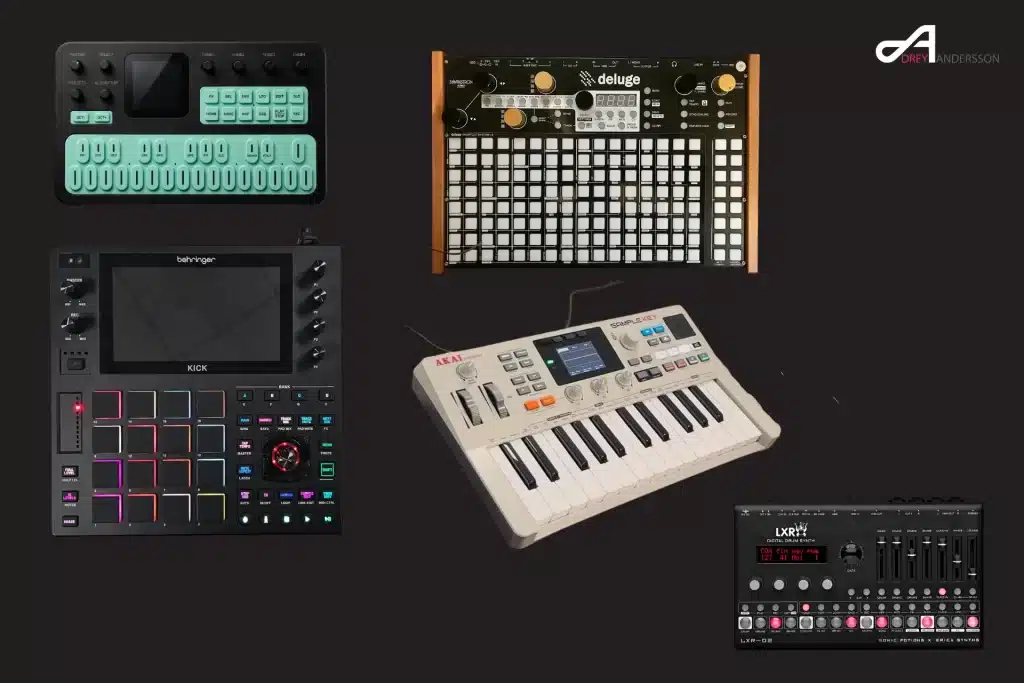
The Behringer KICK is pitched as a $150 open-source sampler. Akai’s next sampler is reported to be open too, and Polyend has just put the Tracker’s code on GitHub. Those three statements don’t mean the same thing. So on 4 November 2026 I read the repositories, licences and maker posts I could open, and I name the press report wherever that’s all I had.
If you want an open source synth or sampler that runs custom code today, the list is shorter than the headlines suggest. I didn’t build or flash anything for this article, and the KICK, IGNITE, SP1200X, Polykeys 61 and SampleKey aren’t on sale yet. What I can show you is what’s actually in each repo. For the scene that set this off, start with my ranking of the M-VAVE FM-1 custom firmwares.
In short
- Open firmware you can install on existing hardware: the Polyend Tracker family (sampling workstations), the M-VAVE FM-1 (FM synth), the Erica Synths LXR-02 (drum machine) and the Synthstrom Deluge (sequencer, synth and sampler).
- Behringer KICK: the code is public, the reported target price is about $150 and I found no release date. Its own README says the build “will not work out of the box”.
- Behringer SP1200X ($200 aim) and Polykeys 61, Akai SampleKey and MPC Sample: promises so far, and I found no code for them on 4 November.
- “Open” still has closed parts. Polyend keeps two DSP libraries closed, and M-VAVE keeps the FM-1 sound engine closed.
- If you’re buying for the firmware, check what happens after a failed flash before you check anything else.
Which music gear is actually open source?
Four product lines in my main table have open firmware you can install on hardware that already exists: the Polyend Tracker family, the M-VAVE FM-1, the Erica Synths LXR-02 and the Synthstrom Deluge. The Behringer KICK and IGNITE have public code but no hardware on sale. Everything else in the table has been announced or teased, with no code. I read each licence and repo on 4 November 2026, so this is a dated snapshot.
| Product | Status | Price | Code public? | Licence | Closed or missing |
|---|---|---|---|---|---|
| Behringer KICK | Prototype, no release date | $150 target | Yes, but it doesn’t build as published | AGPL-3.0-or-later | Samples, a font, build files; no schematic |
| Behringer IGNITE | No hardware, no date | Not announced | Yes, no official firmware release yet | AGPL-3.0-or-later | MCU firmware, prebuilt bootloader, SoundFont, Wi-Fi firmware |
| Behringer SP1200X | In development | $200 aim | No | None published | Everything so far |
| Behringer Polykeys 61 | Teased, no date | $199 target | No | None published | Everything so far |
| Akai SampleKey | Teased, not formally announced | Not announced | No | None published | Everything so far |
| Akai MPC Sample | Shipping, opening reported | $399 | No | None published | Stock firmware; no SDK yet |
| Polyend Tracker, Tracker+, Tracker Mini | Community Edition 1.0 released | Not checked | Yes | MIT with clone restriction | Two DSP libraries; no bootloader source found |
| M-VAVE FM-1 (FM1 Open) | Open branch V14 released | About $60-80 | Yes | GPLv3 with SDK exception | FM-1 sound engine library |
| Erica Synths LXR-02 | Firmware opened 23 Oct 2026 | Not checked | Yes | GPL-3.0 | Not checked; bootloader source is public |
| Synthstrom Deluge | Community firmware since 2023 | Not checked | Yes | GPL-3.0 | Not checked |
Sources: each maker’s repo and licence file. Prices and status for the KICK, Polykeys 61, SampleKey and MPC Sample come from press reports; the SP1200X aim comes from Behringer’s own post, and the FM-1 price from earlier press reports. “Doesn’t build as published” is the repo’s own statement plus user reports. I didn’t compile it.
GitHub stars show attention, and last-commit dates show whether anyone’s still working on the main branch. KICK has the second-most stars in this chart despite having no hardware on sale, but its main branch has been quiet for almost three weeks.
Source: GitHub API and the default branch of each repo, read on 4 November 2026. Star counts move quickly.
Behringer KICK: price, release date and what’s on GitHub
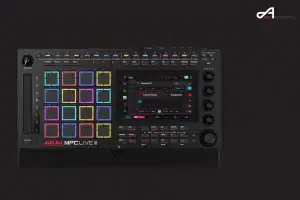
Press reports give the Behringer KICK a target price of about $150 and no release date, and describe it as a prototype sampler and groovebox. Its repo lists a touchscreen, 16 RGB pads in 8 banks, four assignable knobs, a jog wheel, MIDI, USB and four CV/gate jacks. Synth Anatomy calls it an MPC One clone. I couldn’t open Behringer’s own post about it, and its product URLs returned errors, so the repo is the best primary source I could read.
The code really is there. The KICK repo was created on 14 October 2026, almost two weeks before the press noticed it on 26 October. It holds the application, the audio engine, the hardware protocol and a Linux build tree, with the Music Tribe code under AGPL-3.0-or-later. What the coverage leaves out:
- It doesn’t build as published. The app’s README says “The build will not work out of the box”. It calls two libraries private even though both are in the repo, so that note looks out of date, and you have to build the cross-compilation SDK yourself. Samples and a font were removed too. The build also calls a file named juce_modules.cmake, and I couldn’t find it in the repo.
- Users have got the app running with stand-ins. One user reported about 4,500 errors after stubbing the gaps. Others then got the app target running on macOS and Linux with hand-written replacements, some marked as guesses. That’s good community work, and it’s separate from the published code building.
- The AI camera isn’t in the published code. The main README lists “AI camera for gesture control”. A full-text search of the published tree outside its Linux folder found only that line and third-party code, and the Linux config doesn’t mention libcamera. That doesn’t prove the hardware won’t have a camera. It does mean you can’t hack on one yet.
- The effects aren’t new DSP. The main README advertises “Over 300 built-in effects”, and the audio engine’s README says “more than 300 Airwindows effects”. Airwindows is Chris Johnson’s MIT-licensed plugin code, which is a sensible thing to reuse.
- The chip is an open question. A 15 October commit removed the “NXP i.MX8M Mini” wording from the READMEs, while the Linux README still points at an imx8mm_var_som board folder. RAM isn’t stated, and nothing confirms what the retail unit will use.
- No outside change appears to have landed yet. All six merged pull requests came from MT-Release and abdullahghani-et, which look like Music Tribe accounts. 23 are still open, and the main branch last changed on 15 October.
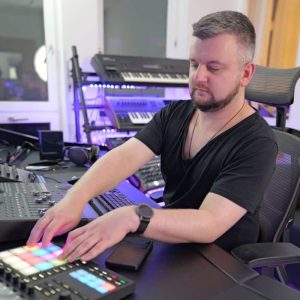
I’d rather have code before hardware than a promise. For now, though, this is a source preview. I sketch ideas on an MPC Live II in my dawless setup, so a box with pads and a touchscreen targeted at $150 has my attention. I wouldn’t plan around it until there’s a shipping date and a build that works from the repo.
Behringer SP1200X: an SP-1200 clone with a $200 target
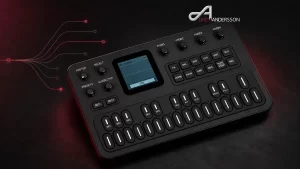
The Behringer SP1200X is an announced tribute to the E-mu SP-1200, which Gearnews and MusicRadar call a clone, with a $200 target and no published code. Behringer’s Facebook post from 29 October 2026 says “We’re aiming for just $200.” and “And yes, we’re making it open source.” On 4 November there was no repo for it in Behringer’s GitHub organisation, and no licence or spec sheet. MusicRadar inferred a larger colour display, stereo inputs and USB from the photos, so those are guesses from pictures.
For scale, Rossum’s official SP-1200 reissue, made by E-mu co-founder Dave Rossum, is listed at $3,999 and marked “Batch Sold Out”. It’s a 12-bit, 26.04 kHz machine with 20 seconds of sampling. Whether the SP1200X matches any of that is unknown until Behringer publishes specs.
Behringer open source: IGNITE, Polykeys 61 and the other repos
“Behringer open source” covers very different things, from published application code with parts missing to a closed firmware tool with an AGPL file on top. The MusicTribeOpenSource organisation appeared on 14 October 2026. Its profile promises “schematics, bootloaders, board-support layers, documentation” and says “The community votes on the hardware we build.” I found no schematic in the KICK or IGNITE repos, so that promise is only partly met so far.
- IGNITE: a 64-channel multi-track sequencer with no hardware or price yet. Its README says “There is no official firmware release here yet”. MCU firmware, the prebuilt bootloader, a SoundFont and Wi-Fi firmware are left out, though its Linux build compiles U-Boot from source. It also documents desktop builds for Windows, macOS and Linux, which KICK doesn’t.
- Polykeys 61: a MIDI controller with polyphonic aftertouch, teased on 1 November with a $199 target according to Synthtopia and Synth Anatomy. There’s no repo yet, and even the keys are disputed: Synthtopia’s spec list says mini, Synth Anatomy says standard.
- BCR32: a controller with 32 push encoders. The BCR32 repo has demo firmware, a schematic and MCU documentation, which is a starting point for your own firmware and isn’t the shipping code.
- AQ64L: a 64-pad grid controller. Its developer kit says “The factory firmware is not open source.” You can write your own, and the signing key ships with the kit.
- PRO-800: the one existing synth here. Its firmware packer repo has a schematic and a packer that ships only as a binary, with no firmware source. You can run your own code on its STM32F446, but you start from nothing.
Akai SampleKey and MPC Sample firmware: what’s been promised
You can’t install official custom MPC Sample firmware yet. Press reports say Akai plans open firmware for the MPC Sample and the SampleKey, but I found no code, licence, SDK or date as of 4 November. MusicRadar reports that a second Akai video confirms the MPC Sample’s firmware will be opened up in the same way as the SampleKey’s. I couldn’t view Akai’s Instagram clips myself.
Until that happens, an MPC Sample firmware update means Akai’s stock firmware. Per Akai’s support page, you connect the unit over USB and open mpc-sample.local in a browser, and Windows 10 users get a downloadable updater.
There’s also a community project. SampQOL OS adds up to 16 drum tracks, a step sequencer, inserts, 128-slice chop and stem export to the MPC Sample, which Synth Anatomy lists at $399 and MusicRadar says came out in March. Its README says “It does not flash the MPC.” Take the SD card out and the unit starts as stock. It’s beta, tested only on firmware 1.3.0, and it warns: “A failed project load can delete samples.” So back up first. Older MPCs are getting third-party operating systems too, as I cover in my Akai MPC3000 entry.
According to MusicRadar and Synth Anatomy, the SampleKey exists only as Instagram teasers from 27 and 28 October: a two-octave, 25-key sampler with no specs, price or release date. MusicRadar describes mods in the clips, including one made with Claude and a version of Native Instruments Massive.
The Verge’s report, which I read through a syndicated copy, says the SampleKey will have open-source firmware. What it reports from CEO Jack O’Donnell is narrower: seeding early devices to developers, open-sourcing some software and providing an SDK. MusicRadar notes that Akai hasn’t said whether the stock source will be published or whether modding will be limited to Akai’s tools. That isn’t yet the same as an open-source MPC. For more on Akai’s hardware, see my MPC Live III article.
Polyend Tracker open source: what the licence allows
Polyend’s release covers all three Tracker models with ready-to-install builds, but by my reading it isn’t open source in the strict sense. On 2 November 2026 Polyend published the source and Community Edition 1.0 for the original Tracker, Tracker+ and Tracker Mini. It merged a community pull request two days later, while I can’t find one on KICK after three weeks.
Three limits are easy to miss. The licence is called “MIT License with Wholesale Commercial Clone Restriction”, and it bans selling compiled firmware builds or commercial clone hardware. As I read it, a no-selling clause like that falls outside the usual open-source definitions, though you can still reuse individual modules and sell .ptfx plugins. Two libraries, libPolySynth.a and libPolyDSP.a, stay closed. And I found no bootloader source. Polyend’s changelog also warns that Community Edition saves a newer pattern format that older firmware can’t read, so back up your projects before you switch.
Installing is simple: copy a .ptf file to the /Firmware/ folder on the microSD card and run the update from the Config menu. Polyend also documents the clearest recovery route in this roundup, covered below.
M-VAVE FM-1: where this wave started
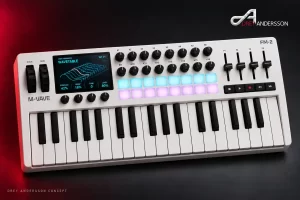
Synthtopia and MusicRadar both credit the independent modding scene around the M-VAVE FM-1, which took off in September 2026, with starting this trend. M-VAVE followed with FM1 Open in October: a GPLv3 application with a browser workbench that installs firmware over USB-MIDI. The same model now exists for the SMK-37.
The catch is in the third-party notes: “No proprietary SDK source is supplied.” The core engine ships as a closed library that’s only licensed for FM-1 devices, and substatica’s overview on Matrixsynth describes the firmware the FM-1 ships with as closed source. I’ve run a community firmware myself. I loaded Melodee’s PROPHET engine on my own FM-1 with real Prophet-5 Rev 4 patches and compared it against Repro-5. It wasn’t on par with the analog original, though many patches sounded great. That’s what I’d expect from a $60-80 box. My M-VAVE FM-2 article covers what’s known about the successor.
Already open, and not open at all
Some of the strongest open projects are older or quieter than this month’s news, and one well-known name isn’t open at all.
- Synthstrom Deluge: community firmware under GPL-3.0, active since 2023 and still getting commits this week.
- Erica Synths LXR-02: firmware opened on 23 October under GPL-3.0, and the bootloader source is public too, which is rare in this list. Erica offers no support for self-built firmware.
- Mutable Instruments: the Eurorack repo is the long-running reference, with code under GPL 3.0 or MIT and hardware under CC-BY-SA 3.0.
- Korg logue SDK: an SDK under BSD-3-Clause for custom units on Korg hardware such as the drumlogue. You add to the firmware rather than replace it.
- Electrosmith Daisy: MIT-licensed libraries for building your own instrument, rather than one product’s firmware.
- Dirtywave M8: not open. The public M8 firmware repo holds precompiled headless firmware and a EULA, with no source. That repo gives you nothing to modify.
Can open firmware brick your gear?
Yes, it can. Polyend and Behringer’s AQ64L and PRO-800 document a way back from a failed flash, while KICK and IGNITE document none so far. This table lists what each maker or project states. I haven’t tested any of it.
| Product | How you install | If a flash goes wrong |
|---|---|---|
| Polyend Tracker family | .ptf file on microSD | Isolated bootloader; a recessed pinhole button reflashes from the card. Custom firmware damage isn’t covered by warranty; paid repair is offered |
| Behringer AQ64L | Signed package over USB | Hold USER1 + USER2 at plug-in. “the device cannot be bricked” while the bootloader region is untouched |
| Behringer PRO-800 | SysEx update file, sent with any SysEx tool | Fixed, write-protected bootloader; the README says the unit can always be recovered via SynthTribe. Removing flash protection over JTAG/SWD erases it and bricks the unit |
| Erica Synths LXR-02 | Built-in updater, from SD card | Separate bootloader with public source; no support for self-built firmware |
| M-VAVE FM-1 (FM1 Open) | Browser workbench over USB-MIDI | Can return to the original V15; “not a guarantee” for every third-party firmware. No recovery mode documented |
| SampQOL OS on MPC Sample | Boots from SD card | Doesn’t flash the unit, so removing the card starts stock firmware. Project data is still at risk |
| Behringer KICK and IGNITE | No hardware to install on yet | No user recovery procedure documented |
Source: each project’s README, read on 4 November 2026.
Should you buy gear for its firmware?
Buy gear because you’d enjoy it with the firmware it ships with today, and count open firmware as a bonus. A promise can’t be installed, and a $150 target isn’t a price. Before you pay for something on the strength of “open source”, I’d ask five questions:
- Is the code public today? Look for a repo, not a post.
- Does it build? Read the README and the open issues as well as the announcement.
- What stays closed? A closed sound engine limits what anyone can change.
- What does the licence allow? It matters most if you plan to sell your work.
- What happens after a failed flash? A documented recovery route is worth more than a long feature list.
For a cheap way into custom firmware, get the FM-1, knowing that it documents no recovery mode, only a route back to V15 that isn’t guaranteed from every third-party firmware. For a sampling workstation with the clearest documented recovery, look at the Polyend Tracker family, though the Tracker+ and Mini showed as sold out on Polyend’s site when I checked. For MPC-style sampling that works right now, buy an MPC Sample for what it does today. And wait on the KICK until it has a shipping date and a working build.
Frequently asked questions
How much will the Behringer KICK cost?
Synthtopia and Synth Anatomy report that Behringer is targeting about $150. That’s a target and not a confirmed price, and I couldn’t read Behringer’s own post. As of 4 November 2026 press reports still describe the KICK as a prototype, and I found no working product page or shipping date.
When is the Behringer KICK release date?
I found no announced release date. The KICK repository was created on GitHub on 14 October 2026 and the press picked it up on 26 October, but reports still describe the hardware as a prototype. I’ll update this page when Behringer publishes a date or a real product page.
Can you install custom firmware on the MPC Sample?
Not through an official Akai route yet. MusicRadar reports that Akai will open the MPC Sample firmware, but I found no code, SDK or date on 4 November 2026. A community mod called SampQOL OS says it boots from the SD card on firmware 1.3.0 without flashing the unit, though it’s still beta software.
Is the Polyend Tracker fully open source?
Mostly, but not fully. Polyend published the source and Community Edition 1.0 for all three Tracker models, but two DSP libraries stay closed and the licence bans selling compiled firmware builds or commercial clones. You can still build, change and install your own firmware, and a recovery button helps after failed flashes.
Is the Dirtywave M8 open source?
No. The public Dirtywave repository I checked holds M8 Headless firmware for the Teensy 4.1 as a precompiled download with an end-user licence, and no source code. If you want a tracker with public firmware source, the Polyend Tracker family is the closest option here, within its licence limits.
Sources
Everything was read on 4 November 2026, except the FM-1 street price, which comes from my earlier FM-1 research. Repo statements come from the files in each repo. I didn’t build or flash any of this firmware for this article, and none of the unreleased hardware is available for me to test.
- Music Tribe: KICK, KICK app README, KICK issue 9, commit 46f1075, IGNITE, organisation profile.
- Behringer on Facebook, SP1200X post, 29 October 2026, also mirrored by Matrixsynth.
- Synthtopia: KICK, the open firmware trend, Polykeys 61.
- Synth Anatomy: KICK, SampleKey, MPC Sample, Polykeys 61.
- MusicRadar: Akai Sample Key, SP1200X. Gearnews: SP1200X.
- The Verge’s Akai report, read through a syndicated copy, because I couldn’t open the original.
- Polyend: announcement, licence, closed library licence.
- M-VAVE: FM1 Open third-party notes, SMK-37 Open, and substatica’s overview on Matrixsynth.
- Erica Synths, LXR-02 firmware. Rossum Electro-Music, SP-1200. Akai, MPC Sample firmware update.
Update log
- 4 November 2026: first published. Repo numbers and statuses are from that day and will age quickly, so I plan to re-check them regularly.