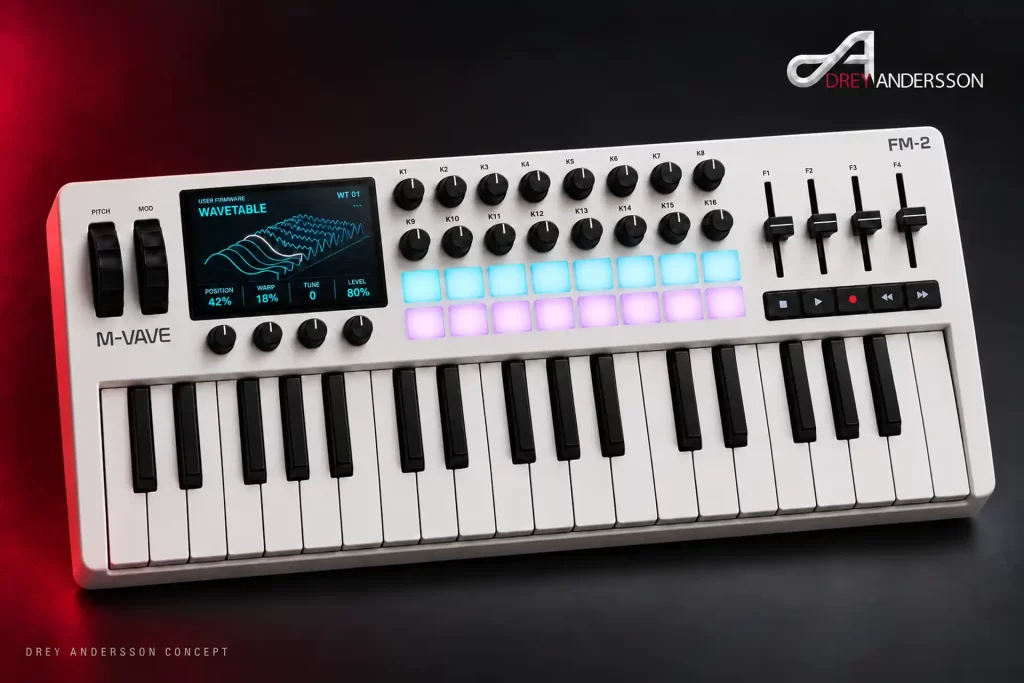
The M-VAVE FM-2 is real, but so far it’s one sentence long. In an interview filmed at the Music China trade show and published on 29 October 2026, Sonicstate’s Nick Batt asked M-VAVE’s Austin whether there was room for something bigger than the FM-1. Austin answered: “we are coming for the FM2 in the late of this year probably.” That’s the whole announcement. There are no specs, no price and no product page. When I checked m-vave.com and its download page on 30 October, neither mentioned an FM-2.
So this isn’t a review. It sorts what M-VAVE actually said from what the internet has already added to it. It also covers the FM-1’s real hardware limit, its RAM, and what I’d want M-VAVE to change before the FM-2 ships. If you want the background on why everyone is talking about this little synth, start with my ranking of the M-VAVE FM-1 custom firmwares.
In short
- Confirmed: an FM-2 is in development, aimed at late 2026 “probably”. M-VAVE says it is still working out mass production.
- Not confirmed: size, specs, price or open firmware. The word “bigger” came from the interviewer’s question, not from M-VAVE.
- The FM-1 runs on a JieLi AC791N: two cores at 240 MHz, 1 MB of flash and about 512 KB of RAM. In my view, RAM is the wall that FM-1 firmware hits first.
- My wishlist for the FM-2: a faster CPU, megabytes of RAM instead of kilobytes, a microSD slot, and a price under $150.
What did M-VAVE actually say about the FM-2?
M-VAVE confirmed that an FM-2 is in development and aimed at late 2026, with a “probably” attached. The source is a Sonicstate interview filmed at Music China 2026 and published on 29 October. At 4:47 Nick Batt points out that the FM-1 is “very small and has limited DSP” and asks whether there is room for “something bigger and more ambitious that people could then hack as well”. Austin’s reply starts at 4:58. He says the FM-2 is coming late this year, probably, and that M-VAVE is “still like figuring out how to mass production” the new product.
Two other moments in the same interview matter for what comes next. At 3:02 Austin agrees that the FM-1 is “more like a platform” than a product, because anyone can change its firmware. At 8:01 Nick suggests a model with “spare capacity, more room to grow into”, even if it costs more, and Austin answers “Definitely.” He doesn’t name the FM-2 in that exchange, so I read it as a direction, not a promise.
What’s confirmed about the FM-2, and what’s guesswork?
Only the existence of the FM-2 and a rough target date are confirmed. Everything else in the headlines, including “bigger”, comes from interpretation. Synth Anatomy’s headline asks whether it will be “a bigger version of the open-source FM synth”, and an r/synthesizers thread repeats the question. By 30 October, Google’s AI Overview for “m-vave fm-2” was already describing it as a larger synth. Here’s how each claim stands.
| Claim | Status on 30 October 2026 | Where it comes from |
|---|---|---|
| An FM-2 is in development | Confirmed by M-VAVE | Austin, Sonicstate interview, 4:58 |
| Release in late 2026 | Target only, “probably” | Same answer |
| Ready for mass production | No. M-VAVE is “still like figuring out” how | Same answer, 5:07 |
| Bigger than the FM-1 | Not confirmed | Nick Batt’s question at 4:47, not Austin’s answer |
| Specs, chip and price | Nothing published | No FM-2 page on m-vave.com or cuvave.com |
| Open firmware like the FM-1 | Not stated, but it fits M-VAVE’s “platform” pitch | Interview, 3:02 |
I’ll update this table as soon as M-VAVE publishes anything official. Until then, treat any FM-2 spec sheet you see as a fan wishlist, including mine further down.
Is the M-VAVE FM-2 the same as the Korg volca fm2?
No. They are two different synths from two different companies, and search results are already mixing them up. The Korg volca fm2 is a 6-voice, 6-operator FM synth with all 32 DX7 algorithms and a 16-step loop sequencer. On 30 October 2026, Vintage King listed it at $179.99. The M-VAVE FM-2 is M-VAVE’s unreleased follow-up to the roughly $70 FM-1. If a Reddit thread or a video compares “the FM2” with the FM-1, check which one they mean.
What CPU and RAM does the M-VAVE FM-1 have?
The FM-1 is built on a JieLi AC791N, with two cores of JieLi’s own 32-bit pi32v2 CPU running at 240 MHz. It has 1 MB of flash and about 512 KB of RAM. M-VAVE hasn’t published a datasheet-style spec for the FM-1, so these figures come from the people who know the chip best. Those are the developers who emulate it and write firmware for it. Joakim Eriksson’s fm1-emu project emulates the whole FM-1, and it names the chip, the two cores and the 240 MHz clock. Its hardware notes give the flash as 1 MB, in a single bank with no recovery button. The RAM figure comes from Felucca’s open-source memory map, which lays out a 512 KB window from address 0x01C00000 to 0x01C80000.
| Part | M-VAVE FM-1 | Source |
|---|---|---|
| Chip | JieLi AC791N | fm1-emu, M-VAVE FM1 Resource Hub |
| CPU | 2 cores, JieLi pi32v2, 32-bit | fm1-emu |
| Clock | 240 MHz | fm1-emu |
| RAM | About 512 KB SRAM | Felucca memory map (app.ld) |
| Flash | 1 MB, one application bank | fm1-emu hardware notes |
| App window in Felucca’s layout | About 568 KB (581,564 bytes) | Felucca memory map |
| Stock engine (V16) | 6 operators, 32 algorithms, 8 parts, 20 voices shared | fm1-emu hardware notes; M-VAVE V16 release, via M-VAVE FM1 Resource Hub |
Two details matter for the FM-2. First, none of the public memory maps I checked shows any external RAM, so as far as public firmware shows, 512 KB is what a firmware works with. Second, the fm1-emu notes describe units on which the second core sometimes misreads RAM, more often under load. Firmwares that use that core check for it and fall back to one core. Whether that’s a parts defect or a design limit, it means developers can’t fully count on the second core.
Why is RAM the FM-1’s real bottleneck?
In my view, RAM, not CPU speed, is the limit FM-1 firmware hits first. Flash holds the code and the fixed data, but everything that changes while you play has to fit into those 512 KB at the same time. That means voices, delay lines, reverb buffers, sequencer patterns and screen canvases. A simple calculation shows how small that is. One second of 16-bit mono audio at 44.1 kHz takes 88,200 bytes. Two seconds of delay line would fill almost half of the 360 KB pool that Felucca keeps for its big buffers.
The memory map itself shows the kind of work this causes. A comment in Felucca’s linker file records that version 1.5 moved 24 KB from one RAM budget to the other, from 96/336 KB to 72/360 KB. Developers on this chip spend real time shuffling kilobytes around, and every new engine, effect or longer sequence has to win its space from something else. A sample-based engine has it worst: the samples can stay in flash, but anything that streams, records or reverses audio needs room in RAM.
Why can’t you switch FM-1 firmware on the spot?
You can’t switch on the spot because each firmware takes over the whole chip. The 1 MB flash holds one application of up to about 568 KB in Felucca’s layout, and only one runs at a time. To go from SLOOP to Felucca, you connect the FM-1 to a computer and flash the other firmware over USB, either with M-VAVE’s web workbench or the developer’s installer. There’s no menu in the stock setup that lets you keep two full firmwares and pick one.
The closest thing to a switcher is Joakim Eriksson’s fm1-dock. You install it once, its synths live as modules in flash, and you hold HOME to pick another one with no reinstall. It works, but look at its rules: a module gets 272 KB of RAM and 16 KB of RAM code, about half of the chip. Felucca alone reserves 432 KB for its variables and its pool, so a firmware of that size can’t run as a module without being cut down. fm1-dock also has a developer-only boot slot for one whole firmware, but that’s still one at a time. That 272 KB limit sums up the problem. With more RAM and somewhere to store several images, quick switching would be easy.
Why the FM-2 matters
The FM-1 went from 1,300 to 9,900 monthly US searches in three months, and the firmware scene has kept it in the news since. Whatever M-VAVE builds next lands in front of an audience that already exists, including dozens of developers who know the FM-1’s limits better than anyone. It also lands in a busier field. Since the FM-1 scene took off, Behringer and Polyend have published open code and Akai is reported to be following, as I cover in my look at which open-source synths and samplers are really open.
What should the M-VAVE FM-2 have?
If anyone at M-VAVE reads this, here is what I’d put into the FM-2. Austin already agreed in the interview that a model with spare capacity makes sense, and the FM-1 scene shows exactly where that capacity should go.
- A bigger CPU. More headroom per voice means heavier engines, like virtual analog, wavetables and physical models, at full polyphony. It also means less juggling between two cores that some units can’t fully trust.
- More RAM, measured in megabytes, not kilobytes. This is the change that matters most. It would give room for long delays and real reverbs, sample engines that can record and stream, deeper multitimbral setups and longer songs. It would also let several firmwares or engines stay loaded at once.
- A microSD slot. Several firmwares on one card, chosen from a boot menu. Samples, wavetables, projects and backups would sit on the card instead of in 1 MB of flash. You would no longer need a computer to change what your synth is.
- Keep what works. Open firmware, USB-C, the battery, the speaker and DX7 SysEx import are why the FM-1 took off. Don’t lock any of it.
- Stay under $150. Austin also mentioned higher-quality instruments coming from M-VAVE, so a pricier tier is possible. But the FM-1 is an impulse buy at about $70. Even at double that, a $150 ceiling leaves room for better parts and still undercuts the Korg volca fm2 at $179.99. Above that, it’s competing with established gear instead of being the cheap, hackable box everyone wants to try.
Get those right and the FM-2 doesn’t have to be bigger to win. It has to give the developers who made the FM-1 famous room to build things that don’t fit today.
Should you buy an FM-1 now or wait for the FM-2?
Buy the FM-1 now if you want one this year. It costs about $70, it has the biggest firmware scene of any cheap synth I know, and the FM-2 date is “probably” late 2026 with mass production still unsolved. Even when the FM-2 arrives, nobody knows yet whether today’s FM-1 firmwares will run on it, because a new chip would mean new ports. Wait only if you specifically need what the FM-1’s RAM can’t give you, such as long sample recording, and you’re willing to bet that the FM-2 fixes it.
I have an FM-1 myself. I ran Melodee’s Prophet-5 engine on it with real Prophet-5 patches: it isn’t on par with the analog original, but many patches sounded great. For a synth of that price, that’s the point. It’s a box you play, hack and reflash, not a replacement for the real thing.
If you start with an FM-1 today, the FM-1 firmware guide shows which builds are safe to flash. The FM-1 itself fits well in a small dawless setup. And keep the effects budget in proportion: a $70 synth doesn’t need a $500 reverb pedal. A used vintage rack unit that costs synth money does the job, and my Yamaha REV500 review covers one that sounds far better than its price.
Frequently asked questions
When will the M-VAVE FM-2 be released?
M-VAVE aims to release the FM-2 in late 2026, but only as a probable target. Austin from M-VAVE said so in a Sonicstate interview on 29 October 2026 and added that the company is still working out mass production. There is no official date, preorder or product page yet, so a slip into 2027 is possible.
How much will the M-VAVE FM-2 cost?
M-VAVE hasn’t announced a price for the FM-2. The FM-1 sells for about $70, and M-VAVE says its goal is to be affordable for everyone, while it also plans higher-quality instruments. In my view the FM-2 should stay under $150, still undercutting the Korg volca fm2 at $179.99.
How much RAM does the M-VAVE FM-1 have?
The M-VAVE FM-1 has about 512 KB of RAM, next to 1 MB of flash. Its JieLi AC791N chip runs two 32-bit cores at 240 MHz. Felucca’s memory map gives 360 KB to effects, engines and screen buffers. That is why longer delays, reverbs and sample recording are hard to fit.
Will FM-1 custom firmware run on the FM-2?
Nobody knows yet, because M-VAVE hasn’t named the FM-2’s chip. If it keeps the JieLi AC791N, ports could be quick: the SMK-37 keyboard shares that chip and already runs community ports. A different processor would mean new ports, so plan for rebuilds rather than one-click installs on day 1.
Is the M-VAVE FM-2 the same as the Korg volca fm2?
No. The Korg volca fm2 is a separate 6-voice, 6-operator FM synth from Korg, listed at $179.99 by Vintage King in October 2026. The M-VAVE FM-2 is M-VAVE’s unreleased follow-up to its $70 FM-1. The similar names mix them up in search results, so check which one a review means.
Sources
- Sonicstate, MusicChina26: M-VAVE FM-1 – And There’s More, and the interview video, 29 October 2026. My quotes are from the video, at the timestamps given.
- Synth Anatomy, M-VAVE FM-2 is coming later this year: a bigger version of the open-source FM synth?, 29 October 2026.
- Joakim Eriksson, fm1-emu (chip, cores, clock, flash, panel and the second-core notes) and fm1-dock (module RAM limits), read on 30 October 2026.
- Hügelton Instruments, Felucca firmware/app.ld (RAM map), read on 30 October 2026.
- M-VAVE FM1 Resource Hub (chip name, V16 release details), read on 30 October 2026.
- Vintage King, Korg Volca FM 2 listing, price checked on 30 October 2026.
- Google Ads search volume via DataForSEO, United States, pulled on 30 October 2026.
Update log
- 30 October 2026: first published, one day after the announcement. M-VAVE had published no FM-2 specs or price at that point.