Groovebox meaning
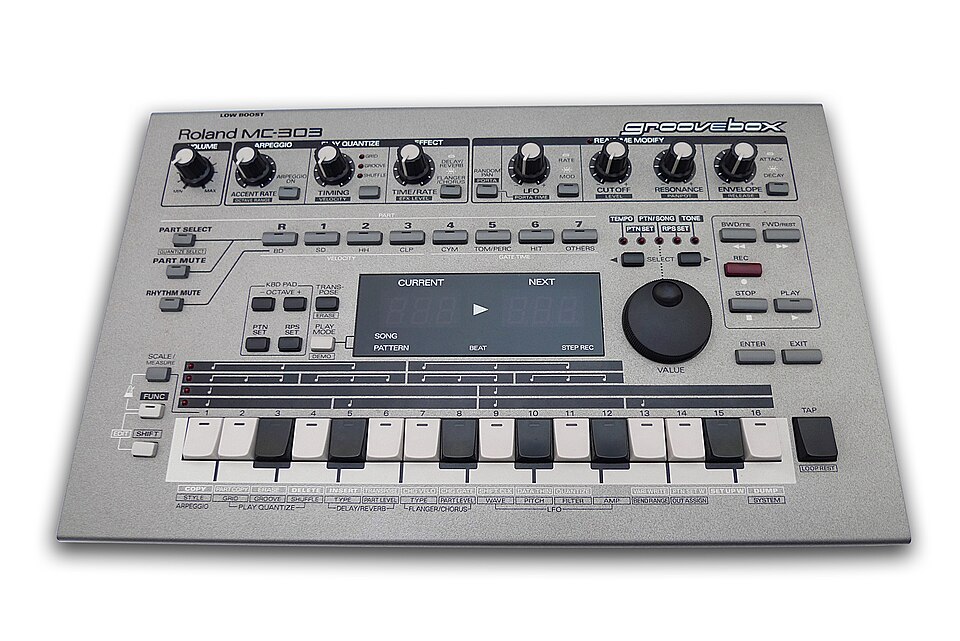
A groovebox is a standalone instrument that puts sound sources (drums, synths, a sampler or a mix of them), a pattern sequencer and hands-on controls into one box. You build loops on it, switch between them and play them live without a computer. Roland coined the word for its MC-303 in 1996.
Key takeaways
- A groovebox combines sounds, a sequencer and playable controls in one standalone box, built for loops and live jamming.
- The name comes from the Roland MC-303 (1996). Roland’s US trademark on GROOVEBOX was cancelled in 2007, and today makers from Novation to Sonicware use the word.
- It’s a marketing label, not a spec: of the 16 current boxes I checked, exactly 8 use the word on their own product page.
- Worldwide search interest bottomed out in 2018 and is about 2.9 times higher in 2026 so far.
- Choose by workflow: whether you need to sample, whether it runs on batteries, and how the sequencer works.
Three parts make a box a groovebox:
- Sound sources. Drum sounds, one or more synth engines, a sample player or a full sampler, often all in the same unit.
- A pattern sequencer. You record or step in short patterns, then chain them into a song or switch between them live. Each pattern is a loop you can mute, change and stack.
- Controls you play. Knobs, pads and mute buttons change the sound while the loop keeps running. Many boxes add an arpeggiator on top.
Roland’s archived product page describes the original MC-303 as a “self-contained, retro-styled sequencer and integrated sound module”. Its current MC-707 page states the goal in plain words: it “has everything you need to create a song or perform a live set without a computer”. That’s why a groovebox so often ends up as the brain of a DAWless setup, where it takes over the jobs a DAW would normally do.
Groovebox vs drum machine, sampler, MPC and workstation
A drum machine plays drums. A groovebox adds melodic parts (bass, chords, leads) so one box can carry a whole track. A sampler records and plays back audio, and many grooveboxes include one. An MPC-style production center is a sampler-first groovebox that grew into a computer-free studio. A workstation is usually a keyboard aimed at writing full songs, not at looping.
Main job: Loops and live jamming
Example: Roland MC-707
Main job: Beats
Example: Roland TR-8S
Main job: Record, chop and play audio
Example: Roland SP-404MKII
Main job: A whole studio without a computer
Example: Akai MPC Live III
Main job: Writing and arranging full songs
Example: Polyend calls its Tracker+ “the standalone workstation”
In practice the line is drawn by marketing. Elektron sells the Digitakt II as a “16 Track Drum Computer & Stereo Sampler” and never says groovebox on its page, while the Sound On Sound review calls it “a great standalone groovebox”. Roland, the company that coined the word, calls its TR-8S “The most complete drum machine to date” and the SP-404MKII “the ultimate SP sampler”.
The MPC is older than the word. Akai’s MPC60, built with Roger Linn, was reviewed in Music Technology in April 1988. Its working name was ADR15, and the review notes that “A DRum machine became a MIDI Production Centre”. I trace that line in my history of the Akai MPC.
Where the word “groovebox” came from
Roland introduced the word with the MC-303 Groovebox in 1996. Its 2019 press release puts it this way: “In 1996, Roland launched the original MC-303 GROOVEBOX to great acclaim”. Sound On Sound reviewed the unit in August 1996: “It’s a 28-voice polyphonic sound module, with 448 sample-based presets”, with “an 8-track, Pattern-based sequencer (one rhythm Part and seven normal Parts)”. It cost £565 in the UK.
Roland also protected the name. The USPTO record for GROOVEBOX (registration 2423522) lists “First Use: May 31, 1996” and “Registration Date: Jan. 23, 2001”. It also shows “Date Cancelled: Oct. 27, 2007”, because Roland “did not file an acceptable declaration under Section 8”. Today makers from Novation to Sonicware use the word for their own boxes. At least one retailer guide dates the term to 1997. The August 1996 review and the May 1996 first-use date both say otherwise.
Other makers followed fast. In its October 2001 review of the Yamaha RS7000, Sound On Sound wrote: “The ‘groovebox’ category of instrument is pretty much an invention of the last five years or so”. Looking back in 2019, Engadget confirmed that “it was Roland that first used the term”.
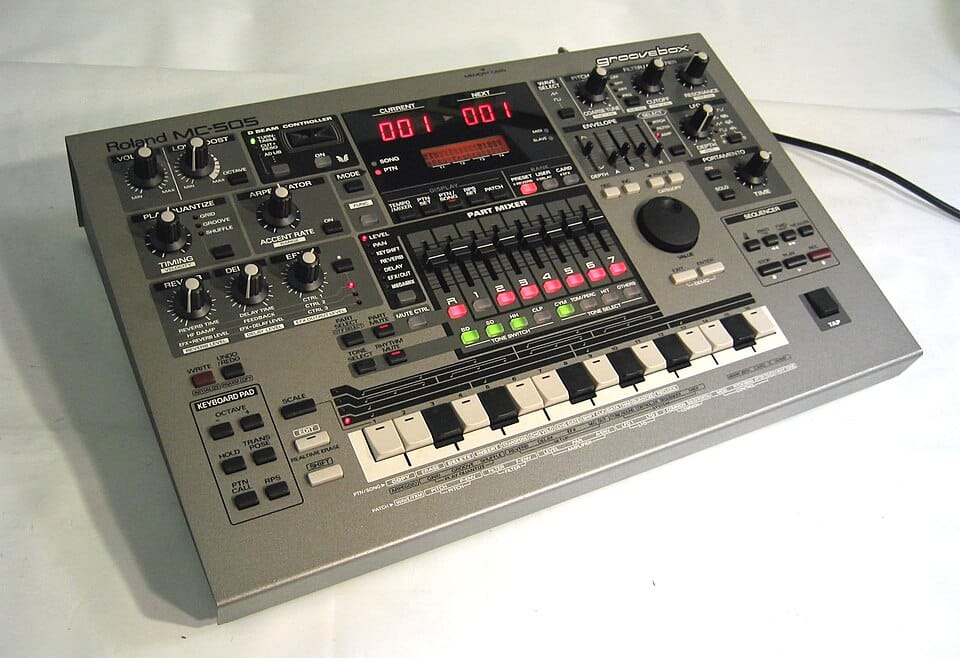
Roland kept the line going. The MC-505 arrived in 1998 with “polyphony increased to 64 voices (from 28)”. The MC-909 followed in 2002, which Roland’s announcement, as reported by Sonicstate, called “the first Groovebox with sampling and synthesis combined”. Then, as Engadget put it, Roland “quietly let its MC line of loop-based musical instruments die in 2008”. It came back in September 2019 with the MC-707 and MC-101 at $999.99 and $499.99.
What I found: 22 years of search data and 16 current boxes
Search interest fell for 14 years, then turned
I pulled the full Google Trends history for “groovebox” (worldwide, monthly, January 2004 to September 2026, 273 data points) through DataForSEO on 11 October 2026, and averaged each year. Trends scores every month from 0 to 100 against the busiest month in the range, so these are relative numbers, not search counts.
Google also divides each data point by all searches in that place and month. In its own words: “Each data point is divided by the total searches of the geography and time range it represents”. So the line shows the word’s share of searching, and a falling share can sit alongside a growing total. For scale: Google Ads data puts “groovebox” at about 1,900 searches a month in the US today.
The yearly average fell from 75.7 in 2004 to 8.9 in 2018. Since then it has climbed: 17.1 in 2025 and 25.9 for January to September 2026, about 2.9 times the low. Two months stand out. September 2019 scored 20 after three months of 8, 7 and 9, and Roland announced the MC-707 and MC-101 on 5 September 2019. April 2026 scored 41, the highest month since May 2009, a few weeks after Sound On Sound reported the MPC Sample as the “Smallest, most affordable MPC to date” on 24 March 2026. The timing lines up, but Trends can’t tell me why people searched.
One caution on the early years. Trends samples its data, and a second pull on the same day gave a different value for January 2004 (86 instead of 96). That’s why I use yearly averages for the long trend, treat single months (including the April 2026 peak) as approximate, and read 2004 to 2008 as a rough level, not an exact one.
Only half of today’s grooveboxes use the word
Next I read the maker’s product page for 16 current boxes from 11 makers, and checked whether the word appears in the product’s own name or description.
I started from 27 candidates and kept the standalone boxes that pair their own sounds with a pattern sequencer. I left out boxes the maker sells as a pure drum machine or sampler (the TR-8S and SP-404MKII), a synth (the Digitone II), discontinued models, a keyboard MPC, and six where the maker’s page didn’t give me a clear spec. Where that line falls is my judgment call, and it’s the same blurry line this whole page is about.
Site menus and shop categories don’t count. The result: 8 of 16 products use it, and 6 of 11 makers. Elektron, teenage engineering, Synthstrom, 1010music and Ableton don’t use it on these product pages. Akai’s MPC Live III page only promises “Dedicated controls for groovebox-style workflow”. Polyend calls its Play+ a “16-track Sample and Synth-based groovebox” but its Tracker+ “the standalone workstation”.
| Model | The maker’s own words | Says groovebox? | Tracks | Battery |
|---|---|---|---|---|
| Akai MPC Live III | “Dedicated controls for groovebox-style workflow” | Yes (as groovebox-style) | 16 audio + 32 plug-in | Built in (up to 3 h typical) |
| Akai MPC Sample | “portable sampler, sequencer, and effects processor” | No | not stated | Built in (about 5 h) |
| Ableton Move | “a portable instrument for intuitive music making” | No | not stated | Built in (up to 4 h) |
| Elektron Digitakt II | “16 Track Drum Computer & Stereo Sampler” | No | 16 | None listed |
| Elektron Syntakt | “12 Track Drum Computer & Synthesizer” | No | 12 | None listed |
| Roland MC-707 | “MC-707 GROOVEBOX” | Yes | 8 | None listed |
| Roland MC-101 | “MC-101 GROOVEBOX” | Yes | 4 | 4 AA (about 5 h) |
| Novation Circuit Tracks | “All-in-one creative groovebox” | Yes | 8 (2 synth, 4 drum, 2 MIDI) | Built in (4 h) |
| Novation Circuit Rhythm | “More than a simple groovebox” | Yes | 8 | Built in (up to 4 h) |
| Polyend Play+ | “16-track Sample and Synth-based groovebox” | Yes | 16 | None listed |
| Polyend Tracker+ | “the standalone workstation” | No | 16 | None listed |
| Native Instruments Maschine+ | “A groovebox like no other” | Yes | not a fixed count | None built in |
| Sonicware deconstruct MINIMAL | “a compact groovebox” | Yes | 11 | 6 AA |
| Synthstrom Deluge | “Portable synthesizer, sampler and sequencer” | No | not a fixed count | Built in (6+ h) |
| 1010music Bento | “portable, all-in-one sampling production lab” | No | 8 | Built in (up to 3 h) |
| teenage engineering OP-XY | “sequencer, sampler, and performance instrument” | No | 8 + 8 auxiliary | Built in (16 h) |
10 of the 16 can run on batteries, built in or AA. That matters to the people behind the 720 monthly US searches for “portable groovebox”. Battery figures are the makers’ own claims, not my measurements.
What one track costs
For the 7 boxes where I could tie a US price to a dated source, I divided the price by the number of instrument tracks the maker lists. The source is the maker’s US store today, or a launch or review price where the maker shows none: the Roland prices date from 2019, and the Digitakt II and OP-XY prices from 2024. The spread is wide: from $53.75 per track on the Novation Circuit Rhythm to $287.38 on the teenage engineering OP-XY, about 5.3 times as much. It’s a blunt measure that ignores what a track can do. I counted instrument tracks only, so the Circuit Tracks’ two MIDI tracks and the OP-XY’s eight auxiliary tracks are left out.
Types of groovebox
- Synth grooveboxes build sounds from synth engines. The Roland MC-707 has “eight tracks of recording, sequencing, synthesizers, and effects”, the Circuit Tracks pairs two synth tracks with four drum tracks, and Elektron sells the Syntakt as a “12 Track Drum Computer & Synthesizer”. Korg’s drumlogue mixes four analog drum voices with six sample parts and a slot for user-made synth engines.
- Sampler grooveboxes are built around your own recordings: the Digitakt II, the Circuit Rhythm with its “eight flexible sample tracks”, Akai’s MPC Sample and 1010music’s Bento. Not every sample-based box can record, though. When Sound On Sound reviewed it in April 2024, the Polyend Play+ “still cannot sample”.
- MPC-style production centers such as the MPC Live III (16 audio tracks plus up to 32 plug-in instruments) and Native Instruments’ Maschine+ come closest to a full computer-free studio. If you’re weighing one, my MPC Live III article goes deeper.
- Trackers such as the Polyend Tracker+ sequence in scrolling lists of notes instead of a step grid.
- Pocket and portable boxes are built to run on batteries: Roland says the MC-101 “runs for about five hours on four AA batteries”, and teenage engineering claims 16 hours for the OP-XY.
How to choose a groovebox
- Decide if you need to sample. If you want to record your own sounds, check that the box has an audio input and can record, not just play samples back.
- Decide where you’ll play it. 10 of the 16 boxes in my table run on batteries. If you want to make music on the sofa or on a train, that matters more than the track count.
- Count the tracks you actually use. Four tracks can hold drums, bass, chords and a lead. More tracks help with longer arrangements.
- Try the sequencer first. Step grids, clip launching, tracker lists and real-time pad playing feel very different. Watch a full walkthrough or try one in a shop before you buy.
- Check MIDI out. If the groovebox will run other synths in a DAWless rig, it needs MIDI or CV outputs and spare tracks to drive them.
My own groovebox is an Akai MPC Live II. It’s part of my DAWless setup, and it’s the box I use for sketching ideas, on the go or in the living room. I compared it with an iPad in MPC Live II vs iPad with Logic Pro. If you sample a lot, time-stretching is the next term worth knowing, because it’s how a groovebox fits a loop to your tempo.
Frequently asked questions
What is a groovebox?
A groovebox is a standalone music instrument that combines sound sources, a pattern sequencer and hands-on controls in one box. You can build drum, bass and melody loops and play them live without a computer. Roland coined the name with the MC-303 Groovebox in 1996, and today makers from Akai to Elektron build them.
What is the difference between a groovebox and a drum machine?
A drum machine makes drum patterns. A groovebox also makes the melodic parts, such as bass, chords and leads, so one box can carry a whole track. The line is blurry: Elektron sells the Digitakt II as a drum computer, Sound On Sound calls it a groovebox, and only 8 of 16 current boxes I checked use the word.
Is an MPC a groovebox?
Mostly, yes. An MPC has sounds, a sequencer and pads in one standalone box, which fits the definition. The name means production center and goes back to the 1988 MPC60, but the MPC Live III page itself promises a groovebox-style workflow. Think of an MPC as a sampler-first groovebox.
Is the Elektron Digitakt a groovebox?
By function, yes. The Digitakt II sequences up to 16 tracks of samples and runs without a computer. Elektron itself calls the Digitakt II a drum computer and stereo sampler and avoids the word groovebox, while Sound On Sound’s November 2024 review calls it a great standalone groovebox. The label is marketing.
Who invented the groovebox?
Roland introduced the name with the MC-303 Groovebox in 1996 and registered GROOVEBOX as a US trademark in 2001. That registration was cancelled in 2007, and other makers use the word today. The idea of a standalone sampler and sequencer is older: Akai’s MPC60 with Roger Linn dates from 1988.
How much does a groovebox cost?
In my sample of 7 boxes with a dated US price, prices ran from $429.99 for the Novation Circuit Rhythm to $2,299 for the teenage engineering OP-XY at launch. That works out to $53.75 to $287.38 per instrument track. Boxes I couldn’t tie to a dated US price, such as the MPC Sample and deconstruct MINIMAL, aren’t in that range.
Can a groovebox replace a DAW?
For writing and performing loops, often yes. A groovebox can sketch ideas, run a live set and drive other synths over MIDI, all without a computer. Mixing, editing and mastering are where a computer still helps most. Bigger boxes like the MPC Live III, with 16 audio tracks, get closest to doing everything in one place.
Back to Music Production Terms Index Page