What is plate reverb?
Plate reverb is an artificial reverb made by vibrating a large, thin sheet of metal. A driver shakes the plate with the audio signal, the vibrations spread and bounce around the sheet, and contact pickups turn them back into sound. The result is a dense, smooth wash with no distinct early echoes. Alesis’s QuadraVerb manual notes that the plate sound “has become quite popular over the years especially when used on vocals or snare drums” (Alesis QuadraVerb manual).
The best-known unit is the EMT 140, introduced in 1957 by the German company Elektromesstechnik (EMT). Today plate reverb is mostly heard as a preset or a plugin that copies that sound, so “plate” now names a reverb character as much as a box. It is a different thing from a spring reverb, which uses coiled springs, and from a hall or room reverb, which imitate real spaces. I compare all four further down.
- A plate reverb is a steel sheet of about 1 m by 2 m with a driver, one or two contact pickups and a porous damper that sets the decay, roughly 1 to 5 seconds on an EMT 140.
- Sound travels through the plate as bending waves, and high frequencies move faster than low ones. That dispersion smears every echo, so a plate has no clear early reflections.
- In my numpy test, a modelled EMT-140-sized plate reached an echo density of 0.73 to 0.85 on the Abel and Huang scale (1.0 = noise-like) 5 ms after the sound arrived. Simple image-source rooms were at about 0.02 or less at that point.
- The same model has only about 1.31 resonances per hertz at every frequency, far fewer than a 500 cubic metre room above about 75 Hz (or a 50 cubic metre room above about 254 Hz). In the model, the early density comes from dispersion smearing the sound in time, not from a huge number of resonances.
- Vocal starting points: about 1.2 seconds of decay with 60 to 80 ms of pre-delay (Sound On Sound), or Peter Mokran’s 87 ms with a low cut up to about 180 Hz (Universal Audio).
How a plate reverb works
A plate reverb has four parts: the plate, a driver, the pickups and a damper. A 1962 BBC engineering monograph describes the EMT design as “a steel sheet approximately 3 ft by 6 ft, suspended vertically by its corners in a steel frame” (BBC Engineering Monograph 40, 1962). Valhalla DSP’s Sean Costello gives the modern figures as “A 1 meter x 2 meter x 0.5 mm rectangular steel plate is suspended via tight springs in a steel frame” (Valhalla DSP, the physics of plate reverbs). Waves, which modelled the plates at Abbey Road, gives the case as 8 feet long, 4 feet tall and 1 foot wide (Waves).
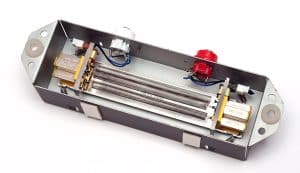
- The driver. “Sound waves are induced into the steel plate by a moving coil exciter element welded to it at a critical point,” says the BBC report. It works much like a loudspeaker coil, with the plate in place of the cone.
- Bending waves. The plate does not compress like air. Walter Kuhl’s patent puts it directly: “The plate is not excited to density or longitudinal waves but to bending waves” (US patent 2,923,369). The waves run out to the edges, reflect and keep crossing the plate until the damping and the steel itself use up their energy.
- The pickups. Early units used a single “crystal contact microphone welded at another carefully selected point on the sheet” (BBC). The stereo EMT 140 has two. EMT’s own 1971 literature says that two pickups “mounted at unequal distances from the driving coil are entirely uncorrelated”, which is what gives a plate its wide stereo image (EMT 140 TS literature, 1971).
- The damper. A second sheet of porous material hangs parallel to the plate and never touches it. Costello: “The closer the damping plate gets to the steel plate, the shorter the decay time is.” Sound On Sound describes “a fibreglass damping panel hung parallel to the plate but not touching it” (Sound On Sound, Waves Abbey Road Reverb Plates review).
The BBC reports a decay that “can be varied between one and five seconds”. EMT’s 1971 text gives about 1 second with the damper at its closest position, about 1/8 inch from the plate, and “about 5 seconds at 500 cps” with no damping. These figures are for the midrange. A plate’s decay is not the same at every frequency. Costello writes that “At 10 kHz, the decay time on an EMT140 is <1 second, at any setting of the decay damper” (Valhalla DSP). He also notes a “Bass RT60 (reverberation decay time) that is considerably longer than the midrange” (Valhalla DSP, chambers and plates). Kevin Arcas and Antoine Chaigne showed that the plate’s internal and external damping mechanisms “determine the frequency dependence of the reverberation time” and checked their model on a real EMT 140 (Arcas and Chaigne, Applied Acoustics 2010).
Why a plate has no early reflections
The key is dispersion. In air, every frequency travels at the same speed, so a hand clap in a room comes back as a series of separate, sharp echoes from the walls. In a plate, the speed of a bending wave “is proportional to the square root of frequency”, so “higher frequency waves travel faster and arrive first” (Daniel A. Russell, Penn State, flexural waves). Every click turns into a falling chirp, and every reflection from an edge does the same. Costello sums up the effect: “the high frequency echos will have a bunch of reflections by the time the low frequencies have their first reflection”.
Stefan Bilbao at the University of Edinburgh has published a physical computer model of the plate. He says the plate’s sound differs from a room “mainly due to the absence of strong early reflections, and to the modal distribution, which is nearly uniform”. And “both result from the inherently dispersive nature of wave propagation in a plate” (Stefan Bilbao, plate reverberation). Sound On Sound puts the practical side in one line: “a reverb plate produces a very dense sound very quickly, and has no discernable early reflections” (Sound On Sound, Choosing The Right Reverb). Because early reflections tell your ear what kind of room it is in, a plate does not sound like any particular space. That may be part of why it sits so well on a vocal: it adds sustain without pushing the singer into a room.
How fast a plate gets dense: my numpy test
I wanted to see these two claims as numbers, so I wrote a small, deterministic numpy model (the script and results JSON are kept with this entry). It does three things. It counts the resonances of an ideal 2 m by 1 m steel plate, at 0.25, 0.5 and 1 mm thick, and compares them with rooms of 50, 500 and 5,000 cubic metres. It works out the delay of the direct bending wave at different frequencies. And it synthesises impulse responses from every mode below 20 kHz (25,997 for the 0.5 mm plate, 12,965 for the 1 mm plate), at two pickup positions, then measures how quickly the echoes fill in. The plate is a textbook model: simply supported edges, steel at 200 GPa and 7,850 kg per cubic metre, and an assumed decay of 2 seconds in the lows falling to 1 second at 5 kHz. It is not a measurement of a real EMT 140.
The yardstick for the last part is the normalised echo density (NED) that Jonathan Abel and Patty Huang proposed in 2006. It “compares the distribution of an RIR in a sliding time window to the Gaussian distribution” (Darabundit, Abel and Woszczyk, DAFx 2023). A value near 1 means the reverb is as dense as noise; a value near 0 means sparse, separate echoes. I compared the plate with two image-source shoebox rooms of 200 and 2,000 cubic metres with a 2-second decay, a Schroeder-style delay-line reverb built from four comb filters and two allpasses, and a Dattorro-style digital plate tank. All were timed from the moment the first sound arrives.
The modelled plate is dense almost at once. Five milliseconds after the first sound arrived, the two 0.5 mm plate responses read 0.83 and 0.73, and the 1 mm plate read 0.85 and 0.73. Over the first 150 ms the four plate responses had medians of 0.73 to 0.80; single windows ranged from 0.41 to 1.02. The simple rooms started near zero: 0.02 and 0.001 at 5 ms. The 200 cubic metre room did not stay above 0.5 (for at least 5 ms) until 59 ms in; the 2,000 cubic metre room took 205 ms. The Dattorro-style tank, which Dattorro presented as a “plate-class” design, got there after 26 ms; the four-comb Schroeder reverb never held above 0.5 within the 300 ms I analysed. A 10 ms and a 20 ms analysis window gave the same picture (all values are in the JSON).
One caveat matters. My rooms are mirror-image models with flat, perfectly reflecting walls and no furniture, so they are sparser than a real room, where scattering fills in the echoes sooner. They are also raw impulse trains with no air absorption or band-limiting, which the echo-density measure scores as sparser, while a single smeared chirp already scores high on it. So the measure shows how evenly the energy is spread over time, not a literal count of echoes. The comparison shows the direction and the size of the effect, not the exact figures for a studio you could walk into.
Fewer resonances than a room, not more
The resonance count went the other way, which surprised me. The 0.5 mm plate has 1.31 resonances per hertz, and the count per band hardly changes from 50 Hz to 20 kHz (counted values 1.22 to 1.30). That matches Costello’s description: “Plate reverbs have a roughly uniform resonance density with regards to frequency”, while in a room it rises “with the square of frequency”.
| Band | Plate 0.5 mm | Plate 1 mm | Room 50 m³ | Room 500 m³ | Room 5,000 m³ |
|---|---|---|---|---|---|
| 100-200 Hz | 1.23 | 0.61 | 0.6 | 4.5 | 40 |
| 800-1,600 Hz | 1.29 | 0.64 | 24.6 | 239 | 2,355 |
| 6.4-12.8 kHz | 1.30 | 0.65 | 1,499.1 | 14,932 | 149,048 |
Above about 75 Hz, a 500 cubic metre room has more resonances per hertz than the plate, and in the 6.4 to 12.8 kHz band it has about 14,932 per hertz against the plate’s 1.30. Thinner plates help: halving the thickness doubles the count. Jon Dattorro notes that, from Manfred Schroeder’s work, a colourless reverb network needs an eigentone (resonance) density approaching 3 per hertz, though he does not treat that as a hard rule. The 0.5 mm plate has less than half that. Dattorro also says the time density of the echoes matters at least as much, and that is where the plate wins. In my model, its instant density is a time-domain effect of dispersion, not the result of a dense forest of resonances. That may be one reason the Lexicon literature calls plate programs “colored”: the 480L manual describes “a relatively bright, colored sound” (Lexicon 480L manual). My test does not prove that link.
Highs first, lows later
In the 0.5 mm plate, a 1 kHz bending wave has a phase speed of about 69 m/s, around a fifth of the speed of sound in air. Its energy travels at twice that, about 139 m/s (the group velocity), and that sets the arrival times below. For a pickup 0.6 m from the driver, the direct wave arrives after 1.37 ms at 10 kHz, 4.33 ms at 1 kHz and 13.7 ms at 100 Hz. Sound in air would cover the same distance in 1.75 ms at every frequency.
| Frequency | 0.3 m | 0.6 m | 1.0 m |
|---|---|---|---|
| 100 Hz | 6.85 ms | 13.69 ms | 22.82 ms |
| 1 kHz | 2.17 ms | 4.33 ms | 7.22 ms |
| 10 kHz | 0.68 ms | 1.37 ms | 2.28 ms |
| Sound in air (any frequency) | 0.87 ms | 1.75 ms | 2.92 ms |
This lines up with Costello’s note that dispersion gives the two channels “a significant time difference (~10 msec) in the onset of reverberation between the left and right channels for very low frequencies” (Valhalla DSP, chambers and plates). A real plate starts the moment the signal hits it (Costello: “Instant onset of reverb.”), and it had no pre-delay control of its own. As Sound On Sound notes, engineers once set up pre-delay with a tape machine.
A short history of the plate reverb
Before plates, studios made reverb by playing sound into a real echo chamber and recording it with a microphone. Springs existed too: Laurens Hammond filed a patent for a spring “mechanical reverberation system for electrical musical instruments which occupies a relatively small space” in 1939, granted in 1941 (US patent 2,230,836). But as Sound On Sound puts it, “it wasn’t until the reverb plate was developed that artificial reverb really got serious”.
Walter Kuhl, EMT and the 140
The plate came out of German broadcasting research. The inventor named on the patents is Walter Kuhl, and the applicant is Wilhelm Franz KG, the company behind EMT. The Austrian patent has a priority date of 11 August 1955 (AT 196145), and the US patent 2,923,369 was granted in 1960. Mix magazine says the plate was “Developed by Dr. Walter Kuhl at the Institute for Broadcast Technology in Hamburg” (Mix, 1957 EMT Model 140 Plate Reverb). Kuhl described it in “The Acoustical and Technological Properties of the Reverberation Plate”, E.B.U. Review, Part A, No. 49, May 1958, which the BBC monograph cites. EMT itself was founded by Wilhelm Franz in Berlin in 1940, by the company’s own account, and moved back to Lahr in the Black Forest after the war (EMT history).
The EMT 140 plate reverb went on sale in 1957, a date Mix, Universal Audio and Bonhams agree on. Mix adds: “In 1961, EMT debuted the Model 140S, which added a second output pickup for a stereo effect.” Early units used valve amplifiers; the solid-state version “carries the designation EMT 140 TS”, according to EMT’s 1971 literature, which lists it at 170 kg, or 190 kg with remote damper control. Other sources quote heavier figures, up to 600 pounds; the published figures differ. EMT recommended a quiet spot, ideally a separate room, and Universal Audio notes that “Many studios repurposed their chambers as acoustic isolators for their new plates” (Universal Audio, EMT reverb history).
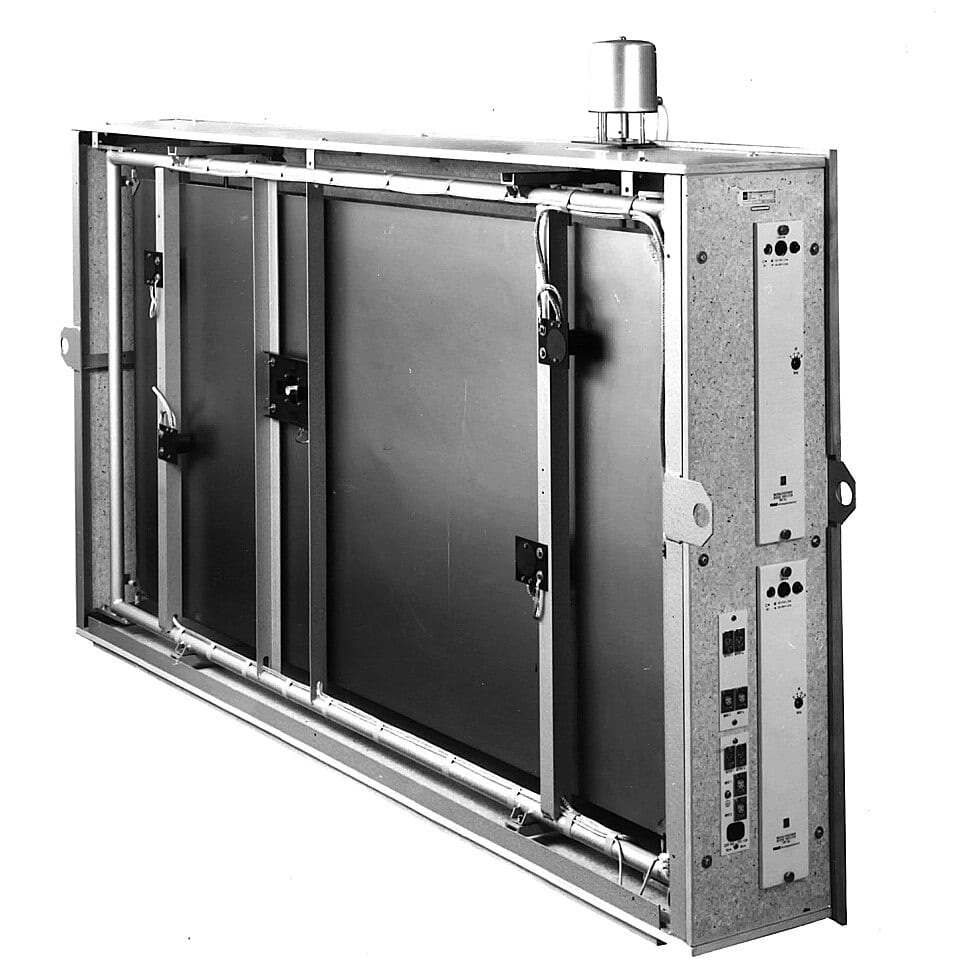
The EMT 240 gold foil and the move to digital
The EMT 240 replaced the steel sheet with a very thin gold foil. Sound On Sound says it “used stretched gold foil in place of the 140’s steel plate, allowing it to be made much more compact” (Sound On Sound, Soundtoys SuperPlate review). Vintage Digital gives the foil as 0.02 mm thick and 30 by 30 cm and dates the 240 to 1971 (Vintage Digital, EMT 240); Mix gives 1970. In 1976 EMT also released the EMT 250, which Mix calls “the first commercial digital reverb” (Mix, 1976 EMT Model 250). The 250 is not a plate at all, which is worth knowing when a record is credited to “the EMT”.
Records that used plates
Abbey Road bought four plates in 1957 “to complement the existing chambers” (Waves, Abbey Road reverb plates). Universal Audio credits those four units on Pink Floyd’s The Piper at the Gates of Dawn and The Dark Side of the Moon and on the Beatles’ Sgt. Pepper’s Lonely Hearts Club Band. MusicRadar reports that “Alan Parsons claims that the 140 was the only reverb used on Dark Side of the Moon” (MusicRadar, EMT 140 guide). John Lennon’s own “stereo, solid-state unit”, serial number 02802, was installed at his Tittenhurst Park home in 1970 and used for Imagine, according to the Bonhams auction listing (Bonhams). In New Jersey, Rudy Van Gelder bought serial number 44 and kept it in the bedroom next to his Hackensack control room (RVG Legacy).
EMT’s current site lists no reverbs, only turntables, tonearms, cartridges and phono electronics, and the EMT trademarks went to EMT International GmbH in Switzerland. MusicRadar names a few modern hardware plates, such as the Plattenhall and PlateToGo from DS AudioService.
Plate vs hall vs room vs spring reverb
The quickest way to tell the four apart is to listen to the first fraction of a second. A plate starts dense, with no echoes you can pick out. A room has clear early reflections. A hall builds up more slowly and lasts longer. A spring has a dispersive, sproingy character of its own; my spring reverb entry explains why.
| Type | Made with | Start of the reverb | Character | Source |
|---|---|---|---|---|
| Plate | Steel sheet, driver, pickups | Dense almost at once, no distinct early reflections | Smooth; highs die away fast, lows ring longer than mids (digital plate presets are often voiced brighter) | Sound On Sound, Valhalla |
| Hall | A concert hall, or an algorithm imitating one | “gradually builds in time and density” | Real halls decay in about 1.8 to 2.2 s | Valhalla DSP |
| Room | A smaller room, or an algorithm | “some prominent early reflections” | Sounds best with a fairly short decay | Valhalla DSP |
| Spring | One or more coiled springs, driver, pickup | Dispersive echoes that flutter along the spring | “sproingy”; upper partials cut off around 2 to 5 kHz | Bilbao, Valhalla |
Plates and real echo chambers share more than you might expect. Costello lists instant onset, high density, a long bass decay and a short treble decay for plates, then adds: “Interestingly enough, these characteristics are shared by reverberation chambers!” The difference is that “A reverb chamber will have a higher modal density than a plate”, which is consistent with the room counts in my test.
Digital plate reverbs
Most plate reverbs sold today are digital. Costello points out that delay-line reverbs also have a roughly even resonance density, so “This makes a plate model a reasonable goal for a digital reverb.” Jon Dattorro’s 1997 paper starts from the wish for “instantaneous high-density reflections with smooth exponential decay of the envelope” and adds: “This desire most closely describes the plate class of reverberators” (Dattorro, Effect Design Part 1, JAES 1997). His figure is a “Simplified plate-class reverberation topology in the style of Griesinger”. In it, four input diffusers “decorrelate the incoming signal quickly before it reaches the tank”, and damping filters make highs die away faster than lows, as in a real plate. Physical models go further: Bilbao’s 2007 A Digital Plate Reverberation Algorithm simulates the plate itself, in the same spirit as physical modeling synthesis.
Plate programs in hardware units
| Unit | Plate programs | Source |
|---|---|---|
| EMT 140 (1957) | Steel plate, the original | Mix |
| EMT 240 (1970/71) | Gold foil, about 0.02 mm thick, 30 by 30 cm | Vintage Digital |
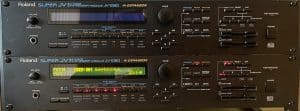
| Lexicon 480L | Bank 4 Plates: A Plate, Snare Plate, Small Plate, Thin Plate, Fat Plate | 480L manual |
| Lexicon PCM70 | Rich Plate programs, “the ideal basis for percussion treatments” | Music Technology via muzines |
| Yamaha REV500 | PLATE bank of 25 presets, e.g. Basic Plate, Beauty Plate, LA Plate, Vocal Plate 1, Perc. Plate 1 | REV500 manual |
| TC Electronic M300 | Plate I and Plate II | M300 manual |
| Boss SX-700 | One Plate type among 8 reverbs | Sound On Sound, 1996 |
The Yamaha REV500 gives its PLATE type a full quarter of its 100 factory programs: “The REV500 has four program types: HALL, ROOM, PLATE, and SPECIAL. Each program type contains 25” programs (Yamaha REV500 manual). Its manual describes Beauty Plate as “A bright, highly dense plate reverb” and LA Plate as “The bright, transparent plate sound that is popular on the West Coast”. My REV500 review covers the unit as a whole.
The TC Electronic M300 offers Plate I and Plate II next to a Spring type, and its manual says the characteristics of plates “are diffuse and bright and are still successfully used on many percussive instruments” (TC Electronic M300 manual). The Boss SX-700 has one Plate type among its eight reverbs, listed in Sound On Sound’s review as “Room 1, 2, & 3 Hall 1 & 2 Garage Plate” plus Non-linear (Sound On Sound, Boss SX700 review, 1996). The original Alesis QuadraVerb has a Plate type too: “The Reverb types available are: Plate, Room, Chamber, Hall, and Reverse.” (QuadraVerb manual). My QuadraVerb guide covers the whole family.
Plate reverb plugins
Outside hardware, plate sounds come as plugins you load in any DAW. Universal Audio’s EMT 140 is “Modeled after three original vintage units” and endorsed by EMT International (Universal Audio, EMT 140); its manual gives a damper range of 0.5 to 5.5 seconds. Waves Abbey Road Reverb Plates models “four modified EMT 140 plates used at Abbey Road Studios”, according to Sound On Sound. ValhallaPlate goes another way: “Seven of the reverb modes in ValhallaPlate are closely modeled on steel plates” (Valhalla DSP, ValhallaPlate modes). The UAD Lexicon 224’s Constant Density Plate A shows a digital twist on the plate idea. Sound On Sound says it “starts with a high initial density, consistent with a real plate, but then maintains this density rather than allowing it to increase” (Sound On Sound, UA Lexicon 224 review).
Plate reverb on vocals and snare: settings that work
Use a plate on an aux send rather than as an insert, set it 100% wet, and blend it in with the send level. Then adjust four things.
Pre-delay
Pre-delay is the gap between the dry sound and the start of the reverb. Universal Audio notes that “At 0ms the reverb is glued directly to the source” (Universal Audio, EMT 140 and 250 explained), which can blur the start of each word. Sound On Sound’s typical vocal treatment is a plate “with a decay time of 1.2 seconds or so and a pre-delay of 60-80ms”. Mixer Peter Mokran’s vocal preset uses 87 ms, and Universal Audio suggests “Anywhere between 70ms and 180ms is a reasonable range to explore” (Universal Audio, Peter Mokran vocal preset). For drums, the REV500 manual suggests adjusting the pre-delay to the tempo on its percussion plate.
Decay time
Pre-delay and decay work together. Universal Audio notes that “With enough Pre Delay, you can keep decay times short and still create a sense of real space”. Engineer Kevin Killen uses the UAD EMT 140 “B” plate “at 2.5 seconds, and a 250 Hz input filter, with the predelay anywhere from around 30 milliseconds to about 90 milliseconds” (Universal Audio, reverb roundtable). Mokran’s rule of thumb: “Longer decay and less Pre Delay for ballads; shorter decay and more Pre Delay for tighter, more modern sounds.”
Low cut and EQ
A real plate’s lows ring longer than its mids, so engineers often thin out the bottom of the reverb with an EQ. The original EMT 140 already had an input filter centred at 80 Hz with three steps of cut (UAD plug-ins manual). Universal Audio’s advice for a muddy plate is to “try raising the Input Filter to clean it up in the low end”, and Mokran “often goes up to 180Hz”. Mixer Don Gunn, writing on Valhalla’s blog, adds that “one can EQ into the plate if you want to excite higher frequencies, or one can EQ after the return” (Valhalla DSP, reverb tips).
Snare and drums
The plate’s fast build-up is a good match for snares. Universal Audio says drums “typically sound more realistic with small to mid-sized rooms (shorter reverb tails, shorter pre-delay), or plate programs” (Universal Audio, the basics of reverb), and the Lexicon 480L even has a dedicated Snare Plate with “a rapid buildup” of high frequencies. Mixer Don Gunn says “ValhallaPlate is my go-to reverb on most mixes for snare drum and lead vocals.” On a snare, start with a shorter decay than on the vocal; the REV500’s Perc. Plate 1 is described as “A short, bright plate reverb for percussion.” If the tail still crowds the next hit, shorten it further or duck the return with a compressor keyed from the snare.
Frequently asked questions
What does a plate reverb do?
Plate reverb is an artificial reverb made by vibrating a thin steel sheet, about 1 m by 2 m on the classic EMT 140. A driver excites the plate, contact pickups read its vibrations, and a damper sets the decay between about 1 and 5 seconds. It sounds dense and smooth, with no distinct early echoes.
Who invented the plate reverb?
Walter Kuhl, a German broadcasting engineer, is the inventor named on the patents, with a priority date of 11 August 1955. The applicant was Wilhelm Franz KG, the company behind EMT, which launched the EMT 140 in 1957. Kuhl described the device in the EBU Review in May 1958.
What is the difference between plate and hall reverb?
A hall reverb builds up gradually, and real halls decay in about 1.8 to 2.2 seconds. A plate is dense almost at once, with no separate early reflections. In my numpy model the plate was at 0.73 or more on the echo-density scale 5 ms in; two modelled rooms first held above 0.5 after 59 and 205 ms.
What is the difference between plate and spring reverb?
Both are mechanical. A spring reverb sends the sound down coiled springs, which gives fluttering echoes, with the upper partials usually cut off between 2 and 5 kHz. A plate is a flat steel sheet about 1 m by 2 m that builds a dense tail almost at once, without the spring’s flutter. EMT launched it in 1957.
What are good plate reverb settings for vocals?
Sound On Sound suggests a plate with about 1.2 seconds of decay and 60 to 80 ms of pre-delay. Peter Mokran’s vocal preset uses 87 ms, and he often raises the low cut to about 180 Hz. Use longer decays and less pre-delay on ballads, shorter decays and more pre-delay for tighter, modern vocals.
Is the EMT 250 a plate reverb?
No. The EMT 250 from 1976 is a digital reverb, described by Mix magazine as the first commercial one. EMT’s plates are the steel EMT 140 from 1957 and the much smaller EMT 240, which uses a gold foil about 0.02 mm thick. Credits that just say EMT can mean either kind.
Back to Music Production Terms Index Page