What is spring reverb?
Spring reverb is an artificial reverb made by sending the audio signal down one or more coiled steel springs. A transducer at one end twists the spring, the twist travels to the other end and bounces back and forth, and a pickup there turns the motion back into sound. Valhalla DSP’s Sean Costello sums up the result as “a short to medium length reverb, with a sproingy sound” (Valhalla DSP, Effect-O-Pedia: Reverb Types).
Laurens Hammond applied for a patent on the idea for his organs in 1939 (granted 1941), and a compact Hammond tank from 1960 put reverb into guitar amps, Fender’s included. Sound On Sound calls the spring “probably the first successful artificial reverb device” (Sound On Sound, Choosing The Right Reverb). Its sibling, the plate reverb, shakes a large steel sheet instead and sounds denser and smoother. Today you meet spring reverb in guitar amps, pedals, plugins, a few classic synths and Eurorack modules.
- A spring reverb tank usually holds two or three springs between an input transducer and an output transducer. Each spring has its own delay, 33, 37 or 41 ms in vintage Accutronics specs; after the first arrival, the echoes repeat once per round trip.
- Springs are dispersive: below a transition frequency, usually 2 to 5 kHz, low frequencies travel faster than high ones. Every echo arrives as a rising chirp, the spring’s typical drip.
- Hammond’s spring patent was filed in 1939. Hammond licensed Alan C. Young’s compact Type 4 tank (1960) to amp makers; Fender’s 6G15 Reverb unit (1961) used it, and Ampeg, Danelectro, Magnatone, Premier and others had reverb amps in 1961.
- In my numpy model with a 2.4 kHz transition, a 1789 Hz tone came back 20.0 ms later than a 97 Hz tone after one round trip, 40.3 ms after two and 60.0 ms after three. The 97 Hz tone repeated 27.1 times a second, the 1789 Hz tone 17.6.
- Common practice: high-pass the reverb return (Amplified Parts suggests 50 to 100 Hz for rumble), keep the mix low on an insert or run it 100% wet on a send, and use three springs and less treble on drums.
How a spring reverb works
A spring reverb has four main parts: the input transducer, the springs, the output transducer and the tank that holds them. Parker and Bilbao describe the drive this way: “The magnetic bead is driven torsionally by passing a signal into a nearby electromagnetic coil.” Merlin Blencowe (The Valve Wizard) explains that the changing magnetic field “exerts a tiny twisting force on the pole, which twists the spring too” (The Valve Wizard, Spring Reverb Drivers). At the far end the motion is read out “through the use of another magnet” (Stefan Bilbao, Spring Reverberation).
Inside the tank, the springs and transducers are “mounted on an inner aluminum channel, which is connected by four small support springs to an outer steel chassis” (Amplified Parts, Spring Reverb Tanks Explained and Compared). The wave bounces between the two ends, and each spring sets its own delay: the signal is reflected “with an amount of delay determined by each spring’s diameter, wire gauge, and length”. For the lowest frequencies, Parker and Bilbao define the echo spacing as “the time taken for a wave to propagate the length of the spring twice” (Parker and Bilbao, Spring Reverberation: A Physical Perspective, DAFx-09). Amplified Parts lists the delay per spring (the time before the first reflections arrive) in vintage Accutronics tanks as 33 ms (short), 37 ms (medium) and 41 ms (long).
Most tanks use more than one spring. A Universal Audio patent says typical units “consist of several (usually two or three) independent spring elements, operating in parallel” (US patent 8,391,504). With springs of different delay, “one spring’s response will fill voids or holes in the other spring’s response”, in Amplified Parts’ words. They describe the audible difference too: “Two spring tanks have more flutter and grit”, while three-spring tanks have “a more smoothed out flutter with a bigger, fuller sounding reverb effect and more lows”.
Why a spring sounds drippy: dispersion
The sound of a spring comes mostly from dispersion: different frequencies travel along the spring at different speeds. Jonathan S. Abel and David P. Berners’s patent for Universal Audio states it plainly: “low-frequency portions of these signals propagate faster than high-frequency portions”. The Valve Wizard agrees that this is “part of what gives spring reverb its unique sound”. Julian Parker writes that “The group delay has a maximum at fC”, the transition frequency, so tones just below it are delayed the most (Parker, EURASIP 2011).
The result is that “the dispersivity of the spring bends the echoed impulses into chirps”. Each echo starts low and sweeps upward. Stefan Bilbao ties the transition to the twist of the helix and adds that “This partial cutoff normally occurs in the range between 2 and 5 kHz”. Above it there is a second, quieter set of echoes; the UA patent describes that mode as “weakly dispersive, propagating high frequencies faster than low frequencies”. Parker and Bilbao note that “the characteristic sound of a spring reverberator is mainly related to the region below FC”. Parker’s doctoral thesis goes further: springs “derive almost all of their recognized sonic character and desirability from the dispersion they induce” (Parker, Dispersive Systems in Musical Audio Signal Processing, Aalto University).
Costello describes the same thing by ear: real springs have a pronounced DWIP! sound “caused by dispersion”, and “Digital springs often don’t capture” it. Over time the chirps blur. The UA patent says the arrivals are eventually “sufficiently smeared that they give the impulse response a noiselike ‘wash’ rather than the repeated chirp heard during the impulse response onset”. The tank does not reproduce the full audio range either. The Valve Wizard says the response “drops off very quickly above about 3kHz and is largely irrelevant above 5kHz”.
Reverb tank types and the Accutronics code
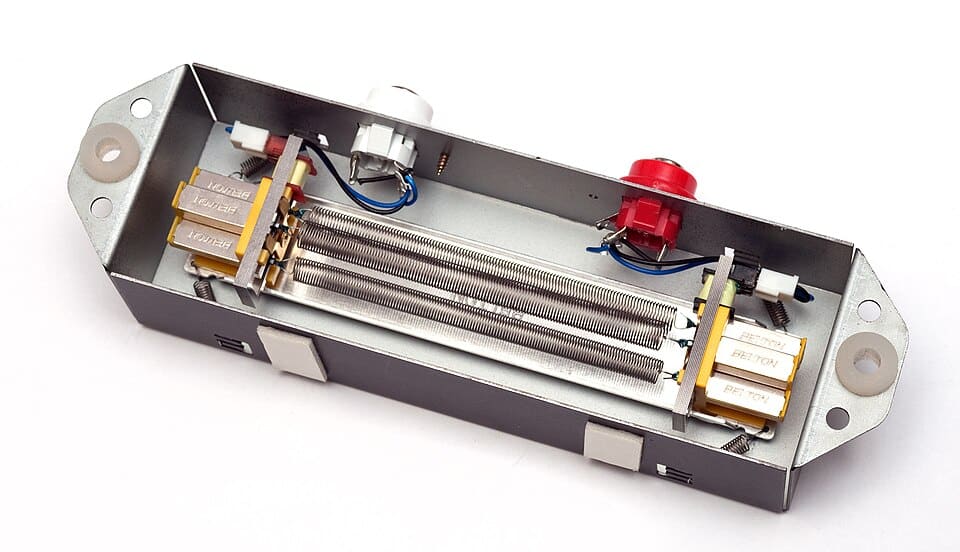
Amplified Parts explains that Accutronics part numbers “consist of a seven digit code” and that each digit “represents a specification” (Amplified Parts, Accutronics Products and Specifications). The first digit is the tank type: 1 is a short tank with two springs, 4 a long 16.25-inch tank with two, 8 a short 9.25-inch tank with three and 9 a long tank with three. Mojotone’s guide gives the same types (Mojotone). The table decodes the Fender Twin Reverb’s tank, which Amplified Parts lists as a 4AB3C1B.
| Digit | Meaning | 4AB3C1B | Value |
|---|---|---|---|
| 1st | Tank type | 4 | Long tank (16.25 inches), two springs |
| 2nd | Input impedance | A | 8 ohms |
| 3rd | Output impedance | B | 2,250 ohms |
| 4th | Decay | 3 | Long, 2.75 to 4.0 s (1 = 1.2 to 2.0 s, 2 = 1.75 to 3.0 s) |
| 5th | Connectors | C | Input insulated, output grounded |
| 6th | Locking device | 1 | No lock |
| 7th | Mounting plane | B | Horizontal, open side down |
A datasheet quoted by Amp Books gives the 4AB3C1B a “typical decay time: 2.75 to 4.0 seconds” and a “nominal drive current: 28.0mA RMS” (Amp Books, Fender Parallel 12AT7 Reverb Driver). Amplified Parts adds two practical notes: impedances are “measured at 1kHz”, and the effect “will sound poor or inaudible if the impedances are not matched”. The code tables list the Type 4 with two transmission springs, although Amplified Parts’ product page describes “Four counter-wound and coupled springs”, which reads as two coupled pairs. Accutronics now belongs to Belton: Amplified Parts says the tanks “are currently made in Korea with Accutronics equipment”, and Belton’s own numbers add a prefix, for example BL2AB3C1B.
Driving the tank
A tank needs a driver stage, and in Blencowe’s words “it is current which drives the tank”. In Fender amps “The classic Fender driver is simply a small power stage, using a paralleled 12AT7.” He adds that Fender used “a ~320Hz low-cut filter before the driver”, which, with the tank’s own roll-off, makes the reverb mid-heavy. On the way out, the signal is tiny: “The output signal from the tank should be about 1 to 5 mV”, so a recovery stage amplifies it back up. In blackface Fender amps one 12AT7 drives the tank and a 7025 (a 12AX7 type) recovers it, while the earlier stand-alone Reverb unit also had a large 6K6 output tube (Amp Books).
How dispersion shapes each echo: my numpy test
I wanted to see the drip as numbers, so I wrote a small, deterministic numpy model (the script and results JSON are kept with this entry). It follows the structure Parker describes for the parametric spring model: a Schroeder-style feedback loop “with the addition of long chains of all-pass filters which produce the required dispersion”. My loop has 100 stretched first-order allpass filters (coefficient 0.5) and a plain 30 ms delay, sampled at 48 kHz. I set the stretch for two transition frequencies, 2,400 Hz and 4,800 Hz, both inside Bilbao’s 2 to 5 kHz range. The parameters are mine and illustrative. The model is not a measurement of a real tank, and it only covers the main band below the transition frequency.
I sent short tone bursts at 97, 233, 440, 1013 and 1789 Hz through the loop, each at -1 and -20 dBFS, and timed the peak of every echo. I chose pitches that are not simple multiples of each other, so no single test tone could decide the result. A control run with the allpass coefficient set to 0, a plain delay, gave the same 20.8 ms through the chain for every pitch at the 2,400 Hz setting.
With the transition at 2,400 Hz, one pass through the dispersive chain delayed a 97 Hz burst by 7.0 ms and a 1789 Hz burst by 27.0 ms. The measured burst peaks matched the theoretical group delay to within 1.3 ms; the largest error was the 1789 Hz burst, whose short length spreads it across the steep part of the curve near the transition. The level made no difference at all: -1 and -20 dBFS gave identical timings, which is expected in a linear model. A real tank is not perfectly linear, so this says nothing about overdriving one.
Every round trip makes the chirp longer
Because the sound passes through the dispersive spring again on every round trip, the gap between low and high frequencies grows with each echo. At the first echo the 1789 Hz tone came back 20.0 ms after the 97 Hz tone; at the second 40.3 ms; at the third 60.0 ms. An impulse showed the same pattern across octave bands: in every one of the first three echoes the lowest band peaked first and the highest band last. This fits the UA patent’s description of a real spring: the spacing of arrivals at a low frequency is “earlier and shorter in time than the spacing of the same arrivals” above 2 kHz.
| Tone | Chain delay (2,400 Hz) | Echoes per second | Chain delay (4,800 Hz) | Echoes per second |
|---|---|---|---|---|
| 97 Hz | 7.0 ms | 27.1 | 3.5 ms | 29.9 |
| 233 Hz | 7.1 ms | 27.0 | 3.5 ms | 29.9 |
| 440 Hz | 7.5 ms | 26.7 | 3.5 ms | 29.8 |
| 1013 Hz | 10.5 ms | 24.7 | 3.8 ms | 29.6 |
| 1789 Hz | 27.0 ms | 17.6 | 4.8 ms | 28.7 |
The echo rate depends on pitch, too. With the transition at 2,400 Hz, the 97 Hz tone repeated every 37.0 ms (27.1 echoes per second), the 1789 Hz tone every 57.0 ms (17.6 per second). With the transition moved up to 4,800 Hz, the same two tones repeated at 29.9 and 28.7 per second and the first-echo gap shrank to 1.3 ms. In this model, how strongly a note is bent depends on how close it sits to the transition frequency: the dispersion is concentrated just below it. Without the allpass chain, the loop would be a plain feedback comb filter; see my comb filter entry for that side of the maths.
A short history of spring reverb
The spring started inside the Hammond organ. Amplified Parts explains why: “churches were designed to be acoustically dead, and the Hammond organ had to have its own artificial reverberation.” Laurens Hammond’s US patent 2,230,836 was filed on 15 July 1939 and granted on 4 February 1941. It describes “means for introducing a reverberation effect of selected degree in the music irrespective of the acoustic properties of the place where the instrument is being played” (US patent 2,230,836). A companion patent for a shipping lock, US 2,211,205, was granted earlier, on 13 August 1940, to hold “the parts therein in position when the apparatus is being shipped” (US patent 2,211,205). The brand’s history page says the first unit “stood four feet tall” (Accutronics history).
From the necklace reverb to the Type 4
Two Hammond engineers, Herbert E. Meinema and Herbert H. Canfield, filed the so-called necklace reverb patent, US 2,982,819, on 13 October 1958; it was granted on 2 May 1961 (US patent 2,982,819). The Accutronics history says it was “Introduced in 1959” and credits Alan Young as a third developer, while the patent itself names only Meinema and Canfield. Young’s own patent, US 3,106,610, was filed on 30 January 1961 and granted on 8 October 1963 (US patent 3,106,610). Its goal was “to simulate the reverberative effect of a room or hall of appropriate acoustical properties”. The result became the tank that Accutronics says “is now called the Accutronics Type 4 reverb unit”. Vox Showroom notes that it cut the four-foot length of the original design “to less than 18” inches (Vox Showroom).
Fender, surf and the 1961 reverb amps
Hammond released the compact system in September 1960, and “By the NAMM show of July 1961, use of the new Hammond spring assemblies (and driver transformers) had become the norm” for American reverb amps (voxac30.org.uk). Guitar World notes that Hammond “immediately licensed” the Type 4 to amp makers, and that reverb amps from “Ampeg, Danelectro, Magnatone, Premier and more emerged much earlier in 1961” than Fender’s. It adds that “it’s impossible to determine which amp model was actually the first” (Guitar World, Ampeg Reverberocket).
Fender’s first reverb was a separate box: Amplified Parts says reverb “made its debut in the Fender line as a separate item, using a spring unit bought from Hammond, in 1961”. That box was the 6G15 Reverb unit, with “6K6GT, 12AT7 & 7025 valves” and the Hammond Type IV tank, according to Guitar World, which also says it was developed with Dick Dale. Vintage Guitar notes that Fender’s unit “didn’t become widely available until ’62” (Vintage Guitar). Guitar World says the unit “became very popular among surf-rock guitarists in the early 60s”, and that reverb first appeared inside a Fender amp in 1963, with the Vibroverb (Guitar World, Classic Gear: Fender Reverb). Fender dates its Twin Reverb to “late summer 1963” (Fender, the Twin story). The 6G15 was discontinued in 1966.
| Year | Event | Source |
|---|---|---|
| 1939 | Laurens Hammond files US patent 2,230,836 (granted 1941) | Google Patents |
| 1958 | Meinema and Canfield file the necklace reverb patent, US 2,982,819 (granted 1961) | Google Patents |
| 1960 | Alan C. Young’s compact Type 4; Hammond releases the system in September | Accutronics, voxac30.org.uk |
| 1961 | Fender 6G15 Reverb unit; reverb amps from Ampeg, Danelectro, Magnatone, Premier and others | Guitar World (Fender), Vox Showroom, Guitar World (Ampeg) |
| 1963 | Fender Vibroverb, Twin Reverb and Deluxe Reverb; AKG DX11 reverb microphone | Guitar World, Fender, MusicRadar, SOS |
| 1971 | Reverb production moves to Accutronics in Geneva, Illinois; later the shorter Type 1 and Type 8 tanks | Accutronics |
| 1974 | Roland RE-201 Space Echo, tape echo plus spring reverb | Roland |
| 1986 | Home studios swap springs for cheap digital reverbs such as the Midiverb | HSR via muzines |
| 2009 | Belton Engineering (Korea) acquires the Accutronics brand | Accutronics |
Studio springs
Springs were also a studio tool. AKG’s DX11 was a “1963 microphone with built-in spring reverb”, and Sound On Sound says that research “would eventually lead to the unparalleled BX series of studio reverb boxes” (Sound On Sound, AKG DX11). The BX20 “occupied a large wooden case and cost in the region of $3500”, and “Electronic motional feedback rather than mechanical damping was used to change the decay time” (Sound On Sound, UA AKG BX20 review). A 1982 E&MM article put the BX range at a decay of “2 to 4.5 seconds” (Electronics & Music Maker, April 1982, via muzines).
Cheaper springs filled home studios. In 1979 the Great British Spring cost GBP 159 and “uses six springs” (Sound International, May 1979, via muzines); the Mk3 cost “£229.95 including VAT” in 1984 (Home & Studio Recording, June 1984, via muzines). As late as April 1986, a round-up concluded “there’s still no more cost effective way of producing reverb” (Home & Studio Recording, April 1986, via muzines). By November the same magazine reported people “almost giving them away and buying Midiverbs instead” (Home & Studio Recording, November 1986, via muzines). Sound On Sound later remembered that “as soon as affordable digital reverbs hit the market, we all dumped our spring reverbs with much rejoicing” (Sound On Sound, VSR3 review, 2000).
Spring reverb in dub
Jamaican dub turned the spring into an instrument. Red Bull Music Academy writes that on King Tubby’s MCI desk, “Each channel had a dedicated reverb send, which enabled reverb to be placed solely on individual elements” (Red Bull Music Academy, The Roots of Dub). The same piece quotes UK dub DJ Nick Manasseh, who “has confirmed that the effect was created by whacking a spring reverb with a large stick”. King Jammy remembered that at Tubby’s studio “it was a Fisher reverb”, which they modified (Dread Library). The popular story of Tubby kicking the tank does not appear in those sources; they speak of hitting it.
At Lee “Scratch” Perry’s Black Ark, Ableton lists “a Grampian spring reverb” among the early gear (Ableton, Studio as an Instrument part 3). Daniel Boyle told Sound On Sound that Perry’s “primary use for it was on the drum bus” (Sound On Sound, Back To The Ark). Not everyone in dub liked the sound: Gearnews notes that “some dub artists like Mad Professor condemned spring reverb” (Gearnews).
Springs in synths and Eurorack
Some classic synths and echo units have a spring built in, next to the oscillators and filters that my sound synthesis overview explains. The ARP 2600 has “a stereo spring reverb (with independent reverb level for the left and right channels)” (Perfect Circuit). On the EMS VCS3, Sound On Sound described “a dual line spring reverb which can do little more than go ‘boing’, but can, if used judiciously, have a charm of its own” (Sound On Sound, EMS VCS3). MusicRadar notes the reverb mix is “available as a destination in the pin matrix” (MusicRadar). Roland’s RE-201 Space Echo, introduced in 1974, is “a combination tape echo and reverb” (Roland). Eurorack has real tanks too: Doepfer’s A-199 uses “3 spiral springs” (Doepfer A-199), and Befaco (Befaco Spring Reverb) and Erica Synths (Erica Synths Black Spring Reverb) make spring modules as well.
Spring vs plate vs digital reverb
Spring and plate reverbs are both mechanical, and both lack true early reflections. Sound On Sound notes that “springs and plates generate no early reflections in the true sense of the word”, and suggests adding a delay in front as a spatial cue. The differences are in the medium and the texture. A spring flutters: in Sound On Sound’s words, “the sound fluttered and pulsed as the reflections bounced back and forth along the length of the spring”. A plate builds a dense tail almost at once. A digital algorithm can imitate a room, a hall, a plate or a spring.
| Type | Made with | Start of the reverb | Character | Source |
|---|---|---|---|---|
| Spring | Two or three coiled springs, a driver and a pickup | Echoes that repeat every round trip, each one a rising chirp | “sproingy”; little output above about 5 kHz | Valhalla, Valve Wizard |
| Plate | A steel sheet about 1 m by 2 m, a driver and pickups | Dense almost at once, no distinct early reflections | Smooth and dense, without the spring’s flutter | my plate reverb entry, linked below |
| Digital | Delay networks, convolution or physical models | Whatever it imitates: room, hall, plate or spring | Depends on the algorithm | Strymon, Parker 2011 |
For the plate side in detail, including my own echo-density test of a modelled EMT 140, see the plate reverb entry.
Digital spring reverb and plugins
Springs are hard to model. Parker and Bilbao wrote in 2009 that standard methods for modelling analog audio effects “are not well suited to modeling spring reverberation, due to the complex and dispersive nature of its mechanical vibration”. Research took three routes. Parker lists waveguide models and finite difference models as the earlier work; Bilbao reports that difference schemes “do a good job of reproducing the response”, though their echoes below the cutoff were “too coherent”. The third route is the parametric allpass-chain model, which my test copies in miniature, and Parker’s 2011 refinements “reduce the computational complexity of the structure to one third of its original cost”. The UA patent models “each spring element” as waveguide sections with filters for delay, attenuation and dispersion, and illustrates it with “an Accutronics Type 8 spring reverberator”. Finite difference modelling is the same family of methods used in physical modeling synthesis; Bilbao groups springs and plates under “Virtual analog modelling”, the effects counterpart of virtual analog synths.
Spring reverb plugins and pedals
Here are spring reverb plugins and hardware models, with what each maker says it models. I list them for reference and have not tested them.
| Product | Type | What the maker says it does | Source |
|---|---|---|---|
| Softube Spring Reverb | Plugin | 1 to 3 spring pairs; Springs on TWO with minimum Tension gives “a typical Accutronics Type 4 sound” | Softube manual |
| Arturia Rev SPRING-636 | Plugin | Based on the Grampian 636; 2 preamp types, 8 swappable tanks | Arturia |
| UA AKG BX 20 | Plugin | The BX 20’s dual-tank Torsion Transmission Line unit; delay networks plus convolution | UA manual |
| AudioThing Springs | Plugin | 19 spring reverb types, from a 6-spring pipe to a single-spring unit | AudioThing |
| Eventide Spring | Plugin | Physical parameters a real tank does not offer | Eventide |
| Strymon Flint | Pedal | ’60s Spring Tank among three reverbs | Strymon |
| BOSS FRV-1 | Pedal (discontinued) | The 1963 Fender Reverb via COSM modelling | BOSS |
| Anasounds Element | Pedal | Drives a real external spring tank via RCA, with a spring saturation switch | MusicRadar |
Older digital multi-effects have spring programs too. The TC Electronic M300 manual says its Spring algorithm “is designed to reproduce the sound of the old spring Reverbs, such as the ones used in vintage guitar amps”. In a DAW, any of these plugins runs as a VST or similar plugin on an insert or a send.
How to use spring reverb: settings and tips
Spring reverb works best where its flutter is wanted. Valhalla’s list of uses reads “Surf guitar, old school electronic music, dub, spaghetti western footsteps, etc.”, and Softube says it can add character “to a vocal track, a snare drum, percussion, an electric organ or just about anything” (Softube Spring Reverb). Sound On Sound’s Paul White notes that early springs “worked well enough on vocals, guitars, and electronic organs, it wasn’t so good on percussive sounds”.
Insert or send
Softube’s manual says that “when used as an insert effect, the Mix knob will typically be set between 0 and 20%”; on a send the plugin runs fully wet (Softube Spring Reverb manual). A send also follows the dub habit of reverb on single parts: set up an aux channel with the spring on it and feed only the elements that should splash. Soundgas describes the Roland RE-201 spring as useful “as a dub/mix send effect” as well as for tracking (Soundgas).
Guitar: dwell, mix and tone
On a Fender-style reverb, Dwell sets how hard the springs are driven. Guitar World explains that more Dwell sends more signal to the tank, “with a distinctive ‘drip’ sound becoming audible at higher settings”. MusicRadar’s review of the ’63 reissue sums up the controls: “The Mix knob dials in the reverb, Dwell drives the springs harder” (MusicRadar, Fender ’63 Tube Reverb review). Tape Op notes that attenuating the input is “a very useful tool for moderating the amount of” boing in the sound (Tape Op, Spring Reverb). Amplified Parts lists the traditional decay choices as long (2.75 to 4.0 s) for guitar, medium (1.75 to 3.0 s) for organ and short (1.2 to 2.0 s) for vocals.
Drums and percussion
Transients are the spring’s weak point. Sound On Sound warns that “percussive attack transients can cause the springs to become temporarily unstable”, and suggests lowering the send or running it “via a limiter set pretty hard” (Sound On Sound, Q&A on vintage spring reverb). Softube’s tip for drums is to turn the springs all the way up and then “reduce Treble to decrease the metallic character”. For the UA BX 20, Universal Audio suggests disengaging Direct on drums “to mute the direct component of the spring tank and prevent the reverb from interfering with transients” (Universal Audio blog).
EQ the return
Several sources recommend cutting lows on the spring. Rod Elliott writes that it is “common to include a high pass filter as well, because the spring reverb effect doesn’t work well at low frequencies” (Elliott Sound Products), and Amplified Parts suggests a 50 to 100 Hz high-pass against rumble. In a mix, Tape Op’s reviewer found a high-pass “helpful in preventing the reverb effect from clouding the midrange” (Tape Op, Endless Summer review), and iZotope’s example cut a drum spring “at 342 Hz” (iZotope, What is spring reverb?). With a hardware unit, Sound On Sound adds that you can “roll off the top end to reduce the hiss”. My EQ entry covers the filter types.
Frequently asked questions
What does a spring reverb do?
A spring reverb adds an artificial reverb by sending the signal down usually two or three coiled springs and picking it up at the far end. Each spring adds its own delay, 33 to 41 ms in vintage Accutronics specs, the echoes keep returning on every round trip, and dispersion turns each echo into a rising chirp.
Who invented spring reverb?
Laurens Hammond filed his original spring reverb patent, US 2,230,836, on 15 July 1939 for his electric organs; it was granted in 1941. Hammond engineer Alan C. Young later designed the compact Type 4 tank of 1960, which spread spring reverb into guitar amps from 1961.
What is the difference between spring and plate reverb?
Both are mechanical reverbs without true early reflections. A spring sends the sound down coiled wire, which gives fluttering, chirping echoes below a transition of about 2 to 5 kHz. A plate vibrates a steel sheet of about 1 m by 2 m and builds a dense, smooth tail almost at once.
What do the numbers on a reverb tank mean?
Accutronics tanks use a seven-character code: type, input impedance, output impedance, decay, connectors, locking and mounting. A 4AB3C1B, the Fender Twin Reverb tank, is a long two-spring type 4 with 8 ohm input, 2,250 ohm output and a long 2.75 to 4.0 second decay.
Why does spring reverb sound drippy?
A spring is dispersive: below its transition frequency, usually 2 to 5 kHz, low frequencies travel faster than high ones. Each echo therefore arrives as a rising chirp, and every round trip stretches it further. Driving the tank harder, for example with more Dwell on a Fender unit, makes the drip more audible.
How should I EQ a spring reverb?
Cut the lows on the reverb return. Amplified Parts suggests a 50 to 100 Hz high-pass against rumble, Fender’s own driver already cuts lows near 320 Hz before the tank, and iZotope cut a drum spring at 342 Hz. Rolling off the top end on a hardware tank also lowers its hiss.
Back to Music Production Terms Index Page