What is a rompler?
A rompler is a synthesizer, sound module or plugin that plays back factory samples stored in read-only memory instead of generating its sound with oscillators, and that cannot record new samples of its own. Sound On Sound (SOS)’s glossary puts it as an instrument that “uses audio samples instead of oscillators for sound generation, with the sample waveforms stored in ROM” and adds that “A ROMpler cannot sample audio to create new sounds, unlike a conventional ‘Sampler’.” (SOS glossary).
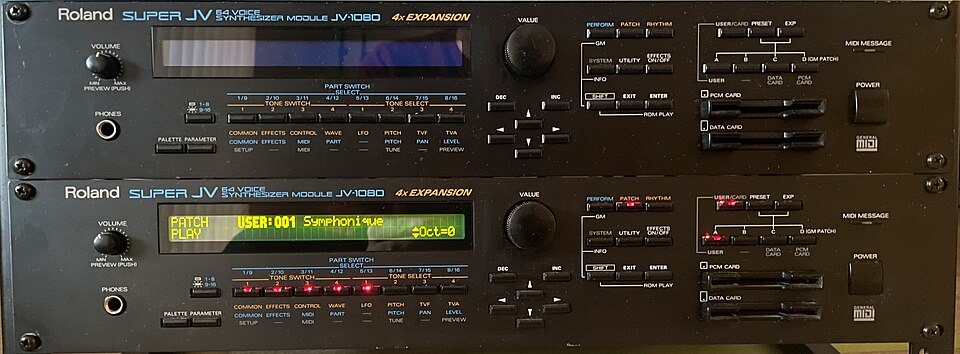
The word itself is slang. Sweetwater’s InSync glossary, first published in October 2004, calls it “A slang term given to sound modules that feature stock presets based on samples stored in ROM” and explains that “The term is a conjunction of the terms ROM and Sampler.” (Sweetwater InSync). Robin Vincent’s history of the format for Perfect Circuit has the shortest version: “A ROMpler is a read-only sampler, or a sampler that doesn’t sample” (Perfect Circuit). SOS names one machine as the model case: “The Roland JV1080 is a classic example of a ROMpler.”
On this page I explain how a rompler voice is built, how it differs from a sampler, a workstation and a synth, and how the format grew from the late 1980s to today’s sample-library plugins. I also add my own table of how much waveform ROM 24 classic instruments had, from manuals and dated reviews, and a short look at why the word can sound like an insult. Many of the instruments have their own entries in this glossary, and I link each one where it comes up.
- Rompler = ROM + sampler. It plays factory samples from memory, usually through a filter, envelopes and effects, and it cannot record its own.
- Makers used their own names for the engine: Korg’s AI, Yamaha’s AWM, Roland’s LA on the D-50, where sampled attacks were paired with synthesized sustains.
- In my table of 24 instruments, wave ROM grew from 0.5 MB on the Roland D-50 (1987) to 160 MB of physical ROM on the Korg Triton Extreme (2004), doubling about every 2.5 to 2.7 years.
- Nobody has documented who coined the word. The earliest dated uses I found are Sweetwater in 2004 and SOS in 2005.
- The term is often a put-down for preset boxes, but players such as Jem Godfrey have defended the format in print.
How a rompler voice works
A rompler voice starts with a recorded waveform and then treats it like an oscillator in a subtractive synth. SOS’s 1989 review of the E-mu Proteus said the easiest way to think of these machines is as “synthesizers that use sampled sounds instead of oscillators” (SOS, November 1989). The signal path usually has four stages.
The samples are organised before you ever touch them. On the Proteus, “The samples are organised as 125 Instruments, many of which are multisampled for added realism throughout the keyboard range”, and “The Instruments can be further combined into Presets”. That spares you the work a sampler needs: according to the SOS glossary, “there is no need to setup keymapping etc as that is all taken care of by the manufacturer”. The same glossary entry notes that “Most Romplers allow the mixing of different samples in layers, and to change the filters and envelopes, add effects etc.”
Layers are where a rompler gets its depth. The Proteus 2000 manual has sections called “To Switch Layers According to Key Position” and “Defining the Velocity Crossfade Range”, so one preset can change sample with the note you play and with how hard you hit it (Proteus 2000 manual). Roland’s JV-1080 manual names the source “WG (Wave Generator)” and the filter a “TVF (Time Variant Filter)” (JV-1080 manual).
Samples plus synthesis: AI, AWM and LA
Most late-1980s instruments mixed samples with some form of synthesis, and each maker gave the mix a name. Music Technology wrote in 1988 that “Korg call their new system AI (Advanced Integrated) synthesis”, built on “a mixture of 16-bit PCM multi-samples” (Music Technology, July 1988). Korg kept the idea for years: SOS’s 1996 review of the Korg N364 notes that the engine “was still called AI2”.
Yamaha’s name is AWM. Its own history pages say “we call this type of engine the Advanced Wave Memory (AWM) tone generator”, and that on the SY77 “the PCM waves of the AWM2 engine could even be used as operator waves in the AFM tone generator” (Yamaha). Music Technology reported that “Yamaha call this Realtime Convolution and Modulation synthesis” (Music Technology, 1990). The rack version, the TG77, has the same engine.
Roland’s D-50 took a different route. In LA synthesis, each Partial “can be a software simulation of an analogue synthesizer or a stored (digitally sampled) PCM sound” (SOS, June 1987). The samples were mostly short: “Of the 100 samples, 47 are attack portions”, according to SOS’s later retro review (SOS). Roland’s own anniversary page describes the result as an instrument that “combined PCM waveforms and subtractive synthesis with on-board digital effects” (Roland). A D-50 is not usually called a rompler, but it showed what a little sample memory could do.
Rompler vs sampler vs workstation vs synthesizer
These four labels overlap, and the dividing line that matters most is whether the box can record. A sampler records sound; a rompler only plays what the maker put in. A workstation adds a sequencer and effects to either. A synthesizer, in the narrow sense, builds its sound from oscillators. The table uses glossary definitions from SOS and Sweetwater.
| Type | What it does | Records its own samples? | Example | Definition |
|---|---|---|---|---|
| Rompler | “uses audio samples instead of oscillators for sound generation”, stored in ROM | No | Roland JV-1080, E-mu Proteus | SOS glossary |
| Sampler | “can record, alter and playback digital audio data” | Yes | Yamaha A3000 | Sweetwater |
| Workstation | An all-in-one keyboard with “capabilities for composition, recording, sound design and performance”, including a sequencer | Depends on the model | Korg M1 (samples, no sampling), Roland W-30 (sampler) | Sweetwater |
| Synthesizer | “uses sound generating elements (such as oscillators or the like) to create audio waveforms” | No | Any analog subtractive synth | Sweetwater |
The edges are blurry, and SOS says so: “there is something of a grey area between Sampler and ROMpler”. It means instruments that cannot sample but can load user waveforms: “The Yamaha SY85 is an old example of this kind of setup”, alongside the Kurzweil K2700. I cover the SY85’s sound libraries in my SY85 soundbanks post. The reverse case exists too. The Roland W-30 is a sampler that also carries factory ROM; Music Technology’s 1989 review describes “The W30’s sampler section (minus the ROM side of things)” and heads the article “Roland W30 Music Workstation” (Music Technology, July 1989). A sampling option could turn a rompler into a sampler: Kurzweil’s own product history lists the K2000S as the “K2000 with sampling option (includes 2 meg sample RAM)” (Kurzweil).
Modern hardware keeps the argument going. SOS found the Nord Wave 2’s sample engine “more akin to a ROMpler than a true sampler” (SOS, 2020), and wrote that “The Prophet X is not an alternative to a conventional ROMpler or digital workstation” (SOS, 2018). For a dedicated sampler of the same era as the late romplers, see the Yamaha A3000, which SOS reviewed in July 1997 as the “Yamaha A3000 Digital Sampler” (SOS). For the underlying idea of a recorded sound clip, see my sample entry.
How much ROM did classic romplers have? My table
Wave ROM is the one number every rompler spec sheet prints, so I collected it for 24 instruments from 1987 to 2004. Each figure comes from the owner’s manual, a service manual or a dated magazine review, quoted word for word in my source file. The smallest is the Roland D-50’s 0.5 MB of PCM samples in 1987; the largest physical figure is the Korg Triton Extreme’s 160 MB in 2004, 320 times as much.
A least-squares fit of the logarithm of ROM size against year gives a doubling about every 2.5 years, or roughly 32% more ROM per year (R² = 0.86 across all 24 instruments). Leaving out the three figures that are printed only as 16-bit linear equivalents gives 2.7 years. The median was 3 MB in 1987 to 1990, 6 MB in 1991 to 1996 and 74 MB in 1998 to 2004, or 32 MB if the three linear-equivalent figures are left out.
Three patterns stand out:
- 4 MB was the most common size from 1988 to 1992. Five of the 13 instruments in that window print it: the Korg M1 (1988), E-mu Proteus (1989), Yamaha SY77/TG77 (1989), Roland JV-80 and JV-880 (both 1992). The rest range from 1 MB to 8 MB.
- Compression stretched the numbers. Music Technology wrote in May 1992 (JV80 review) that Roland’s compression could “effectively double the storage capacity of the JV80’s standard 4Mb wave data ROM”. SOS wrote that the JV-880’s waveforms “occupy 4MB of ROM” and Roland’s compression doubled their effective size; the Korg Trinity’s 24 MB held the equivalent of 48 MB because “2:1 data compression has been used”. The XV-5080 (2000), Motif (2001) and Motif ES (2003) are printed only as uncompressed equivalents, such as the XV-5080’s “64MB (16-bit linear format)”.
- 8 MB was common into the mid-1990s. Kurzweil’s K2000 (1991), K2500 (1995) and the Korg N364 (1996) all shipped with 8 MB, though the Korg Trinity already had 24 MB in 1995. SOS noted that “the N364’s 8Mb of sample ROM is 1.33 times that of the X3”. Three years after the N364, the E-mu Proteus 2000 and Korg Triton both had 32 MB.
| Year | Instrument | Wave ROM as printed [my notes in brackets] | MB | Type | Source |
|---|---|---|---|---|---|
| 1987 | Roland D-50 | 4Mbit ROM (PCM samples) | 0.5 | physical | SOS |
| 1988 | Korg M1 | 4 Megabytes of waveform memory | 4 | physical | SOS |
| 1989 | Roland W-30 | 512K of ROM sample memory [May 1989 preview: 1Meg of unalterable samples] | 1 | physical | Music Technology, Music Technology, May 1989 |
| 1989 | Ensoniq VFX | 1.5 Mbytes of waveform ROM | 1.5 | physical | Music Technology |
| 1989 | Yamaha TG55 / SY55 | 2 megabytes of sampled waveform ROM | 2 | physical | Owner’s manual |
| 1989 | Roland U-220 | Internal ROM : 3 Mbyte (128 Tones) | 3 | physical | Service notes |
| 1989 | E-mu Proteus | 4Mb of waveform ROM | 4 | physical | SOS |
| 1989 | Yamaha SY77 / TG77 | Waveform memory: 2 Mwords (4 Mbytes), 112 sounds | 4 | physical | Owner’s manual |
| 1989 | Korg T2 | PCM ROM 4Mword (8Mbyte) | 8 | physical | SOS |
| 1991 | Ensoniq SD-1 | a total 3.5MB of ROM | 3.5 | physical | SOS |
| 1991 | Korg 01/W | Waveform Memory: 48Mbits (PCM) | 6 | physical | SOS |
| 1991 | Kurzweil K2000 | 8Mb sample ROM | 8 | physical | Music Technology |
| 1992 | Roland JV-80 | 4MB of ROM [compression effectively doubles it, MT May 1992] | 4 | physical, 2:1 compressed | SOS, Music Technology, May 1992 |
| 1992 | Roland JV-880 | 4MB of ROM [2:1 compressed, equivalent to 8 MB] | 4 | physical, 2:1 compressed | SOS |
| 1995 | Korg X5 | 6Mb of waveform ROM | 6 | physical | SOS |
| 1995 | Kurzweil K2500 | base ROM of 8Mb, expandable to a maximum of 28Mb | 8 | physical | SOS |
| 1995 | Korg Trinity | 24Mb of ROM [2:1 compressed, equivalent to 48 MB] | 24 | physical, 2:1 compressed | SOS |
| 1996 | Korg N364 | 8Mb of sample ROM | 8 | physical | SOS |
| 1999 | E-mu Proteus 2000 | Sound Memory: 32 MB (expandable to 128 MB) | 32 | physical | Owner’s manual |
| 1999 | Korg Triton | 32 MB PCM ROM expandable to 64 MB | 32 | physical | Owner’s manual |
| 2000 | Roland XV-5080 | Wave memory 64MB (16-bit linear format) | 64 | linear equivalent | Owner’s manual |
| 2001 | Yamaha Motif | Equivalent 84Mb waveform ROM | 84 | linear equivalent | SOS |
| 2003 | Yamaha Motif ES | equivalent to 175MB, with 1859 waveforms | 175 | linear equivalent | SOS |
| 2004 | Korg Triton Extreme | Waveform ROM: 160MB | 160 | physical | SOS |
Two warnings before anyone reads too much into these numbers. The year is the maker’s release year where I found one, otherwise the month of the first review, which only proves the instrument was on sale by then. And bytes are not sounds: 4 MB of 12-bit samples and 4 MB of compressed 16-bit samples hold very different amounts of audio. I did the conversion and the fit myself with a short script, using the method described above.
A short history of the rompler
Machines that played samples from ROM existed long before the word did. SOS in 1989 thought “the 360 Systems MIDI Bass modules were perhaps the first to become available”. Kurzweil started its 1000 series in the fall of 1987, “featuring quality sample playback of acoustic instruments at a fraction of the cost of the 250” (Kurzweil). SOS wrote in 1991 that “Kurzweil may have invented the ROM sample player as we know it” (SOS, November 1991). Sources name different first machines, so I don’t pick one.
1987 to 1990: sampled attacks, then whole instruments
The Roland D-50 arrived in 1987 with 4 Mbit of PCM samples, many of them attacks, as described above. Roland’s U-110 followed as a dedicated sample player; its manual is dated 1988 (U-110 manual). SOS’s January 1989 review, headlined Roland U110 Sample Player, explained that “the sounds are stored as DC-PCM samples in internal ROM” and that “the U110’s sound range can be greatly expanded through the four front panel card slots” (SOS, January 1989).
Korg released the M1 in 1988 with 4 MB of samples (SOS, August 1988) and an 8-track sequencer (Korg). Music Technology summed it up as “a synth with sample (but not sampling) capabilities”. Korg says the M1 “defined a whole new music instrument”, the workstation, and that when “Production of the M1 ceased in 1995” it was “the best-selling synthesizer of all time” (Korg). That is Korg’s own claim; I found no independent sales figure.
E-mu’s Proteus was reviewed in November 1989. Its samples were “sampled at 39kHz from the Emulator III” (Music Technology, November 1989). SOS called it plainly: “Proteus is a ROM sample player.” Its 4 MB “can be enlarged to a total of 8Mb with the addition of an expansion board”. The same year Yamaha’s SY77 put AWM2 samples next to AFM, and the cheaper TG55 (1989) and SY55 (1990) carried 2 MB of sampled waveforms. Kawai’s K4, reviewed by SOS in January 1990, mixed “96 DC (Digital Cyclic) waveforms and 160 PCM (Pulse Code Modulation) waveforms” (SOS, January 1990).
1991 to 1999: General MIDI, expansion boards and big ROM
In December 1991, Kurzweil released the K2000, “the first product to employ a powerful new synthesis technology, Variable Architecture Synthesis” (Kurzweil). It had 8 MB of sample ROM, and the later K2500 (rack version April 1995) held “a base ROM of 8Mb, expandable to a maximum of 28Mb” (SOS). Kurzweil stayed with the format: in 2011 SOS called the three PC3 models “the flagship ROMplers” (SOS, 2011). See also my Kurzweil PC1x entry.
Also in 1991 came Roland’s SC-55 Sound Canvas. Roland says the SC-55 “introduced General MIDI (GM) and General Standard MIDI (GS)” (Roland), and SOS’s September 1991 review called it “the first of a whole new generation of MIDI instruments, conforming to the General MIDI standard” (SOS, September 1991).
Roland’s JV-1080 was “Released in 1994” (Roland). The Mix wrote that “You can also plug in up to four of the company’s SR-JV80 wave expansion boards” (The Mix, December 1994), and Roland says the result was “a total of over 1,700 sounds”. Roland describes the later JV-2080, with room for eight boards, as “the pinnacle in sample-playback synthesis at the time”. I go through the whole family in my Roland JV guide. By the end of the decade some modules took standard memory: the Proteus 2000 manual says it “contains four user-upgradable sound SIMM sockets”, for up to 128 MB.
2000s to today: the rompler as software
Since the early 2000s the rompler has also lived in plugins. Perfect Circuit dates Native Instruments’ Kontakt to 2002 and calls a curated Kontakt library “the very essence of a ROMpler”. Native Instruments now offers Kontakt Player as “A free sample player for Kontakt instruments and official third-party libraries.” (Native Instruments). SOS was using the word for software by 2005, in the drum-library review quoted below, and in 2008 it called IK Multimedia’s SampleMoog and SampleTron “plug-in ROMplers” (SOS, 2008).
The classic hardware has come back as software too. Korg sells the M1 V2 in its Korg Collection (Korg), Roland Cloud offers a JV-1080 software synthesizer, and UVI’s player, long known as UVI Workstation, has been renamed: “UVI Workstation becomes UVI Player” (UVI). Bigger instruments blur the line again. SOS described Spectrasonics Omnisphere’s engine as “the familiar double whammy of synthesis and sample playback” (SOS, 2008). For how sample playback fits next to the other methods, see my overview of types of sound synthesis.
Where the word comes from, and why it can sound like an insult
No source I found names who coined “rompler” or when. Robin Vincent recalls that “the term ROMpler first floated across the store” at “the Turnkey Music Store in the mid 1990s” in London, but that is his memory, not a dated record. The magazines of the time used other words: “ROM sample player” (SOS, 1989) or simply “sample player”. The archive of 1980s to mid-1990s UK magazines at muzines.co.uk returns no match for the word at all (muzines search).
The earliest dated uses I could find are Sweetwater’s glossary entry from October 2004 and an SOS review from March 2005. There, Paul White still put the word in quotes: “these are the only two drum ‘rompler’ instruments that stand comparison with each other” (SOS, 2005). By 2022 the magazine wrote that “the term ROMpler has become so embedded in the music technology vernacular” (SOS, 2022).
The word has often carried criticism. Vincent describes the word as “a derogatory term thrown at preset sound modules by industry nerds” and says hardware romplers “are still treated with a whiff of disdain”, the attitude of “it’s only a ROMpler, but…”. Sweetwater’s definition says romplers “generally lack in-depth synthesis technology and sampling capabilities”. Even the 1989 Proteus review conceded that “the idea of samplers that can’t sample seems abhorrent” to some readers, and SOS’s U-110 review complained that 99 Tones are “not really all that many when you aren’t provided with any editing facilities for them”. Synthtopia, in 2017, called it “the often-maligned ROMpler” (Synthtopia).
Defenders have made their case in print, too. In an SOS column, Jem Godfrey wrote that a “bog-standard Japanese ROMpler did the job 98 percent of the time” (SOS, 2009). The Synthtopia piece makes the case that “they can be powerful and they also tend to be relatively inexpensive”, and the 2022 HoriZEN review warns that “it’s easy to dismiss HoriZEN as another product from that crowd” before arguing against doing so. A KVR forum user put the definition, rather than the quality, this way: “It’s not just about presets, it’s about the oscillators being sample based” (KVR forum).
Romplers and ROM-based instruments in this glossary
These entries cover instruments that play factory samples from ROM, or that sit at the edge of the category:
- Roland D-50 (1987): LA synthesis with 4 Mbit of PCM samples; SOS counts 47 of the 100 as attacks.
- Yamaha SY77 and TG77 (1989 and 1990): AWM2 samples plus AFM, 4 MB of waveform ROM.
- Yamaha SY55 and TG55: 2 MB of sampled waveform ROM.
- Kawai K4: 160 PCM waveforms next to 96 digital cyclic waves.
- Kurzweil K2000 (December 1991) and K2500: 8 MB of base sample ROM; the K2000S added sampling.
- Korg N364 (1996): 8 MB of sample ROM and Korg’s AI2 engine.
- Roland W-30: a sampler workstation with factory ROM samples on board.
Frequently asked questions
What does rompler stand for?
Rompler is a blend of ROM, short for read-only memory, and sampler. It describes an instrument that plays samples from memory but cannot record its own. The word is slang, not a brand. Sweetwater defined it in 2004, Sound On Sound used it in 2005, and no source shows who coined it.
Can a rompler sample?
No. By the Sound On Sound definition, a rompler cannot record audio, which is what separates it from a sampler. Some instruments add sampling as an option, such as the Kurzweil K2000S with 2 MB of sample RAM. Others, like the Yamaha SY85, load user waveforms but cannot record them.
Is the Korg M1 a rompler?
It depends on the definition. The M1 of 1988 plays 4 MB of factory samples and cannot sample, which fits the Sound On Sound definition. Korg sold it as a workstation because it adds an 8-track sequencer, and Music Technology called it a synth with sample but not sampling capabilities.
What is the difference between a rompler and a synthesizer?
A synthesizer in the narrow sense builds its sound from oscillators, while a rompler starts from recorded samples. After that the signal path is often the same: filter, envelopes and effects. Many 1980s instruments mix both, like the Roland D-50, where Sound On Sound counts 47 of its 100 samples as attack portions.
How much memory did a typical rompler have?
It grew fast. In my table of 24 instruments, the Korg M1, E-mu Proteus and Yamaha SY77 all had 4 MB of wave ROM in 1988 and 1989, Kurzweil’s K2000 had 8 MB in 1991, and the Korg Triton had 32 MB in 1999. The Triton Extreme reached 160 MB in 2004.
Are there software romplers?
Yes. Many romplers today are plugins that play a fixed sample library. Native Instruments’ free Kontakt Player runs Kontakt libraries, Korg sells a software M1 V2, and Roland Cloud offers a JV-1080. Sound On Sound was already using the word for software sample libraries in 2005.
Back to Music Production Terms Index Page