What the Roland W-30 is
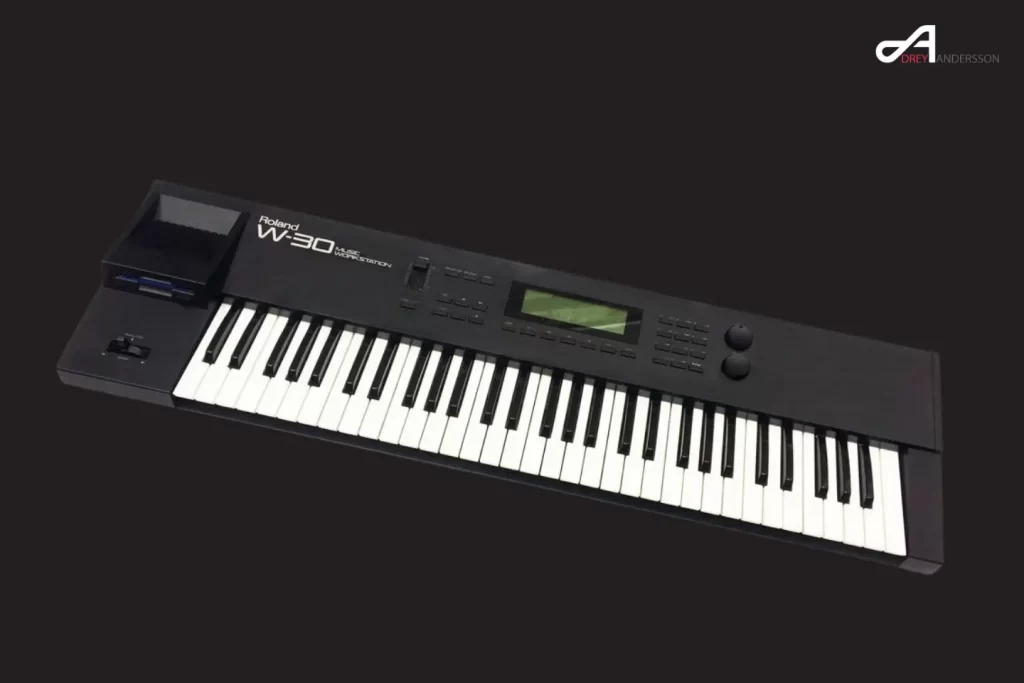
The Roland W-30 is a 61-key sampling music workstation that Roland released in 1989, combining a 12-bit sampler with 16 voices and eight parts, a 16-track sequencer and a 3.5 inch floppy drive. Roland’s manual calls it a package of sequencer, sampler and keyboard controller. Magazines of the time wrote it as Roland W30, and listings today use both W30 and W-30 for the same instrument.
This page gives the specs from Roland’s own manual, then explains how the sampler, the sequencer and the disk-based operating system work. It also places the W-30 among Roland’s S-series samplers and MC-series sequencers, and lists the manual, demo videos and dated used prices.
- 16 voices across 8 parts, sampling at 30 or 15 kHz, with 7.2 seconds per RAM bank at 30 kHz and two banks.
- 512K words of sample RAM plus 512K words of wave ROM, with up to 96 tones and 16 patches in memory.
- The sequencer has 16 tracks plus a tempo track, holds about 15,000 notes in 20 songs and runs at 96 ppqn.
- Sound On Sound and Music Technology listed it at £1,599 including VAT in 1989, and the KW-30 SCSI kit cost £135 more.
- On 8 November 2026, Reverb estimated €250 to €662 for a used W-30 from 16 orders. Its newest sale was €339.15.
Roland W-30 specs
The figures below come from the specification pages of Roland’s owner’s manual. Where the manual is silent, the table names the 1989 review that supplied the figure.
| Feature | Roland W-30 |
|---|---|
| Released | 1989 |
| Keyboard | 61 keys, velocity and aftertouch (channel aftertouch, per Music Technology) |
| Polyphony | 16 voices |
| Multitimbrality | 8 parts, A to H |
| Sound source | Roland DI Process sampler |
| Sample rates | 30 kHz or 15 kHz |
| Sample resolution | 12-bit, per Sound On Sound and Music Technology |
| Sample RAM | 512K words in two banks, 7.2 seconds per bank at 30 kHz |
| Wave ROM | 512K words, not rewritable |
| Tones in memory | 96: 32 using RAM waves, 64 using ROM waves |
| Patches in memory | 16 |
| System disk library | 128 ROM-wave tones and 32 patches |
| Sequencer tracks | 16 phrase tracks plus 1 tempo track |
| Sequencer memory | About 15,000 notes in up to 20 songs |
| Resolution | 96 clock pulses per quarter note |
| Song length | Up to 9,998 measures |
| Display | 8 x 40 character backlit LCD, per Music Technology |
| Audio outputs | 8 multi outputs and a headphone socket |
| Audio input | 1 sample input with a gain knob |
| MIDI | In, Out, Thru |
| Pedal inputs | DP-2 pedal switch and EV-5 expression pedal |
| Storage | 3.5 inch double-density floppy drive, SCSI connector for the optional KW-30 kit |
| Effects | None, per Music Technology |
| Power consumption | 18 W |
| Size (W x D x H) | 1,014 x 301 x 106 mm |
| Weight | 9.8 kg |
The W-30 shipped with the system disk, three data disks, the owner’s manual, a mode chart, a sound chart, a MIDI guide book and a PJ-1 cable. Roland listed the DP-2, the EV-5, the KW-30 upgrade kit, MF2-DD floppy disks and the CD-5 CD-ROM player as options.
Details that differ between sources
The release year is the most common conflict. Vintage Synth Explorer and Syntaur say 1988, while the manual carries a 1989 copyright, its MIDI implementation is dated 13 April 1989, and all three magazine articles appeared in May to July 1989. Bit depth is the second. The 1989 magazines give 12-bit sample storage, Vintage Synth Explorer and Syntaur list 16-bit, and Wikipedia and the restorer AMSynths describe a 16-bit D/A converter on playback. The manual’s specification pages print no bit depth.
Sources also split on the sampler it came from. Music Technology and Sound On Sound name the S-330, and AMSynths calls it the S-330 reworked as a keyboard, with the TVF and TVA from the S-550. Vintage Synth Explorer and theprodigy.info name the S-550 engine. Vintage Synth Explorer also says the W-30 has no SysEx, while Roland’s MIDI chart marks System Exclusive as sent and received. Espen Kraft’s video title and Vintage Synth Explorer call the W-30 Roland’s first workstation, but Music Technology’s July 1989 review names the D-20 as an earlier, synth-based one. Music Technology’s May preview gave the ROM as 1 Meg of samples. Roland counts it in words, 512K of them, and I don’t convert that into bytes here.
How the W-30 sampler works
Sound data on the W-30 has four levels. Roland calls the smallest playable unit a tone: a stretch of sample data plus the settings that loop, tune, filter and shape it.
Tones 1 to 32 read the two rewritable RAM banks, A and B, and tones 33 to 96 read the two ROM banks, which can’t be edited. A patch places one or two tones on each key across a range of up to nine octaves. The eight parts each have their own patch, MIDI channel, audio output and level, so the sequencer or an external controller can play eight sounds at once.
Sampling time and memory
Roland lets you choose between two sample rates, 30 kHz and 15 kHz, and Music Technology notes that samples of both rates can be combined.
Memory is used in whole segments, so a 1 second sample at 30 kHz occupies three segments of 0.4 seconds. Sound On Sound counted that among the limits on the length and number of samples.
Taking a sample
The rear panel has a single mono input for microphone or line signals, with its own gain knob. Before recording you set the tone number, name, wave bank, rate, length, original key and pre-trigger. Sampling starts manually or when the signal crosses a threshold, and the pre-trigger keeps 10, 50 or 100 milliseconds from before that point. The LCD works as a level meter during setup and shows the waveform during editing. A sample can play forward or backward with a forward or alternating loop, and an auto-loop function searches for loop points.
Roland calls its method the DI Process. Instead of changing the playback rate to change pitch, it keeps a fixed sampling rate and uses differential interpolation to calculate values between stored samples, which lets a sharp digital filter remove noise. Music Technology wrote that this gives the 12-bit samples a quality closer to 16-bit.
Tones, filter and envelopes
Each tone has a TVF, a time variant filter, and a TVA, a time variant amplifier, both with envelopes of up to eight stages, each stage with its own level and rate. Music Technology noted a resonance control on the filter, and an LFO can modulate pitch, volume or tone. This is the same filter-and-amplifier shaping that subtractive synthesis applies, and Music Technology pointed out that a sampled sawtooth run through it works much like a conventional synth. Velocity and aftertouch come from the keyboard, and two tones on one key can run in unison with detune, switch by velocity, crossfade by velocity or mix by velocity.
ROM waves and the system disk
Music Technology counted some 70 samples in the 512K words of ROM: drums and percussion, several basses, electric piano, and synth-derived strings, brass, sawtooth and pulse waves. The system disk holds 128 tones and 32 patches built on those waves. At power-up, the first 64 tones load into tones 33 to 96 and the first 16 patches into memory, and the other 16 patches can replace them. The three included Sound and Song disks add RAM samples, among them acoustic piano and acoustic guitar.
Outputs and voice assignment
In mix mode every voice leaves through output 1, which also feeds the mono headphone socket. In multi mode each part goes to the output assigned to it, and a third setting lets each tone pick its output, so one drum sound in a kit can have its own socket. According to Music Technology, voices can be assigned dynamically, or fixed with one of 22 voicing configurations across the outputs.
The W-30 sequencer
Sound On Sound traced the sequencer to Roland’s MRC and Super-MRC software for the MC-500 and MC-300. Music Technology added that the W-30 doubles Super-MRC’s eight phrase tracks to 16 and replaces its rhythm track with a tempo track. Each phrase track can hold several MIDI channels, but there is only one MIDI Out. The sequencer stores about 15,000 notes in up to 20 songs at 96 ppqn, with songs of up to 9,998 measures. Its memory is separate from the sample memory, so samples don’t reduce the note count.
Recording is linear, track by track, with tape-style transport buttons and ten locate points. The modes include normal, key-on start, automatic and manual punch-in and punch-out, and a loop mode that overdubs each pass. Quantizing covers most values from a half note to a 64th note. Sound On Sound gives the offset as 1/8, 1/4 or 1/2 note before or after the beat, while Music Technology describes a constant offset of up to plus or minus 100 clock pulses. Micro Edit steps through every event on a track, and track edits include erase, copy, extract, transpose, merge, insert measure and delete measure.
The sequencer records the keyboard and MIDI In at the same time. It stores SysEx up to 500 bytes at a time and polyphonic aftertouch for external instruments, though the W-30’s own keyboard sends channel aftertouch only. There’s no built-in metronome sound, so the click is a MIDI note you choose. Track mutes can’t be recorded. The W-30 syncs to MIDI clock with Start, Stop, Continue, Song Position Pointer and Song Select, and Music Technology’s preview noted that it has no sync-to-tape function.
Songs save to floppy in two formats. A song disk holds up to 64 songs and about 100,000 notes. A sound and song disk holds one full set of sound data plus up to 64 songs and about 7,000 notes.
S-series and MC-series compatibility
The W-30 reads sound disks from the S-50, S-550 and S-330, and song data from the SYS-503, SYS-553 and SYS-333 programs for those samplers. It also loads MRC-500, MRC-300 and Super-MRC sequences from the MC-500 and MC-300. Going the other way, W-30 sounds can be saved in S-50 and S-330/S-550 disk formats, with some W-30 features lost, and songs can be stored in Super-MRC format for the MC-300 and MC-500.
Disk drive, operating system and SCSI
At power-on the W-30 loads its operating system from a 3.5 inch double-density floppy, which took about 30 seconds in Music Technology’s review. The manual says no sounds play until the system disk has loaded. Sampling and editing routines load from the system disk again each time you open them, so it stays in the drive. Music Technology reviewed version 1.00, and Sound On Sound noted that the disk isn’t copy-protected.
The rear SCSI connector came covered. Using it needs the KW-30 upgrade kit, £135 in the UK in 1989, which adds hard disk support and the CD-5 CD-ROM player. Music Technology’s preview mentioned Roland’s HD-80 80 MB drive. An archived W-30 fan site says the W-30 handles up to four hard disks plus a CD-ROM drive, uses at most 80 MB of each disk, and gains no extra sampling time from SCSI. AMSynths describes enabling SCSI with a separately bought 40-pin SCSI chip and OS 1.07, and notes that the W-30 won’t boot without a floppy drive connected, even when it then boots from a SCSI device.
Replacement parts and upgrades are still sold. On 8 November 2026, Reverb’s W-30 search showed a USB floppy drive emulator for the W-30 at €122.51, replacement LCD displays in white, blue and black at €134.99 each, and a set titled OS v1.03 Final EPROM Firmware Upgrade at €33.36. I haven’t tested any of them. Syntaur lists 64 replacement parts.
Roland W-30 history and related Roland gear
Music Technology previewed the W-30 in May 1989, Sound On Sound’s Paul Ireson reviewed it in June, and Music Technology’s Simon Trask in July. Both magazines gave the UK price as £1,599 including VAT. Roland’s case, as Music Technology reported it, was that a sampler can imitate a synth more easily than a synth can imitate acoustic sounds. Music Technology’s preview also noted that the W-30 has no effects section, and Trask’s review compared its memory with the expandable Akai S950 and Ensoniq EPS. Reverb gives the production years as 1989 to 1992 and Wikipedia 1989 to 1994, and I found no Roland statement on when production ended.
| Model | Type | Link to the W-30 in the 1989 reviews and manual |
|---|---|---|
| S-50 | Keyboard sampler | The W-30 reads its sound disks and its SYS-503 song data |
| S-550 | Rack sampler | Sound disks and SYS-553 song data load on the W-30 |
| S-330 | Rack sampler | Music Technology calls the W-30’s sampler section essentially the S-330 in a different box |
| MC-500 and MC-300 | Hardware sequencers | The W-30 sequencer is based on their MRC and Super-MRC software, and songs move both ways |
| D-20 | Synth workstation | Music Technology names it as Roland’s earlier, synth-based workstation |
| CD-5 | CD-ROM player | Connects through the KW-30 SCSI kit |
Several musicians have described how they used the W-30. The Prodigy fan archive theprodigy.info says Liam Howlett ignored the sampling section and used the W-30 as a MIDI sequencer and master keyboard. It names it his main songwriting tool until The Fat of the Land in 1997, and his stage master keyboard until 2008. In a live setup it quotes, samples sat on an Akai while two W-30s, plus a spare, sequenced the songs.
Steve Hillier of Dubstar writes on the band’s site that the first song he wrote on the W-30 used a slowed Durutti Column sample, and that Anywhere began on string samples from its factory floppy disk. A 24-second clip on a YouTube channel in Erick Sermon’s name says he made beats on the W-30, Pick It Up among them. Wikipedia lists further users that I haven’t checked.
Other hardware entries on this site cover the Roland D-50, the Akai MPC3000 and the Yamaha A3000. For other keyboard workstations, see the Kurzweil K2000 and the Korg N364. My history of the Akai MPC covers another line of samplers with built-in sequencers.
Roland W-30 demo videos
The first video walks through the W-30’s features. The second is a longer session of sampling and sequencing on it.
W-30 manual and documentation
Roland hosts the W-30 owner’s manual as a 212-page PDF of about 6.9 MB on its own server. It’s a scan without a text layer, so searching inside it finds nothing. The chapters cover first steps, an overview, operation, a functional guide, the screens and a reference section, and the specifications sit on printed pages 200 to 202.
The three 1989 magazine articles are on mu:zines as text: the Music Technology preview, the Sound On Sound review and the Music Technology review. Sound On Sound’s includes the list of the 32 system disk patches.
W-30 price and availability
Instruments now sell used. On 8 November 2026, viewed from Berlin, Reverb’s W-30 page estimated €250 to €662, based on 16 orders in good to mint condition. Its transaction table lists 7 dated sales.
The €790 sale from October 2025 sits above the estimate’s upper end and is graded mint, and the €250 sale from May 2023 sits at its lower end. Prices exclude shipping and tax, and the table doesn’t say whether disks or upgrades came with each sale.
On the same day, the only W-30 instrument in Reverb’s search was a unit in France at €289, reduced from €329, whose listing says the floppy drive doesn’t work and the keyboard can’t boot. A US Google Shopping block showed four pre-owned listings at $442.99 to $1,195, and the highest was titled as upgraded and serviced. I opened none of them. These are asks, not sales, and they change quickly.
Frequently asked questions
When did the Roland W-30 come out?
Roland released the W-30 in 1989. Music Technology previewed it in May 1989, Sound On Sound reviewed it in June, and the manual’s MIDI implementation is dated 13 April 1989. Vintage Synth Explorer and Syntaur say 1988, which the Roland manual I read doesn’t support.
What sample rate and bit depth does the Roland W-30 use?
It samples at 30 kHz or 15 kHz, and Sound On Sound and Music Technology both give 12-bit sample storage. Roland’s specification pages print no bit depth. Vintage Synth Explorer and Syntaur list 16-bit, while Wikipedia and a restorer describe a 16-bit D/A converter on playback.
How much sampling time does the Roland W-30 have?
Each of its two RAM banks holds 7.2 seconds at 30 kHz or 14.4 seconds at 15 kHz, so both banks give 14.4 or 28.8 seconds. Memory is used in blocks of 0.4 seconds at 30 kHz, and one sample can’t cross from one bank into the other.
How many voices does the Roland W-30 have?
It plays 16 voices, shared across eight parts named A to H. Each part plays its own patch on its own MIDI channel. A patch can stack two tones on one key, and Music Technology’s July 1989 review noted that layering tones leaves fewer of the 16 voices.
Does the Roland W-30 need a boot disk?
Yes. It loads its operating system from a 3.5 inch system disk at power-on, which took about 30 seconds in Music Technology’s 1989 review. The restorer AMSynths notes that it won’t boot without a floppy drive connected, even when it then boots from a SCSI device.
Does the Roland W-30 have effects?
No. Music Technology’s May 1989 preview said it has no effects section, and Roland’s specification lists none. Sound leaves through a mix output or up to 8 separate outputs, which can be set per part or per tone, so each output can feed its own external processor.
Can the Roland W-30 load S-550 and S-330 disks?
Yes. Roland’s manual says it reads sound data from the S-550, S-330 and S-50, and sequence data from SYS-503, SYS-553, SYS-333, MRC-500, MRC-300 and Super-MRC. Music Technology’s July 1989 review adds that W-30 sounds can be saved in S-50 and S-330/S-550 formats, losing some features.
Did The Prodigy use the Roland W-30?
Yes, according to the fan archive theprodigy.info. It says Liam Howlett ignored the sampling section and used the W-30 as a MIDI sequencer and master keyboard, wrote on it until The Fat of the Land in 1997, and kept it on stage until 2008.
Where can I find the Roland W-30 manual?
Roland hosts the W-30 owner’s manual as a 212-page PDF of about 6.9 MB on its own server. It’s a scan without a text layer, so searching inside it finds nothing. The specifications are on printed pages 200 to 202, and mu:zines carries three 1989 magazine articles as text.
How much is a used Roland W-30 worth?
On 8 November 2026, viewed from Berlin, Reverb estimated €250 to €662 from 16 orders, and its newest sale was €339.15 in April 2026. Those figures exclude shipping and tax. The only complete W-30 listed on Reverb that day asked €289 for a unit whose floppy drive didn’t work.
Back to Music Production Terms Index Page