What is a sawtooth wave?
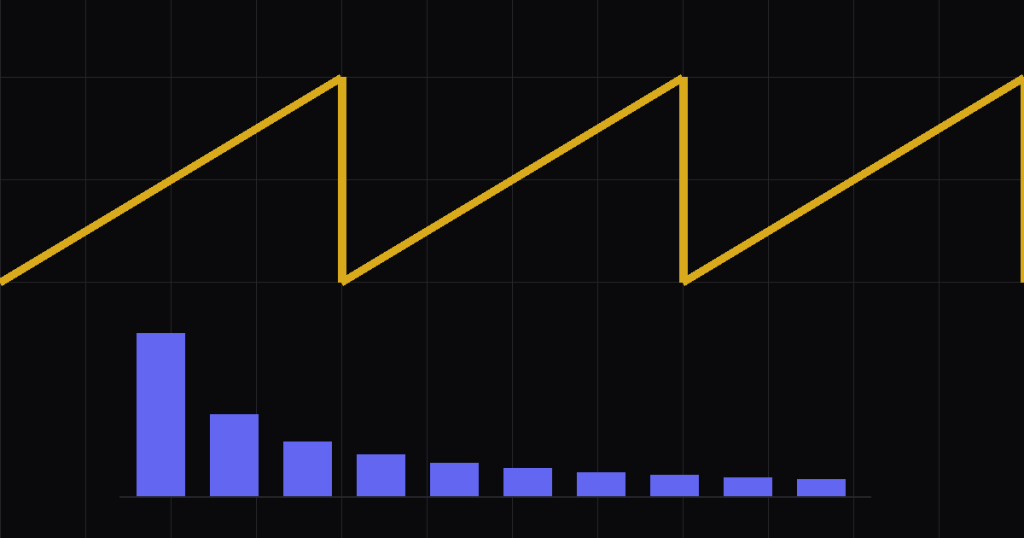
A sawtooth wave is a waveform that rises in a straight line and then drops back instantly, over and over, so on a scope it looks like the teeth of a saw. It contains every whole-number harmonic of its fundamental, each one at 1/n of the fundamental’s level, which makes it the brightest and buzziest of the basic synth waveforms.
Synth manuals and plugins usually shorten it to “saw” or “saw wave”, and a sawtooth waveform is the same thing. It’s the raw material of subtractive synthesis: you start with a sound full of harmonics and filter away what you don’t want.
I’d call the saw the wave of electronic music. No matter the genre, you find it everywhere. I reach for it mostly in Serum. Below: what a saw is made of, four things I calculated and measured that the textbook drawing doesn’t show, and how to use one in a patch.
Not to be confused with the medical term: on an ECG, sawtooth waves are a sign of atrial flutter. As the Cleveland Clinic puts it, the lines “will look like a sawtooth or picket fence pattern” (Cleveland Clinic, Atrial Flutter). This page is about the audio waveform.
- A sawtooth wave contains all harmonics, odd and even, and the nth harmonic sits at 1/n of the fundamental. That’s a slope of -6 dB per octave.
- How many harmonics you get depends on the note: a saw at A1 (55 Hz) has 363 harmonics below 20 kHz, one at A7 (3,520 Hz) has just 5.
- In my test, a clean band-limited saw peaked up to 1.41 dB above the ideal ramp it imitates. That’s the Gibbs overshoot, and it eats headroom before a saturator or clipper.
- Only about 60.8% of a saw’s energy is in the fundamental, against 81.1% for a square and 98.6% for a triangle. The rest is what your filter gets to shape.
- A ramp-up and a ramp-down saw sound identical as a lone oscillator, but behave very differently as an LFO.
What a sawtooth wave sounds like, and why
A sawtooth wave sounds bright, buzzy and slightly nasal, with a rasp that reminds most people of brass or a bowed string. Played low, it growls. Played high, it gets thinner and more whistly than you’d expect, for a reason I’ll show below.
The sound comes straight from the harmonic recipe. A sine wave has one frequency and sounds pure. A saw stacks the full harmonic series on top of the fundamental, so there is energy at 2, 3, 4, 5 times the pitch and onward, each step a little quieter. Your ear hears that dense, evenly falling ladder as brightness. Filter the upper rungs away and the same saw turns warm and round, which is why one oscillator waveform can cover basses, pads, strings and leads.
Sawtooth wave harmonics: the 1/n rule
Roland’s S-1 manual describes it plainly: “The wave includes the nth harmonic at a volume of 1/n” (Roland S-1 Owner’s Manual, Oscillator section). Gordon Reid’s Synth Secrets series opens with the same rule: “Every harmonic is present, and the amplitude of the nth harmonic is 1/n times that of the fundamental” (Sound On Sound, Synth Secrets Part 1, May 1999).
In decibels, 1/n means each doubling of frequency drops the level by 6 dB. The 2nd harmonic sits 6 dB under the fundamental, the 4th 12 dB under, the 8th 18 dB under. The chart shows the first ten.
The sawtooth wave formula
Written out, a sawtooth that ramps from -1 to +1 is a sum of sine waves at every harmonic, with alternating signs and 1/n amplitudes.
ω = 2πf, f = the pitch in Hz. Each term is one harmonic: frequency n×f, amplitude 1/n.
Math references often write it for a ramp from 0 to 1 instead, which only shifts and scales the same series. Wolfram MathWorld’s version is f(x) = 1/2 − (1/π) × Σ sin(nπx/L)/n (MathWorld, Fourier Series: Sawtooth Wave). Dropping the alternating signs moves the drop by half a cycle and also flips the ramp. MathWorld’s leading minus sign flips it back, so both versions rise. Neither changes the 1/n levels, and the 1/n is what you hear. Adding harmonics one at a time is exactly what an additive synth does, and a saw is its classic first exercise.
Sawtooth vs square, triangle and sine
The four basic synth waveforms are sine, triangle, square and sawtooth. The square keeps the same 1/n levels, but in Roland’s words “the even-numbered harmonics are left out entirely.” The triangle also has odd harmonics only, and they fall away much faster, with what Fiore’s Fourier notes call “an inverse square amplitude characteristic” (J. Fiore, Mohawk Valley Community College). So the saw is the only one of the four that carries even harmonics.
Level: one partial only
Energy in fundamental: 100%
Typical use: Sub bass, pure tones, FM carriers
Level: 1/n² (-12 dB/octave)
Energy in fundamental: 98.6%
Typical use: Soft leads, flutes, LFOs
Level: 1/n (-6 dB/octave)
Energy in fundamental: 81.1%
Typical use: Hollow leads, clarinet, chiptune
Level: 1/n (-6 dB/octave)
Energy in fundamental: 60.8%
Typical use: Brass, strings, basses, supersaw
That missing set of even harmonics is why a square sounds hollow and woody next to a saw, and why pulse width modulation is the square’s main trick for getting some of them back.
What I calculated and measured: four things the textbook drawing doesn’t show
The perfect saw in every diagram, with its razor-sharp drop, can’t exist in a real synth. It would need infinitely many harmonics. So I built band-limited saws in numpy the way a clean digital oscillator does: every harmonic up to the 24 kHz limit of a 48 kHz session, at exactly 1/n. I tested ten pitches from A1 to A7, including off-A pitches (C2, F#3, C6, F7) whose cycles don’t divide evenly into the sample rate, and two input levels where level matters. The script is deterministic, so it gives the same numbers on every run.
A caveat: these are textbook oscillators, not any specific synth. Commercial oscillators may normalize their level, round the corner, or add analog-style drift, so their exact numbers will differ. The principles carry over.
1. High saws have surprisingly few harmonics
Every harmonic has to fit below the top of the audio band. At A1 (55 Hz) that leaves room for 363 harmonics under 20 kHz. At A4 (440 Hz) it’s 45. At A7 (3,520 Hz) only 5 remain, so a very high saw is really just its fundamental plus a handful of overtones. That’s why high saw leads lose their buzz and drift toward a softer, flute-like tone, and why a bright lead often works better an octave down with more filter.
It’s also where digital oscillators get into trouble. A naive saw, a counter that simply ramps and resets, produces all the harmonics above the limit too, and they fold back down as inharmonic aliases. Stilson and Smith’s paper on alias-free synthesis traces it to “having to round off the discontinuity time to the nearest available sampling instant” (Stilson and Smith, CCRMA, Stanford). My virtual analog entry measures how much aliasing a naive saw makes and how much the usual fixes remove.
2. A clean saw peaks hotter than the ideal one
This is the result I find most useful in practice. The ideal ramp peaks at exactly 1.0. The band-limited version, with every audible harmonic in place, overshoots right before each drop and peaks at 1.177 at A1. That’s 1.41 dB above the shape it’s imitating. At A4 the overshoot was 1.29 dB, and at A7, with only 6 harmonics below Nyquist (5 of them under 20 kHz), 0.28 dB.
The overshoot has a name: the Gibbs phenomenon. A truncated Fourier series always overshoots a jump, and UCSD lecture notes on the effect put the size at “about 8.94 percent” of the jump (R. L. Parker, UCSD, Gibbs’ Phenomenon). A saw drops by 2 (from +1 to -1), so the prediction is a peak near 1.18. That’s what I got at the low notes. The 48 kHz samples themselves reached the same level, so these are real sample peaks, not just peaks between samples.
| Note | Pitch | Harmonics below 20 kHz | Harmonics below 24 kHz | Peak vs ideal ramp | Crest factor |
|---|---|---|---|---|---|
| A1 | 55 Hz | 363 | 436 | +1.41 dB | 6.19 dB |
| C2 | 65.4 Hz | 305 | 366 | +1.41 dB | 6.19 dB |
| F#3 | 185 Hz | 108 | 129 | +1.37 dB | 6.16 dB |
| A3 | 220 Hz | 90 | 109 | +1.36 dB | 6.16 dB |
| A4 | 440 Hz | 45 | 54 | +1.29 dB | 6.11 dB |
| A5 | 880 Hz | 22 | 27 | +1.16 dB | 6.03 dB |
| C6 | 1,046.5 Hz | 19 | 22 | +1.10 dB | 5.99 dB |
| A6 | 1,760 Hz | 11 | 13 | +0.88 dB | 5.85 dB |
| F7 | 2,793.8 Hz | 7 | 8 | +0.55 dB | 5.65 dB |
| A7 | 3,520 Hz | 5 | 6 | +0.28 dB | 5.48 dB |
The overshoot shrinks at high notes because with only a handful of harmonics the series never gets close enough to the jump to reach the full Gibbs peak.
In practice: if an oscillator scales its saw to the ideal ramp, the band-limited version runs up to 1.41 dB hotter at the peaks than you’d expect. That matters when the saw goes straight into something level-sensitive, such as clipping, a waveshaper or wavefolding. The crest factor (peak-to-RMS ratio) tells the same story: 4.77 dB for the ideal ramp, 6.19 dB for the band-limited saw at A1.
3. Same spectrum, different saw
Next, I kept the 40 harmonic levels of a saw exactly as they were and randomized their phases, 200 times. The magnitude spectra stayed identical, so a spectrum analyzer would call all 200 a saw. The waveforms didn’t. Their crest factors ranged from 4.28 to 9.83 dB (median 7.07 dB), against 6.08 dB for the real saw.
Then I pushed all of them through the same tanh saturator (y = tanh(4x)/4) at the same RMS level. At -18 dBFS RMS, saturation shifted the real saw’s harmonic levels (relative to the fundamental) by 1.31 dB on average, against a median of 1.04 dB for the randomized versions. At -9 dBFS it was 4.16 dB against 3.17 dB. So the saw’s harmonic levels shifted more than the median look-alike’s (the randomized set ranged from 0.61 to 1.70 dB at -18 dBFS), even though its crest factor is lower than the median.
It isn’t about peaks, since the randomized versions peak higher. My reading, which the test doesn’t prove: in a saw every harmonic is lined up in phase, so the new harmonics the saturator creates land in step with the existing ones and move their levels a lot. With random phases they arrive at random angles and partly miss.
This is the part that matters for wavetable work. Two frames can look identical in a harmonic editor and still distort differently, because the phase relationship between harmonics is part of the sound once anything nonlinear follows. I didn’t run a listening test on the randomized versions, so I won’t claim how close they sound on their own.
4. Only about 61% of a saw’s energy is in the fundamental
Adding up the power of all harmonics, the fundamental of an ideal saw with unlimited harmonics holds 60.8% of the total (the exact limit is 6/π²). A square keeps 81.1% in the fundamental and a triangle 98.6%. Even at A7, where only 6 harmonics fit below Nyquist, the saw’s fundamental has just 67.1%. So about two fifths of a saw’s energy lives in the overtones, more than any of the other basic shapes. That’s the material a low-pass filter carves into, and it’s why a filter sweep on a saw is so much more dramatic than the same sweep on a triangle.
How synths make a sawtooth wave
An analog oscillator makes a saw by filling a capacitor at a steady rate and emptying it in an instant. Electric Druid’s analysis of the Roland Juno’s DCO describes the ramp as “generated by charging a capacitor linearly in an op-amp integrator configuration” (Electric Druid, Roland Juno DCOs). A clock edge then “discharges the capacitor and resets the sawtooth.” Free-running analog VCOs often work the same way, with a comparator triggering the reset. Georgia Tech’s analog-synthesis course lists them as “Sawtooth cores (comparators with resettable integrators)” (Georgia Tech ECE4450 course outline).
The ramp is a handy starting point for the other shapes. In the Juno, the pulse wave comes from “feeding the Ramp output and a PWM LFO control voltage to a comparator.” Compare the ramp against a level, and you get a pulse whose width moves with that level.
Digital synths have it harder because of the aliasing problem above. They either compute a band-limited saw on the fly or read it from a wavetable that holds a pre-filtered copy for each pitch range.
In a wavetable engine the saw is one frame of a table. In Serum, as Sound On Sound’s review explains, “a wavetable consists of up to 256 single-cycle waveforms, known as frames” (Sound On Sound, Xfer Serum review, July 2015), and a plain saw is simply one of those frames. If you want to build your own saw-based tables, my free Fizform wavetable generator starts from the same single-cycle idea.
Outside music, the saw is a workhorse in electronics. An oscilloscope’s time base sweeps the beam across the screen with one. A 1960 IBM manual on Tektronix scopes says “The output of this circuit is a sawtooth” that is fed to the horizontal amplifier (IBM, Tektronix Oscilloscopes manual, 1960). CRT televisions did the same with current, and a 1985 Bosch patent describes “generating a sawtooth current wave in the horizontal deflection coil” (US Patent 4,547,711).
Sawtooth vs reverse sawtooth (ramp wave)
A saw can rise and drop, or drop and rise. Manufacturers don’t agree on names: some call the rising one a ramp and the falling one a saw, others say “saw up” and “saw down”, others “reverse saw”. The two are mirror images, so they have the same harmonics at the same levels.
As an audio oscillator, you can’t tell them apart on their own. Playing a saw backwards gives the same wave as turning it upside down (inverting its polarity), just shifted in time, and a lone oscillator sounds the same either way. It matters when you mix it with another oscillator, where polarity decides which harmonics add up and which cancel, and when it feeds an asymmetric distortion that adds even harmonics. My phase cancellation entry covers that effect.
As an LFO, the difference is huge. A rising ramp on filter cutoff gives a slow swell that snaps shut, like a reversed sound. A falling saw gives a sharp opening that decays, which is a quick way to fake a rhythmic pluck or a repeating “wow” without touching the envelope.
Where you hear sawtooth waves
Strings. A bowed string really does behave a bit like a saw. Erik Jansson’s violin acoustics notes from KTH explain that the bowing motion “results in a saw tooth force at the bridge”, with partials that drop by “1/2 (6 dB) at every frequency doubling”, the same 1/n slope (E. Jansson, Acoustics for Violin and Guitar Makers, KTH). That’s why, in Synth Secrets, “we use sawtooth waves to synthesize the sounds of violins, violas and cellos” (Sound On Sound, April 2003).
Brass. For the classic Minimoog brass patch, “the starting point for your brass patch is a single oscillator producing a sawtooth wave” (Sound On Sound, June 2001). The brassiness comes from the filter envelope opening on each note.
Trance leads and pads. Stack detuned saws and you get the supersaw. Roland’s JP-8000 page lists it as “Super Saw (7 detuned Saws)” (Roland, JP-8000).
The Hoover. One of rave’s most famous sounds grew out of a modified saw. The Roland Alpha Juno offered “three types of pulse wave, five types of sawtooth” according to a 1986 review (International Musician, February 1986).
Mundo Muzique recalled of Second Phase’s “Mentasm” that “The hoover was essentially a patch from the Roland Alpha Juno 1”, the preset called What The, “tweaked and sequenced by Muzique” (Red Bull Music Academy Daily, 2014). According to Gearnews, that preset “makes use of both the sawtooth PWM and pitch envelope” (Gearnews, March 2026). So it isn’t a plain saw. It’s a pulse-width-modulated saw variant plus a pitch envelope. On the record, the filter came from a Casio sampler: Muzique says it “was also the FZ-1 cutoff filter.” More in my Roland Alpha Juno article.
How to use a sawtooth wave in a patch
Most sounds built on a saw follow the same chain: saw into a low-pass filter, an envelope on the filter, an envelope on the amp. Typical starting points:
- Brass stab: one saw, 24 dB low-pass filter at about a third open, filter envelope with fast attack, short decay and medium sustain. Add a little envelope to pitch if it sounds too clean.
- String pad: two saws detuned by a few cents, slow amp attack, filter mostly open, a touch of chorus. More detune moves it toward a supersaw.
- Bass: one saw an octave down, low-pass filter fairly closed, short filter decay so each note starts bright and settles. Watch the headroom from finding 2 if a distortion follows.
- Lead: a saw plus a square an octave lower, some glide, and keyboard tracking on the filter so high notes don’t go dull. Keep it out of the top octave, where the saw has only a few harmonics left.
- LFO movement: a ramp LFO on cutoff, synced to the tempo, for rhythmic swells or plucks.
Shape the result with the ADSR envelopes and, for thinner vintage tones, a band-pass filter instead of the low-pass.
Frequently asked questions
What is a sawtooth wave in simple terms?
A sawtooth wave is a sound wave that rises in a straight line and then drops back instantly, like the teeth of a saw. It contains every harmonic of its pitch, the nth one at 1/n of the fundamental’s level. That makes it bright and buzzy, and the most common starting waveform in subtractive synthesizers.
What does a sawtooth wave sound like?
A sawtooth wave sounds bright, buzzy and brassy, close to a bowed string or a trumpet. All harmonics are present, falling by 6 dB per octave, so it has more overtones than a square, triangle or sine. Through a low-pass filter it turns warm and round, which is why synths use it for basses, pads and leads.
What is the difference between a sawtooth and a triangle wave?
A sawtooth contains every harmonic at 1/n, while a triangle has only odd harmonics at 1/n squared, so its overtones fade much faster. The triangle sounds soft and flute-like, the saw bright and buzzy. Worked out from those levels, a triangle keeps about 98.6% of its energy in the fundamental, a saw only about 61%.
What are the four basic waveforms?
The four basic synthesizer waveforms are sine, triangle, square and sawtooth. The sine has only the fundamental. The triangle and square have odd harmonics only, at 1/n squared and 1/n. The sawtooth has all harmonics at 1/n. Many synths add a variable pulse wave and noise as a fifth and sixth option.
What is the formula for a sawtooth wave?
A sawtooth from -1 to +1 is x(t) = (2/π) × the sum of (-1)^(n+1) × sin(nωt)/n over all harmonics n = 1, 2, 3 and up, with ω = 2πf. Each term is one harmonic at 1/n amplitude. Band-limited digital oscillators stop at or below the highest harmonic under half the sample rate.
Is a ramp wave the same as a sawtooth wave?
Yes, a ramp is a sawtooth, usually the rising version, though manufacturers use the names differently. Rising and falling saws both contain every harmonic at 1/n and sound the same as an oscillator, since flipping one only inverts polarity. As an LFO they differ completely: one swells up and snaps back, the other jumps up and decays.
Back to Music Production Terms Index Page