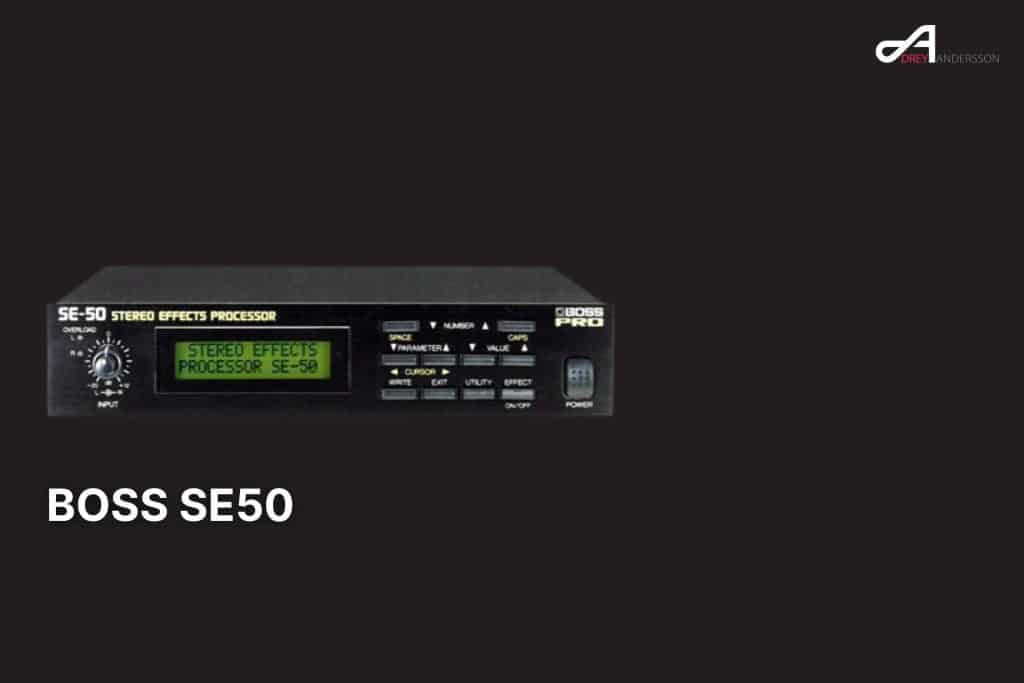
The Boss SE-50 is a half-rack stereo multi-effects processor that Roland launched under the Boss name in 1990, and Boss describes it as the company’s first half-rack multi-effects unit (Boss Classics). It carries 28 effect algorithms and 128 patch locations. The ten Reverb sales I’ve recorded since August 2025 ran from €50 to €165. Mine lives in the rack next to a Boss VF-1. You’ll see it written both ways, SE-50 and SE50, but Roland’s manual uses SE-50.
This page covers the SE-50’s specifications, the sample rate and MIDI control of every algorithm, owner reports on noise, dated used prices, and its power and rack-mount requirements. Specs come from Roland’s owner’s manual. I last checked prices on 4 November 2026.
In short
- Boss dates the SE-50 to 1990 and describes it as the company’s first half-rack multi-effects processor. It has 28 algorithms and 128 patches, 100 of them user-writable (Roland owner’s manual, p.113 and p.136).
- The manual sets 7 algorithms to 48kHz and 21 to 32kHz. All seven single-effect reverbs run at 32kHz, where the specified frequency ceiling is 15kHz.
- It needs 12V AC from a Boss BRB adaptor. Roland warns that any other adaptor could cause damage, malfunction or electric shock.
- Ten recorded Reverb sales from August 2025 to October 2026 ran from €50 to €165, with a median near €105.
What is the Boss SE-50?
The SE-50 is a 1990 digital multi-effects processor in a half-rack chassis measuring 218 x 44 x 235mm and weighing 1.6kg (Roland owner’s manual, p.136). Boss built it around 28 algorithms, from single effects to multi-effect chains and dual parallel pairs, and you edit their parameters.
Algorithm 21 is the longest chain, at eight stages. The manual lists it as compressor, overdrive/distortion, EQ, noise suppressor, delay, chorus, reverb and line driver.
Memory splits into 100 user locations and 28 factory presets across 128 numbered slots, and changes to presets 101 to 128 can’t be written back to those slots (Roland Knowledge Base, archived copy). The manual’s patch table also names patches in the user slots, such as No.31 Dark Hall and No.32 Bright Hall (p.114).
Boss dates the launch to 1990, though Sound On Sound placed the release in “early 1991, to be a bit more precise”. The same magazine wrote in October 1993 that the SE-50 “practically flew off the retailers’ shelves” after what it called rave reviews, and gave its asking price as £390 (Sound On Sound, 1993).
What sample rate does each SE-50 algorithm use?
Seven algorithms run at 48kHz and the other 21 at 32kHz. The manual sets the rate per algorithm and specifies a response of 20Hz to 20kHz at 48kHz, and 20Hz to 15kHz at 32kHz (Roland owner’s manual, p.113 and p.136).
The 48kHz group is Stereo Delay, Space Chorus, Stereo Pitch Shifter, Stereo Flanger, Stereo Phaser, Keyboard 1 and Stereo Enhancer. All seven single-effect reverbs (algorithms 1 to 7) run at 32kHz: Hall 1, Hall 2, Room, Plate, Ambience, Gate Reverb and Stereo Reverb. So do Multi Delay, Multi Tap Delay, the four-voice Pitch Shifter and the Vocoder.
Of the 17 algorithms with a reverb or ambience stage, 16 run at 32kHz. The exception is Keyboard 1 (algorithm 18), whose EQ, delay, chorus and reverb chain runs at 48kHz.
Frequency ceiling by sample rate
Boss SE-50, as specified in the owner's manual
Source: Roland SE-50 Owner's Manual, p.113 and p.136.
If a reverb sounds dark on this unit, the documented 15kHz ceiling is one possible reason, though I haven’t measured how much it contributes. Other settings also shape the top end. The hall reverbs have HF Damp, High EQ and a low-pass filter that runs from 500Hz to 12kHz or THRU, and the manual’s patch table includes both a Dark Hall and a Bright Hall.
Boss SE-50 noise: the spec and owner reports
Roland specifies residual noise at less than -95dBm, IHF-A weighted, with the rear LEVEL switch at -20dBm and the condition marked THRU (owner’s manual, p.136). I read THRU as a measurement with no effect running, so the figure doesn’t tell you how much hiss a given algorithm adds. Owners describe the unit differently.
Writing on Reverb in August 2025, a verified buyer using the handle Mike R. said: “I had a new one back in 1992 and used it until 2002 and always thought it was horribly noisy. I just got ahold of one again now and guess what? It’s still horribly noisy. With decades of experience in proper gain staging I find no way to make this hiss monster quiet.” Reviewing it on Audiofanzine in 2007, Claygues reported hiss, “sometimes a lot of hiss on some algorithms” (translated from French).
Another verified Reverb buyer, Neoklis D., wrote in August 2023: “Great sound, no evident DIGITAL texture, lots of parameters, ease of use, ultra fast response to midi.” That passage doesn’t mention noise. The same review mentions owning five of them. In my own use, the noise floor has never bothered me in a mix. That’s a use note, not a measurement.
The manual says the rear LEVEL switch should be matched to the level of the mixer you’re using, and that -20dBm is the ordinary setting. If the Overload indicator lights too often with the Input Level knobs fully down, it says to move the switch to +4dBm.
What does a Boss SE-50 cost in 2026?
Reverb’s price guide estimates €60 to €147 for units in good to mint condition, calculated from 48 orders (Reverb, checked 4 November 2026). In July the same guide read €61 to €133 from 43 orders.
The chart below lists the sales I recorded from Reverb’s transaction list across two checks, on 20 July and 4 November 2026. These are only the sales visible in those two reads, not every order behind the price guide, and their median is about €105. Price doesn’t follow the seller’s grade neatly: the highest sale, €165, was graded Good, while a Very Good unit sold for €80 the following month.
Recorded Reverb sales, August 2025 to October 2026
Final prices in EUR before shipping and tax, condition as graded by the seller
Source: Reverb transaction list, read 20 July and 4 November 2026. Bars scaled against the €165 high.
Six listings were live on Reverb on 4 November, asking €89 to €190 before shipping.
Reverb prices at a glance
Ranges plotted on a €0 to €200 scale, checked 4 November 2026
Source: Reverb price guide, listings and transaction list.
In July, US-facing listings asked from $30 up to $179, with most around $95 to $125. Most of those shipped from Japan, so import duty can apply.
SE-50 memory battery and patch backup
The SE-50 keeps its user patches on an internal backup battery. Roland expects it to last 3 years or more, strongly recommends changing it every 3 years, and says to consult qualified service personnel when it’s time (owner’s manual, Important Notes). I replaced the one in mine with a CR2032. That’s the battery I fitted, not a Roland specification.
The manual also advises storing important data in another MIDI device, such as a sequencer, or writing it down on paper. Its Bulk Dump function sends the patch settings out over MIDI, patch by patch (p.102 and the MIDI implementation).
Both battery and power show up in listings. On 4 November, one Reverb listing mentioned a changed battery, one said “no power supply” and one included the original supply.
Boss SE-50 power supply requirements
It needs 12V AC from a Boss BRB-series adaptor, drawing 1A (Roland owner’s manual, p.136). The manual’s accessory list gives the BRB-120, 220 and 240. Roland’s support page lists the BRB-100, 120, 220, 230 and 240 and adds that voltage and plug types differ by region. The manual prints the instruction on the rear panel diagram in capitals, “USE BOSS BRB ADAPTOR ONLY”, and warns that any other adaptor “could result in damage, malfunction, or electric shock.”
That’s AC, not DC. The common Boss PSA pedal supply is 9V DC and is the wrong type. The BRC-120 has a similar name but is a 14V AC adaptor that Roland lists for other Boss units, such as the SX-700 and GX-700.
Boss included a BRB adaptor with the unit. If yours arrives without one, use the BRB model for your region from Roland’s list.
How do you rack-mount a half-rack SE-50?
Boss sold a rack adaptor called the RAD-50, and the manual is explicit that the RAD-10 “cannot be used for this unit” (owner’s manual, p.136). I didn’t use the RAD-50, and here’s what I did instead.
I mounted mine using a Thomann Thon Rack Adapter 1U 25, which holds two half-rack modules side by side in a single rack space. My tray carries the SE-50 and a VF-1. Thomann lists the tray at about 255mm deep, and the SE-50 is 235mm deep. The tray already has the correct hole spacing for two modules, so no drilling is involved.
The part worth writing down is the screws. I researched this and settled on M4 x 10mm pan-head screws in black (Linsenkopfschrauben). Two screws in total hold both modules in my rack with no flex. Get the length wrong and you either bottom out against the chassis or leave the module loose.
Quick reference: Thon Rack Adapter 1U 25, two half-rack modules per rack space, fixed with two M4 x 10mm black pan-head screws in total.
Boss SE-50 specifications
Figures below come from the specifications page of the official Roland owner’s manual (p.136), which you can download from Roland as a PDF. The algorithm count comes from p.113 and the configuration labels from Roland’s archived algorithm list.
| Specification | Value |
|---|---|
| Patch memories | 100 user + 28 preset = 128 total |
| Algorithms | 28, in single, multi and dual-parallel configurations |
| A/D and D/A converters | 16-bit |
| Sampling frequency | 48kHz / 32kHz, set per algorithm |
| Frequency response | 20Hz-20kHz at 48kHz; 20Hz-15kHz at 32kHz |
| Residual noise | Less than -95dBm (IHF-A), LEVEL switch at -20dBm, THRU |
| Rated input / output level | -20dBm or +4dBm, rear switch (0dBm = 0.775 Vrms) |
| Input gain range | -20dB to +12dB |
| Input impedance | 1M ohm |
| Output load impedance | More than 50k ohm |
| Channels | 2 in, 2 out |
| Display | 16 characters x 2 lines, backlit LCD |
| Indicators | Overload L/R, Effect On/Off, Utility |
| MIDI | IN and OUT only, no THRU |
| Other jacks | Effect Remote, Number Shift, AC adaptor |
| Power | 12V AC, Boss BRB-120/220/240, 1A draw |
| Dimensions | 218 x 44 x 235mm |
| Weight | 1.6kg |
| Included | BRB AC adaptor, 4 foot rubbers, owner's manual |
| Rack adaptor | RAD-50 (the RAD-10 cannot be used) |
| Other options | FS-5L and FS-5U foot switches, PCS-31 insert cable, FC-100mkII foot controller, RMC-1 RRC to MIDI convertor, EV-5 and EV-10 expression pedals |
Boss SE-50 full algorithm list
All 28, with names, effect chains and sample rates as printed on p.113 of the manual and group labels from Roland’s archived algorithm list. The MIDI control column marks the 11 algorithms the manual says can have parameter values controlled by MIDI message. Algorithm n ships as factory preset 100 + n (p.114), so preset 116 is the vocoder demonstrating algorithm 16.
| No. | Algorithm | Effect chain | kHz | MIDI control | Preset |
|---|---|---|---|---|---|
| Single effect configuration (1-15) | |||||
| 1 | HALL 1 | Reverb | 32 | No | 101 |
| 2 | HALL 2 | Reverb | 32 | No | 102 |
| 3 | ROOM | Reverb | 32 | No | 103 |
| 4 | PLATE | Reverb | 32 | No | 104 |
| 5 | AMBIENCE | Ambience | 32 | No | 105 |
| 6 | GATE REVERB | Gate Reverb | 32 | No | 106 |
| 7 | STEREO REVERB | Reverb | 32 | No | 107 |
| 8 | MULTI DELAY | Delay x 5 | 32 | No | 108 |
| 9 | MULTI TAP DELAY | Tap Delay x 5 | 32 | No | 109 |
| 10 | STEREO DELAY | Stereo Delay | 48 | No | 110 |
| 11 | SPACE CHORUS | Space Chorus | 48 | Yes | 111 |
| 12 | PITCH SHIFTER | Pitch Shifter x 4 | 32 | Yes | 112 |
| 13 | ST. PITCH SHIFTER | Stereo Pitch Shifter | 48 | Yes | 113 |
| 14 | STEREO FLANGER | Flanger + Gate | 48 | Yes | 114 |
| 15 | STEREO PHASER | Phaser | 48 | Yes | 115 |
| Multi effect configuration (16-24) | |||||
| 16 | VOCODER | Vocoder + Chorus + Noise Suppressor | 32 | No | 116 |
| 17 | ROTARY | Rotary + Noise Suppressor | 32 | Yes | 117 |
| 18 | KEYBOARD 1 | EQ + Delay + Chorus + Reverb | 48 | Yes | 118 |
| 19 | KEYBOARD 2 | Phaser + EQ + Chorus + Reverb | 32 | Yes | 119 |
| 20 | RHODES | EQ + Phaser + Noise Suppressor + Delay + Chorus + Panning + Reverb | 32 | Yes | 120 |
| 21 | GUITAR MULTI | Compressor + Overdrive/Distortion + EQ + Noise Suppressor + Delay + Chorus + Reverb + Line Driver | 32 | Yes | 121 |
| 22 | VOCAL MULTI | Limiter + Enhancer + Noise Suppressor + Delay + Chorus + Reverb | 32 | Yes | 122 |
| 23 | STEREO ENHANCER | Limiter + Enhancer + Noise Suppressor | 48 | No | 123 |
| 24 | 2CH MIXER | EQ + Noise Suppressor + Reverb/Delay/Chorus | 32 | No | 124 |
| Dual parallel effect configuration (25-28) | |||||
| 25 | REVERB 1 + REVERB 2 | Reverb + Reverb | 32 | No | 125 |
| 26 | GATE REVERB + REVERB | Gate Reverb + Reverb | 32 | No | 126 |
| 27 | CHORUS + REVERB | Chorus + Reverb | 32 | No | 127 |
| 28 | DELAY + REVERB | Delay + Reverb | 32 | No | 128 |
Roland’s two lists don’t match everywhere. Its support article named algorithm 17 with a distortion stage and left the delay out of algorithm 20. The table follows the manual.
The algorithms I use on mine are Pitch Shifter (12), Stereo Pitch Shifter (13), Space Chorus (11) and the Vocoder (16). The manual gives Pitch Shifter up to four pitch variations across two octaves in either direction. Stereo Pitch Shifter reaches one octave either way and runs at 48kHz, where Pitch Shifter runs at 32kHz, so the two aren’t interchangeable despite the similar names.
Roland’s manual explains algorithm 16 plainly: it “converts sound from a microphone, such as that of a person singing, to the pitch of sounds output from a keyboard”, dividing the mic signal into seven frequency portions. The chorus and noise suppressor are part of that algorithm, so there’s no vocoder-only algorithm.
How does the SE-50 compare to the SE-70, RSP-550 and SX700?
Sound On Sound set the SE-50 against the newer SE-70 in October 1993 (Sound On Sound, 1993).
| Spec | SE-50 | SE-70 |
|---|---|---|
| Algorithms | 28 | 45 |
| Patches | 128 | 145 |
| Max effects per algorithm | 8 | 16 |
| Front-panel buttons | 10 | 6 |
You’ll read on forums that the Roland RSP-550 is simply the SE-50 in a full-width rack. Roland’s documentation doesn’t support that. It gives the RSP-550 39 algorithms across three categories, against the SE-50’s 28, and describes its vocoder as having eight frequency bands, where the SE-50 divides the signal into seven. Both links are archived copies, because Roland has since removed those articles.
In October 1996, Sound On Sound reported that the SE-50 and SE-70 had been discontinued and that the SX700 was designed to replace them. The review called its pitch shifters “notably better” than both and noted that it dropped the vocoder (Sound On Sound, 1996).
Related gear and demos
Related rack effects include the Alesis QuadraVerb, the Yamaha REV500 and the TC Electronic M300. Tim Draksler’s demo from May 2026 runs through the SE-50 at length.
CRANK IT UP #34 BOSS SE-50 by Tim Draksler. Fergie’s Guitar stuff covers the delay and reverb algorithms in a second demo.
Frequently asked questions
What is the Boss SE-50 used for?
The SE-50 is a half-rack stereo multi-effects processor for reverb, delay, chorus, flanging, phasing, pitch shifting, rotary and vocoder effects. It offers 28 algorithms, from single effects to multi-effect chains and dual parallel pairs, and you edit their parameters. Five of the nine multi-effect algorithms are labelled for keyboards, Rhodes, guitar and vocals.
How much is a Boss SE-50 worth in 2026?
Reverb’s price guide estimated €60 to €147 for good to mint units in November 2026, based on 48 orders. The ten sales I recorded between August 2025 and October 2026 ran from €50 to €165, with a median near €105, before shipping and tax. Six live listings asked €89 to €190.
Which power supply does the Boss SE-50 need?
It requires 12V AC from a Boss BRB adaptor. Roland lists the BRB-100, 120, 220, 230 and 240, and voltage and plug types differ by region. The 9V DC Boss PSA is the wrong type, and the BRC-120 is a 14V AC adaptor for other Boss units. Roland warns other adaptors risk damage or electric shock.
Does the Boss SE-50 have a vocoder?
Yes, but only inside algorithm 16, which the manual lists as Vocoder + Chorus + Noise Suppressor. It divides the microphone signal into seven frequency portions and converts it to the pitch of notes played on a keyboard. There’s no vocoder-only algorithm, and algorithm 16 runs at 32kHz.
Is the Boss SE-50 noisy?
Roland specifies residual noise below -95dBm, IHF-A weighted, with the LEVEL switch at -20dBm and the condition marked THRU. I read that as no effect running, so it doesn’t show what an algorithm adds. Owner reports differ: some describe persistent hiss, sometimes on particular algorithms, while the noise floor has never bothered me in a mix.
Which Boss SE-50 algorithms run at 48kHz?
Seven of the 28: Stereo Delay, Space Chorus, Stereo Pitch Shifter, Stereo Flanger, Stereo Phaser, Keyboard 1 and Stereo Enhancer. The other 21 run at 32kHz, including all seven single-effect reverbs. Roland’s manual gives a frequency ceiling of 20kHz at 48kHz and 15kHz at 32kHz, with the rate set per algorithm.
Back to Music Production Terms Index Page