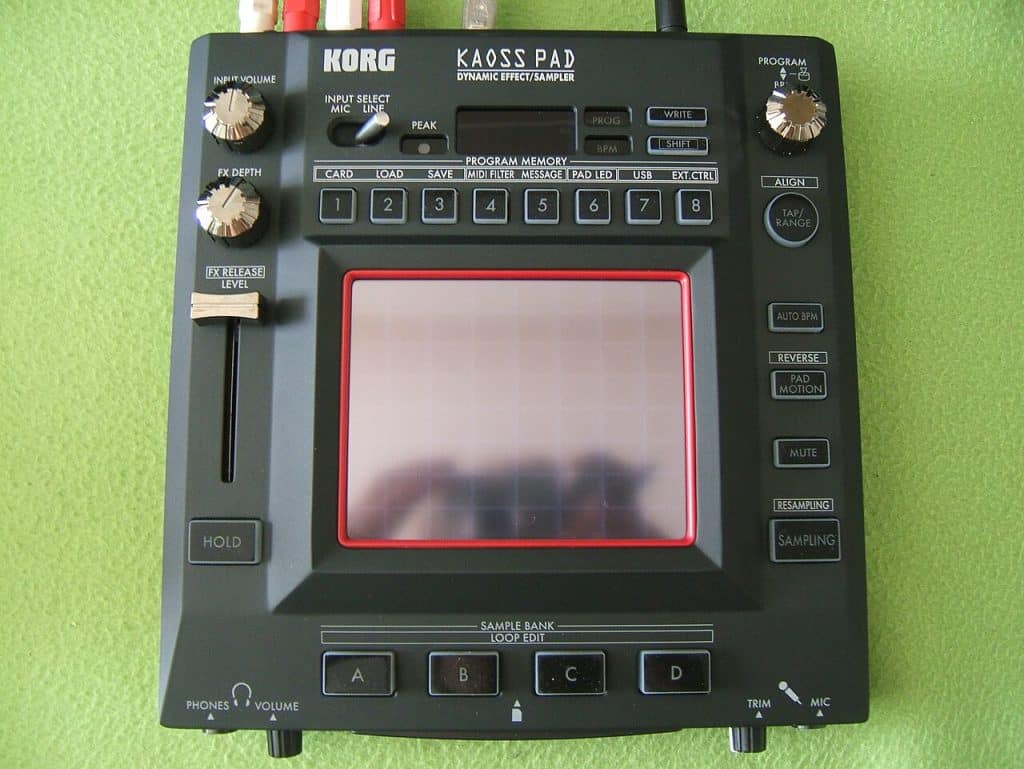
What the Korg Kaoss Pad is
The Korg Kaoss Pad is a line of effects processors and phrase samplers that are played from a touch-sensitive X-Y pad, started by Korg with the KP1 in 1999. Moving a finger across the pad changes two effect parameters at once, and the Hold button keeps the current position when the finger lifts. Korg sells the line as the KAOSS PAD series.
The current full-size model is the Kaoss Pad V (KPV), which Korg announced at the NAMM show in January 2026. This page lists every model from the KP1 to the Kaoss Pad V with dates and specs from Korg’s own pages and from period reviews in Sound On Sound and other magazines and sites. It also gives the Kaoss Pad V’s full specs and the new and used prices that I checked on 12 November 2026.
- Twelve hardware models covered here, from 1999 to 2026: the KP1, KP2, KP3, KP3+ and Kaoss Pad V at full size, the Entrancer with video, the Quad, three handheld mini models, the KAOSS Replay and the NTS-3 kit.
- Effect programs grew from 60 on the KP1 to 128 on the KP3, 150 on the KP3+ and 270 on the Kaoss Pad V (170 presets plus 100 user slots).
- The Kaoss Pad V is the first model with dual-touch control. Compared with the KP3+, it adds a Hi-Z guitar input and a USB audio interface.
- New prices on 12 November 2026: Kaoss Pad V $649.99, KAOSS Replay $999.99, NTS-3 $169.99 at Korg’s US store. Used KP3s were estimated at €181 to €287 on Reverb.
Kaoss Pad models and years
The Kaoss Pad line covered here has twelve hardware models. Five are full-size desktop units (KP1, KP2, KP3, KP3+ and Kaoss Pad V). The rest are the Entrancer for audio and video, the four-effect Quad, the handheld mini-KP, mini kaoss pad 2 and mini kaoss pad 2S, the pad-based KAOSS Replay sampler and the NTS-3 build-it-yourself kit. The table gives each model’s year, program count, sampling, MIDI and the price a dated source printed.
| Model | Year | Effect programs | Sampling | MIDI and USB | Price in a dated source |
|---|---|---|---|---|---|
| KP1 Kaoss Pad | 1999 | 60 (50 effects, 10 sampling programs) | One 5-second stereo sample, lost at power-off | MIDI Out only | None found |
| KP2 Kaoss Pad 2 | 2002 | 100 | Two 6-second samples | MIDI In and Out | £285 inc. VAT (UK, SOS) |
| KPE1 Kaoss Pad Entrancer | 2004 | 100 audio, 100 video, 100 combined | Two sample memories, up to 6 seconds of video each | MIDI In and Out | None found |
| KP3 Kaoss Pad 3 | 2006 | 128 | Four 16-bit, 48 kHz samples; SD card up to 2 GB | MIDI In and Out, USB | £315 inc. VAT (UK, SOS) |
| mini-KP | 2007 | 100 | Looper effects | None | $250 list (US, CDM) |
| Kaoss Pad Quad | 2011 | 20 effects in 4 groups, 1,295 combinations | Looper effects | None listed in Korg’s specs | £275 / $350 (MusicRadar) |
| mini kaoss pad 2 | 2012 | 100 | MP3 player, microSD card | No MIDI jack in Korg’s connector list | £168 expected at launch (UK) |
| KP3+ | 2013 | 150 | Four samples; SD up to 2 GB or SDHC up to 32 GB | MIDI In and Out, USB | None found |
| mini kaoss pad 2S | 2014 | 100 | Sampler for WAV and MP3 files, microSD card | No MIDI jack in Korg’s connector list | $200 MSRP (US) |
| KAOSS Replay | 2023 | 209 effect types (Version 2) | 16 pads x 8 banks per project, 100 projects | MIDI In and Out, USB audio | $999.99 new in November 2026 |
| NTS-3 kaoss pad kit | 2024 | 35 effects, 200 program slots | Looper effect | Sync in and out, USB-C | $169.99 new in November 2026 |
| Kaoss Pad V (KPV) | 2026 | 270 (170 preset, 100 user) | Up to 8 bars with overdub | MIDI In and Out, USB audio | £519 (UK, MusicRadar); $649.99 in November 2026 |
How the Kaoss Pad works
The full-size models from the KP1 to the KP3 share the same basic controls. An input source runs through the unit, an effect program is chosen with a knob, and the pad’s X and Y axes are each mapped to an effect parameter. On the KP1, Sound On Sound found that the input passed through unchanged until the pad or the Hold button was touched. Its stereo delay program set delay time and feedback from the pad, with a short slap-back on the left and a long delay on the right. The KP1’s pad measured 3 x 4 inches and was derived from the X-Y controller of Korg’s Z1 physical modelling synth.
Program memory buttons recall stored programs: six on the KP1, eight on the Entrancer, KP3 and KP3+, and three on the mini kaoss pad 2 and 2S. On the KP1 and KP3 they also store the pad position. The KP2 added an FX Depth knob, a Tap/BPM button with automatic tempo detection from MIDI clock or from the audio, and a sprung Pad Motion/Mute lever. Pad Motion records a short finger movement and replays it; the Mute side cuts the input and lets a delay or reverb tail ring on. The KP3 added FX Release, which Sound On Sound describes as a preset, tempo-based delay that fades out when the finger leaves the pad.
Sampling is the second half of the design. The KP1’s programs 51 to 60 recorded one five-second stereo sample that could be looped, reversed by scratching across the pad or time-stretched. The KP3 records up to four loops or one-shots in lengths of 1, 2, 4, 8 or 16 beats. It can resample its whole output, and each loop splits into eight slices that can be skipped during playback. Sound On Sound compared that slice trick on very short loops to granular synthesis.
The pad also works as a MIDI controller on the KP1, KP2 and KP3. The KP1 sent the X, Y and diagonal X+Y positions, pad touch, the effect button and program changes from its MIDI Out. The KP2 added a MIDI In for clock and remote control, and the KP3 added a USB port that carries the same MIDI data to a computer. Effect families across the line include filters, delays, reverbs and pitch shifters, vocoders from the KP2 on, and looper and grain shifter programs on the KP3. The mini-KP and Quad also list a Decimator (see bitcrusher), and the Quad, mini kaoss pad 2 and KP3+ a ducking compressor.
History of the Kaoss Pad line
KP1 (1999)
Chris Carter reviewed the KP1 for Sound On Sound in August 1999, the month after the magazine covered Korg’s Electribe desktop units. He described a lightweight plastic box about 7 x 8 x 2 inches with 60 programs: 50 effect algorithms and 10 sampling programs. The rear panel had RCA stereo pairs for line in, line out and a turntable phono input, a mono jack for a microphone, an FX Loop switch that removes the dry signal, and a MIDI Out. Power came from an external 12 V supply with no battery option, and the stored sample was lost at power-off. The review notes that Korg promoted it as a DJ effects unit, hence the phono and mic inputs.
KP2 and the Kaoss Pad Entrancer (2002 to 2004)
The KP2 replaced the plastic case with an aluminium one and added a MIDI In next to the MIDI Out. Mike Senior reviewed it in Sound On Sound in November 2002 at £285 including VAT. It stored two six-second samples, 12 seconds of stereo audio in total, which could be recorded and triggered from inside any effect program. New programs included tempo-synced delays and modulation, vocoder programs whose carrier is a synth voice played from the pad, rhythmic drum and bass patterns, and synth sounds. The pad itself glowed blue and changed colour with the finger position. Paul Gilby’s June 2005 review of the Kaoss Pad Entrancer gives the KP2’s total as 100 audio effects.
The KPE1 Kaoss Pad Entrancer kept the KP2’s audio functions and added video. Engadget reported it in April 2004 with video inputs, 100 video effects and 100 combined audio and video effects. Sound On Sound lists 20-bit conversion at 44.1 kHz, switchable NTSC or PAL video, composite and S-Video connections, and two sample memories that hold up to six seconds of moving video each.
KP3 and the mini-KP (2006 to 2007)
Korg dates the KP3 to 2006 on its KP3+ page; Paul Nagle reviewed it in Sound On Sound in February 2007 at £315 including VAT. The touchpad sits over an 8×8 matrix of red LEDs that can also scroll program names and a user message of up to 13 characters. The KP3 dropped the turntable inputs, added a USB port and an SD card slot for samples and settings, and moved to 24-bit converters with 16-bit, 48 kHz sampling. It has 128 programs and eight program memories, and a card holds up to 100 samples numbered 00 to 99. The review also recalls that the KP1 lacked a MIDI input and was rather noisy and easy to overload.
The mini-KP was shown at the NAMM show in January 2007, and Create Digital Music called it the first pocket-able KAOSS Pad. Its report listed a $250 US list price, 100 effects including filters, delays, a decimator and looper programs, 24-bit, 48 kHz audio on RCA jacks, and up to five hours on AA batteries. To keep it small, Korg left out MIDI. The same report noted that DJ Logic had a new album coming out that made heavy use of the KP3.
Quad and mini kaoss pad 2 (2011 to 2012)
The Kaoss Pad Quad came out in March 2011, when The Guardian described it as out this month and MusicRadar reviewed it at £275 or $350. It runs up to four effects at once, one from each of four modules: Looper, Mod, Filter and Delay/Reverb. Each module offers five effects or none, which gives Korg’s figure of 1,295 combinations. A Freeze button holds the settings when the finger leaves the pad. Juno called it one of the most stripped-down models for connections, and Korg’s spec page lists only RCA line inputs, a mic jack, RCA line outputs and headphones, on a 9 V, 1700 mA supply.
The mini kaoss pad 2 followed at the NAMM show in January 2012, with MusicRadar expecting a May release at £168. It has 100 programs, an organic EL display, a built-in speaker and mic, an MP3 player with pitch control, a microSD slot, and two AA batteries.
KP3+ (2013)
MusicRadar’s 2026 Kaoss Pad V report dates the KP3+ to 2013, seven years after the KP3. Korg’s features page for the Kaoss Pad KP3+ lists 150 effects: 108 carried over from the KP3 and 42 new or improved ones, among them Vinyl Break and a Ducking Compressor. It reads SD cards up to 2 GB and SDHC cards up to 32 GB, and keeps MIDI In and Out and USB. DJ Mag counted 22 more programs than on the KP3 and four samples of up to 13 seconds.
mini kaoss pad 2S (2014)
Korg announced the mini kaoss pad 2S on 3 September 2014, with the S standing for sampler. It loads WAV and MP3 files from a microSD card and plays them as one-shots, gated or looped, and Synthtopia reported a $200 US MSRP from the end of that month.
KAOSS Replay, NTS-3 and the plug-in (2023 to 2024)
Korg introduced the KAOSS Replay on 9 November 2023. It combines the X-Y effects with 16 velocity-sensitive pads, 128 sample slots per project (16 pads x 8 banks), up to 100 projects on microSD, a 5-inch colour touchscreen, an aluminium case and USB-C power. Korg’s spec page lists 209 Kaoss effect types after the Version 2 update, and Korg calls its vocal effects a first for the series. The NTS-3 kaoss pad kit followed in 2024 as a solder-free Nu:Tekt kit that Korg says takes under 20 minutes to build. It runs up to four of its 35 effects at once, stores 200 programs (100 preloaded) and accepts user effects written with Korg’s logueSDK.
Korg also sells KAOSS PAD for Mac/Win, a plug-in included in KORG Collection 4. It has 128 programs built from 25 effect algorithms with up to five effects per program, four LFOs, four envelope generators and two envelope followers. Korg says it is a new design, not a software version of the hardware units.
Kaoss Pad V (2026)
MusicRadar reported the Kaoss Pad V from the NAMM show on 16 January 2026 as the first full-size, traditional Kaoss Pad since the KP3+ in 2013, priced at £519. It introduces dual-touch control, a Voice FX engine for harmonies, pitch shifting and robot effects, and a curated set of effects from earlier Kaoss Pad generations. Korg published System Updater v1.40 for it on 10 September 2026.
Kaoss Pad V specs
The Kaoss Pad V (KPV) is Korg’s current full-size Kaoss Pad: a dynamic effect processor and sampler with a dual-touch X-Y pad, 270 programs, mic, guitar, line and USB inputs, MIDI and an SD card slot. The mic, line and USB inputs can be used at the same time, and the built-in USB audio interface records or streams the processed sound to a computer. Pad LED colours, effect depth and program behaviour can be edited, and user programs are saved on the unit. The table below follows Korg’s US spec page.
| Feature | Korg Kaoss Pad V |
|---|---|
| Maker | Korg |
| Announced | NAMM show, January 2026 |
| Type | Dynamic effect processor and sampler with an X-Y touch pad |
| Touch control | Dual-touch: two fingers move two sets of parameters at once |
| Programs | 270: 170 preset programs and 100 user programs |
| Sampling | Up to 8 bars, depending on tempo, with overdubbing, BPM-synced Gate Hold and several playback and slicing modes |
| Inputs | LINE IN L/R (RCA), MIC/GUITAR IN (6.3 mm TRS: balanced for a microphone, unbalanced Hi-Z for guitar or bass), USB audio |
| Outputs | OUTPUT L/R (RCA), headphones (6.3 mm stereo jack) |
| MIDI and USB | MIDI IN and OUT (5-pin DIN), USB Type B with a built-in audio interface |
| Storage | SD or SDHC card up to 32 GB (card not included) |
| Power | 9 V DC from the included AC adapter |
| Size and weight | 210 × 226 × 49 mm (W × D × H), 1.3 kg without the adapter |
| Firmware | System Updater v1.40, published by Korg on 10 September 2026 |
Kaoss Pad V video
Korg KP3 vs KP3+ vs Kaoss Pad V
On Korg’s spec pages the KP3+ and the Kaoss Pad V have the same body: 210 x 226 x 49 mm and 1.3 kg. The main differences are the program count, the sampling model and the inputs.
| Feature | KP3 | KP3+ | Kaoss Pad V |
|---|---|---|---|
| Introduced | 2006 (SOS review, February 2007) | 2013 | 2026 |
| Programs | 128 | 150 (42 new or improved types) | 270 (170 preset, 100 user) |
| Samples and loops | 4 pads, 1 to 16 beats, about 13.2 seconds at 74 BPM | 4 samples of 13 seconds (DJ Mag) | Up to 8 bars, with overdub |
| Converters | 24-bit converters, 16-bit 48 kHz sampling | 48 kHz, 24-bit linear | Not stated on Korg’s spec page |
| Card | SD, 16 MB to 2 GB | SD to 2 GB, SDHC to 32 GB | SD or SDHC to 32 GB |
| Audio inputs | Line (RCA), microphone jack | Line (RCA), mono unbalanced mic jack | Line (RCA), mic/guitar TRS with Hi-Z, USB audio |
| MIDI and USB | MIDI ports, USB | MIDI In and Out, USB Type B | MIDI In and Out, USB Type B audio interface |
| Dual-touch | No | No | Yes, the first Kaoss Pad with it |
| Size and weight | Not captured | 210 × 226 × 49 mm, 1.3 kg | 210 × 226 × 49 mm, 1.3 kg |
Details that differ between sources
- KP1 year. Korg’s plug-in page says the KP1 was introduced in 1999, matching the August 1999 review and later press. Korg’s Kaoss Pad Quad page says 1998.
- KP3 year. Korg’s KP3+ page says the KP3 appeared in 2006; Sound On Sound reviewed it in February 2007, and a CDM report from January 2007 called it the new flagship.
- Kaoss Pad V program count. Korg lists 270 programs, 170 preset and 100 user. MusicRadar’s launch report gave 200 effects presets and up to 100 custom presets.
- KP3+ new programs. Korg says 108 programs carried over from the KP3 and 42 are new or improved, which makes 150. DJ Mag counts 22 more programs than on the KP3. Both fit: 150 minus 128 is DJ Mag’s 22, and 128 minus 108 leaves 20 KP3 programs that were not carried over.
Who has used a Kaoss Pad
In a 2011 Guardian article, David McNamee wrote that the Kaoss Pad first reached a wide public through Radiohead’s Kid A, and that Jonny Greenwood fed Thom Yorke’s vocal through a Kaoss Pad on Everything in Its Right Place. The same article names Brian Eno as an early user who got Bryan Ferry into it, and calls the beatboxer Beardyman an unofficial spokesman for it. It also says Muse’s Matt Bellamy has a controller for his Kaoss Pad built into his Manson guitars. It quotes Eno calling the Kaoss Pad “a way of taking sounds into the domain of muscular control”. Beyond these and the DJ Logic note above, I found no primary source for other artists and leave them out.
Prices and availability in November 2026
On 12 November 2026, Sweetwater listed the Kaoss Pad V at $649.99 and in stock, the KAOSS Replay at $999.99 and the NTS-3 kit at $158.99. Korg’s US store listed the Kaoss Pad V at $649.99, the KAOSS Replay at $999.99 (or $899.99 certified refurbished) and the NTS-3 at $169.99, all available. Korg’s product catalogue still shows pages for the KP3+, Quad, mini kaoss pad 2 and mini kaoss pad 2S, but neither store offered them new. Sweetwater also lists Korg’s KA-350 9 V, 1700 mA adapter, sold for the Monotribe and KAOSS Pad, at $26.25.
For the discontinued models, Reverb’s price guides give an estimated used value from orders in good to mint condition, excluding shipping and tax. I read them on 12 November 2026 from Berlin, so Reverb showed euros. It had no used estimate for the mini kaoss pad 2 or 2S.
Related Korg gear and terms
Korg reused the X-Y pad idea in the Kaossilator synthesizer series, the padKONTROL and nanoPAD controllers and the M3’s TouchView display, according to its Quad page. Its current catalogue also lists the KAOSS DJ controller and the KAOSSILATOR PRO+. The Kaoss Pad sits between an effects unit and a phrase sampler, so the sample, groovebox and DAWless entries cover the setups it is used in. For other Korg hardware on this site, see the Korg drumlogue and Korg MS2000 entries.
Manuals and photo credit
Korg publishes an online version of the Kaoss Pad V owner’s manual and the downloads for each model from its product pages, for example the Kaoss Pad V page and the KP3+ page. The photo at the top of this page shows a KP3 and is by MTV.Home, published on Wikimedia Commons under CC BY-SA 3.0.
Frequently asked questions
When did the first Korg Kaoss Pad come out?
Korg introduced the first Kaoss Pad, the KP1, in 1999. Sound On Sound reviewed it in its August 1999 issue and described 60 programs, a five-second stereo sampler and an X-Y pad derived from Korg’s Z1 synthesizer. Korg’s own page for the Kaoss Pad Quad gives 1998 instead.
Which Kaoss Pad models are still sold new?
On 12 November 2026, the Kaoss Pad V was the current full-size model, listed at $649.99 and in stock at Sweetwater and in Korg’s US store. The KAOSS Replay at $999.99 and the NTS-3 kaoss pad kit were also on sale new. Neither store listed the KP3+, the Quad or the mini models.
What is the difference between the KP3 and the KP3+?
The KP3+ from 2013 has 150 effect programs against the KP3’s 128, and Korg counts 42 of them as new or improved types, among them Vinyl Break and a ducking compressor. It also reads SDHC cards up to 32 GB, while the KP3 took SD cards of 16 MB to 2 GB.
What is new on the Kaoss Pad V?
The Kaoss Pad V, announced at NAMM in January 2026, is the first Kaoss Pad with dual-touch control, so two fingers move two sets of parameters. Compared with the KP3+, it adds a Voice FX engine, a combined mic and Hi-Z guitar input, a USB audio interface and looping of up to 8 bars with overdubbing.
How many effects does the Kaoss Pad V have?
Korg’s spec page lists 270 programs: 170 preset programs and 100 user programs. MusicRadar’s NAMM 2026 report counted 200 effects presets plus room for 100 custom presets. Korg describes its curated set as filters, delays, reverbs, modulation and voice processing drawn from earlier Kaoss Pad generations.
Can a Kaoss Pad sample and loop audio?
Every full-size model can. The KP1 held one five-second stereo sample, the KP2 two six-second samples, and the KP3 four loops or one-shots of 1 to 16 beats each. The Kaoss Pad V samples up to 8 bars and can overdub, while the KAOSS Replay adds 16 velocity-sensitive pads.
Does the Kaoss Pad have MIDI?
The KP1 had only a MIDI Out, which sent the pad’s X and Y positions. The KP2 added a MIDI In for clock and remote control, and the KP3, KP3+ and Kaoss Pad V have MIDI In and Out plus USB. The mini-KP has no MIDI jack, and Korg’s connector lists for the later mini models show none.
What is the mini Kaoss Pad?
The mini-KP, shown at NAMM in January 2007 at a $250 US list price, is a handheld Kaoss Pad with 100 effects that runs on AA batteries and has no MIDI. The mini kaoss pad 2 of 2012 added an MP3 player, and the mini kaoss pad 2S of 2014 added a sampler.
What is a used Kaoss Pad worth?
Reverb’s price guides on 12 November 2026, viewed from Berlin in euros, estimated €181 to €287 for a KP3 from 125 orders and €240 to €357 for a KP3+. A KP2 was put at €117 to €197, a mini-KP at €77 to €116, and a KP1 at €49 to €255.
Is there a Kaoss Pad plugin?
Yes. Korg’s KAOSS PAD for Mac/Win is a plug-in that is part of KORG Collection 4. It has 128 effect programs built from 25 effect algorithms, with up to five effects at once, and Korg describes it as a new design rather than a software copy of the hardware units.
Back to Music Production Terms Index Page