What the Akai MPC60 is
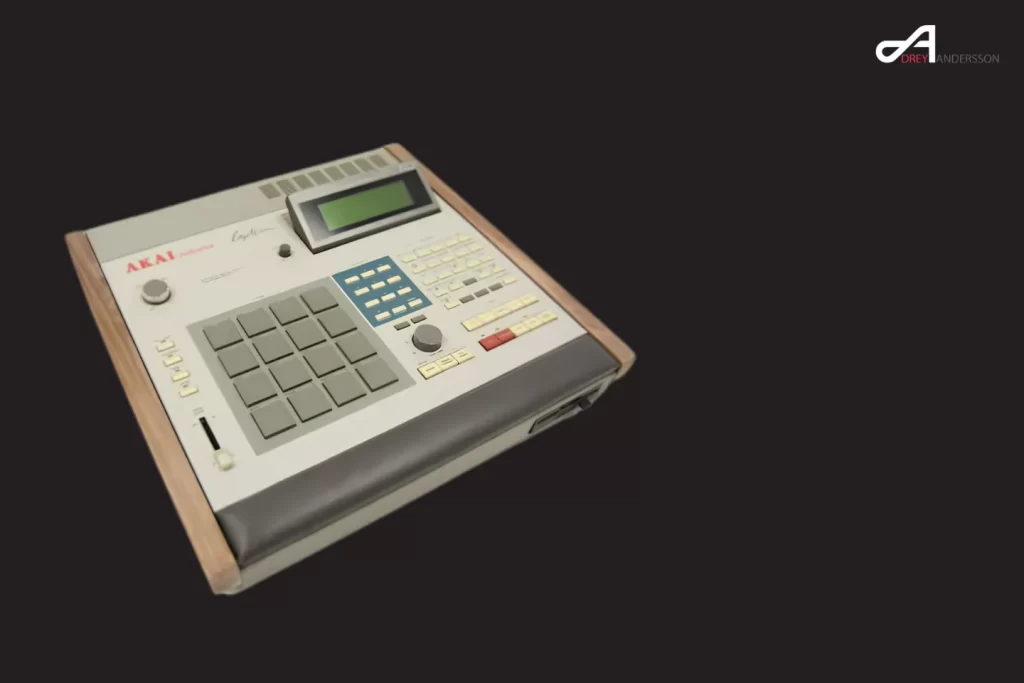
The Akai MPC60 is a sampling drum machine and MIDI sequencer that Roger Linn designed with Akai, first shown in 1987 and presented at the 1988 NAMM show, with 16 pressure-sensitive pads, 12-bit sampling at 40 kHz and a 99-track sequencer. Akai followed it in 1991 with the MPC60 II, which has the same electronics in a cheaper case. The names are also written MPC 60, Akai MPC 60, MPC 60 II and MPC60-II.
MPC stands for MIDI Production Center. This page lists the specs from Akai’s brochure, explains how the sampler, pads and sequencer work, and tells the history of Linn’s work with Akai from his own account and the magazine reviews of the time. It also covers the MPC60 II, Linn’s version 3.10 software, the documents that survive and dated used prices.
- 12-bit non-linear sampling at 40 kHz, 13.1 seconds of mono memory (26.2 with the EXM003 board), 16 voices and 16 velocity and pressure sensitive pads.
- A sequencer of 99 sequences with 99 tracks each, 96 parts per quarter note, swing from 50 to 75 percent, two MIDI inputs and four MIDI outputs.
- By Linn’s 2026 account, he designed the functions, interface and screens, Alan Trimble wrote the software, David Cockerell designed the sound chip, and Akai in Tokyo designed the circuit boards and case to his specifications.
- Linn gives the 1988 NAMM price as $5,000, later cut to $3,500. The UK price was £2,999 in 1988; the MPC60 II cost £1,899 in 1991.
- On 8 November 2026, viewed from Berlin, Reverb estimated €2,928 to €3,506 for a used MPC60.
Akai MPC60 specs
Linn describes the MPC60 II as the same machine inside, so one table covers both models. Where a figure changed with the software, the next sections say so.
| Feature | MPC60 and MPC60 II |
|---|---|
| Type | Sampling drum machine and MIDI sequencer |
| Sampling | 12-bit non-linear format, fixed 40 kHz, mono; 16-bit A/D and D/A converters |
| Frequency response | 20 Hz to 18 kHz |
| Sample memory | 13.1 seconds (750 KB) standard; 26.2 seconds with the EXM003 board |
| Voices | 16 |
| Pads | 16, velocity and pressure sensitive, in two banks |
| Tuning | Up half an octave, down one octave, in 0.1 semitone steps |
| Sequencer | 99 sequences of 99 tracks, about 60,000 notes (512 KB) |
| Timing resolution | 96 parts per quarter note |
| Tempo | 30 to 300 BPM |
| Song mode | 20 songs, 256 steps each |
| MIDI | 2 inputs (merged), 4 independent outputs |
| Sync | SMPTE, MIDI Time Code, MIDI clock with or without Song Position Pointer, FSK24, Pulse 96, quarter-note clicks |
| Audio outputs | Stereo pair, 8 assignable mix outputs, echo send; stereo echo return inputs |
| Other jacks | Record input with a three-position gain switch, sync in and out, metronome out, 2 footswitches |
| Display | 320-character LCD (8 lines of 40), 240 x 64 dots, backlit |
| Disk drive | 3.5-inch double density, 793 KB formatted |
| Processor | 80186 at 10 MHz |
| Size and weight | See MPC60 vs MPC60 II below |
| Supplied | Four sound disks: Studio, Rock, Dry and Synth |
The memory is volatile: sounds and sequences are lost at power-off and load again from floppy disk. The four factory disks hold drum kits put together by Linn and Utopia drummer Willie Wilcox, plus a bass sound in the second pad bank. Sound On Sound counted 64 factory sounds across the four disks. The MPC60 can exchange samples with Akai’s S900 and with other samplers over the MIDI Sample Dump Standard.
MPC60 vs MPC60 II
Akai presented the 1991 model as a new MPC. Linn’s FAQ calls it a cost-reduced MPC60 with the exact same electronics, a cheaper plastic chassis, a headphone jack, a fixed screen and some new software features that could also be loaded into the first model. He says he told Akai it could have called the machine the MPC60/PC/HP, for plastic chassis and headphone jack.
| Aspect | MPC60 (1988) | MPC60 II (1991) |
|---|---|---|
| Case | Box with end panels and a padded arm rest | One-piece grey plastic chassis |
| Display | Tilts to adjust the viewing angle | Fixed in a sloping front panel |
| Headphone jack | None | Yes |
| RS-232C port | Yes, never given a function | None; a blanked panel for an optional SCSI port |
| Size and weight | 495 x 127 x 471 mm, 10.5 kg | 515 x 165 x 427 mm, 9 kg |
| Inside | Original design | The same electronics, per Roger Linn |
| UK price | £2,999 including VAT (1988) | £1,899 including VAT (1991) |
| Reverb lists production as | 1988 to 1991 | 1991 to 1994 |
Warren Cann reviewed the MPC60 II for Sound On Sound in November 1991. Akai told him only modest software changes had been needed since the first model. He measured one minute and 35 seconds to boot the sequencer from disk, and noted that the price had dropped from around £3,000 to £1,899.
Details that differ between sources
Sources disagree on several figures. This table lists each figure as the source gives it.
| Detail | What the sources say |
|---|---|
| First appearance | Shown as the ADR15 at the summer 1987 NAMM show in Chicago (Music Technology, August 1987); reported from the British Music Fair as renamed MPC60 (Music Technology, September 1987); released in October 1987 (Sound On Sound, 1991); example software date 14 December 1987 (service manual); introduced at the 1988 NAMM show (Linn’s FAQ), where Music Technology’s March 1988 report also saw it |
| Length of one new sample, stock software | 5.2 seconds, not the six the manual stated (Music Technology’s test of version 1.0); 5 seconds (Sound On Sound 1991, Linn’s 3.10 overview); 4.5 seconds (3.10 manual) |
| Standard sample memory | 750 KB for 13.1 seconds (Akai brochure, Music Technology); 768 KB, called 13 seconds (Linn’s 3.10 FAQ); Vintage Synth Explorer’s spec box also gives 768 KB |
| Steps per song | 256 (brochure, both reviews); 250 (3.10 manual) |
| Voices | 16 (Akai, both reviews, Linn); Vintage Synth Explorer’s text says 18, its spec box 16 |
| Stereo | Mono sampling (Akai, both reviews, Linn); Vintage Synth Explorer’s spec box and a 2017 MusicRadar piece say stereo |
| Looping | None (Music Technology); Vintage Synth Explorer’s text describes looping as simple |
| MIDI output channels | 16 (Akai brochure); the first software could only spread 16 channels over the four outputs (Music Technology 1988); 64, or 16 per port (Sound On Sound 1991, 3.10 manual) |
| Tuning range | Up 7, down 12 semitones (Music Technology); up half an octave, down one octave (brochure, Sound On Sound 1991) |
How the MPC60 works
The MPC60 joins three devices in one box: a drum sampler, a drum machine played from pads, and a MIDI sequencer for other instruments. Akai’s brochure calls it an integrated MIDI sequencer and drum sampler and pitches it as the brain of a MIDI studio.
Sampling
The MPC60 records through one rear input at a fixed 40 kHz. The converters are 16-bit, and Akai’s service manual lists PCM54HP and PCM77P converter chips, but samples are stored in a 12-bit non-linear format. Linn explains that quantization noise is reduced by boosting high frequencies while sampling and cutting them again on playback. A pre-record time catches the attack of a drum before the threshold triggers recording.
Each pad can play its own start and end points of a sample, so one sample assigned to several pads can be cut into pieces without copying it. Each pad also has its own tuning, level, pan and fade-out, and Sound On Sound’s 1991 review lists reverse. There is no looping and no filter. Music Technology noted that the MPC60 always plays each sample to its end point, by design, so a long crash or ride cymbal isn’t cut short when recording drops out or a track is muted. On the stock software, sampling erases the sequence memory, and the MPC60 warns before it does.
Pads, hi-hat slider and 16 Levels
The 16 rubber pads respond to velocity and pressure, which Music Technology also calls aftertouch. A Bank button switches to a second set of 16 sounds, and the hi-hat pad can hold closed, medium and open samples chosen by a decay slider, a control first used on the Linn 9000. 16 Levels spreads the last sound played across all 16 pads at fixed volumes from soft to loud. Note repeat, on the Timing Correct key, repeats a held pad at the current note value, with its volume following pad pressure. Double Play lets one pad trigger a second sound.
Sequencer, timing correct and swing
The sequencer holds 99 sequences of 99 tracks, each 1 to 999 bars long, and about 60,000 notes. It records in real time with tape-style transport keys, or in a step editor that shows up to four events at once. Timing correction to a note value works while recording or afterwards and keeps each note’s length. Sequences chain into 20 songs. A track can also store System Exclusive messages of up to 512 bytes, and mix changes can be recorded as automation.
Swing, which Linn introduced on his first drum machine, works as part of timing correction for 1/8 and 1/16 notes. The version 3.10 manual defines the setting as the share of time given to the first note of each pair, from 50 percent, which is even timing, to 75 percent. At 66 percent, which the manual calls a technically perfect swing, the first note gets twice the time of the second, a triplet feel. Linn wrote that he was pleased by how hip-hop musicians used his swing feature.
Mixer, outputs and sync
A screen shows a 16-channel mixer for each pad bank, with level and pan, and an echo mixer feeds a mono send to an external reverb. Eight assignable mix outputs can each carry any combination of the 32 sounds, and the echo send can serve as a ninth. Linn’s 3.10 FAQ notes that the levels to these outputs are fixed on the MPC60. The two MIDI inputs merge, so a keyboard and a sync source can arrive at once. In the first software, Music Technology found that the four outputs could only spread the 16 MIDI channels between them; by 1991 Sound On Sound listed 64 output channels, 16 per port. The MPC60 reads and generates SMPTE at four frame rates and reads but does not send MIDI Time Code.
Akai MPC60 history: Roger Linn and Akai
Roger Linn’s first company, Linn Electronics, made the LM-1 Drum Computer, announced in 1979, the LinnDrum in 1982 and the Linn 9000 in 1984. The 9000 already combined a sampling drum machine with a MIDI sequencer, touch-sensitive pads and a hi-hat decay slider. According to Linn, about 1,100 were made, and the last units sold in February 1986, when Linn Electronics closed.
| When | What happened | Source |
|---|---|---|
| 1979 | Linn Electronics announces the LM-1 Drum Computer | Roger Linn’s museum page |
| 1982 | LinnDrum | Same |
| 1984 | Linn 9000: sampling drum machine plus MIDI sequencer, about 1,100 made | Same |
| February 1986 | Linn Electronics closes | Linn’s museum page and FAQ |
| May 1986 | Stephen Paine of Syco Systems tells Linn that Akai Professional wants to work with him | Linn’s FAQ |
| Summer 1987 | Shown at the NAMM show in Chicago as the ADR15, with a UK price of £2,999 | Music Technology, August 1987 |
| Later in 1987 | Reported from the British Music Fair as renamed MPC60; Sound On Sound later dated the release to October 1987 | Music Technology, September 1987; Sound On Sound 1991 |
| Early 1988 | Shown with Linn at the Winter NAMM show in Anaheim; Linn gives the US price as $5,000; ASQ10 sequencer shown at £1,599 | Music Technology, March 1988; Linn’s FAQ |
| April 1988 | UK review: £2,999 including VAT, software version 1.0 | Music Technology |
| 1991 | MPC60 II | Linn’s museum page, Sound On Sound |
| 1994 | MPC3000, the last Akai product designed with Linn | Linn’s museum page |
| Mid-1990s | Royalty dispute between Linn and Akai | Linn’s FAQ |
| 1997 | MPC2000, designed without Linn and the first without his signature | Linn’s museum page, Sound On Sound 1997 |
How the Akai deal began
In his FAQ, Linn writes that around May 1986 Stephen Paine of Syco Systems, his London dealer, told him that the new Akai Professional company wanted to work with him. He told Sound On Sound the same story in 2002: Paine knew the top people at Akai and put them in touch. Linn met Tommy Moore, owner of Akai’s US distributor International Music Corporation, and then flew to Tokyo. Akai wanted a high-end sampling drum machine and MIDI sequencer similar to the Linn 9000. Linn drew up two products, code-named BigDrum and LittleDrum, and Akai chose BigDrum, which became the MPC60.
His FAQ describes the split of work this way: he developed the functional design, the user interface and the screen contents; his software engineer Alan Trimble wrote the software with help from Linn and a few others; David Cockerell designed the sound chip in London; and Akai in Tokyo created the circuit boards and mechanical design to Linn’s specifications. Akai handled sales, marketing, manufacturing, finance and service.
A 2003 Sonic State interview gives a slightly different split: there Linn said the hardware circuitry was created by Cockerell and his team, and that Akai did the production engineering.
Launch, price and the first reviews
Akai first showed the machine at the summer 1987 NAMM show in Chicago under the working name ADR15, for A DRum machine, and the service manual still lists a ROM part numbered TM2764AD-20-ADR15-7-V1. Linn’s FAQ says the MPC60 was introduced at the 1988 NAMM show at a US price of $5,000 with 13 seconds of sampling, and that Akai later cut the price to $3,500 because it was too expensive. In the UK, Simon Trask’s review in Music Technology, April 1988, listed £2,999 including VAT and about £250 for the memory expansion. He tested software version 1.0, found sync bugs that Akai said it would fix, and noted that the RS-232C port on the back had no function. Akai also sold an hour-long training video in which Linn explains the machine. The ASQ10 sequencer, released in 1988, was the MPC60’s sequencer without the sampler and pads.
In 2012 Linn said the MPC60 got only 13 seconds of sampling because he thought that was enough for drum sounds. He recalls a visitor at a later NAMM show asking for about two minutes of stereo to sample loops from records, and realised that the era of sampled loops was emerging. Sound On Sound’s 2026 retrospective by Alex Ball says DJ Shadow made his 1996 debut album Endtroducing with little more than an MPC60 II, turntables and an ADAT.
The end of the Linn and Akai collaboration
The MPC3000 of 1994 was the last product of the collaboration, and Linn’s version 3.10 manual calls it the successor to the MPC60. Linn writes that in the mid-1990s Akai tried to reduce or stop his sales royalty. He challenged it and the payments continued, but the relationship soured, and starting with the MPC2000 Akai took his name off the product and continued without him. In the 2003 interview he put it more briefly: Akai made the MPC2000 without him to avoid his design royalties. Sound On Sound’s 1997 MPC2000 review counts three Akai MPCs that carried Linn’s name: the MPC60, the MPC60 MkII and the MPC3000.
In a 2012 interview with BBoy Tech Report, Linn said that after Akai went out of business and Numark bought its assets, his royalty payments stopped. Jack O’Donnell bought Numark in 1992, and his company inMusic dates his purchase of Akai Professional to 2005. His FAQ adds that he can’t reissue the MPC60 because, although he designed it with Akai, it was an Akai product. In a June 2026 essay on his site he writes that he now uses a current Akai MPC to make music. For the whole MPC line from 1988 on, see my history of the Akai MPC.
MPC60 software versions and the 3.10 upgrade
The operating system sits in four ROM chips on the CPU board. Music Technology reviewed version 1.0, and Linn’s documents name version 2.12 as the original software that his upgrade replaces. According to Linn’s 3.10 FAQ, version 2.14 was the only version that shipped with the Marion Systems MPC-SCSI hard disk interface, and on a first-model MPC60 the rear connector labelled RS232C can be either the unused original port or that board’s SCSI connector.
Roger Linn Design sells a version 3.10 chipset that adds the MPC3000’s software improvements to the MPC60, the MPC60 II and the ASQ10. It comes as four replacement chips that owners can fit themselves, and on 8 November 2026 its overview page listed it at $195. The manual is no longer printed, but the support page links to it as a PDF.
| Feature | Stock software (versions 1 and 2) | With version 3.10 |
|---|---|---|
| Length of one new sample | About 4.5 to 5.2 seconds, depending on the source | Up to all free memory, 26.2 seconds when expanded |
| Sampling and sequences | Sampling erases sequence memory | Sequences are kept |
| Stereo | Mono only | Two mono passes joined into a stereo sound |
| Sounds in memory | 34 | 128, in up to 8 drum sets |
| Pad banks | 2 (32 pad assignments) | 4 (64 pad assignments) |
| Sound compression | None | Resamples sounds to 20 kHz, half the memory |
| Files | MPC60 files on floppy | Also MPC3000 files and Standard MIDI Files |
| Hard disk | Version 2.14 with the Marion Systems MPC-SCSI board | Save and load to Zip 100 or 250 MB drives with that board |
Version 3.10 does not change the hardware. Linn’s 3.10 FAQ lists what the MPC3000 still has over an upgraded MPC60: 16-bit linear sampling at 44.1 kHz, 32 voices instead of 16, resonant filters, delay effects, a digital input, a high-density floppy drive, a SCSI port and a processor about 2.5 times as fast. His legacy support page adds that he can’t support the MPC60 beyond his chipset.
MPC60 demo video
This video covers the MPC60’s history and plays it in two demos.
MPC60 manuals and documents
These are the MPC60 documents I found on 8 November 2026:
- Akai’s MPC60 Operator’s Manual for software version 2.0, written by Roger Linn and dated April 1989, 228 pages on ManualsLib.
- The Akai MPC60 brochure, with the full specifications page, scanned at the Internet Archive.
- The Akai service manual for the MPC60 and the EXM003 memory board, with test modes, the MIDI implementation chart and parts lists, also at the Internet Archive.
- Roger Linn’s version 3.10 manual, a 241-page PDF that also covers the MPC60’s basic operation and has Akai’s technical specifications in its appendix, and the five-page install sheet, both on Roger Linn Design’s support page.
The Internet Archive item titled as the Akai operator’s manual is the same file as Linn’s version 3.10 manual, not Akai’s version 2.0 manual.
MPC60 price and availability
Both models are long out of production and sell used. On 8 November 2026, viewed from Berlin, Reverb showed an estimated range for each, based on its own orders in good to mint condition.
The wide MPC60 II range comes from 15 orders. A US Google Shopping block for mpc 60 on the same day showed six MPC60 or MPC60 II units from $2,800, a first model sold for parts, to $5,378.58. I opened none of them. These are asks, not sales, and they change quickly. Some listings name version 3.10 or a SCSI board, which changes what a unit can do. For comparison, the UK prices were £2,999 in 1988 and £1,899 in 1991, including VAT.
Related entries on this site cover the Akai MPC3000, the groovebox as a category, and DAWless setups built around hardware like this instead of a DAW.
Frequently asked questions
When did the Akai MPC60 come out?
Akai first showed it as the ADR15 at the summer 1987 NAMM show in Chicago and renamed it MPC60 by the British Music Fair later that year. Roger Linn dates its introduction to the 1988 NAMM show, and Music Technology reviewed it with the first release software, version 1.0, in April 1988. The MPC60 II followed in 1991.
Who designed the Akai MPC60?
Roger Linn, after his company Linn Electronics closed in 1986. According to Linn, he designed the functions, interface and screens, his engineer Alan Trimble wrote the software, David Cockerell designed the sound chip in London, and Akai in Tokyo designed the circuit boards and case. In a 2003 interview he credited the hardware circuitry to Cockerell’s team.
What is the difference between the MPC60 and the MPC60 II?
Roger Linn says the 1991 MPC60 II has the same electronics in a cheaper plastic case, with a headphone jack, a fixed screen and new software features that also load into the first model. The UK price fell from £2,999 in 1988 to £1,899 in 1991.
How much sampling time does the MPC60 have?
It has 13.1 seconds of mono sampling at 40 kHz as standard, and 26.2 seconds with the EXM003 memory board. On the stock software one new sample is limited to roughly 5 seconds; Roger Linn’s version 3.10 upgrade lets a single sample use all free memory.
What bit depth and sample rate does the MPC60 use?
It samples at a fixed 40 kHz with a frequency response of 20 Hz to 18 kHz. The converters are 16-bit, but samples are stored in a 12-bit non-linear format, with high-frequency pre-emphasis during sampling and matching de-emphasis on playback to reduce noise.
What is MPC60 version 3.10?
Version 3.10 is a software upgrade from Roger Linn Design that brings MPC3000 software features to the MPC60, MPC60 II and ASQ10. It comes on 4 chips and adds longer samples, two-pass stereo, MIDI files and 128 sounds. Its page listed it at $195 on 8 November 2026.
Why did Roger Linn stop working with Akai?
Linn writes that in the mid-1990s Akai tried to reduce or stop his sales royalty. He challenged it and the payments continued, but the relationship soured. Starting with the MPC2000 in 1997, Akai took his name off the product and continued development without him.
How much is a used Akai MPC60 worth?
On 8 November 2026, viewed from Berlin, Reverb estimated €2,928 to €3,506 for an MPC60 from 24 orders and €448 to €4,043 for an MPC60 II from 15 orders, before shipping and tax. A US Google Shopping block that day showed asks from $2,800 to $5,378.58.
Back to Music Production Terms Index Page