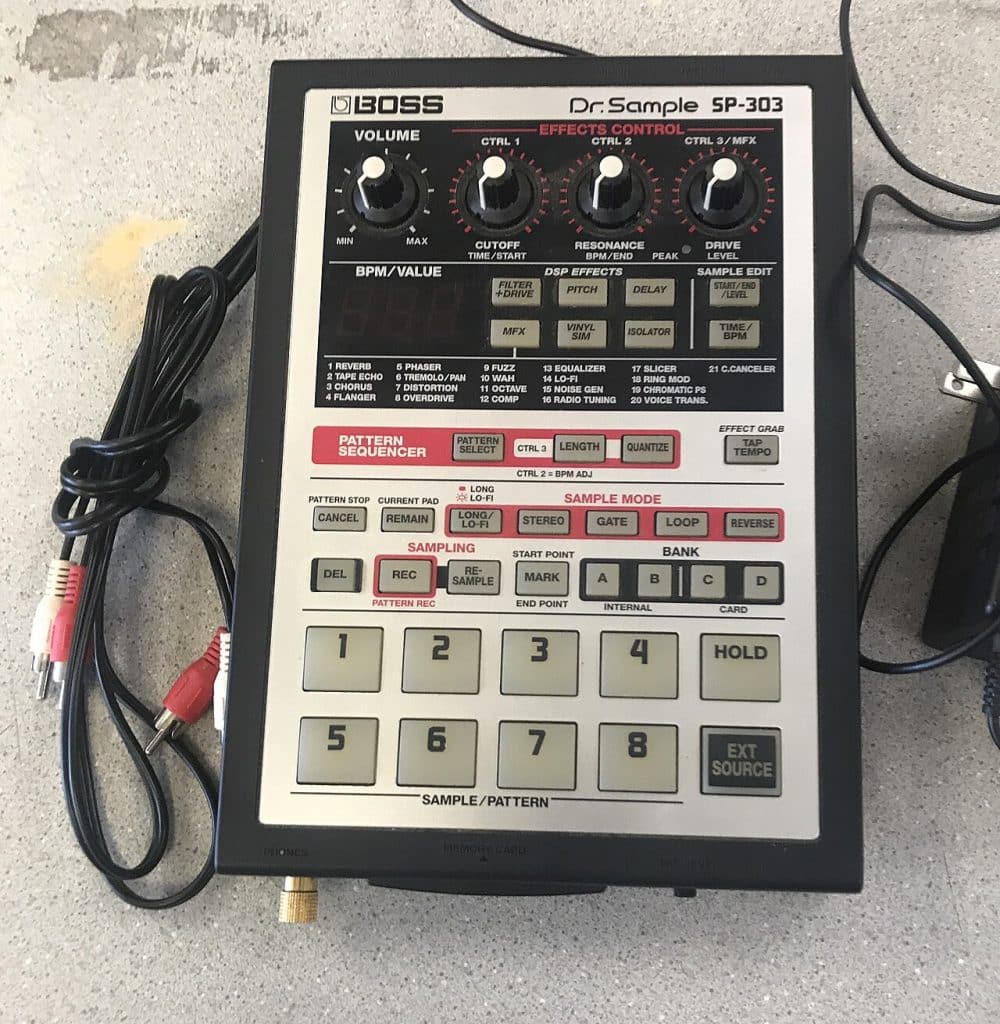
What the Boss SP-303 is
The Boss SP-303 Dr. Sample is a compact phrase sampler that Boss, a brand of Roland Corporation, released in 2001, with eight sample pads, 44.1 kHz sampling, eight-voice polyphony, 26 effects, a pattern sequencer and a SmartMedia card slot. Searches write it as SP-303, SP303, Boss SP-303 or Roland SP-303, and all of these mean the same unit.
This page lists the specs from Boss’s owner’s manual and explains the sampler, the effects and the sequencer. It also places the SP-303 between the SP-202 before it and the SP-404 after it, covers the producers who have described using it in interviews, and gives the manual, a demo video and dated used prices.
- 8 pads, 8 voices, sampling at 44.1, 22.05 or 11.025 kHz, and 31 seconds of internal Standard-mode time, or 33 minutes with a 64 MB SmartMedia card.
- 26 effects, one at a time: Filter + Drive, Pitch, Delay, Vinyl Sim and Isolator on their own buttons, plus 21 more in the MFX group.
- It is a Boss product, but Roland’s own documents also call it the Roland SP-303.
- It followed the Boss SP-202 of 1998, and Roland’s SP-404 of 2005 took its place.
- On 9 November 2026, Reverb estimated €317 to €497 for a used SP-303 from 72 orders.
Boss SP-303 specs
The figures below come from the specification page and the main chapters of the SP-303 owner’s manual, which Roland still hosts as a PDF created in August 2001.
| Feature | Boss SP-303 Dr. Sample |
|---|---|
| Brand and maker | BOSS, a brand of Roland Corporation |
| Released | 2001 |
| Type | Phrase sampler with effects and a pattern sequencer |
| Polyphony | 8 voices with mono samples; a stereo sample uses 2 voices; 4 voices while resampling |
| Pads | 8 sample pads plus a Hold pad and an Ext Source pad; not velocity sensitive |
| Sample memory | 16 samples internal (2 banks of 8), 16 on a card (2 banks of 8), 112 backup slots on a card (2 banks x 7 sets) |
| Sampling grades | Standard 44.1 kHz, Long 22.05 kHz, Lo-Fi 11.025 kHz; mono or stereo |
| Internal sampling time | 31 seconds Standard, 63 seconds Long, 3 minutes 10 seconds Lo-Fi |
| Conversion | 20-bit A/D and D/A |
| Memory card | SmartMedia, 8 MB to 64 MB, 3.3 V cards only |
| Pattern sequencer | About 7,500 notes, 96 ticks per quarter note, 1 to 99 measures, 16 patterns internal and 16 on a card |
| Effects | 26 types: 5 on their own buttons and 21 in the MFX group, one at a time |
| Display | 3-character, 7-segment LED |
| Connections | Line in L/R, line out L/R, stereo 1/4 inch headphone jack, mic jack, MIDI In, AC adaptor jack, memory card slot |
| Input level and impedance | Mic -40 to +4 dBu, 2 kΩ; line -10 dBu, 23 kΩ |
| Output level and impedance | Line -10 dBu, 2 kΩ |
| Power | AC adaptor, Roland ACI series (120/230 V) or ACB series (230 V UK, 240 V); 1,000 mA current draw |
| Size (W x D x H) | 170 x 241 x 67 mm (6-3/4 x 9-1/2 x 2-11/16 in) |
| Weight | 850 g (1 lb 14 oz) without the adaptor |
The SP-303 shipped with an AC adaptor, the owner’s manual and a Roland Service information sheet. A Roland Corporation U.S. TurboStart sheet from 2001 says factory samples come pre-installed in Bank A, on pads 1 to 8, and Roland’s support article on initializing the memory notes that these factory samples and patterns can’t be restored once deleted.
Details that differ between sources
The internal sampling time appears three ways. The manual’s specification table gives 31 seconds in Standard mode and 3 minutes 10 seconds in Lo-Fi mode, while its Main Features page says up to three minutes and twelve seconds. Sound On Sound’s review gives approximately 30 seconds of 44.1 kHz mono sampling. For the SP-202, Boss’s product page lists 6 built-in effects, while Sound On Sound’s SP-303 review speaks of the 202’s five.
I found no launch price for the SP-303. Neither Sound On Sound’s review text nor Boss’s product page, its 2001 info sheet or the TurboStart sheet gives one. Reverb’s product details give production years of 2001 to 2005, and I found no Roland statement on when production ended.
Boss SP-303 or Roland SP-303?
The unit is a Boss product. Its top panel, the owner’s manual and Boss’s archived product page all name it the BOSS SP-303 Dr. Sample. Boss is a Roland brand, and Sound On Sound’s January 1998 review of the SP-202 already asked how Roland chose between the two names for products made at the same factory.
Roland’s own papers mix the names. The 2001 TurboStart sheet from Roland Corporation U.S. calls it the New Roland SP-303 DR. Sample, and Roland’s SP-404 page says the SP-404 picks up where Roland’s SP-303 left off. A 2003 profile of Madlib on the Stones Throw site writes Roland/Boss SP-303.
Roland’s 2021 article Inside the SP Series gives the timeline: the SP-202, SP-303 and SP-505 came out as BOSS products, the SP-808 was the Roland exception, and the SP series moved to Roland after the SP-606 in 2004. Roland’s history of its samplers puts the team’s move after the SP-303 and the SP-505 of 2002, ahead of the first SP-404 in 2005.
How the SP-303 works
The manual describes a short signal path. Audio comes in through the stereo line inputs or the mic jack, gets recorded to one of eight pads in a bank, and plays back with or without one effect. The Ext Source pad sends the live input straight through the effects, so the unit also works as an effects box for a turntable or a microphone, which the manual’s examples chapter describes.
Pads, banks and playback
There are four sample banks of eight pads. Banks A and B are internal, and Banks C and D live on the SmartMedia card. Each pad can play in Gate mode, sounding only while held, in Loop mode, or in Reverse, and the Hold pad keeps Gate samples sounding. The pads don’t respond to playing strength, and the manual sets levels per sample instead. Sound On Sound adds that the unit responds to velocity over MIDI.
Sampling grades and memory
Each pad gets its own sampling grade: Standard at 44.1 kHz, Long at 22.05 kHz or Lo-Fi at 11.025 kHz, in mono or stereo. The mono or stereo choice is fixed at sampling time and can’t be changed later. An Auto setting starts recording when the input detects a signal. Sound On Sound gives the internal memory as less than 1 MB and notes that, as on the SP-202, samples are stored data-compressed by a Roland algorithm.
SmartMedia cards from 8 MB to 64 MB extend the time, and the manual rules out 1, 2 and 4 MB cards and anything but 3.3 V types. Boss gives up to 200 minutes as the headline figure, which the manual’s table lists as 202 minutes for a 64 MB card in Lo-Fi mode.
BPM and Time Modify
The SP-303 works out each sample’s tempo from the distance between its start and end points, and the result can be halved or doubled when the guess is off. Time Modify changes a sample’s length without changing its pitch, from one-half to about 1.3 times the original BPM, within a range of 40 to 200 BPM. Set to Ptn, it follows the pattern tempo. The manual warns that a rapid tremor or noise may become audible, and Sound On Sound described it as a real-time time stretch of 50 to 130 percent per sample.
Resampling
Resampling records the playback of existing pads, with an effect applied, onto a new pad. The manual calls the process entirely digital, with no loss in quality, and it is the route to more than one effect on a sound, since only one effect runs at a time. Polyphony drops to four voices while resampling. Sound On Sound found two limits: resampling can’t cross banks, as it can on Roland’s SP-808, and the sequencer can’t play during resampling.
Pattern sequencer
Patterns record pad hits in real time, in a loop of 1 to 99 measures against a metronome, with one of four quantize values. Pattern banks A and B are internal and C and D are on the card, so up to 32 patterns are available at once, and one tempo applies to all of them. Tap Tempo sets the tempo from a CD or turntable. Sound On Sound notes that there is no step-time recording.
MIDI and computer import
The single MIDI In receives notes to play the pads and MIDI clock with start and stop, so patterns can follow an external sequencer. There is no MIDI Out. With a SmartMedia reader, WAV or AIFF files at 44.1 kHz can be copied to a card under fixed names, SMPL0001 to SMPL0008, and loaded to pads 1 to 8. Files must be longer than about 100 milliseconds. Sound On Sound gives a 30-second maximum and up to 10 minutes of conversion time for a full-length file.
SP-303 effects
The SP-303 has 26 effects, and only one can be on at a time. Five have their own buttons. The other 21 sit in the MFX group, chosen by holding the MFX button and turning the CTRL 3 knob, with the numbered list printed on the panel. Effects can apply to one pad, several pads or the live input, and holding Tap Tempo while pressing an effect button (Effect Grab) turns it on only while the button is held.
| Effect button | What it does | Knobs CTRL 1 / 2 / 3 |
|---|---|---|
| Filter + Drive | Low-pass filter with overdrive | Cutoff, Resonance, Drive |
| Pitch | Pitch shift up or down two octaves | Pitch, Feedback, Direct/effect balance |
| Delay | Delay synced to note values, up to about 1,450 ms | Delay time, Feedback, Effect level |
| Vinyl Sim | Gives the sound the qualities of an analog record | Compressor, Noise level, Wow flutter |
| Isolator | Extracts or deletes the low, mid or high range | Low, Mid, High |
The 21 MFX types, in panel order, are Reverb, Tape Echo, Chorus, Flanger, Phaser, Tremolo/Pan, Distortion, Overdrive, Fuzz, Wah, Octave, Comp, Equalizer, Lo-Fi, Noise Gen, Radio Tuning, Slicer, Ring Mod, Chromatic PS, Voice Trans. and C.Canceler. The Lo-Fi type reduces the sample rate and bit depth, similar to a bitcrusher, and Noise Gen adds noise, a topic covered under noise generators.
Vinyl Sim
Boss’s manual describes Vinyl Sim as giving the sound the sonic qualities of an analog record, and its three knobs control a compressor setting for the compression it calls characteristic of records, the level of record noise, and wow and flutter. Boss’s product page called it new on the SP-303.
The SP line: SP-202, SP-303 and SP-404
The SP-303 sits between the SP-202 and the SP-404. Roland dates the SP-202 Dr. Sample to 1998, and its history says Boss upgraded it into the SP-303 three years later. Boss’s archived SP-202 page says similar capabilities can be found in the SP-303. Sound On Sound’s reviewer, who had also reviewed the SP-202, called the SP-303 an updated version that dropped the 202’s built-in microphone and battery power but added resampling, a sequencer, more effects and more real-time controls.
| Feature | SP-202 (Boss) | SP-303 (Boss) | SP-404 (Roland) |
|---|---|---|---|
| Year | 1998 | 2001 | 2005 |
| Pads | 8 | 8, plus Hold and Ext Source | 12 |
| Polyphony | 4 voices | 8 mono voices | 12 voices |
| Highest sampling grade | 31.25 kHz (Hi-Fi) | 44.1 kHz (Standard) | CD quality |
| Effects | 6 per Boss, 5 per Sound On Sound | 26 | 29 |
| Pattern sequencer | No | About 7,500 notes | 8,000 notes |
| Memory card | SmartMedia, 4 MB card | SmartMedia, 8 MB to 64 MB | CompactFlash, up to 1 GB |
| Built-in microphone | Yes | No | Yes |
| Battery power | Yes | No | Yes |
Roland released the SP-404 in 2005. Its English product page says the SP-404 picks up where the SP-303 left off and surpasses its predecessor with battery power, a CompactFlash slot and a built-in microphone. Its Japanese page describes it as a new model that keeps the SP-303’s operation while adding sound quality and longer sampling. Roland’s engineering article calls the later SP-404SX a successor to the SP-202 and SP-303, with the pad numbering starting from the top left as on those two. Between the SP-303 and the SP-404 came the Boss SP-505 in 2002 and the SP-606 in 2004. The SP-808, which Roland released in 1998, was the Roland-branded exception in the early series.
Producers who used the SP-303
Several producers have named the SP-303 in interviews. The accounts below come from their own words or from reports of the time, and each names the source.
Madlib. At his Red Bull Music Academy lecture in São Paulo in 2002, asked which sampler he used, Madlib held up a Boss SP-303, and when asked whether he had made the music just played on it, he nodded and said he made all his hip-hop on it. Asked about effects, he read names off the display and added “Mainly the wah wah.” In Bill Murphy’s 2003 profile, he says “I basically do everything on the 303,” and the article names a Roland/Boss SP-303 Dr. Sample and a Roland VS-880 eight-track as his main tools. In a 2005 interview with Scratch magazine, he says he made the track Raid in a hotel room in Brazil with a portable turntable, his 303 and a small tape deck, and that he did most of the Madvillain album in Brazil.
J Dilla. A 2006 article in The Source reports that friends from Stones Throw came to Dilla’s aid during an extended hospital stay the summer before. Karriem Riggins describes what they brought as “a little Boss [SP] 303 sampler and little 45 record player,” and says it let him make a lot of the music on Donuts. Accounts of how much of Donuts was made in hospital differ: Peanut Butter Wolf said in a 2021 interview that Dilla gave him a version of the album before he fell ill again.
Knxwledge and Dibia$e. A 2020 Bandcamp Daily interview reports that Knxwledge’s parents gave him an SP-303 when he was in middle school, and that learning it took him a long time. In a 2013 interview with Gino Sorcinelli, republished in full on Micro-Chop in 2019, Dibia$e said that the “vinyl sound compression sounds way different in the 303” compared with the 404.
Roland’s 2021 history of its samplers also lists Animal Collective and Four Tet among SP-303 users. I didn’t find interviews in which they describe it themselves, so they aren’t covered further here.
Related gear
When Sound On Sound reviewed the SP-303 in August 2001, it named the Korg Electribe-S and the Yamaha SU200 as its budget competition. For the larger sampling drum machines of the same years, see the Akai MPC2000 and the Akai MPC1000, and for an earlier Roland sampler with a sequencer, the Roland W-30. Other Boss studio units in this glossary are the Boss SE-50 and the Boss SX700 effects processors. The terms sample, loop and groovebox explain the basics behind a phrase sampler.
SP-303 demo video
The video below, titled Making A Sample Based Beat For Beginners On The SP-303, is by the YouTube channel NervousCook$ and runs about 76 minutes.
SP-303 manual and documentation
Boss’s support page for the SP-303 listed no downloads on 9 November 2026, but Roland’s CDN still serves the owner’s manual as a PDF of 77 pages. Its PDF data says it was made on 31 August 2001. The specifications are on printed page 72, the effect tables on pages 24 to 26, and the MIDI implementation chart on page 71. The Boss info sheet with the full feature list carries a PDF date of 1 February 2001 and notes that the pictured unit is a prototype.
The photo at the top of this page is by LonerXL, published on Wikimedia Commons under CC BY-SA 4.0.
SP-303 price and availability
The SP-303 is discontinued and sells used. On 9 November 2026, viewed from Berlin, Reverb’s SP-303 page estimated €317 to €497, based on 72 orders in good to mint condition. Its transaction table lists 7 dated sales.
Six of the seven sales fall inside the estimate. The €600 sale from November 2025 sits above its upper end, and the newest sale was €395 in September 2026. On the same day, Reverb showed 5 listings. I opened none of them, and asks are not sales. The table doesn’t say whether units came with a SmartMedia card or adaptor.
Frequently asked questions
When did the Boss SP-303 come out?
Boss released the SP-303 Dr. Sample in 2001, three years after the SP-202, according to Roland’s history of its samplers. Boss’s info sheet carries a PDF date of 1 February 2001 and shows a prototype, and Sound On Sound reviewed the finished unit in its August 2001 issue.
What are the specifications of the SP-303?
The SP-303 has 8 pads, 8-voice polyphony, 20-bit converters and three sampling grades of 44.1, 22.05 and 11.025 kHz. It holds 16 samples internally and 16 on a SmartMedia card, has 26 effects and a pattern sequencer of about 7,500 notes, and weighs 850 g.
Is the SP-303 analog?
No. The SP-303 is a digital sampler with 20-bit A/D and D/A conversion, and Sound On Sound reported that it stores samples data-compressed by a Roland algorithm. Its Vinyl Sim effect imitates the compression, noise and wow and flutter of analog records with three knobs.
Who used the SP-303?
Madlib showed his SP-303 at a 2002 Red Bull Music Academy lecture and said in 2003 that he did everything on the 303. A 2006 article in The Source reported that Stones Throw friends brought J Dilla an SP-303 in hospital, and Karriem Riggins said it helped him make much of Donuts. Knxwledge started on one in middle school.
Is the SP-303 made by Boss or Roland?
It is a Boss product, and Boss is a brand of Roland Corporation. The panel and manual say BOSS SP-303 Dr. Sample, but a 2001 Roland U.S. sheet calls it the Roland SP-303. Roland says the SP series moved to the Roland brand after the SP-606 in 2004.
What is the difference between the SP-303 and the SP-404?
The Roland SP-404 of 2005 has 12 pads instead of 8, 12 voices instead of 8, 29 effects instead of 26, CompactFlash instead of SmartMedia, a built-in microphone and battery power. Roland’s SP-404 page says it picks up where the SP-303 left off.
What does the Vinyl Sim on the SP-303 do?
Vinyl Sim is one of the five SP-303 effects with its own button. Boss’s manual says it gives sound the qualities of an analog record, and its three knobs set compression, record noise level and wow and flutter. Like every SP-303 effect, it runs alone, so combining it with another effect needs resampling.
How much sampling time does the SP-303 have?
Internally it has 31 seconds in Standard mode at 44.1 kHz, 63 seconds in Long mode and 3 minutes 10 seconds in Lo-Fi mode, all mono. A 64 MB SmartMedia card adds 33 minutes in Standard mode or 202 minutes in Lo-Fi mode, according to the manual.
Where can I find the SP-303 manual?
Roland’s CDN still hosts the SP-303 owner’s manual as a 77-page PDF, although Boss’s own support page listed no downloads on 9 November 2026. The specifications are on printed page 72 and the effect tables on pages 24 to 26.
How much is a used Boss SP-303 worth?
On 9 November 2026, viewed from Berlin, Reverb estimated €317 to €497 for a used SP-303, based on 72 orders. Its newest dated sale was €395 in September 2026, and the highest of its 7 listed sales was €600. Prices exclude shipping and tax.
Back to Music Production Terms Index Page