What the Akai MPC2000 is
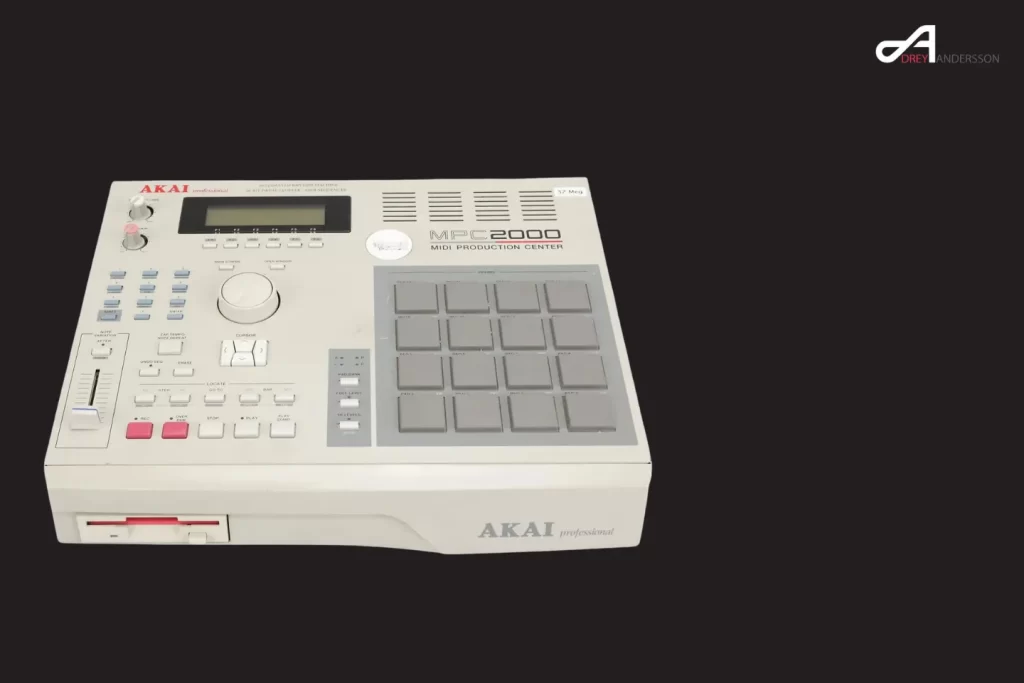
The Akai MPC2000 is a sampling drum machine and MIDI sequencer that Akai released in 1997, with a 16-bit, 44.1 kHz sampler of 32 voices, 16 pressure-sensitive pads and a 64-track sequencer. Akai calls it a MIDI Production Center, and the front panel drawing in its manual reads Integrated Rhythm Machine. In 1999 Akai followed it with the MPC2000XL, which kept the engine and added time stretch, room for more sounds and notes, and an operating system in flash ROM.
This page covers both models. Akai’s manuals write MPC2000 and MPC2000XL, while listings also use spellings such as MPC 2000 and Akai MPC 2000XL. The specs table puts the two models side by side. The page then explains the sampler, the sequencer and the expansion boards, lists what the XL changed, and gives the manuals, demo videos and dated used prices.
- Both models sample at 44.1 kHz in 16 bits, play 32 voices and hold 2 MB of sample memory, expandable to 32 MB with SIMMs.
- The sequencer has 99 sequences of 64 tracks at 96 ppq, with two MIDI outputs for 32 channels.
- The MPC2000XL raised the limits from 128 to 256 sounds and from 100,000 to 300,000 notes, and added time stretch with 18 algorithms.
- Sound On Sound’s April 1997 review put the MPC2000’s UK price at £1,199, and Sweetwater gave a US list price of $1,495 that spring.
- On 8 November 2026, Reverb estimated €309 to €1,054 for a used MPC2000 and €233 to €1,519 for a used MPC2000XL.
Akai MPC2000 and MPC2000XL specs
The figures come from the technical specification pages of Akai’s two operator’s manuals. Where a row says Same, both manuals print the same value.
| Feature | MPC2000 | MPC2000XL |
|---|---|---|
| Released | 1997 | 1999 |
| Sampling | 16-bit linear, 44.1 kHz, stereo or mono | Same |
| Voices | 32 | Same |
| Sample memory | 2 MB, expandable to 32 MB with SIMMs | Same |
| Sounds in memory | 128 | 256 |
| Programs | 24, with 64 sound assignments each | 24, up to 4 playing at once |
| Filter | 12 dB per octave resonant low-pass per voice | Same |
| Sequencer memory | 100,000 notes | 300,000 notes, up to 50,000 per sequence |
| Sequences and tracks | 99 sequences of 64 tracks | Same |
| Resolution | 96 ppq | Same |
| Songs | 20 songs of 250 steps | Same |
| MIDI | 2 In, 2 independent Out, 32 output channels | Same |
| Pads | 16 velocity- and pressure-sensitive, 4 banks | Same, with 4 separate bank keys |
| Display | 248 x 60 dot graphic LCD | Same, on a tilting panel |
| Operating system | Loads from floppy or SCSI hard disk | Stored in flash ROM, updated from floppy |
| Storage | 3.5 inch 2HD/2DD floppy, Apple 25-pin SCSI | 3.5 inch 2HD/2DD floppy, 50-pin high-pitch SCSI |
| Audio connections | Stereo record in, stereo out, headphones | Same |
| Size (W x H x D) | 405 x 126 x 328 mm | 405 x 106 x 331 mm |
| Weight | 6.3 kg | 5.5 kg |
| Supplied library | OS disk and 3 sound library floppies | Sound library CD-ROM |
The MPC2000 manual lists a power cable, four floppy disks and the manual as standard: one operating system disk and three sound library disks. The XL manual lists a sound library CD-ROM instead. Both units run on 23 W with options fitted, or 13 W without.
Details that differ between sources
The supplied library is one conflict. Akai’s version 1.0 manual lists three sound library floppies, while Sound On Sound’s April 1997 review describes a CD-ROM of drum sounds that came with its review unit. The scanned manual is inconsistent on sequencer memory: its feature list reads 10,000 notes in the archive.org text, and its specification page reads 100,000. Sweetwater’s 1997 newsletter gives 100,000, and Sound On Sound wrote that the XL trebled the figure to 300,000, so this page uses 100,000.
Production years differ too. Reverb’s MPC2000 page says 1997 to 2000 in its text and 1997 to 2001 in its product details, and its MPC2000XL page gives 2000 to 2005. Sound On Sound reviewed the XL in December 1999, and Vintage Synth Explorer and Sonic State date it to 1999. I found no Akai statement on when either model was discontinued. Sweetwater’s 1997 text also calls digital inputs and outputs standard on the MPC2000, while Akai’s manual lists S/PDIF only on the optional IB-M208P board.
How the MPC2000 works
The MPC2000 combines a sampler and a MIDI sequencer in one box, so the same pads can play internal sounds and record parts for external instruments. Sound On Sound found the sequencing side virtually identical to the earlier MPCs.
Sampler and sound memory
Akai specifies 16-bit linear sampling at 44.1 kHz, in stereo or mono, from a stereo record input on two 1/4 inch jacks. Sound On Sound’s XL review noted that 44.1 kHz is the only recording rate, so 48 kHz audio from a DAT has to be converted first. Each voice has a 12 dB per octave resonant low-pass filter, and the MPC2000 holds up to 128 sounds in memory at once.
The standard 2 MB is fixed on the main board, and two 72-pin SIMM slots raise it to 32 MB. Sound On Sound contrasted this with the MPC3000, which mixed one 8 MB Akai board with one SIMM. The sampler can copy, paste, mute or reverse parts of a sound and set loop points, and it shows the waveform while you edit.
Looping was new on an MPC. Sound On Sound’s Paul Wiffen wrote that the MPC60, MPC60 MkII and MPC3000 could not loop samples, and that the MPC2000’s looping seems to come from Akai’s S2000 sampler. The envelopes have attack and decay values only, which suits drums but also covers simple piano, string and brass shapes. One limit he noted: each sample plays at one MIDI note, so a single sample can’t be spread across a keyboard at different pitches.
The Beat Loop function works out a loop’s tempo from the number of beats you enter, then shows the new tempo as you retune it. Sound On Sound linked this to Akai’s Remix 16. On the MPC2000 it changes pitch along with tempo, because the original model has no time stretch.
Programs, pads and the note variation slider
A program assigns sounds to pads and MIDI notes, with up to 64 assignments per program and up to 24 programs. The 16 pads respond to velocity and pressure, and four banks give 64 pad positions. The pressure sensing provides aftertouch, which the manual pairs with note repeat for drum rolls and hi-hat parts. One MIDI note can play three sounds together, switch between them by velocity, or choose them with the note variation slider, which also changes decay or filter in real time. A sound can cut off another, which Akai’s manual gives as the way to mimic an open and closed hi-hat.
Sound On Sound described the MPC2000 as lighter and more compact than its predecessors, with the pads moved to the right-hand side and a Shift key that gives the number keys a second job as mode selectors. Its Open Window key opens a second screen of parameters, which the reviewer wrote holds more than half the settings on the unit. He also noted that the backlit LCD is much smaller than on earlier MPCs.
The sequencer
The sequencer holds 99 sequences of 64 tracks at 96 parts per quarter note, plus 20 songs of 250 steps. Each track plays either the internal sounds or a MIDI channel. Channels are named in the form 10A or 6B, because the two outputs each carry 16 channels. Sound On Sound pointed out that the MPC3000’s C and D ports are gone and that no option adds more MIDI outputs. The MPC2000 records 16 MIDI channels at once, and the XL manual raises that to 32.
Recording features include loop recording, auto punch, tap tempo, programmable tempo changes and an undo key. Step Edit shows four events at a time and can filter the view by event type. The swing setting shifts the even 1/8 or 1/16 notes by the ratio you set. Sync covers MIDI clock and MTC, plus SMPTE with an option. It is MMC compatible, and sequences import and export as standard MIDI files.
Disks, SCSI and the operating system
The original MPC2000 loads its operating system at power-on, either from floppy or from a SCSI hard disk where the system has been copied. Sound On Sound listed the lack of a ROM-based system among its cons. The floppy drive reads double- and high-density disks, and the SCSI port on the MPC2000 is an Apple-style 25-pin D connector. Sound On Sound listed hard disks, magneto-optical and CD-ROM drives among the SCSI sources the disk screens show, and noted that the SCSI ID is fixed at 6.
The disk screen’s Type field identifies MPC2000, MPC3000, S1000, S3000 and MS-DOS disks. In Sound On Sound’s tests, S1000 and S3000 samples loaded from floppy with their loops intact. An MPC3000 bank took 2 minutes 12 seconds to load from SCSI against 25 seconds on the MPC3000, while a floppy bank loaded in 44 seconds against 1 minute 2 seconds. The review unit, running software dated 24 December 1996, loaded MPC3000 sequences but left their songs empty, and it recognised MPC60 disks but couldn’t load their sounds. Akai told the magazine that MPC60 support was due in the next software release, and the reviewer expected the New Year release to add the song data.
Expansion boards
Most of the extra connections are optional boards. Sound On Sound counted back-panel slots for the outputs and SMPTE boards, plus internal slots for the effects and flash ROM boards.
| Option | What it adds | Notes |
|---|---|---|
| IB-M208P | 8 individual outputs plus S/PDIF digital in and out | Fits both models. Sound On Sound listed it as available in April 1997. |
| EB16 | Multi-effects processor board | Fits both. The MPC2000 manual says version 1.0 software doesn’t support it yet. |
| IB-M20T / IC-M2TC | SMPTE synchronization | The MPC2000 uses the IB-M20T board. The XL has SMPTE sockets and needs only the IC-M2TC chip. |
| FMX008M | 8 MB flash ROM board | Fits both. Version 1.0 software on the MPC2000 doesn’t support it. |
| SIMMs | Sample memory up to 32 MB in two 72-pin slots | Akai recommends 70 ns or faster. With a 32 MB SIMM fitted, the 2 MB on the main board is ignored. |
The SIMM table in the XL manual lists 2 MB as standard, 18 MB with one 16 MB SIMM, and 32 MB with two 16 MB SIMMs or one 32 MB SIMM. Sound On Sound noted that the effects and flash ROM boards had never been offered on a sampling drum machine before, and that the MPC2000 needed a later software update to use them.
What the MPC2000XL changed
The MPC2000XL keeps the MPC2000’s sound engine, standard memory, MIDI ports and the EB16, IB-M208P and FMX008M boards, and Sound On Sound described it as an evolution of the same design. The XL changes are in the panel, the capacity and the software.
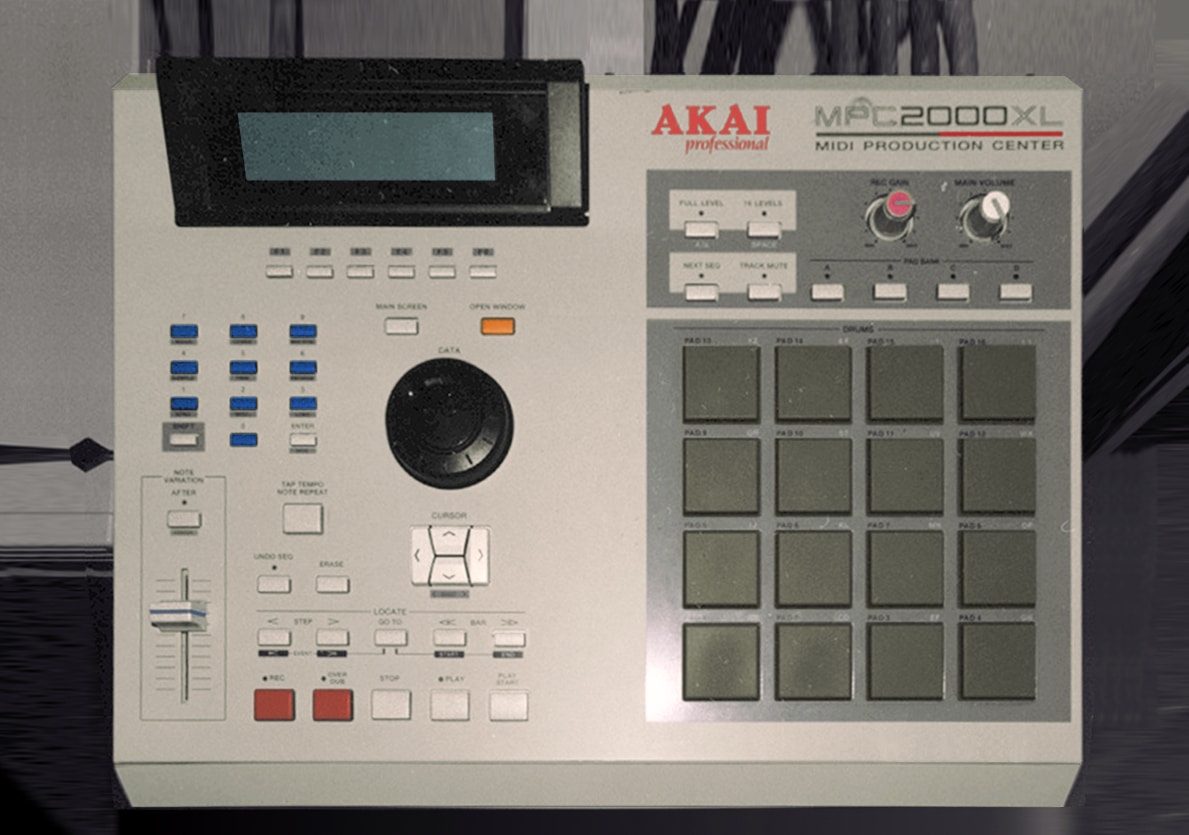
On the panel, the LCD sits on a hinged mount with three positions, a feature Sound On Sound said earlier Akai units had and the MPC2000 dropped. Four separate bank keys replace the single bank key, and a Next Sequence key queues the next sequence while the current one plays. Vintage Synth Explorer also lists a Track Mute key, multi-program playback and MIDI soft thru. Akai’s XL manual adds a second sequence that plays alongside the main one.
Inside, the XL holds 256 sounds instead of 128 and 300,000 notes instead of 100,000, with up to 50,000 notes per sequence. Up to four programs can play at once, and the sampler reads and writes PC .WAV files. The operating system lives in flash ROM, so the unit starts without a disk and still takes updates from floppy. The SCSI port changed to a 50-pin high-pitch connector, and the SMPTE sockets are fitted as standard but need the IC-M2TC chip to work.
Time stretch, slicing and resampling
The XL added time stretching, which the MPC2000 lacked. Sound On Sound counted 18 presets for drums, full mixes, voices and orchestral hits, each at three quality levels, plus an Adjust control from -50 to +50. In its test a four-second sample processed in under 30 seconds at the highest quality. A BPM Match screen sets the stretch from the number of beats, the source tempo and the new tempo.
Zone mode divides a sample into up to 16 equal zones, whose start and end points you can then move. Slice Sound turns the zones into separate samples and can lay them out across the 16 pads as a new program. The review noted that the XL doesn’t build a sequence that replays the slices in their original timing. Resample converts a sound to a lower rate or bit depth, and Vintage Synth Explorer gives 22 kHz or 8-bit as the targets.
Price and compatibility
Sound On Sound reported that the XL launched at £300 less than the MPC2000 and called it the cheapest Akai sampling drum machine and sequencer so far. It reads both sound and sequence data from the MPC60 and MPC3000, which the MPC2000 could only partly do at launch, and it works with the MPC2000’s EB16 and IB-M208P boards. The two MIDI outputs stayed, with no expansion.
Vintage Synth Explorer names two bundled versions: the Studio Sampler with the 8-output, digital and SMPTE boards fitted, and the Studio Plus, which also has the EB16. It quotes about $250 per board and $350 for the effects board. Akai’s own MPC2000XL notice for version 1.14 refers to units with an internal ATAPI Zip drive, and Reverb also lists an MPC2000XL MCD model. I haven’t checked the exact contents of these versions against an Akai price list.
MPC2000 history and the MPC line
Sound On Sound’s April 1997 review called the MPC2000 the first Akai MPC without Roger Linn’s signature. Wiffen counted three earlier units that carried his name: the MPC60, the MPC60 MkII and the MPC3000. He also noted that the MPC3000 was not being discontinued, and that its list price was just over double the MPC2000’s.
| Model | Year | Link to the MPC2000 in the sources |
|---|---|---|
| MPC60 | 1988 | Reviewed by Music Technology in April 1988. Sound On Sound counts it among the three MPCs with Roger Linn’s name |
| MPC60 MkII | 1991 | The second of those three |
| MPC3000 | 1994 | The third. Sound On Sound wrote that its list price was just over double the MPC2000’s and that Akai was not discontinuing it in 1997 |
| S2000 | By 1997 | Akai rack sampler. Sound On Sound linked the MPC2000’s looping to it and noted that both expand with SIMMs |
| Remix 16 | By 1997 | Akai phrase sampler. Sound On Sound linked it to the Beat Loop tempo function |
| MPC2000 | 1997 | First MPC without Linn’s signature, per Sound On Sound |
| MPC2000XL | 1999 | Successor with time stretch and a flash-ROM operating system |
One stage appearance is documented: Wikipedia, citing The New York Times, says Kanye West closed the 2010 MTV Video Music Awards by performing Runaway on an MPC2000XL. For the wider story of the series, see my history of the Akai MPC. The Akai MPC3000 entry covers the model the MPC2000 sat below, and the MPC Live III post covers a current model.
Operating systems, mods and the vMPC2000XL emulator
Akai’s legacy downloads page offers two XL operating systems, 1.20 and 1.14. The 1.20 file inside Akai’s download is dated 11 November 2004. Among five fixes, the 1.14 update, dated 17 May 2001, addressed Zip disk data corruption by extending a wait time from 3 to 20 seconds. The page has no entry for the original MPC2000.
As of autumn 2026, two third-party projects modify the operating system of these units. Neither is made or endorsed by Akai, and I haven’t run either of them.
2KXL PLUS by Clevedon Road, developed in Auckland, New Zealand, is a paid replacement operating system for the MPC2000XL only. Version 1.3.2 came out on 7 October 2026 at $49. Its product page lists mute groups, a Lazy Chop function, a high-pass filter, normalize, improved resampling and faster performance, and asks buyers to keep Akai’s OS 1.20 as a fallback. It installs from a floppy emulator, a ZuluSCSI or a similar drive, and the maker calls it experimental.
MPC2000 Mods by vubeatz patches the original Akai operating system of both models with optional changes and was at version 2.1 when I checked. One of them is an MPC3000-style swing option: at 1/16 and 66 % swing, its documentation says the second note lands on tick 32 instead of the stock tick 31. Its page also notes that Akai no longer hosts OS 1.72 for the original MPC2000. The source of eight of its mods is public on GitHub.
The vMPC2000XL is a software emulator of the MPC2000XL, published as open source under the GPL-3.0 licence by the GitHub user izzyreal, with its website at izmar.nl. It runs as a standalone app and as VST3, AU and LV2 plugins, and version 0.9.19 was released on 17 October 2026. Its website states that it isn’t affiliated with inMusic, which holds the Akai Professional trademark. A dBs Institute article from January 2020 noted that it loads the hardware’s file types, including APS, ALL, PGM, SND, MID and WAV. See the VST entry for plugin formats in general.
Akai MPC2000 and MPC2000XL demo videos
The first video compares the two models side by side. In the second, M-Squared shows how he uses an XL to make a beat.
MPC2000XL manual and documentation
Akai’s legacy downloads page has a media file for the XL but no manual. The 208-page MPC2000XL operator’s manual is readable page by page on ManualsLib, with the technical specifications on printed pages 193 and 194. For the original model, archive.org holds a scan of the MPC2000 operator’s manual for software version 1.0, with specifications on printed pages 167 and 168.
The two Sound On Sound reviews by Paul Wiffen are online: the MPC2000 review from April 1997 and the MPC2000XL review from December 1999. The XL review includes the sampling-time figures for full memory and names 14 of the 18 time-stretch presets.
MPC2000 and MPC2000XL price and availability
New, the MPC2000 cost £1,199 in the UK according to Sound On Sound, and Sweetwater’s spring 1997 newsletter gave a US list price of $1,495. The XL launched at £300 less in the UK. I found no US list price for the XL. Akai lists the XL among its legacy products, and both models now sell used.
Reverb bases each estimate on its orders in good to mint condition, 42 for the MPC2000 and 136 for the MPC2000XL. The chart below shows the six dated sales in each page’s transaction table, and Reverb doesn’t say how those rows relate to the estimate.
The €2,000 MPC2000XL sale from June 2026 sits above the XL estimate’s upper end, and the €1,150 MPC2000 sale from February 2026 sits above the MPC2000 estimate. The lowest dated sale is €299 for an XL in May 2026.
On the same day, Reverb listed four complete MPC2000 units at €778.50 to €1,169.87 and six MPC2000XL units at €800 to €1,899.90, several described with new screens, card readers or 8-output boards. A US Google Shopping block for mpc 2000 showed eight listings of both models at $399 to $1,499. I opened none of them. These are asks, not sales, and they change quickly.
Frequently asked questions
When did the Akai MPC2000 come out?
Akai released the MPC2000 in 1997. Sound On Sound reviewed it in April 1997, using software dated 24 December 1996. The MPC2000XL followed in 1999 and was reviewed in December 1999. Reverb gives production years of 1997 to 2000 or 2001 for the MPC2000, and I found no Akai statement on when production ended.
What is the difference between the MPC2000 and the MPC2000XL?
The XL keeps the 32-voice, 44.1 kHz engine and 2 MB of memory, but holds 256 sounds instead of 128 and 300,000 notes instead of 100,000. It adds time stretch, sound slicing, resampling, a tilting display, four bank keys and an operating system in flash ROM.
How much sampling time does the MPC2000 have?
With the standard 2 MB, Akai gives 21.9 seconds in mono or 10.9 seconds in stereo at 44.1 kHz. Expanded to 32 MB with SIMMs, the XL manual figures quoted by Sound On Sound are 378.6 seconds in mono and 189.2 seconds in stereo. Both models use the same memory.
How many tracks and voices does the MPC2000 have?
It plays 32 voices from its sampler. The sequencer holds 99 sequences of 64 tracks each at 96 parts per quarter note, plus 20 songs. Two independent MIDI outputs carry 32 channels, and Sound On Sound noted that no option adds a third output on either model.
Does the MPC2000XL have time stretch?
Yes. Sound On Sound counted 18 time-stretch presets at three quality levels, with an Adjust control from -50 to +50 and a BPM Match screen. The original MPC2000 has no time stretch; its Beat Loop function matches tempo by changing a sample’s pitch.
Does the MPC2000 need a boot disk?
The original MPC2000 loads its operating system from floppy or from a SCSI hard disk at every power-on. The MPC2000XL stores it in flash ROM and starts without a disk. Akai still hosts XL operating systems 1.20 and 1.14 on its legacy downloads page.
How much did the MPC2000 cost new?
Sound On Sound’s April 1997 review put the UK price at £1,199, and Sweetwater’s spring 1997 newsletter gave a US list price of $1,495. Sound On Sound reported in December 1999 that the MPC2000XL cost £300 less than the MPC2000 had. I found no US list price for the XL.
Can the MPC2000 load MPC3000 and S1000 disks?
Yes. It reads MPC3000, S1000 and S3000 disks, and Sound On Sound found that S1000 and S3000 loops loaded too. At launch, MPC3000 songs and MPC60 sounds didn’t load yet. The XL reads sound and sequence data from the MPC60 and MPC3000.
Is there an MPC2000XL emulator?
Yes. The vMPC2000XL, maintained by the GitHub user izzyreal, is an open-source emulator under the GPL-3.0 licence that runs standalone and as VST3, AU and LV2 plugins. Version 0.9.19 was released on 17 October 2026, and its site states that it isn’t affiliated with inMusic.
How much is a used MPC2000 or MPC2000XL worth?
On 8 November 2026, viewed from Berlin, Reverb estimated €309 to €1,054 for an MPC2000 from 42 orders and €233 to €1,519 for an MPC2000XL from 136 orders. Prices exclude shipping and tax, and expansion boards and memory vary between units.
Back to Music Production Terms Index Page