What the Akai MPC1000 is
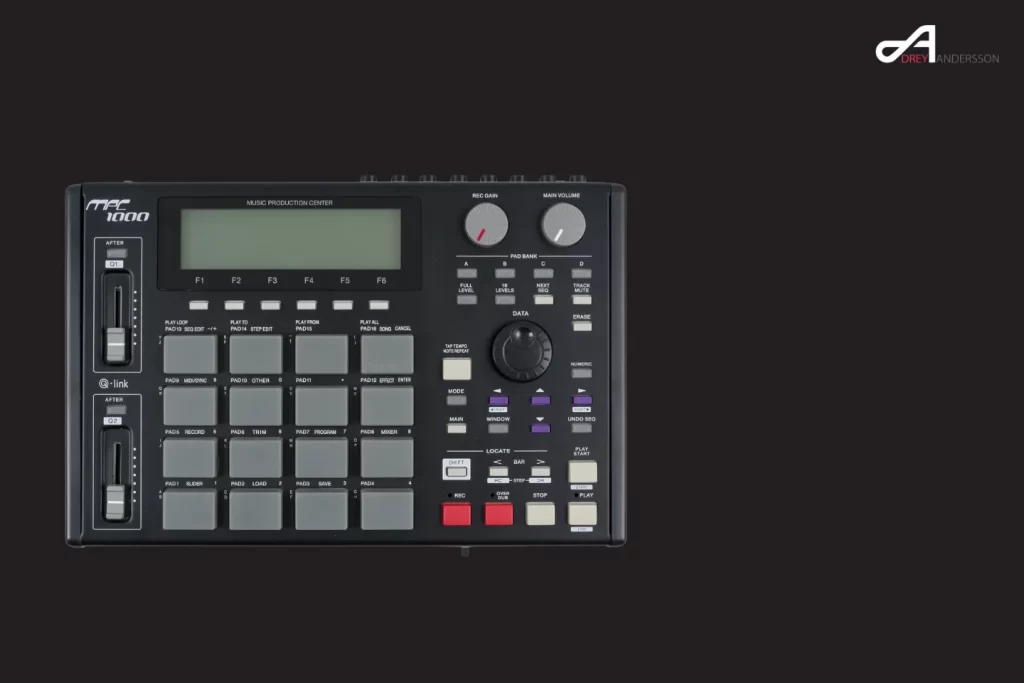
The Akai MPC1000 is a compact sampling drum machine and 64-track MIDI sequencer that Akai Professional shipped in January 2004, with 16 velocity- and pressure-sensitive pads, a 32-voice 16-bit sampler, two Q-Link sliders and a CompactFlash slot. Searches write it as MPC 1000, Akai MPC 1000 or MPC1000, and Akai’s own pages use MPC1000.
This page lists the specs from Akai’s operator’s manual and explains the sampler, the sequencer, the Version 2.0 update and the third-party JJOS operating system. It also compares the MPC1000 with its larger sibling, the MPC2500, and gives the manuals, demo videos and dated used prices.
- 32 voices, 16-bit 44.1 kHz sampling, 16 MB of memory expandable to 128 MB, which gives 136 seconds or 24 minutes 28 seconds of mono sampling.
- The sequencer has 64 tracks per sequence, 99 sequences and 100,000 notes at 96 ppq, with two MIDI outputs for 32 channels.
- Sonic State reported it shipping at $999 in January 2004. Version 2.0 and a black finish followed in January 2006.
- JJOS is a third-party OS whose free version 3.16 dates from 2015. Its OS2XL edition needs a $123 password to save.
- On 8 November 2026, Reverb estimated €365 to €788 for a used MPC1000 from 149 orders.
Akai MPC1000 specs
The figures below come from the specification pages of Akai’s MPC1000 v2 operator’s manual. Where a row comes from another Akai page or from a news report, the caption names it.
| Feature | Akai MPC1000 |
|---|---|
| Released | January 2004, shipping at the Winter NAMM show per Sonic State |
| Pads | 16 velocity- and pressure-sensitive pads in 4 banks, 64 pad slots per program |
| Polyphony | 32 voices |
| Sample format | 16-bit linear, 44.1 kHz, mono or stereo |
| Memory | 16 MB standard (11.5 MB for sound memory), expandable to 128 MB with the EXM128 |
| Recording time (mono) | 136 seconds at 16 MB, 24 minutes 28 seconds at 128 MB |
| Internal flash | 5 MB of preset sounds, kept after power-off |
| Number of programs (Akai spec) | 24 |
| Filters | 2 two-pole filters per voice: low pass, band pass or high pass |
| Effects | 2 stereo effects plus a master effect (4-band EQ and compressor) |
| Sequencer | 64 tracks per sequence, 99 sequences, 100,000 notes, 96 ppq |
| Song mode | 20 songs of up to 250 steps |
| MIDI | 2 In, 2 Out, 32 output channels |
| Sync | MIDI clock |
| Audio inputs | Record in L/R on 1/4 inch jacks (balanced with stereo plugs), coaxial S/PDIF in |
| Audio outputs | Stereo out, 4 assignable mix outs (unbalanced), headphones, coaxial S/PDIF out |
| Display | 240 x 64 dot backlit LCD |
| Storage | CompactFlash, 32 MB to 2 GB; optional 2.5 inch IDE hard disk with the HDM10 kit |
| Computer link | USB slave port, mass storage class |
| Footswitch inputs | 2 x 1/4 inch |
| Power consumption | 19 W |
| Size (W x H x D) | 330 x 75.5 x 228.2 mm |
| Weight | 3.45 kg |
| Akai OS on the 2017 product page | 2.13 |
A unit shipped with a 32 MB CompactFlash card, a power cable and the operator’s manual. Akai listed two options: the EXM128 memory card and the HDM10 kit for an internal hard disk. Akai’s product page says the 32 MB card held about 10 MB of sounds, on top of the 5 MB in internal flash.
Details that differ between sources
The release year varies. Sonic State reported on 19 January 2004 that the MPC1000 was in full production and shipping, while Reverb’s product text gives the production years as 2003 to 2009 and its product details say 2004 to 2013. I found no Akai statement on when production ended. The price is the second point. Sonic State gave a retail price of $999 in 2004, and Synthtopia gave a suggested retail price of $1,499 when Version 2.0 arrived in January 2006.
Reverb’s product text also lists four MIDI outputs, but Akai’s manual and product page give two, MIDI Out A and B, each sending its own 16 channels. The MPC2500 is the model with four. Akai’s own comparison chart v2.1 marks Patched Phrase and Reverse as missing on the MPC1000BK, while the Version 2.0 manual documents both and Synthtopia’s 2006 report lists them among the new features. This page follows the manual. Akai’s specification gives 24 programs, while the JJOS maker’s comparison chart lists 128 for Akai OS 2.13.
How the MPC1000 works
Akai’s manual describes the MPC1000 with a small set of terms. A sample is any sound loaded into memory. A program assigns samples to 64 pads, the 16 physical pads times four banks, and holds each pad’s envelope, filter and other settings. A sequence holds 64 tracks of MIDI events, and a song plays sequences in a set order. Tracks never hold audio in Akai’s own OS: they record the pad hits that trigger samples.
The sampler
The sampler records from the analog record input or the S/PDIF input at 44.1 kHz in 16-bit, in mono or stereo, and it can also resample its own main output. Samples are standard WAV files, so they can be edited on a computer. Each pad can layer up to four samples with velocity switching, and each of the 32 voices passes through two two-pole filters, which Akai’s product page counts as a four-pole filter. Program settings include envelopes, an LFO and the filter type: low pass, band pass or high pass.
All memory is RAM, and its contents are lost at power-off. The manual notes that the MPC1000 can’t play from the card directly, so samples load from CompactFlash into memory first. The internal flash keeps 5 MB of sounds through power cycles.
The sequencer
Each of the 99 sequences can run from 1 to 999 bars, with tempos from 30.0 to 300.0 BPM. Akai’s FAQ on the product page describes both ways of working: one long linear sequence, or short sequences chained in song mode, where 20 songs of up to 250 steps can be built. Timing correct quantizes recorded notes, and its Swing% setting shifts every even-numbered note of the chosen value to create a shuffle. Tap Tempo averages four taps by default.
Note Repeat retriggers a held pad at the timing correct value, with the velocity following the pad pressure. Sonic State’s 2004 report listed the original MPC60’s transport and locate controls and a Note Repeat function among the MPC1000’s features. Two MIDI outputs let the sequencer address 32 external channels, and the two MIDI inputs are merged, so a keyboard and a sync source can both be connected.
Pads, 16 Levels and Q-Link sliders
The 16 pads respond to velocity and pressure. Full Level plays every hit at velocity 127. The 16 Levels key spreads one sound across all 16 pads with stepped values of velocity, tune, filter, layer, decay or attack. With tune selected, the steps are semitones, so one sample can be played chromatically.
The two Q-Link sliders control one pad each. In Note On mode, the slider position is stored with each hit as note variation data. In Real Time mode, moving the slider changes the sound while it plays and is recorded as Q-Link events, for tune, level, pan, or cutoff and resonance of either filter.
Effects
Two stereo effect processors and a master effect run at the same time. The effect types are chorus, flanger, Bit Grunger, 4-band EQ, compressor, phase shifter, tremolo, flying pan, reverb and delay, and chorus, flanger and delay can only be selected in the second processor. The master effect offers a 4-band EQ and a compressor on the main outputs. Input Thru sends an incoming signal through the effects and filters, with the Q-Link sliders controlling the filter.
Storage and USB
CompactFlash cards from 32 MB to 2 GB hold the files. Connected over USB as a mass storage device, the MPC1000 shows its card as a drive on a computer, which needs Windows 2000/Me/XP or later, or Mac OS 9.x/10.x or later. An optional 2.5 inch IDE hard disk fits inside with the HDM10 kit, and Akai’s FAQ names laptop-style IDE drives for both the MPC1000 and the MPC2500.
Version 2.0 and the black MPC1000
At the NAMM show in January 2006, Akai announced Version 2.0 of the MPC1000 software as a free update, together with a change from blue to black for new units. Synthtopia’s report lists the additions: a delay effect, offline time stretch and pitch shift, reverse, Slice Sample in the Chop Shop function, Patched Phrase, real-time Q-Link control through Audio Input Thru, and hard disk support.
The Version 2.0 manual describes the details. Time stretch works offline on a sample and offers 18 preset algorithms, each in A, B and C quality grades, for material from voices to drums and orchestra. Chop can divide a phrase into regions of equal length and turn them into sliced samples on pads, or into a Patched Phrase, a single sample with sequence data that follows the tempo. With a stereo sample, only the left channel is used for this. Akai’s archived 2017 product page offers OS 2.13 as its operating system download.
JJOS, the third-party MPC1000 operating system
JJOS is a replacement operating system for the MPC1000 and the MPC2500, distributed on its maker’s own site, which has English and Japanese pages. The site and its FAQ refer to the developer only as JJ. It lists the MPC1000, MPC1000B, MPC1000BK and MPC1000BK-N as supported models. JJOS comes from an independent developer, not from Akai, and none of the Akai pages and manuals I read mention it.
free
US$123 password
OS2XL password
OS2XL password
US$98, or US$25 with an OS2XL password
Free and paid editions
The free version, 3.16, was uploaded on 16 February 2015 and includes save and load. Its basic specification is the same as the Akai OS, the maker’s explanation says, with additions such as a Grid Edit page, Global Program Edit, audio tracks on tracks 61 to 64 and a pad sensitivity range of 1 to 25.
The paid editions install for free, but the save screen stays hidden until a password is entered. Every other function works without it. On 8 November 2026, the OS2XL password cost US$123, paid by PayPal only, and the Japanese page gave 12,800 yen. The site says it holds no discount sales. OS3 and Light use the same password, so one purchase covers all three. OS128XL is for units fitted with the larger 240 x 128 LCD sold by mpcstuff.com, and costs US$98, or US$25 on a unit that already has the OS2XL password. OS2XL 3.90, OS3 2.60 and OS128XL 2.54 were all uploaded on 15 October 2026.
What JJOS adds
The maker’s comparison pages list what each edition adds to Akai’s OS 2.13. The table below is a selection.
| Feature | Akai OS 2.13 | JJOS free 3.16 | JJOS OS2XL |
|---|---|---|---|
| Grid Edit for drum tracks | No | Yes | Yes |
| Global Program Edit | No | Yes | Yes |
| Audio tracks | No | Yes, tracks 61 to 64 | Yes |
| Recordable track mutes | Yes | No | Yes |
| Save and load to internal memory | Yes | Yes | No |
| Arpeggiator and chord functions | No | No | Yes |
| ADSR envelope | No | No | Yes |
| Non-destructive chop | No | No | Yes |
| Mixdown of a song to a WAV file | No | No | Yes |
| Multitimbral MIDI input | No | No | Yes |
| MTC and MMC sync | No | No | Yes |
| Sample layers per pad | 4 | 4 | 3 |
| Maximum events | 100,000 | 100,000 | 300,000 |
OS2XL also drops some Akai features. It can’t save to or load from internal memory, and it allows three sample layers per pad instead of four. OS3 shares OS2XL’s second, simultaneous sequence and non-destructive chops, and the comparison chart lists real-time time stretch and pitch shift for OS3 but not for OS2XL. Sequences and programs made in OS2XL load in the Akai OS and the free version, though the maker notes some incompatibilities, and going back from OS3 to OS2XL means reinstalling OS2XL. Neither Akai’s OS 2.13 nor the free version has an arpeggiator or an ADSR envelope, and OS2XL adds both.
How it installs
The free version is copied to the CompactFlash card over USB and loaded from Load mode like an Akai OS update, and the same method returns the unit to the Akai OS. OS2XL can’t be installed from the Akai OS, only from the free version. Holding Tap Tempo at power-on starts the free version again, and the password stays on the unit when other editions are installed. The maker asks users to hold the Erase key while switching on after every OS change, and notes that JJOS moves the LCD contrast to Stop plus the data wheel. I haven’t installed any JJOS edition, and I’ve linked only the maker’s pages, not its download files.
The MPC2500, the MPC1000’s larger sibling
Akai introduced the MPC2500, also written MPC 2500, at the same NAMM show in January 2006 as the successor to the MPC2000XL. It shares the MPC1000’s sampler and sequencer figures, and its main differences are in the panel and connections: full-size pads, two Q-Link knobs added to the two sliders, ten balanced analog outputs, four MIDI outputs and MTC sync. Akai’s comparison chart also gives it Grid Edit in the Akai OS, which the MPC1000 only gets through JJOS.
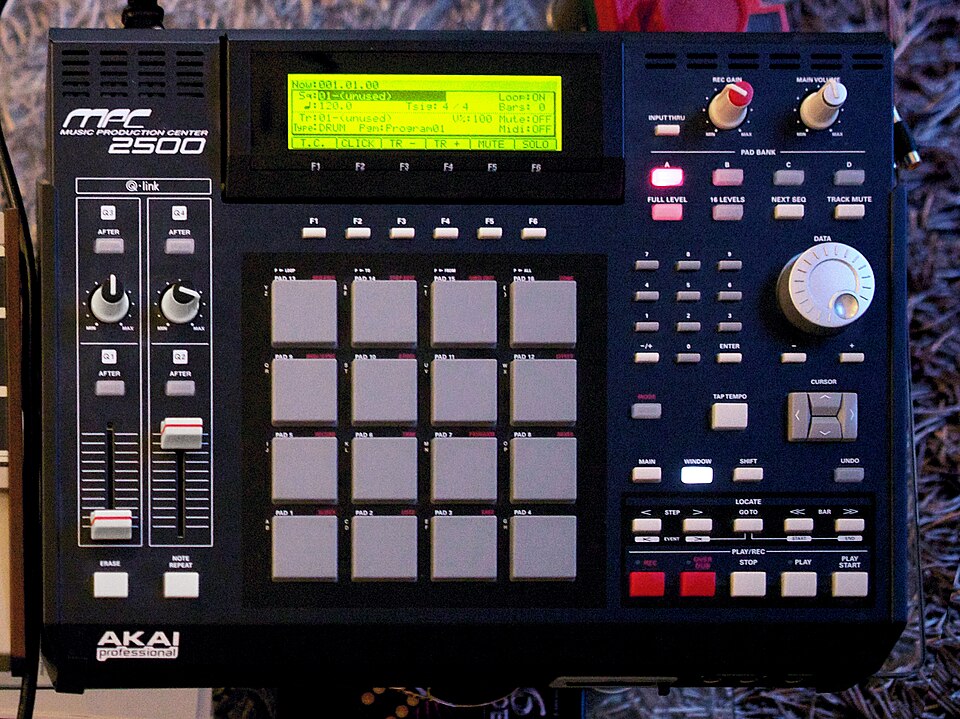
| Feature | MPC1000 | MPC2500 |
|---|---|---|
| Launch | January 2004, $999 retail per Sonic State | January 2006 (NAMM), $2,999 suggested retail per Synthtopia |
| Pads | 16, three-quarter height | 16, full size |
| Q-Link controls | 2 sliders | 2 sliders and 2 knobs |
| Analog outputs | Stereo plus 4 assignable, unbalanced | Stereo plus 8 assignable, balanced |
| MIDI | 2 In, 2 Out, 32 channels | 2 In, 4 Out, 64 channels |
| Sync | MIDI clock | MIDI clock and MTC |
| Grid edit in Akai OS | No | Yes |
| Drive options | 2.5 inch hard disk | 2.5 inch hard disk and a CD drive (CD-M25) |
| Power, weight | 19 W, 3.45 kg | 70 W, 6.15 kg without drives |
| Akai OS on the 2017 product pages | 2.13 | 1.24 |
| JJOS free and XL editions | Free 3.16, OS2XL 3.90 | Free 3.13, OS-XL 3.90 |
Sound On Sound reviewed the MPC2500 in January 2007, when it cost £1,199.99 including VAT in the UK. Mike Senior’s review notes the four Q-Link controls, a choice of five supported hard disk models of 20 to 80 GB, the optional internal CD-RW drive, and that the eight separate outputs and stereo digital I/O had needed an extra IBM208P card on the MPC2000XL. JJOS has its own MPC2500 line on the same site, with free version 3.13, OS-XL 3.90 at the same US$123 price, and OS3 2.63.
Akai MPC1000 history and related gear
Sonic State saw several MPC1000s at Akai’s booth at the Winter NAMM show and reported on 19 January 2004 that the unit was shipping for $999. The report also named Def Jeff as the designer of many of the demo sounds and sequences for the MPC1000 and the MPC4000. In Akai’s later comparison chart, the black MPC1000BK sits between the MPC500 and the MPC2500, with the MPC5000 as the flagship.
| Model | Files the MPC1000 can load |
|---|---|
| MPC2500 | SEQ, WAV, PGM |
| MPC2000 and MPC2000XL | SEQ, WAV, SND, PGM (most program parameters) |
| MPC4000 | SEQ, WAV, PGM (drum programs, note assign and tune only) |
| MPC3000 | SND, through a computer |
| Z4 and Z8 | WAV, PGM (drum programs, note assign and tune only) |
| S5000 and S6000 | WAV only, through a computer |
| S1000 and S3000 | No compatibility |
The Akai MPC3000 has its own entry here, and my history of the Akai MPC covers the whole line up to the current models such as the MPC Live III. For other hardware that combines a sampler or sound engine with a sequencer, see the Roland W-30, the Yamaha RM1x and the groovebox entry. Sonic State presented the MPC1000 in 2004 as an alternative to computer-based systems, and the DAWless entry covers that way of working.
Akai MPC1000 demo videos
The first video plays programs from the MPC1000’s factory memory. The second is a long session on a unit running JJOS2XL.
MPC1000 manual and documentation
Akai’s MPC1000 and MPC2500 pages returned 404 on 8 November 2026, and the download links from their 2021 versions no longer work. The Version 2.0 quickstart manual is still on Akai’s CDN, as a 74-page PDF in five languages. The Version 2.0 operator’s manual, a 120-page PDF of 4.88 MB, survives in the Internet Archive’s copy of Akai’s file. Its specifications are on printed pages 103 and 104, and the MIDI implementation chart is dated September 2005.
The archived Akai product page from 2017 also lists the release notes and OS 2.13. The JJOS maker publishes its own OS2XL manual, which covers only the functions JJOS adds.
MPC1000 price and availability
The MPC1000 sells used. On 8 November 2026, viewed from Berlin, Reverb’s MPC1000 page estimated €365 to €788, based on 149 orders in good to mint condition. Its transaction table lists 7 dated sales.
The €980 sale from September 2026 sits above the estimate’s upper end, and the newest sale, €330.58 in October 2026, sits below its lower end. The table doesn’t say which units had JJOS or other upgrades.
On the same day, Reverb showed 10 MPC1000 listings from €430.51 to €1,100 before shipping. The first, promoted listing, a US unit at €794.58, named JJOS 2XL v3.86, 128 MB of RAM and upgraded pads. Three of the ten listings name JJOS or a RAM upgrade. I opened none of them. These are asks, not sales, and they change quickly. For the MPC2500, Reverb estimated €153 to €1,136 from 61 orders, and its newest sale was €660.25 on 1 November 2026.
Frequently asked questions
When did the Akai MPC1000 come out?
Sonic State reported on 19 January 2004, from the Winter NAMM show, that the MPC1000 was in full production and shipping for $999. Reverb’s product text gives production years of 2003 to 2009. Akai released Version 2.0 and a black finish in January 2006.
What is the difference between the MPC1000 and the MPC2500?
Both have 32 voices, 16-bit 44.1 kHz sampling, up to 128 MB and a 64-track sequencer. The MPC2500 adds full-size pads, two Q-Link knobs, ten balanced outputs instead of six, four MIDI outputs, MTC sync and a CD drive option. It launched in 2006 at $2,999 suggested retail.
How much sampling time does the MPC1000 have?
Akai gives 136 seconds of mono sampling with the standard 16 MB, of which 11.5 MB is sound memory. With the EXM128 card it rises to 24 minutes 28 seconds at 128 MB. Akai quotes these times for mono samples, and everything in RAM is lost at power-off.
What is JJOS for the MPC1000?
JJOS is a third-party operating system for the MPC1000 and MPC2500 from a developer the maker’s site calls JJ. The free version 3.16 adds Grid Edit and audio tracks, and the paid OS2XL adds an arpeggiator and up to 300,000 events. On 8 November 2026, the maker listed free 3.16, OS2XL 3.90, OS3 2.60, Light 1.00 and OS128XL 2.54.
Is JJOS free?
Version 3.16 is free and includes save and load. The paid editions OS2XL, OS3 and Light install for free but hide the save screen until a password is entered. On 8 November 2026, that password cost US$123 by PayPal and covers all three. OS128XL has its own US$98 password, or US$25 with an OS2XL password.
How many tracks does the MPC1000 sequencer have?
Each sequence has 64 tracks, and the MPC1000 holds 99 sequences with up to 100,000 notes at 96 ppq. Song mode chains them into 20 songs of up to 250 steps. The two MIDI outputs address 32 external channels, and JJOS OS2XL raises the event limit to 300,000.
What memory card does the MPC1000 use?
It uses CompactFlash, and Akai’s manual gives a range of 32 MB to 2 GB. A 32 MB card came in the box. An optional 2.5 inch IDE hard disk fits inside with the HDM10 kit, and the JJOS maker’s site has a guide to using a 128 GB microSD card.
Does the MPC1000 have effects?
Yes. It has two stereo effect processors and a master effect with a 4-band EQ and compressor. The ten types include reverb, chorus, flanger, phase shifter and Bit Grunger. Delay arrived with Version 2.0 in 2006, and delay, chorus and flanger only run in the second processor.
Where can I find the Akai MPC1000 manual?
Akai’s MPC1000 page returned 404 on 8 November 2026. The Version 2.0 quickstart manual is still on Akai’s CDN, and the 120-page Version 2.0 operator’s manual survives in the Internet Archive’s copy of Akai’s file. The specifications are on printed pages 103 and 104.
How much is a used Akai MPC1000 worth?
On 8 November 2026, viewed from Berlin, Reverb estimated €365 to €788 from 149 orders. Its newest sale was €330.58 in October 2026, and the highest of its 7 listed sales was €980. Prices exclude shipping and tax, and three of the ten current listings name JJOS or a RAM upgrade.
Back to Music Production Terms Index Page