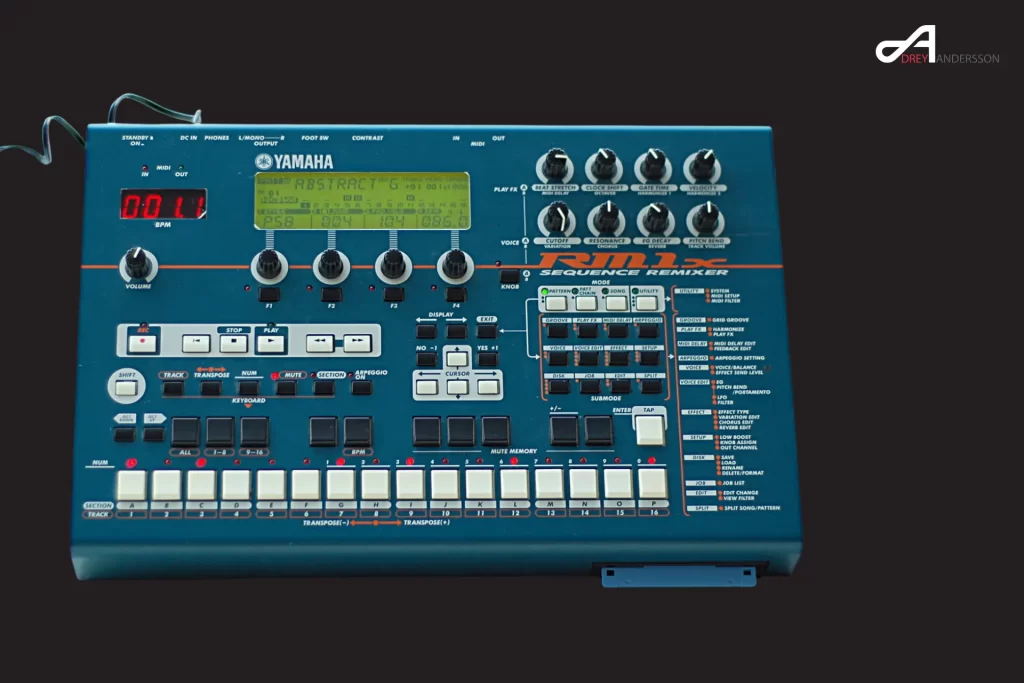
What the Yamaha RM1x is
The Yamaha RM1x is a 16-track MIDI sequencer and AWM2 tone generator in one metal box, released in 1999 and sold under the name Sequence Remixer. It took much of its sequencing from Yamaha’s QY700 and combined it with eight real-time knobs, playback tools and 960 preset dance patterns, which put it in the groovebox market next to Roland’s MC-505.
It records MIDI rather than audio and it doesn’t sample. Everything it plays comes from its preset voices or goes out over MIDI to other gear. This page covers its specs, how its memory and sound engine are organized, the real-time tools, its lineage, the manuals and dated used prices.
- 16 tracks, about 110,000 notes, 480 clocks per quarter note, and a floppy drive that reads and writes SMF format 0.
- The tone generator plays 32 notes in element units, so 16 notes with two-element voices. By my count, 385 of the 654 non-GM normal voices use two elements.
- 60 preset styles of 16 sections give 960 preset patterns, built from over 7,000 preset phrases.
- It has no sampler and no user voice memory. Sound On Sound listed it at £549 including VAT in February 1999.
- Reverb’s estimated used value was €270 to €525 on 4 November 2026.
Yamaha RM1x specs
These figures come from Yamaha’s own specification pages, cross-checked against the launch review in Sound On Sound. Yamaha spells the name RM1x, though you will also see RM1X and RM-1X.
| Feature | Yamaha RM1x |
|---|---|
| Type | Sequence remixer: 16-track MIDI sequencer with a built-in AWM2 tone generator |
| Released | 1999, according to Yamaha |
| Sequencer capacity | About 110,000 notes |
| Resolution | 480 clocks per quarter note |
| Sequencer polyphony | 64 notes |
| Tempo | 25.0 to 300.0 BPM |
| Tracks | 16 in patterns; 16 plus a BPM track in songs |
| Patterns | 960 preset (60 styles x 16 sections), 800 user (50 styles x 16 sections), up to 256 measures each |
| Phrases | Over 7,000 preset; 256 user phrases per user style |
| Chains and songs | 20 pattern chains, 20 user songs |
| Recording | Realtime replace, overdub and punch in (song mode only), step, grid step |
| Jobs | 36 pattern jobs, 8 pattern chain jobs, 28 song jobs |
| Tone generator | AWM2, 32 notes in element units, 16 parts |
| Preset voices | 654 normal voices and 46 drum kits, plus the GM set |
| Filter | Low-pass with cutoff and resonance, set per track as offsets |
| Effects | Reverb (11 types), chorus (11 types), variation (43 types) |
| Digital low boost | 50 Hz to 2.0 kHz, gain up to 24 dB up or down |
| Controls | 8 assignable knobs, 4 display knobs, keyboard pad E2 to F4 (not velocity sensitive), tap tempo button |
| Display | 64 x 240 dot graphic LCD with CFL backlight, 4-digit LED |
| Connectors | Phones, 2 output jacks (L/mono, R), foot switch, DC in, MIDI In, MIDI Out |
| Sync | Internal, MIDI Clock, MIDI Time Code; MIDI Machine Control |
| Storage | 3.5 inch floppy, 2HD (1.44 MB) or 2DD (720 KB), MS-DOS format; battery-backed internal memory |
| File formats | RM1x native sequence format, SMF format 0 |
| Power | PA-5C AC adaptor |
| Size and weight | 420 x 282 x 98 mm, 4.4 kg |
| Main chips | SH7014 CPU, SWX00 tone generator (HG73C201FD) |
The rear panel has one MIDI In and one MIDI Out with no dedicated Thru, and one stereo pair of audio outputs. Power comes from an external adaptor, the PA-5C. The keys don’t send velocity, so the manual offers a fixed keypad velocity setting and four random ones, and it points you to an external MIDI keyboard for recording real velocity. Sound On Sound notes that the RM1x will also respond to and record aftertouch arriving over MIDI.
32 notes, 64 notes and the two polyphony figures
Listings often disagree on RM1x polyphony because the machine has two limits. The sequencer handles 64 notes at once, and the 64 voices on Vintage Synth Explorer match that figure. The tone generator stops at 32, and Yamaha counts that in elements: 32 notes with one-element voices or drum voices, 16 with two-element voices. Past the limit it uses last-note priority, cutting off older notes. To use the full 64 you need more sound sources on the MIDI Out, as Sound On Sound points out. Play FX and MIDI Delay generate extra notes, so they can also eat into polyphony.
How the RM1x sequencer is organized
Yamaha divides the machine into five blocks: sequencer, tone generator, controller, effect and arpeggio. Inside the box the sequencer talks to the tone generator over MIDI, and each track can be sent to an internal part, to the MIDI Out, or to both. That is why it also works as a standalone dawless sequencer for external gear.
The sequencer has three modes. Pattern mode loops short patterns, Pattern Chain mode strings patterns together across up to 999 measures, and Song mode records linearly with a separate BPM track, also up to 999 measures. A song can be split into patterns, and a chain can be converted to a song. Sound On Sound found no cut and paste in Song mode, and no input quantize on any recording, only post-quantizing as a job.
Yamaha’s specification gives 256 user phrases per user style, while Sound On Sound’s reviewers read it as 256 per pattern. In either case the 110,000-note limit applies to everything. The preset styles are a record of late-1990s dance genres: the List Book names Vintage Acid, Bleep Techno, Berlin Techno, Gabba, Darkcore, Big Beat, Garage House and Hip-Hop Abstract among the 60.
Patterns and songs stay in memory at power-off, kept by a non-rechargeable internal battery. The manual says a Backup Battery Low message appears when it runs down, and that Yamaha service staff should replace it. A 2001 Sound On Sound review of the RS7000 says edits were lost at power-down on the RM1x, which doesn’t match the manual or the magazine’s own 1999 review.
The AWM2 tone generator
AWM2 is Yamaha’s sample-based engine. Each normal voice uses one or two elements built from sampled waveforms, passed through a low-pass filter and an envelope, much like subtractive synthesis. The first bank holds the 128 GM voices. Seven more hold 654 voices, and two others hold the 46 drum kits and the GM kit, which makes 829 in total. Sound On Sound reports that this layout makes the RM1x GM-compatible but not XG-compatible, because Yamaha used the banks where XG variations would normally sit for its own themed sets.
The Synth Material bank is the closest to raw oscillators. Its 128 voices are 32 saw, pulse, noise, lead, FM and digital waves in four versions, A to D, which differ in decay length and LFO wave. The Synth Pad bank has the highest share of two-element voices, at 89 of 99, and each of those takes two of the 32 notes per key held.
Voice editing works per track
The RM1x has no user voice memory. Voice Edit applies offsets to a preset’s attack, decay and release (a shortened envelope), filter cutoff and resonance, LFO rate and depths, pitch bend and portamento. Those offsets belong to the track, not the voice, and Sound On Sound says they become part of the pattern or song. Sound On Sound notes that there is no true voice edit mode, despite the button’s name, and that the LFO can’t sync to tempo or MIDI clock.
Effects and low boost
Reverb and chorus always run as system effects, with a send from each part. The variation effect has 43 types, including distortion and overdrive, and runs either as a third system effect or as an insertion effect on any one part. Effect settings are stored per style or song. The digital low boost is a separate setting, with its frequency adjustable from 50 Hz to 2.0 kHz.
Real-time tools
- Knobs: eight assignable knobs cover 16 tracks through a Knob A/B switch. Their movements can be recorded into a pattern or song, and most also transmit over MIDI.
- Keys: the 26-note keyboard runs from E2 to F4, with 16 white and 10 black keys. Depending on the keyboard mode, they play notes, select tracks and sections A to P, transpose, enter numbers, or mute and solo tracks. Five mute setups can be stored for recall.
- Grid Groove: applies note, velocity, gate time and clock offsets on a 16th-note grid during playback. Sound On Sound lists recreating the slide-driven filter effects of a TB-303 among its uses.
- Play FX: harmonize, beat stretch, clock shift, gate time and velocity offset. Beat stretch resembles time stretching applied to MIDI, so one track can appear to run at another tempo.
- MIDI Delay: makes echoes from MIDI notes, not audio. Neither this nor Play FX uses sequence memory unless you fix the result into the track.
- Arpeggiator: up, down, two alternating types and random, over one to four octaves, with Sort and Hold. Sound On Sound found it runs only from the RM1x’s own keys and not on recorded parts, though its output can be recorded.
- Section changes: a system setting chooses whether sections switch on the first beat of a measure or on any 16th note.
History and lineage
Yamaha’s own synth site says the RM1x was released in 1999, and Sound On Sound reviewed it in February 1999. The owner’s manual carries a 1998 imprint. Vintage Synth Explorer lists production from 1999 to 2002. I found no Yamaha document with an end date.
Its base was the QY700 music sequencer from 1996, a £999 unit with the same 110,000-note capacity, 480 ppqn timing, floppy drive and piano-style row of pads. According to the review, the RM1x gave up the QY700’s second MIDI Out, 32-channel recording, chord track and much larger display. The green LCD was borrowed from Yamaha’s 01V mixer instead, and the case was metal in a deep blue-green. Sound On Sound saw the RM1x as Yamaha’s answer to Roland’s MC-303 and MC-505 grooveboxes. Sound On Sound’s RM1x review says the 505’s engine was taken from the JV-2080, and its MC-505 review places it in the same family. My Roland JV guide covers that line. Sound On Sound’s comparison gave the 505 double the polyphony, four-element voices and six audio outputs, against the RM1x’s finer timing, 16 tracks, linear song mode and floppy drive.
| Yamaha QY700 (SOS Nov 1996) | Yamaha RM1x (SOS Feb 1999) | Roland MC-505 (SOS Apr 1998) | Yamaha RS7000 (SOS Oct 2001) | |
|---|---|---|---|---|
| Sequencer tracks | 32 MIDI channels | 16 | 8 | 16 |
| Resolution | 480 ppqn | 480 ppqn | 96 ppqn | 480 ppqn |
| Note capacity | 110,000 | About 110,000 | 95,000 | 259,000 |
| Tone generator | 32-part multitimbral, note count not stated | 32 notes, 16 parts | 64 voices, 8 parts | 62 notes, 16 parts |
| MIDI Outs | 2 | 1 | 1 | 2 |
| Storage | Floppy | Floppy | SmartMedia, MIDI dump | SmartMedia, SCSI |
| UK price in SOS | £999 (SOS Feb 1999) | £549 inc VAT | £949 | Not on the page I read |
The RS7000 followed in 2001. Sound On Sound wrote that its sequencer has things in common with the RM1x and that it loads RM1x patterns, and it added sampling, SmartMedia and SCSI. Sound On Sound also recognised some touches from the SY85 workstation in the RM1x. Other Yamaha instruments on this site include the SY77 and the A3000 sampler. For a sampling drum machine and sequencer from the same decade, see the Akai MPC3000.
Vintage Synth Explorer lists Apollo 440, Crystal Distortion and Signal Electrique among RM1x users.
Yamaha RM1x demo videos
RM1x manuals and documentation
Three Yamaha documents cover the machine, and all three are readable online:
- The 154-page RM1x owner’s manual, from Yamaha Japan’s site, archived in the Wayback Machine. Its specifications are on pp.140 and 141.
- The RM1x List Book, also archived, with the voice, drum and style lists, effect tables, MIDI data format and MIDI implementation chart.
- The 55-page RM1x service manual on ManualsLib, with disassembly steps, circuit boards, chip pinouts and a parts list.
RM1x price and availability
The RM1x is long out of production, so every unit is used. Sound On Sound listed it at £549 including VAT in February 1999. I found no reliable US launch price.
On 4 November 2026, the Reverb price guide, viewed from Berlin, estimated a used value of €270 to €525, based on 73 orders of units in good to like-new condition. The most recent sale it listed was €400 on 16 October 2026, and five listings were live at €375 to €599 before shipping. The Google Shopping block in a US search on the same day showed asks of $450 to $750, plus one unit offered for parts at $180.45. Those are asks, not sales, and condition and accessories differ. These numbers age quickly, so check again before relying on them.
Frequently asked questions
When did the Yamaha RM1x come out?
Yamaha’s synth site says the RM1x was released in 1999, and Sound On Sound reviewed it in February 1999. The owner’s manual carries a 1998 imprint. Vintage Synth Explorer lists production from 1999 to 2002, and I found no Yamaha document that gives an end date.
How much polyphony does the RM1x have?
The tone generator plays 32 notes in element units, which means 16 notes when every voice uses two elements. The sequencer handles 64 notes at once, so reaching that figure takes extra sound sources on the MIDI Out. Listings that say 64 voices match the sequencer figure, not the tone generator’s.
How many sounds does the Yamaha RM1x have?
It has 829 preset voices in total: 128 GM voices, 1 GM drum kit, 654 normal voices and 46 drum kits. Yamaha’s specification counts the 654 and the 46 separately from the GM set, which is why you will see both figures. There is no user voice memory.
Can you save your own sounds on the RM1x?
Not as separate voices. Voice Edit applies offsets to a preset’s envelope, filter, LFO and pitch settings for one track, and Sound On Sound says they become part of the pattern or song. Two of the 16 tracks can use one preset with different edits.
Can the RM1x sample audio?
No. The RM1x has no audio input and no sampler. Its rear panel has 2 output jacks, a headphone jack, a foot switch jack, DC in, MIDI In and MIDI Out. Yamaha’s later RS7000 from 2001 added a 16-bit sampler and loads RM1x patterns.
What disks and file formats does the RM1x use?
It takes 3.5 inch floppy disks, formatting 2HD disks to 1.44 MB and 2DD disks to 720 KB in MS-DOS format. It saves its own sequence format and Standard MIDI File format 0, so patterns and songs can move to a computer with a floppy drive.
What is the difference between the RM1x and the QY700?
Both hold about 110,000 notes at 480 ppqn and save to floppy. Sound On Sound says the £999 QY700 adds a second MIDI Out, 32-channel recording, a chord track and a much larger display, while the £549 RM1x adds knobs, real-time tools and dance-oriented presets.
How much is a used Yamaha RM1x worth?
On 4 November 2026, Reverb’s price guide, viewed from Berlin, estimated €270 to €525 based on 73 orders. US asks in Google Shopping that day ran from $450 to $750, not counting one parts unit. Those are asks, and prices change, so check current listings.
Photo at the top of this page: Darren Stone, Wikimedia Commons, CC BY 3.0.
Back to Music Production Terms Index Page