What is virtual analog synthesis?
Virtual analog synthesis is a digital way of imitating an analog synthesizer. A processor calculates the oscillators, filters and envelopes of a classic analog synth in real time. In 2010, an IEEE paper defined it as the “computational simulation of the sound generation principles of analog synthesizers” (Nam, Välimäki, Abel and Smith, IEEE Transactions on Audio, Speech, and Language Processing, May 2010).
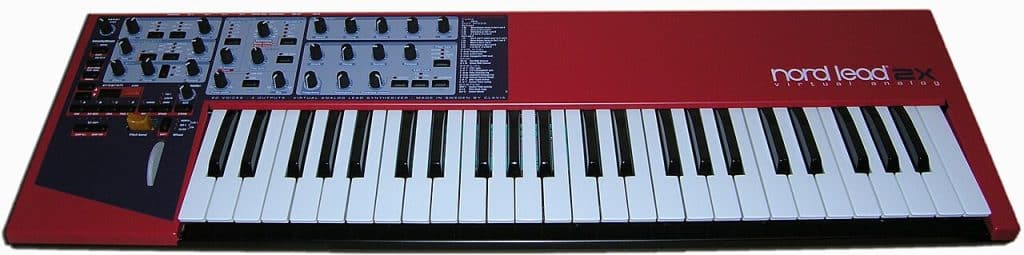
Real time is the whole point. A virtual analog synth, or VA synth for short, doesn’t play back recordings of an old Minimoog. It computes the waveform from scratch, sample by sample, the way an analog circuit would produce it. Reviewing the first Nord Lead in May 1995, Sound On Sound stressed that its DSP was “actually generating its final signal waveforms in real-time” (Gordon Reid, Sound On Sound, May 1995). So the familiar subtractive synthesis controls all behave the way you’d expect: oscillators, a resonant filter, envelopes and LFOs.
Makers used different names for the same idea. Roland called it “Analog Modeling” on the JP-8000. Yamaha sold the AN1x as an “Analogue Physical Modelling Control Synthesizer”. Clavia’s own word was virtual. Its 1996 Nord Lead manual explains: “Virtual because the Nord Lead is actually a digital instrument” (Clavia, Nord Lead User Manual v2.0, 1996).
- Virtual analog means a digital synth that calculates analog-style oscillators and filters in real time, with no samples.
- The name took off in 1995 with Clavia’s Nord Lead.
- The hard engineering problem is aliasing. In my own test at 48 kHz, a PolyBLEP sawtooth produced about 20 dB less audible aliasing than a naive digital one.
- Free emulations now run the original Virus, Nord Lead 2X and JP-8000 firmware on emulated chips.
Where did the term virtual analog come from?
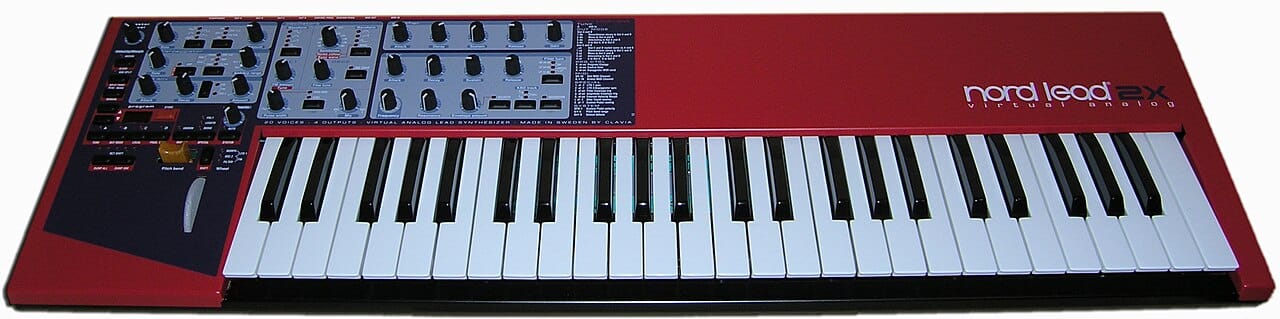
The earliest dated use of the term I could find is in Sound On Sound’s May 1995 Nord Lead review. Reid wrote that the synth “is what they call a VAS, or Virtual Analogue Synthesis instrument”. “They” were Clavia, the Swedish company behind it. Nord’s own history page confirms the timing: “In 1995 Clavia released its first synthesizer, the Nord Lead” (Nord Keyboards, About Us).
Did Clavia coin the phrase? You’ll read that a lot, but I couldn’t find a primary source that proves it. Nord itself only claims that the first Nord Lead “sparked the Virtual Analog revolution in the 90s” (Nord Keyboards, Nord Lead legacy page). The 2010 IEEE paper puts it carefully, too. Full digital emulations began “with the Nord Lead synthesizer introduced in 1995. Since then, ‘virtual analog synthesis’ has become a popular term”.
The rivals followed fast. Previewing the JP-8000 in February 1997, Sound On Sound said Roland’s “Analogue Modelling” seemed “based on a similar concept to a certain red Scandinavian synth” (Brett Mitchell, Sound On Sound, February 1997). The JP-8000 also gave the world the supersaw, seven detuned sawtooth waves in one oscillator.
One myth worth dropping: early VA synths didn’t always beat analog on voice count, since the Nord Lead shipped with 4 voices and the Prophecy was monophonic. Not exactly a polyphony monster. The big counts came later, with the Supernova’s 32 voices and the Virus TI’s claimed 80.
How does a virtual analog synth imitate analog circuits?
A VA synth has to solve two hard problems: clean oscillators and filters that behave like real circuits. In 1996, Stilson and Smith summed up the oscillator problem in one sentence: “Since the analog sawtooth is not bandlimited, the sampled version will be aliased” (Stilson and Smith, Alias-Free Digital Synthesis of Classic Analog Waveforms, ICMC 1996).
Oscillators: the aliasing problem
An analog sawtooth has harmonics that go on forever. A digital system can only hold frequencies up to half its sample rate, the Nyquist limit. Everything above that folds back down into the audible range as new, out-of-tune tones. The 2010 IEEE paper says those harmonics “are aliased, which causes unpleasant noise”. Eli Brandt described the sound in 2001 as “roughness, sub-fundamental tones, and inharmonicity” (Brandt, Hard Sync Without Aliasing, ICMC 2001).
Researchers spent the next decade on fixes. Stilson and Smith built waveforms from band-limited impulse trains (BLIT) in 1996. Brandt’s minBLEP replaced each sharp edge with a pre-computed band-limited step in 2001. In 2005 Vesa Välimäki proposed the efficient differentiated parabolic wave (DPW). Two years later, he and Antti Huovilainen introduced PolyBLEP, which smooths each edge with a tiny polynomial (Aalto University, Virtual Analog Synthesis and Audio Effects). In plain terms, all four methods soften the wave’s sharp jump so that far less of it folds back.
Filters: nonlinear ladders and zero-delay feedback
Filters were the second battle. A plain digital filter is linear, and “some people feel that they sound ‘digital’ and lack the ‘warmth'”, Huovilainen wrote in 2004. His nonlinear model of the Moog ladder filter was meant for “virtual analog synthesizers” (Huovilainen, DAFx-04, October 2004). Later came zero-delay feedback (ZDF) filters. Vadim Zavalishin, then at Native Instruments, explained the name: it comes “from the fact that we avoid introducing a one-sample delay into the feedback” (Zavalishin, The Art of VA Filter Design, rev. 2.1.2, 2020). u-he lists ZDF filter design on Diva “for authentic resonance behaviour” (u-he, Diva).
The newest step goes down to the parts. Roland says its Analog Circuit Behavior uses “a detailed part-by-part analysis of each analog circuit” (Roland, AIRA press release, February 2014). Not everyone bought it. Reviewing the Boutique series, Reid noted Roland’s claim about “the discrete components within each synth being emulated” and called himself skeptical (Sound On Sound, February 2016).
My aliasing test: naive vs PolyBLEP vs 4x oversampling
In my own test, a naive digital sawtooth put out about 80 to 100 times more audible alias energy than a PolyBLEP version, roughly 19 to 20 dB more. Oversampling by 4x cut it by only about 12.6 dB, roughly 18 times less alias energy, against PolyBLEP’s 80 to 100 times. I ran the test in Python on October 7, 2026, so you don’t have to take the papers on faith.
I rendered two seconds of sawtooth at four pitches with three methods. The naive one jumps straight from +1 to -1. PolyBLEP smooths each jump over two samples. The third renders the naive wave at 192 kHz and filters it back down to 48 kHz. Then I ran an FFT and counted every spectral line between 20 Hz and 20 kHz that isn’t a true harmonic as aliasing. A fourth oscillator built from pure harmonics checked the method. It measured -108 dB or lower, so the method itself adds almost nothing.
The worst artifacts land below the note itself. At C8, the naive sawtooth put an alias at 1,954 Hz, only 21 dB under the 4,186 Hz fundamental. That’s a clearly pitched, out-of-tune whistle under the note. PolyBLEP pushed its loudest sub-fundamental alias down to -75.7 dB, and at A6 the gap was even wider, -28.5 dB against -92.3 dB.
Two lessons came out of it for me. First, brute-force oversampling alone isn’t enough, because the naive wave still aliases at 192 kHz. Second, even PolyBLEP leaves some aliasing near the top of the range, mostly close to 20 kHz. Masking hides part of it. Aalto researchers showed in 2012 that “the frequency-masking phenomenon affects the perception of aliasing” (Aalto University). This was a simple test, not a model of any particular synth, and I don’t know which method any commercial VA uses inside.
Is virtual analog as good as real analog?
Virtual analog is a different instrument, not a lesser one. It trades a little of analog’s unpredictability for more voices, presets, stability and features. A 1997 Access Virus already offered 12 voices and 16-part multitimbrality. Sound On Sound said it “scores over its Swedish rival with 12-note polyphony, 16-part multitimbrality”, then listed eight more, from two filters and effects to three LFOs and 256 user patches (Sound On Sound, November 1997).
I’ve owned an Access Virus, a Nord Lead and a Roland JP-8000/8080, so this entry leans on those three. Like any digital synth, all three stay in tune from the first note, store every patch and need no warm-up. What VA has to fake is the slow drift and the way analog parts interact. That’s exactly where ACB, ZDF filters and circuit simulators aim.
If you’re weighing the two families for a first synth, my analog vs digital synthesizers guide goes deeper. For the “warmth” debate itself, see does analog gear sound better?
Which virtual analog synths and emulations matter today?
Several classic VA synths now live on as free plugins that run their original firmware. The Usual Suspects’ project emulates “the original integrated circuits (DSPs, microcontrollers) at the chip level” and runs “the original, unmodified firmware from the real hardware”. They say the result is “bit-exact output compared to the original device” (The Usual Suspects, How the Emulator Works).
If that bit-exact claim holds, it’s why these plugins sound like the real thing: they run the real code. Their homepage notes that the Motorola DSP563xx chips they started with “were used in many virtual analogue synthesizers” (The Usual Suspects). The plugins are free and GPL-licensed, and version 2.2.25 came out on September 20, 2026 (gearmulator on GitHub).
| Plugin | Emulated hardware | First public release |
|---|---|---|
| Osirus | Access Virus A, B, C | July 2021 (open beta) |
| OsTIrus | Access Virus TI, TI2, Snow | April 22, 2024 |
| Nodal Red 2x | Clavia Nord Lead 2X | January 2025 (public beta) |
| JE-8086 | Roland JP-8000 | December 27, 2025 |
| Vavra and Xenia | Waldorf microQ, Microwave II/XT | Donor alphas first; public dates not documented |
There’s one catch. The plugins ship without the sound engine’s firmware. Their FAQ says “a user will need to provide the ROM/Firmware file of a synthesizer that it wants to emulate”, and that the emulators are “intended for use only by legitimate owners of the hardware” (The Usual Suspects, FAQ). The FAQ also admits the emulation “uses plenty of CPU resources”. I’ve written up the Virus TI version in OsTIrus, the Virus TI emulation. The same team’s Xenia covers the Microwave XT, a wavetable synth rather than a VA, in my Waldorf Microwave XT VST post.
The hardware lines today
The originals have mostly gone. Access stopped making the Virus TI2. MusicRadar reported in February 2024 that “The Virus TI 2, the final model in the range, has been out of production for a few months” (MusicRadar, February 2024). Roland’s JP-8000 page marks it as discontinued. Arturia recreated the JP-8000 as Jup-8000 V in April 2025 (Arturia, Jup-8000 V).
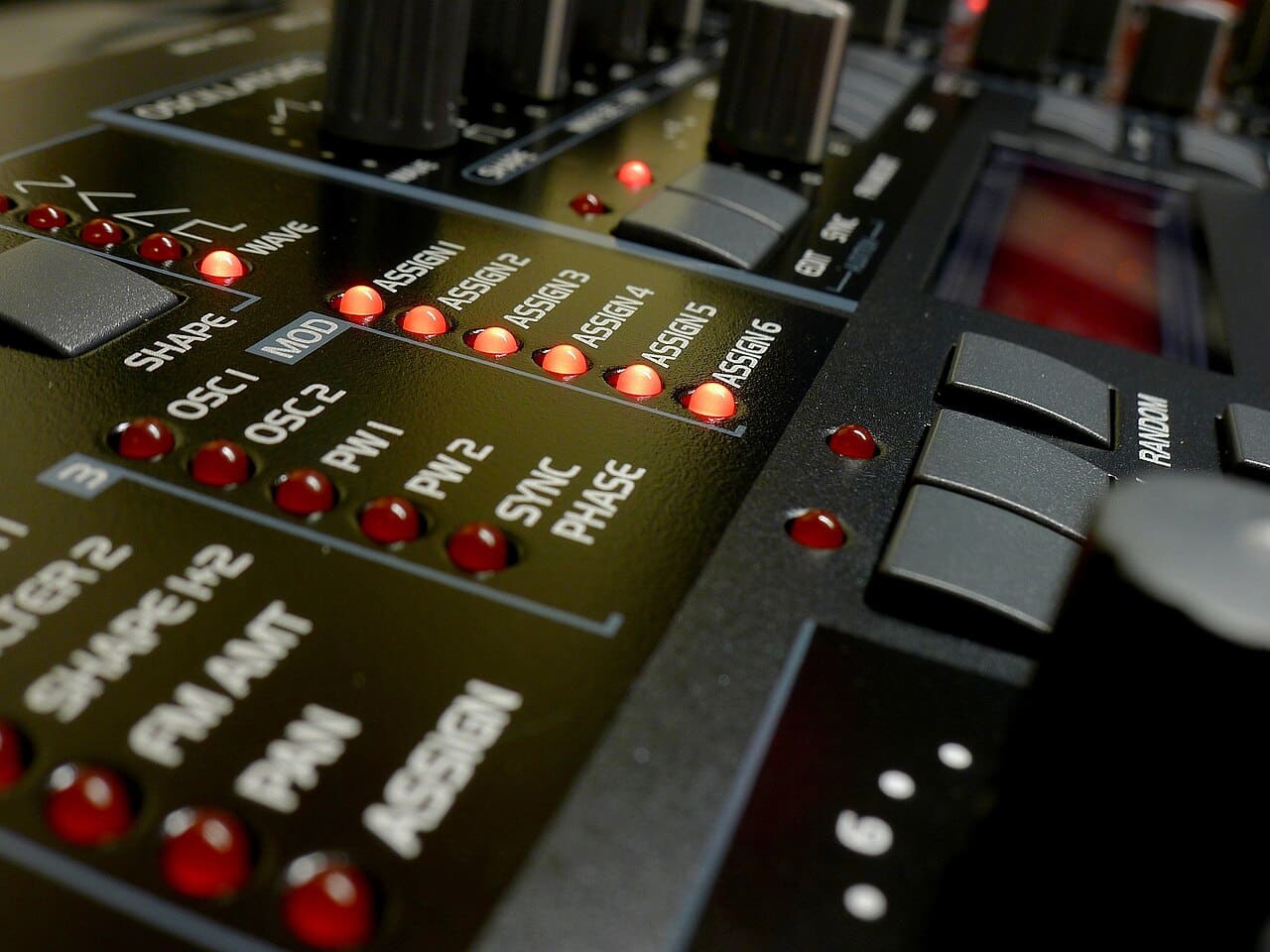
Nord still sells the Lead A1, its only current Nord Lead. Nord says that “At the heart of the Lead A1 is our new analog modeling engine” (Nord Keyboards, Nord Lead A1). Korg calls its microKORG2 “a virtual analog synth that models analog circuitry” (Korg, microKORG2). On the software side, u-he Diva takes the circuit route. u-he says it “applies methods from industrial circuit simulators in realtime” (u-he, Diva). Most of these run as a VST or similar plugin inside any DAW.
Frequently asked questions
What is virtual analog synthesis?
Virtual analog synthesis is a digital imitation of an analog synthesizer. A processor calculates the oscillators, filters and envelopes in real time instead of playing samples. The term took off with Clavia’s Nord Lead, which Sound On Sound described in May 1995 as a “Virtual Analogue Synthesis instrument”. It’s also called analog modeling.
Is a virtual analog synth really analog?
No. A virtual analog synth is fully digital. There’s no voltage-controlled circuit in the sound path, just a DSP chip or a CPU running code. Clavia said so in its 1996 Nord Lead manual: the synth is “actually a digital instrument”. The analog part is the sound and the controls it imitates, not the hardware.
What was the first virtual analog synthesizer?
The Clavia Nord Lead from 1995 is usually credited as the first. A 2010 IEEE paper dates full digital analog emulations to the Nord Lead “introduced in 1995”. Korg’s Prophecy, a modeling monosynth, appeared the same year. Roland’s JP-8000 followed in 1996, and the Access Virus came in 1997.
Is the Access Virus analog?
No. The Access Virus is a virtual analog synth that runs on Motorola DSP chips. The Virus C uses a single 56362 DSP, and the Virus TI uses two DSPs at 133 MHz each. Access claimed the TI could play 80 voices “under average conditions”. Its sound comes from code running on those chips, not from analog circuits.
Do software emulations of VA synths sound like the hardware?
The best ones do, because they run the original code. The Usual Suspects’ free plugins emulate the original DSP chips and run the hardware’s own firmware, with what they describe as “bit-exact output”. You have to supply the ROM yourself. Their version 2.2.25 covers Virus, Nord Lead 2X and JP-8000 emulations.
The bottom line
Virtual analog took off in 1995 as the label on a red Swedish synth. It grew into a whole engineering field. The term stands for a simple idea: compute what an analog circuit would do, in real time. The hard parts were aliasing-free oscillators and filters that resonate like hardware, and research from 1996 onward tackled both.
- VA is digital, real-time and sample-free.
- Good VA design fights aliasing; in my test, PolyBLEP cut the audible part by about 20 dB, while 4x oversampling alone managed about 12.6 dB.
- Free chip-level emulations now keep the Virus, Nord Lead 2X and JP-8000 alive in any DAW.
Want to see where VA’s most famous sound came from? Start with the supersaw, the JP-8000’s signature waveform.
Back to Music Production Terms Index Page