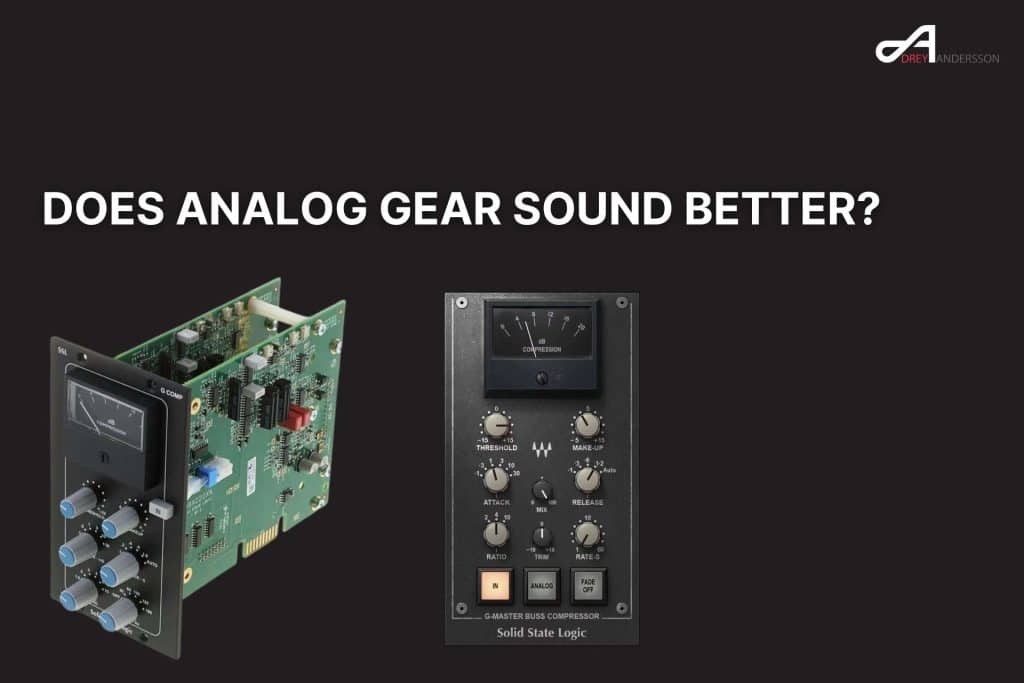
Does Analog Gear Actually Sound Better? The Honest Answer
Short version: no, analog gear does not objectively sound better. It sounds different. In the most rigorous level-matched blind test on record, listeners scored 49.8% correct, which is a coin flip, when a CD-quality digital stage was slipped into high-resolution playback (Meyer and Moran, Journal of the Audio Engineering Society, 2007). So why does the debate never die?
Part of the answer is that analog is having a moment. U.S. vinyl revenue grew about 7% to $1.4 billion in 2024, its 18th straight year of growth and the highest level since 1984 (RIAA 2024 Year-End Report, 2025). The romance is real. The science is just more stubborn than the romance.
Key Takeaways
- In a level-matched blind test, listeners scored 49.8% correct, statistically no better than guessing (Meyer and Moran, 2007).
- The differences analog adds are real but small, and they are mostly low-order (even) harmonic distortion and saturation, not higher fidelity.
- Modern 16-bit / 44.1 kHz digital is already audibly transparent. Higher sample rates add no analog “magic,” and can even add distortion.
- You can get most of a classic hardware sound from a plugin for $39 to $299, versus tens of thousands for the original box.
- The strongest honest case for analog is workflow and commitment, not sound quality.
I have chased analog warmth around a studio for years, bought some of it, sold some of it, and A/B’d a lot of it. This guide separates what the measurements actually show from what our ears want to believe. For the synth-specific version of this fight, see the companion piece on analog vs digital synthesizers.
What Does the Science Actually Say About Analog vs Digital?
The finding is blunt. Under controlled, volume-matched conditions, people cannot reliably tell clean digital from analog. Meyer and Moran ran 554 double-blind trials over a year with engineers, audiophiles, and students on high-end systems, and correct answers landed at 49.8% (Meyer and Moran, JAES, 2007).
That is the sound of a coin landing on its edge.
The old version of this article claimed “scientific studies consistently show analog offers a distinct advantage.” That claim has no source, because the literature says close to the opposite. A later meta-analysis pooled 18 studies and more than 12,500 trials and found only “a small but statistically significant” ability to hear a difference, and that ability “increased dramatically” only after listeners got extensive training (Reiss, JAES, 2016).
Read those two results together and you get the honest picture. Any audible gap is tiny, it mostly shows up for trained ears in lab conditions, and it vanishes in normal listening. Engineer Dan Worrall’s analog vs digital summing null test demonstrates this on real gear: null the two signals against each other and what is left over is nearly silence.
So Where Does Analog Gear Actually Change the Sound?
Here is the part the myth gets right, just for the wrong reason. Analog does change the signal, and you can measure it. The change is not “more fidelity.” It is added harmonic distortion, saturation, and noise, and some of that distortion is genuinely pleasing (Sound on Sound, “Analogue Warmth”, 2010). Tubes, tape, and transformers color sound. That coloration is the product, not a flaw.
The character comes down to which harmonics a circuit adds. Even-order harmonics (the 2nd and 4th) are octave-related, so we hear them as warm, smooth, and musical. Odd-order harmonics (the 3rd, 5th, and 7th) read as gritty and harsh. Simple valve stages lean even. Hard solid-state clipping leans odd. One caveat keeps you honest here: the circuit topology decides the harmonic signature, not the word “tube” on the front panel.
Even-order harmonics (2nd, 4th)
Octave-related. Heard as warm, smooth, and musically sympathetic. This is the “glue” that simple tube, tape, and transformer stages add.
Odd-order harmonics (3rd, 5th, 7th)
Heard as gritty, harsh, and edgy. This is what harder clipping and some solid-state overdrive tend to add when pushed.
Converters used to be a fair knock against digital. Not anymore. A 16-bit / 44.1 kHz path already covers the full range of human hearing, so the popular idea that higher sample rates “enhance analog fidelity” gets Nyquist backwards. Push to 192 kHz and ultrasonic content can fold back down as audible intermodulation distortion (Xiph.Org, Montgomery, 2012). Higher numbers are not automatically higher quality.
How Analog and Digital Really Work
Strip away the folklore and the mechanism is simple. Analog gear represents sound as a continuous electrical voltage that mirrors the original waveform. Digital gear samples that waveform thousands of times a second and stores each slice as a number. Neither approach is magic. Each just has a different failure mode, and knowing the failure mode is how you choose.
Analog’s failure mode is drift and noise. Components age, temperature shifts, tape hisses, and every extra stage adds a little distortion. Sometimes that distortion flatters the sound, which is the whole point of analog EQ and compression. Sometimes it just adds hiss. The “unlimited bandwidth” often credited to analog is a myth too: real circuits and transformers roll off at both ends.
Digital’s failure mode is different. Done badly, it sounds brittle or aliased. Done properly, at sane sample rates with good converters, it is effectively transparent: you get back what you put in. That transparency is exactly why a well-made VST can now stand in for hardware that used to cost a house deposit. The Waldorf Microwave XT plugin is a good example of software nailing a hardware sound.
Why Do So Many Producers Swear By Analog?
If the blind tests are so clear, why does half the industry insist analog is better? Because listening is never really blind. When you know a $30,000 tube limiter is in the chain, you expect it to sound richer, and expectation bias does the rest. Sighted comparisons and level mismatches are how “night and day” differences get born, and both fall apart under controls (Reiss, JAES, 2016).
Level is the sneaky one. Analog gear often adds a touch of gain and low-order harmonics that read as “louder and fuller,” and louder almost always wins a casual A/B. Match the levels to within a fraction of a decibel and the gap shrinks to a whisper. This is exactly what the pro mixers discover in Hardcore Music Studio’s blind analog gear vs plugins test, where even working engineers hesitate.
None of this means the preference is fake. If a piece of gear makes you commit, push it harder, and enjoy the session, it earns its place. That is a real benefit. It is just not a fidelity benefit, and being clear about the difference is what stops you from spending rent money to chase a coin flip.
Is Analog Gear Worth the Money?
Sometimes, though the honest math is brutal.
Original hardware is now collector territory. The only Fairchild 670 listed on Reverb at the time of writing is a Grammy-pedigree studio unit at $240,000, and Reverb’s own price guide shows “estimate unavailable” because they almost never trade. A brand-new authentic reissue runs about $29,500 (Vintage King, 2025). The plugin? Around $299, and often on sale for less (Universal Audio, 2025).
So the old article’s “sixty thousand dollars” figure was not just unsourced, it undersold the top of the market and ignored that you can get 90% of that sound for the price of a pizza night. For most producers, that is the value case settled. Buy the hardware for the parts of the workflow you love, not for a difference a blind test cannot find.
If you do want real iron on a budget, match the money to the instrument. There is no sense pairing a cheap synth with a boutique outboard chain. Point your money at a used vintage rack unit instead: a great-sounding, affordable reverb like the Yamaha REV500, an old hardware stereo compressor, or a character box like the Alesis 3630 that famously pumped French house. That is where cheap analog earns its keep.
What About the Feel? The Real Case for Hardware
This is where analog genuinely wins, and it has nothing to do with waveforms. Physical knobs, faders, and meters give you a tactile, one-hand-per-control workflow that a mouse cannot match. You commit faster, you audition fewer options, and you finish more tracks. In my own sessions, fewer choices almost always means quicker decisions and a lot less second-guessing.
In my own room, the hardware I keep is the hardware that changes how I behave. A compressor with real knobs gets used boldly, because reaching for it costs nothing. The same processor as a plugin sits behind three menu clicks and a nagging urge to tweak forever. The sound difference between the two is tiny. The behavior difference is huge, and the behavior is what shows up in the final mix.
Analog also forces commitment. Print the sound and it is done, so you stop second-guessing and move on. That single constraint has saved more of my mixes than any tube ever has. If you want to go deeper on printing decisions, the piece on the mastering mistake every producer makes covers the same commitment trap at the final stage.
The Verdict: Better, or Just Different?
So, does analog gear sound better? No. It sounds different, and different can be exactly what a record needs. The measurable truth is that clean digital is transparent, analog adds pleasant low-order distortion, and level-matched blind listeners cannot reliably separate the two (Meyer and Moran, JAES, 2007). “Better” is the wrong question.
The right question is what helps you finish music you are proud of. If a knob-covered box makes you braver and faster, buy it and never apologize. If a $49 plugin gets you the same coloration and the same result, that is not settling, that is just smart. Chase the workflow, source the sound honestly, and let the coin flip go.
FAQs
Does analog gear actually sound better than digital?
No, not in any way a controlled test can confirm. In a 554-trial double-blind study, listeners scored 49.8% correct, statistically identical to guessing (Meyer and Moran, JAES, 2007). Analog adds pleasant low-order distortion and saturation, so it sounds different, but “better” is not supported by the measurements or the listening data.
What actually causes the “warmth” of analog gear?
Warmth is mostly even-order harmonic distortion, the 2nd and 4th harmonics, which are octave-related and read as smooth and musical (Sound on Sound, 2010). Tubes, tape, and transformers add it as the signal passes through. It is a form of pleasant distortion, not extra detail or fidelity, and good plugins now model it convincingly.
Do higher sample rates make digital sound more like analog?
No. A 16-bit / 44.1 kHz path already captures the full range of human hearing, so higher rates add no audible benefit. Pushing to 192 kHz can actually introduce intermodulation distortion when ultrasonic content folds back into the audible band (Xiph.Org, 2012). Higher numbers do not mean higher quality here.
Is expensive analog hardware ever worth it over a plugin?
For sound alone, rarely. A Fairchild 670 reissue costs around $29,500 while the plugin runs about $299 for nearly the same result (Universal Audio, 2025). The honest reason to buy hardware is workflow: tactile control, faster decisions, and forced commitment, which change how you work more than they change the waveform.
Why do producers still prefer analog in comparisons?
Mostly expectation bias and level mismatches. Knowing pricey gear is in the chain makes people expect a richer sound, and analog often adds a little gain that reads as “fuller.” Match levels precisely and run the test blind, and the preference largely disappears (Reiss, JAES, 2016). The feeling is real, but it is not about fidelity.