Fatar Keybeds: The Complete Guide to Synth Keyboard Actions
In this post
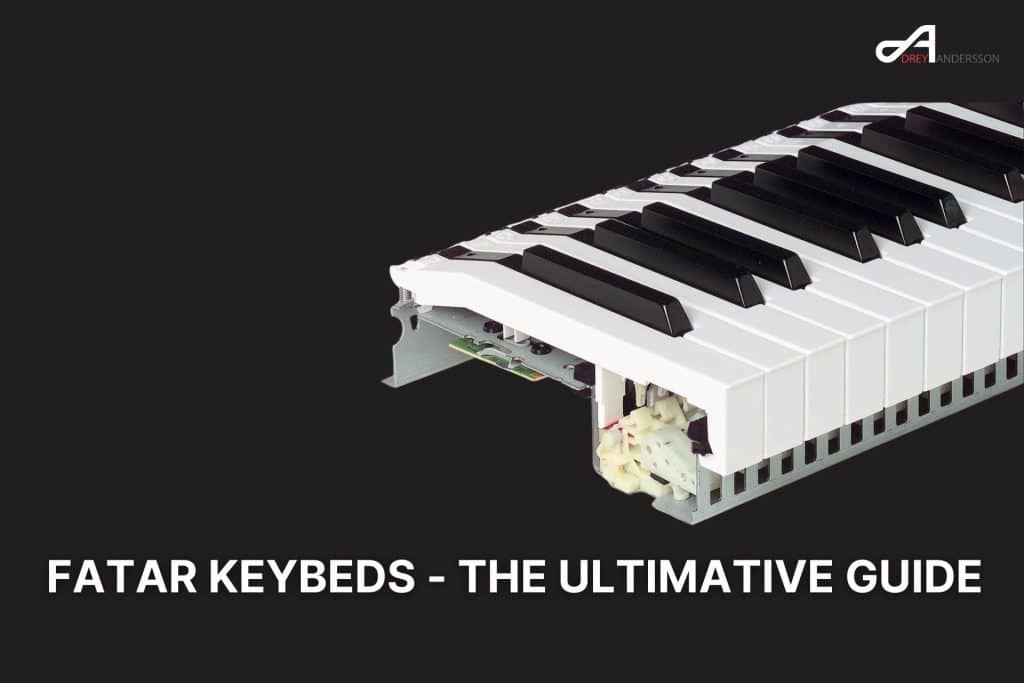
Fatar keybeds sit under the majority of premium synthesizers on the market, yet almost nobody buys one on purpose. The Italian company works business-to-business, so you never see its name on the box, only under your fingers. If you own a Sequential, a Moog, a Waldorf, a Modal, or a Native Instruments controller, you’re already playing one. This guide covers what the different actions feel like, how to tell them apart, and, in a database of more than 300 instruments, exactly which keybed is in yours.
Key Takeaways
A Fatar action appears in 276 of the 340 instruments catalogued on this page. The semi-weighted TP/9 family alone covers 105 of them, making it the action you’re most likely playing.
The TP/8S is the firmer, weighted board many players (myself included) rate as the best semi-weighted synth action made. The TP/9S is lighter and faster.
Fatar has built keyboard mechanisms since 1956 (Fatar). Most repairs are cheap DIY jobs, and in years of use I’ve never had one fail.
What makes Fatar the default synth keybed?
Fatar has manufactured keyboard mechanisms since 1956, and today its actions turn up in 276 of the 340 instruments catalogued further down this page (Fatar). The name stands for Fabbrica Tastiere Ragni, or Ragni Keyboard Factory, after founder Lino Ragni in Recanati, Italy. Because the company sells almost entirely to other manufacturers, you rarely see the brand, but the odds you’ve played one are overwhelming.
The strength is a modular catalogue. Fatar offers the same chassis in different touch weights, commonly documented as light, medium, and heavy options, plus specialised models for synth, organ, and piano duty. The TP/8S is the headline act: longer black keys, a distinctive “dogleg” key shape, and a textured surface. You’ll find it in instruments like the Access Virus TI, the John Bowen Solaris, and several Waldorf boards, where its build complexity pushes prices well past $3,000.
So why does one Italian supplier dominate a market full of Japanese and Chinese rivals? Consistency. A synth designer who specs a Fatar bed knows precisely how it will feel, key after key, unit after unit. That predictability is worth more to a boutique builder than shaving a few dollars per action. For the wider hardware versus software question, see my take on analog versus digital synthesizers.
TP/8S vs TP/9S: which action actually feels better?
If you remember only two Fatar names, make them these. The TP/8S is the weighted, firmer board; the TP/9S is the light, fast one. I’ve played the TP/9S in four different instruments, the Native Instruments Komplete Kontrol MK2, the Modal Argon 8, the Kurzweil PC3A6, and the GEM Equinox, plus the Access Virus, and the pattern holds every time. The 9S rewards speed. The 8S rewards control. For me, the 8S wins.
Fatar keybed families across 300+ catalogued instruments. The semi-weighted TP/9 dominates by a wide margin, which is exactly why it is the one you are most likely to be playing. Source: Drey Andersson analysis of the reference database below (compiled from Musiker-Board and manufacturer specs).
TP/9 series (semi-weighted synth)
105
TP/8S / TP/8SK (weighted synth)
29
TP/40 / TP/400 (hammer action)
40
TP/100 / TP/110 (light hammer)
22
TP/7BA (basic synth)
16
TP/8O (organ / waterfall)
8
Legacy TP (10/20/30/41)
44
TP/8 Piano (weighted)
12
Non-Fatar / other OEM
64
That chart isn’t a marketing claim, it’s a count. Across the 300-plus instruments in the database below, the semi-weighted TP/9 family appears 105 times, roughly one in three keyboards, and more than any other action by a wide margin. When people call the TP/9S “the workhorse,” this is what they mean. The TP/8S is rarer and pricier, which is part of why it carries a certain reputation.
Here’s a claim you’ll read often that I don’t buy: that the same Fatar bed feels dramatically different from one brand to the next. In my hands, a stock TP/9S feels like a stock TP/9S whether it’s in a Waldorf or a Modal. The real differences show up only when a maker actively modifies the action, the way Nord reworks its TP/40 boards. Stock to stock, they’re far more alike than the forums suggest.
How do you tell which Fatar version you have?
This matters most for repairs, and it trips people up constantly. The TP/9S exists in two mechanically incompatible generations. The old version (built until 2003) uses rectangular openings below the spring and a locking mechanism you need a screwdriver to release. The current version (since 2003) lets you lift a key straight forward once the spring is off. Keys from one generation won’t fit the other, so identify yours before you order a single part.
Which actions is Fatar still making? As of 2026 the current line covers the TP/9 semi-weighted synth action, the TP/8 weighted boards, the TP/40 and wooden TP/400 Wood hammer actions, the light TP/100, and the newer TP/110, a technopolymer hammer action that weighs around 7 kg and replaces the older TP/100 (Fatar). Discontinued families include the entire TP/40-era flagships that came before, the TP/20 and TP/30 weighted actions, and the legacy TP/10 hammer boards.
Which synths use which Fatar keybed? The full database
The table below catalogues the exact keybed inside more than 300 synthesizers, stage pianos, and MIDI controllers, grouped by manufacturer. It began as a community effort on the German Musiker-Board forum; I have cross-checked it against manufacturer specs and my own instruments, and I keep it current as new gear ships. If a model runs a non-Fatar action (Matsushita, Huaxin, Pratt-Read, Korg RH3), that is noted too, so the list doubles as a keybed-origin reference for the whole industry.
Access
Model
Fatar keybed & notes
Virus (37)
Fatar TP/9S, weighted
Virus (61)
Fatar TP/8S
Virus Indigo 1 (37)
Fatar TP/7BA
Virus Indigo 2 (37)
Fatar TP/9S weighted, encapsulated weights
Virus Ti 2 Polar/Darkstar (37)
Fatar TP/9S weighted, encapsulated weights
Akai
Model
Fatar keybed & notes
Advance 25/49/61 (25/49/61)
Custom design, weighted, likely built by Huaxin
Alesis
Model
Fatar keybed & notes
Andromeda A6 (61)
Fatar TP/9S, old version
Quadrasynth (76)
Fatar TP/9S, old version
Fusion 6HD (61)
Fatar TP/9S, weighted
Fusion 8HD (88)
Fatar TP/40
Ion (49)
Fatar TP/7BA
QS6 (61)
Fatar TP/9S, old version
QS7 (76)
Fatar TP/9S, old version
QS8(.1) (88)
Fatar TP/20
QS8.2 (88)
Fatar TP/30
Arturia
Model
Fatar keybed & notes
Keylab 88
Fatar TP/100LR
Clavia (Nord)
Model
Fatar keybed & notes
Nord C1, C2, C2D
Fatar TP/8O
Nord Electro x (without HP)
Fatar TP/8O
Nord Electro 3 HP
Fatar TP/100
Nord Electro 4 HP
Fatar TP/100LR
Nord Lead 1,2(x),4, A1 (49)
Fatar TP/7BA
Nord Lead 3 (49)
Fatar TP/9S, weighted
Nord Wave (49)
Fatar TP/9S, unweighted
Nord Wave 2
Fatar TP/8O
Nord Modular (37)
Fatar TP/9S, both versions depending on production year
Nord Modular G2 (37)
Fatar TP/9S
Nord Piano 2
Fatar TP/40GH
Nord Piano 3
Fatar TP/40GH
Nord Piano 4
Fatar TP/40GH
Nord Piano 5 88 and 73
Fatar TP/40H
Nord Stage 2 88
Fatar TP/40 (modified by Clavia)
Nord Stage 3 88
Fatar TP/40 (modified)
Nord Stage 3 HP76
Fatar TP/100
Nord Stage 3 Compact 73
Fatar TP/8O
Nord Stage 4 88 and 73
Fatar TP/40M
Nord Stage 4 Compact 73
Fatar TP/8O
Nord Grand
Kawai RH-N (modified RH3)
Crumar/G.S.I
Model
Fatar keybed & notes
Seven (73)
Fatar TP/100LR
Mojo (61)
Fatar TP/8O
DMC-122 (2×61)
Fatar TP/8O
Spirit 2023 Reissue (37)
Fatar TP/9S
Dexibell
Model
Fatar keybed & notes
Vivo S1 (68)
Fatar TP/8 Piano, special version with different spring characteristics
Fatar TP/9S, weighted, same version as Grandmother
Grandmother (32)
Fatar TP/9S, full weighting (encapsulated weights) and tight springs, same version as Dominion 1, Vermona 14 and Kurzweils. The 32-key size is a special order for Moog, not available in regular program
Minimoog Model D Reissue (44)
Fatar TP/9S, encapsulated weights, but quite weighted and not the tight springs
Native Instruments
Model
Fatar keybed & notes
Komplete Kontrol S61 MK2 (61)
Fatar TP/9S (semi-weighted)
Komplete Kontrol S49 MK3 (49)
Fatar TP/9S with Poly AT
Nonlinear Labs
Model
Fatar keybed & notes
C15 (61)
Fatar TP/8S
Novation
Model
Fatar keybed & notes
Bass Station
Fatar TP/7BA
Bass Station 2
Huaxin, model unknown
Impulse
V-Tech (toy manufacturer), model unknown
K-Station (25)
Fatar TP/7BA
KS-4 (49)
Fatar TP/9S, old version, weighted
KS-5 (61)
Fatar TP/9S, old version, weighted, Aftertouch
SL Remote
Fatar TP/9S weighted (with Aftertouch)
SL MKII
Fatar TP/9S, weighted (with Aftertouch)
Supernova (II/pro/proX (61)
Fatar TP/8S, old version
Ultranova (37)
Fatar TP/9S, unweighted
X-Station (49)
Fatar TP/9S, weighted
Oberheim
Model
Fatar keybed & notes
OB-8 (61), old model
Pratt-Read, model unknown
OB-8 (61), newer model
Matsushita ESK-70
Quasimidi
Model
Fatar keybed & notes
Cyber-6 (61)
Fatar TP/8S, old version
Raven (61)
Fatar TP/8S, old version
Sirius (49)
Fatar TP/7BA
Radikal Technologies
Model
Fatar keybed & notes
Accelerator
Fatar TP/8SK
Rhodes by Roland
Model
Fatar keybed & notes
Model 660 (61)
Matsushita SK-761
Model 760 (76)
Matsushita SK-776
VK-1000 (76)
Matsushita SK-876
Roland
Model
Fatar keybed & notes
A-30 (76)
Fatar TP/9 Piano
A-33 (76)
Fatar TP/9 Piano
A-37 (76)
Fatar TP/9 Piano
A-50 (76)
Matsushita SK-376-DW (polyphonic aftertouch)
A-70 (76)
Fatar TP/8S, old version (heavier and tighter than current)
A-80 (88)
Matsushita SK-688
A-90 (88)
Matsushita PA-4A88-F (J-Wire, Poly AT)
AX-1 (49)
Fatar TP/7BA
AX-7 (49)
Fatar TP/7BA
E-600 (61)
Fatar TP/9S, old version
E-80 (61)
Fatar TP/9S
FA-07 (76)
Fatar TP/9S, weighted
Fantom X6 (61)
Matsushita SK-961
Fantom X7 (76)
Matsushita SK-976
Fantom-6 (61)
SK-14 (presumably built by MIDIplus), weighted, Channel Aftertouch
Fantom-7 (76)
SK-14 (presumably built by MIDIplus), weighted, Channel Aftertouch
Fantom-8 (88)
PH-50m
Fantom-06 (61)
SK-14 (presumably built by MIDIplus), unweighted, no aftertouch
Fantom-07 (76)
SK-14 (presumably built by MIDIplus), unweighted, no aftertouch
Fantom-08 (88)
PHA-4 Ivory feel
FP4 (88)
PHA alpha II
FP7 (88)
PHA II
FP7-F (88)
PHA III Ivory Feel-S
FP-8 (88)
Matsushita PA-488
G-70 (76)
Fatar TP/8S
G-600 (61)
Fatar TP/9S, old version
G-800 (76)
Fatar TP/8S, old version
G-1000 (76)
Fatar TP/8S, old version
HP-126 (88)
Fatar TP/10
Jupiter-X (61)
SK-14 (presumably built by MIDIplus), weighted, Channel Aftertouch
Juno-X (61)
SK-14 (presumably built by MIDIplus), unweighted, Channel Aftertouch
RD-100
Fatar TP/10 MDF
RD-700GX (88)
PHA II Ivory Feel
RD-700NX (88)
PHA III Ivory Feel
RD-800 (88)
PHA-IV
RD-1000 (88)
Matsushita PA-388B wooden beam keyboard
RD-2000
PHA-50 progressive hammer-action keyboard with escapement
VA-7 (61)
Fatar TP/9S, unweighted
VA-76 (76)
Fatar TP/8S
V-Piano (88)
PHA III Ivory Feel
Sequential Circuits (SCI) – former DSI/Dave Smith Instruments
Fatar TP/8SK with polyphonic aftertouch (special size, 8SK otherwise only available in 61 and 76 key versions)
Wersi
Model
Fatar keybed & notes
Pegasus
Fatar TP/8S
How does Fatar compare to Yamaha, Roland, Korg and Kawai?
Fatar owns the synth action, but the piano-feel crown belongs elsewhere. A real acoustic grand needs roughly 50 to 60 grams of down-weight to press a key (PianoFinders), and the makers who chase that resistance, Kawai and Yamaha, are piano builders first. That heritage shows the moment you play a demanding classical passage.
Kawai’s Grand Feel wooden actions get closest to an acoustic, with convincing escapement and dynamic control; premium models run from about $1,000 to $6,000. Yamaha spans everything from entry-level GHS to triple-sensor wooden GrandTouch. Roland’s PHA-50 hybrid wood-and-resin action is a genuinely versatile middle ground, though some players find it initially spongy and note it feels heavier than an acoustic. Korg’s RH3 is a solid stage action that can struggle with the softest dynamics.
The takeaway is simple. Want expressive synth and multi-instrument control? Fatar. Want the deepest classical-piano realism? Look to the piano houses. If you’re weighing vintage digital boards while you’re here, my complete Roland JV guide and the Roland Alpha Juno feature go deep on two very different eras of Roland action and sound.
Which Fatar keybed should you buy for?
Match the action to the job. For synth and multi-instrument work, the TP/9S is the industry standard and the safe default. For stage performance, the weighted TP/8S gives you expressive control that ages well. For classical piano, step outside Fatar toward Kawai or Yamaha wooden actions. Budget buyers get honest value from Casio’s Scaled Hammer boards, roughly $400 to $1,500.
One thing specs won’t tell you: how a board fits your hands. My genuine advice after years of this? Go test the keys in a shop before you commit. If that’s not possible, order two candidates and keep the one that feels right, then return the other. A keybed is the one part of an instrument you touch every second you play, so it’s worth the extra shipping label to get it right.
Do Fatar keybeds actually break?
Less than the horror stories suggest. In years of playing Fatar-equipped gear, the Komplete Kontrol, Virus, Argon 8, PC3A6, and Equinox, I’ve never had a keybed fail on me. When faults do appear they’re usually minor: a squeak from a worn felt strip, a sluggish contact, the odd cracked hammer weight on very old TP/10 boards. None of that is a crisis.
It’s also cheap to fix yourself. Replacement keys, contact-rubber strips, and felts run from under a euro to roughly 15 euros each at specialist vendors like synth-parts.com. A dead note is often just one contact strip. The real friction is availability, not price: Fatar sells B2B, so parts for older or discontinued models can be hard to track down, and a full professional replacement costs far more and varies a lot by region.
What’s next for Fatar?
The current direction is lighter and more expressive. The new TP/110 trims a hammer action to about 7 kg using a technopolymer chassis (Fatar), while the wooden TP/400 Wood flagship adds double escapement and Ivory Feel surfaces (Fatar). Both landed in the Studiologic SL mk2 line launched in January 2025, the SL73 and SL88 on the TP/110, the SL88GT on the TP/400 Wood.
The big open question is expression. Polyphonic aftertouch is having a moment: between 2024 and late 2025, Korg, Expressive E, and Supercritical all shipped new poly-AT or MPE instruments. Fatar plays here too, but only on its semi-weighted TP/8SK, seen in the Waldorf Iridium and UDO Super Gemini. Its hammer-action piano beds, including the TP/400 Wood and TP/110, remain monophonic aftertouch only. A full poly-AT hammer action would be a real milestone, and it isn’t shipping yet.
Frequently asked questions
What’s the difference between the Fatar TP/8S and TP/9S?
The TP/8S is a weighted synth action with longer black keys and a firmer, more deliberate feel, widely rated as the best semi-weighted board ever made. The TP/9S is lighter and faster, built for quick synth lines. Having played both extensively, I prefer the TP/8S for control and expression.
Which synths use the Fatar TP/9S?
The TP/9 family is the most common Fatar action by far, appearing in 105 of the 300-plus instruments catalogued on this page. You’ll find it in the Sequential Prophet 6 and OB-6, the Moog Matriarch and Grandmother, the Modal Argon 8, and Native Instruments Komplete Kontrol controllers.
When was Fatar founded?
Fatar was founded in 1956 in Recanati, Italy by Lino Ragni; the name stands for Fabbrica Tastiere Ragni, or Ragni Keyboard Factory. That gives the company roughly 70 years of keyboard-mechanism manufacturing, most of it spent supplying other brands rather than selling instruments under its own name.
Do Fatar keybeds have polyphonic aftertouch?
Only some semi-weighted models do, such as the TP/8SK in the Waldorf Iridium and the UDO Super Gemini. Fatar’s hammer-action piano keybeds, including the TP/400 Wood and the newer TP/110, offer monophonic aftertouch only. A full poly-aftertouch hammer action is not something Fatar currently ships.
How much does it cost to repair a Fatar keybed yourself?
Individual parts are cheap. Replacement keys, contact-rubber strips, and felts run from under a euro to about 15 euros each at specialist vendors like synth-parts.com. Most common faults, a dead contact or a squeaky felt, are DIY-fixable. A full professional replacement costs far more and varies by region.
The bottom line on Fatar keybeds
Fatar earned its position the boring way: by being predictable for 70 years. The TP/8S remains the connoisseur’s semi-weighted action, the TP/9S is the workhorse under most of the synths you’ll ever touch, and the piano-focused boards are steady rather than class-leading. Buy for the action, test with your own hands, and don’t fear the maintenance. If you’re investing in a serious synth or controller, you’ll almost certainly be playing a Fatar, so it pays to know exactly what’s under the keys.
Get free sounds in your inbox
New free presets and packs, the day they drop. Plus production tips and early access to paid releases.
Drey Andersson is a Berlin-based music producer, sound designer, and synthesist with over 20 years behind the desk. He co-produced Shekhinah's Different (SAMA award, RiSA Gold), won the Beatleague Beat Battle in Berlin, and built a 100K+ community around sound design and synthesis. He co-founded the Berlin producer collective Beat Unit and shares his sounds through his own Serum banks and free downloads.
Want the full toolkit?
My full Serum banks go deeper: hundreds of presets, custom wavetables from real vintage gear, and the exact sounds I use on my own productions.