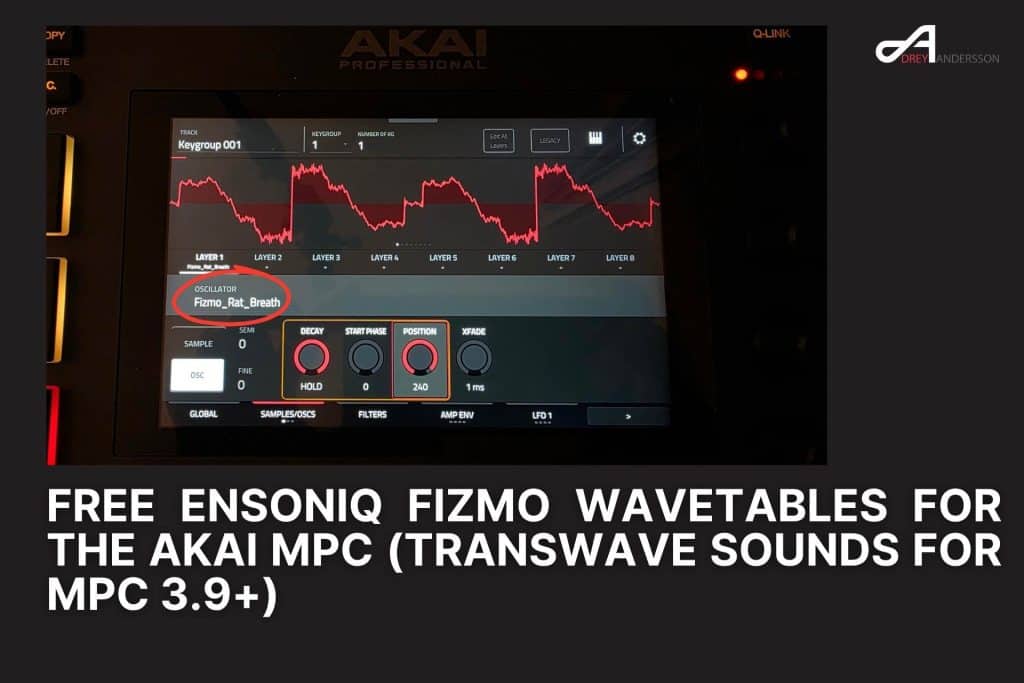
I bought myself an MPC Live II last week, not even knowing this oscillator feature was tucked inside it. The moment I found it, I knew exactly what I wanted to hear through it first: a synth from 1998 that almost nobody talks about, that half the people who owned one couldn’t stand, and that the other half would never sell. It’s teal and purple and airbrushed like a mid-90s rollerblade. Its power supply has a habit of cooking itself. Its display is four characters wide. And it sounds like absolutely nothing else on earth.
That synth is the Ensoniq Fizmo, and the engine inside it, Transwave synthesis, was doing wavetable sound design a full decade before Serum made it cool.
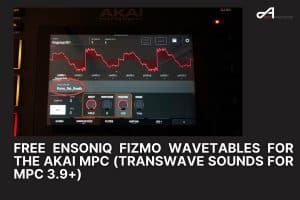
Until recently, the only way to get those glassy, vocal, metallic, slowly-evolving Fizmo textures was to track down one of the few hundred working units left and pray the regulator held. But with MPC OS 3.9, Akai quietly turned every modern standalone MPC into a wavetable synthesizer, which means we can finally bring the Fizmo’s DNA onto the MPC. So I converted a set of Fizmo-style Transwave tables into the MPC’s wavetable format. They’re free. Grab them below, then stick around for the story of why this little synth matters and exactly how to load wavetables onto your MPC.
What is the Ensoniq Fizmo?
The Fizmo was the last real synthesizer Ensoniq ever made.
Ensoniq was the Pennsylvania company founded in 1983 by a handful of ex-MOS Technology engineers, the same people behind the Commodore 64 sound chip. Through the ’80s and ’90s they built a reputation for affordable, characterful gear: the Mirage sampler, the ESQ-1, the VFX and SD-1 workstations, the EPS and ASR samplers. Their sound had a reputation for being “fat” and warm where a lot of Japanese digital gear sounded cold and clinical.
Then, in early 1998, Creative Technology bought Ensoniq for around $77 million, mostly for its soundcard tech, and folded the instrument division into E-mu. The Fizmo landed right in that twilight. It was, in every sense, a last hurrah.
A short, strange history
When Sound On Sound reviewed it in March 1999, the reviewer noted that even Emu-Ensoniq admitted opinion was split “50/50 between those who love it and those who… don’t.” He also flagged the “weird ’80s graphic-design airbrush effect on its purple-and-blue top panel.” That panel is the synth’s calling card; you know a Fizmo the second you see one.
But the same review called it “a breath of fresh air… one of the most distinctive and usable synths I’ve heard in recent years.” The problem was never the sound. It was everything around it: a tiny four-character display, roughly half the parameters buried where you could only reach them with computer editing software, no patch-initialize function, and, most infamously, a power-supply voltage regulator that loved to fail and take the DSP chips down with it.
It sold poorly, got discontinued fast, and became a legend precisely because of all that.
Why producers and collectors love it (and why it’s rare)
Here’s the thing about “loveable losers”: they age into cult objects. Estimates put the production run somewhere between a few hundred and a couple thousand keyboards, with a much smaller batch of rack units, and possibly only about half of them still working today. Parts dried up years ago. A logic-board or regulator repair can run you several hundred dollars if you can find someone to do it.
That scarcity shows up in the price. Working units now trade roughly in the $800–$2,300+ range depending on condition, and clean or refurbished examples sit at the top of that. Artists like Eat Static, Machinedrum, John Medeski and Roger Joseph Manning Jr. have all leaned on its sound for ambient, experimental, industrial and cinematic work.
In other words: it’s expensive, it’s fragile, and it sounds incredible. Which is exactly why having its character as a wavetable pack, with no maintenance and no eBay gamble, is worth something.
What is Transwave synthesis? (Ensoniq’s wavetable synthesis, before Serum)
The heart of the Fizmo is Transwave synthesis, and once you understand it, the whole “wavetables on the MPC” idea clicks into place, because a Transwave is a wavetable.
A Transwave is a single sample built from a series of single-cycle waveforms strung together end to end. Bill Mauchly, the Ensoniq engineer known in sound-design circles as “Waveboy,” described each Transwave as a series of frames that “go together like a movie, to create motion,” and the key part: “that motion is under your control.”
You don’t play a Transwave as a static tone. You scan through it, sweeping the playback position with an envelope, an LFO, the mod wheel, velocity, whatever, so the timbre morphs frame by frame as the note evolves. Ensoniq’s own marketing put it plainly: Transwaves “allow a sound to evolve subtly or dramatically, slowly or quickly over time, producing a richly animated, complex sound.”
If that sounds exactly like what Serum, Vital and Phase Plant do: that’s because it is. Ensoniq just got there first, in hardware, starting with the VFX in the late ’80s and continuing through the SD-1, the EPS-16+ and ASR-10 samplers, the TS-series, and finally the Fizmo, which was the first Ensoniq synth built entirely around the concept.
Transwaves vs. modern wavetables (Serum / Vital)
There’s one beautiful difference, and it’s the reason these tables have a vibe modern wavetables often lack.
Classic Ensoniq Transwaves had no crossfade between adjacent frames. When you swept the position, the engine jumped from one single-cycle to the next with no interpolation, which gave that scan a stepped, slightly grainy, gloriously digital edge. Modern synths smooth those transitions into a buttery morph. The Fizmo’s “second-generation” Transwaves sit somewhere in between: smoother than the old samplers, but still carrying that vintage digital grit.
When you bring these onto the MPC, you get to choose. The MPC’s wavetable oscillator has an XFade parameter: crank it down for the raw, stepped vintage scan; open it up for a smooth modern morph. Same table, two eras of sound design.
Hyper-Wave, resonant filters, and that glassy character
The Fizmo stacked a few more tricks on top of the raw Transwaves:
- Hyper-Wave: Ensoniq’s wave-sequencing feature, conceptually close to the Korg Wavestation. It chains waves and Transwaves over time into long, drifting, evolving textures. This is where the Fizmo’s signature endless-pad sound comes from.
- Resonant filters: 4-pole resonant low-pass and band-pass, which is what gives the Fizmo its vocal, formant-like, almost-talking quality.
- A deep modulation system: eight LFOs, multiple envelopes, and 41 onboard effects across three units, including a vocoder.
Put it together and the Fizmo’s fingerprint is unmistakable: digital, glassy, vocal, metallic, bell-like, and constantly moving. Less “festival bass growl,” more “alien choir slowly opening a door.” That’s the texture in this pack.
Why Fizmo wavetables sound special on the MPC
A quick honest pitch, because this matters for how you’ll use them.
Most free wavetable packs you’ll find are built for EDM: aggressive basses, screaming leads, supersaws. Useful, but everybody has them, and they all sound a bit the same. Fizmo-derived tables are the opposite end of the spectrum: textural, ambient, cinematic, lo-fi-friendly, weird in the right way. They’re for pads, evolving drones, vocal-ish leads, eerie plucks, and anything where you want movement and character instead of brute force.
And here’s where the MPC earns its keep. You’re not just playing back a vintage texture; you’re dropping vintage DNA into a modern engine. Run a Transwave table through the MPC’s resonant filters (3.9 added new Jura and Iona low-pass models), modulate the wavetable position with an LFO, layer it with a sample, chop it, resample it, sequence it, drown it in the onboard FX. Vintage source, modern sound design. That combination is the whole point.
MPC wavetable synthesis explained (OS 3.9 and up)
If you’re new to the MPC’s wavetable engine, here’s everything you need to actually use the pack.
In MPC OS 3.9 (released June 2026), Akai added a full set of MPC Oscillators to Drum and Keygroup tracks (wavetable, FM, ring mod, single-cycle, noise and classic analog-style shapes), turning standalone MPCs into genuine synthesizers with no plugins required. The wavetable oscillator is the one we care about here.
Which MPCs support wavetable synthesis?
The wavetable engine in OS 3.9 runs on the current standalone lineup, including:
- MPC X, MPC X SE, MPC XL
- MPC Live, MPC Live II, MPC Live III
- MPC One, MPC One+, MPC One G2
- MPC Key 61, MPC Key 37, MPC Key 37 G2
- Akai Force (standalone)
If your MPC runs OS 3.9 or higher, you’re good. Update via Preferences → Info → Check for Updates (or through the inMusic Software Center on desktop).
Wavetable format requirements
This is the part worth bookmarking, because it’s the same standard the whole wavetable world uses. MPC wavetables are:
- Mono WAV files
- 16-bit, 44.1 kHz
- Exactly 2048 samples per single-cycle frame (this is non-negotiable; if the frame size is off, your pitch will be wrong)
- Multiple frames concatenated into one file (the MPC’s factory tables use 128 frames, i.e. 2048 × 128 = 262,144 samples, but other frame counts work)
- Stored in a folder that contains a small
format.jsonfile describing the cycle size and frame count for the WAVs in that folder
Because it’s the standard 2048-sample format, this is also the answer to a question I get constantly: yes, Serum and Vital-style wavetables are compatible in principle (same frame size), though they may need a quick conversion pass to match the MPC’s mono/16-bit/44.1 spec and get a matching format.json. The Fizmo pack is already prepped, so you can skip all of that.
How to import and load custom wavetables (step-by-step)
- Update to OS 3.9+ (see above).
- On the root of your SD card or internal SSD, create a folder called
Oscillators. - Inside it, create two subfolders:
SingleCyclesandWavetables. - Inside
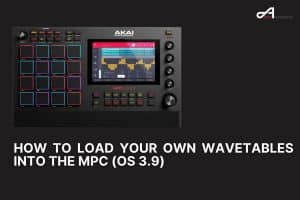
Wavetables, drop the pack folder (it contains the WAVs and theirformat.json). Just copy the whole folder over as-is; that’s why the pack ships ready to go. - On your MPC, load a Keygroup (or Drum) program. Go to Track Edit → Samples tab, set a layer’s source from Sample to Oscillator, choose Wavetable, and pick a table from the pack. (If it asks, enable oscillator content under Preferences → Activations.)
- Play. You’ve got a Fizmo in your MPC.
Sound design tips (this is where it gets fun)
- Modulate the Position. The single most important move. Assign LFO 1 → Osc Position in the Mod Matrix and you’ve recreated the core Transwave sweep. A slow LFO gives you that endless Fizmo-pad drift; an envelope gives you a timbral “attack.”
- Play with XFade. Low XFade = raw, stepped, vintage digital scan. High XFade = smooth modern morph. Automate it for movement.
- Filter it. Add a resonant low-pass (try the new Jura or Iona models), push the resonance, and modulate the cutoff. This is what brings out the vocal, formant character.
- Layer it. Stack the wavetable oscillator with a sample layer (a soft pad, a noise floor, a field recording) for depth the original hardware couldn’t do.
- Resample. Print a moving Transwave patch to audio, chop it, and you’ve got an entirely new sample bank with built-in motion.
Download
FAQ
What is Transwave synthesis? Transwave synthesis is Ensoniq’s wavetable technology, where a series of single-cycle waveforms are strung together into one sample and you “scan” through them with modulation, morphing the timbre over time. It debuted on the Ensoniq VFX in the late 1980s and reached its peak on the Fizmo, conceptually the same idea as modern wavetable synths like Serum and Vital, but a decade earlier and in hardware.
Does the Akai MPC support wavetables? Yes. As of MPC OS 3.9 (June 2026), standalone MPCs include a wavetable oscillator alongside FM, ring mod, single-cycle and other models, so you can run custom wavetables natively without any plugins.
What format are MPC wavetables? Mono WAV files, 16-bit, 44.1 kHz, with exactly 2048 samples per single-cycle frame, multiple frames concatenated into one file, stored in a folder with a format.json describing the cycle size and frame count.
Which MPCs support wavetable synthesis? All current standalone models running OS 3.9 or later, including the MPC X / X SE / XL, MPC Live / Live II / Live III, MPC One / One+ / One G2, MPC Key 61 / Key 37 / Key 37 G2, and Akai Force.
Can I import Serum wavetables into the MPC? In principle yes: they share the 2048-sample frame standard, but Serum tables usually need a quick conversion to match the MPC’s mono/16-bit/44.1 kHz spec and a matching format.json file. The Fizmo pack here is already converted and ready to drop in.
Is the Ensoniq Fizmo rare and expensive? Fairly. Only a few hundred to a couple thousand were made, parts are scarce, and the power supply is failure-prone, so working units typically sell for around $800–$2,300+ depending on condition, which is a big part of why a free wavetable pack is the easy way to get the sound.
Are these wavetables royalty-free? Yes. The pack is free to download and royalty-free to use in your music. These are Fizmo-inspired Transwave-style tables prepared for the MPC, not affiliated with or endorsed by Ensoniq or Akai.