What is the Waldorf Protein?
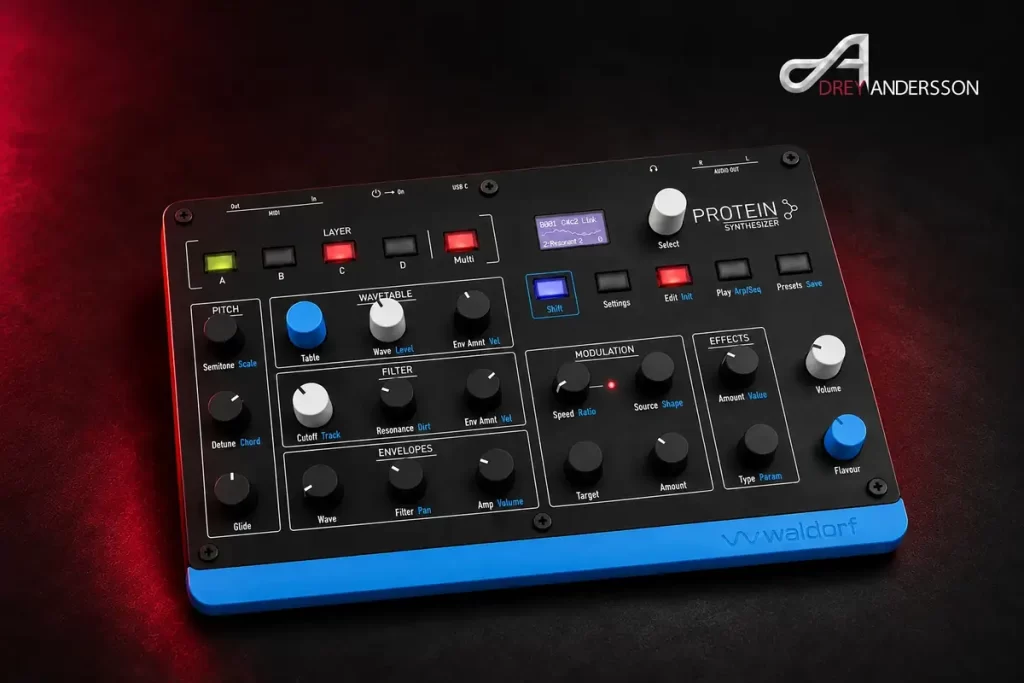
The Waldorf Protein is an 8-voice desktop wavetable synthesizer with four layers. Waldorf announced it on 27 November 2025 at an introductory price of 329 EUR, which rose to 379 EUR on 1 January 2026. In the US it sells for $399, and in the UK for GBP 299. Each voice has two oscillators based on the custom ASIC chip of the original Waldorf Microwave, and they play the original Microwave 1 wavetables.
That makes the Protein an unusually affordable way into the classic Waldorf wavetable sound in hardware: a small, USB-powered box with a panel full of knobs. Waldorf’s product page calls it the “first statement of a new upcoming product line”. This page is a reference for it: the specs, where the Microwave sound comes from, what it costs, how much of it you can play from the panel, and what to know about presets, editing and firmware.
In short
- 8 voices shared by 4 layers, two Microwave-ASIC oscillators per voice, the original Microwave 1 wavetables, a modelled CEM filter and two effect slots.
- Launched at 329 EUR (intro price), then 379 EUR. It sells for $399 in the US and GBP 299 in the UK, and Thomann listed it at 319 EUR on 30 October 2026.
- Of its 21 knobs, 19 shape the sound, and 13 of those have a Shift function, so 32 sound functions sit on the panel. Envelope stages, mod-matrix slots and effect details go through the small display.
- There is no official editor yet. The free Chutney librarian manages the 360 preset slots that firmware 1.01 introduced.
Waldorf Protein specs at a glance
The table combines Waldorf’s specification sheet, the Waldorf Protein manual (Rev. 2, January 2026, written for firmware 1.02) and the changelog. Where Waldorf’s own product page lags behind the firmware, the firmware wins: on 30 October 2026 the page still promised “up to 250 presets”, but firmware 1.01 raised the number of preset slots to 360.
| Feature | Waldorf Protein |
|---|---|
| Type | Desktop wavetable synthesizer, no keyboard |
| Polyphony | 8 voices, shared by all layers |
| Layers | 4 (A to D); Single mode, or Multi mode with Layered, Round Robin, Random Robin and MIDI Split |
| Oscillators | 2 per voice, based on the Microwave ASIC, running at 250 kHz |
| Wavetables | The original Microwave 1 tables (64, per SOS and MusicRadar); 61 table waves plus triangle, square and saw; no user wavetables |
| Filter | Modelled CEM filter, low-pass and high-pass at 12 or 24 dB/oct, or a Drive mode instead of the filter |
| Noise / Dirt | Static, Crackle, Geiger, Click, Burst 1 to 3, Ring Mod (firmware 1.02) |
| Envelopes | 3 ADSR (wave, filter, amp) |
| LFOs | 2, tempo sync and sample and hold |
| Mod matrix | 8 slots; poly aftertouch and MPE sources |
| Effects | 2 slots: reverb, delay, chorus, phaser, flanger, drive, EQ, compressor, tremolo (taken from the Iridium, per Waldorf via Synth Anatomy) |
| Arp / sequencer | Arpeggiator and step sequencer, 16 built-in patterns each; sequences up to 32 steps |
| Performance | Chord and Scale modes, MPE, MIDI CC Learn, Flavour knob |
| Controls | 21 knobs (6 endless encoders, 15 pots), 10 buttons, small display |
| Presets | Over 150 factory presets (heise counted 224); 360 preset slots since firmware 1.01 |
| Audio | Stereo out on two 6.35 mm jacks (unbalanced), 3.5 mm headphones; no audio over USB |
| MIDI | 3.5 mm TRS Type A in and out (two DIN adapters included), USB-MIDI |
| Power | USB-C bus power; no power supply in the box, no battery |
| Size / weight | 252 x 170 x 48 mm, 0.9 kg |
| Price | Launched 27 November 2025 at 329 EUR (intro), then 379 EUR; $399 at Sweetwater, GBP 299 per SOS, 319 EUR at Thomann (30 October 2026) |
Where the Protein’s Microwave sound comes from
The Protein’s Microwave character comes from its oscillators. Waldorf’s spec sheet describes two oscillators per voice based on the Microwave ASIC, running internally at 250 kHz to match the original chip, plus a model of the digital-to-analog converter for every voice. The wavetables are the original Microwave 1 set, which Waldorf calls “bit-identical to original”, including the algorithmic and speech tables. The sheet even lists the recreation of 8-bit quantization and aliasing as a feature.
Those tables have a long history. Sound On Sound notes that the same 64 tables also ran in the Microwave II and Microwave XT, and that they grew out of the 8-bit PPG Wave tables. Each table holds 61 waves, and positions 61 to 63 add triangle, square and sawtooth. If you know the Waldorf Microwave XT or the Microwave XT emulation for your DAW, you know these tables. The Protein lets each of its two oscillators load a different one, which SOS says the original Microwave couldn’t do. For the background on how a table is scanned, see wavetable synthesis, and for why low bit depth adds that grainy top end, see bitcrusher.
Most of the rest of the engine was newly designed. Synth Anatomy’s launch article reports that apart from the oscillators, the engine comes from Waldorf’s Rolf Wöhrmann, so the Protein is not a Microwave plugin in a box. The effects are the exception: according to Waldorf, via Synth Anatomy’s review, the effects come from its Iridium series. The filter is a model of a CEM analog filter with an adjustable de-calibration of cutoff and resonance, meant to imitate slightly detuned hardware.
Instead of the filter, a sound can run through a Drive with PNP, Tube, PickUp, Diode or Crunch character. The Dirt control adds noise and clicks (Static, Crackle, Geiger, Click and three Bursts), and since firmware 1.02 a Ring Mod type between the two oscillators. The Flavour knob adds methodical micro-variations, mainly to wave position and pitch. SOS compares it to the Vintage or Slop controls on other synths, while Synth Anatomy says it is not a vintage knob in the Sequential sense.
Reviewers describe the character in similar terms. Rory Dow’s verdict in Sound On Sound is short: “Ultimately, the Protein sounds like a Waldorf.” MusicRadar heard both classic subtractive sounds and hard-edged ’90s timbres. The Synth Anatomy review calls the sound gritty and 8-bit and especially liked it for basses and pads. Gearjunkies, even without an original unit to compare against, heard the raw Microwave 1 character, gritty and unmistakably digital, and heise describes a metallic sizzle from aliasing and quantization artifacts. In other words, expect a raw, digital Waldorf rather than a clean, modern wavetable synth.
What the Protein costs, and how it compares
The Protein costs a fraction of Waldorf’s bigger synths. Its official price of 379 EUR sits in the same 319 to 399 EUR range as the compact alternatives Synth Anatomy named, and on 30 October 2026 Thomann sold it for 319 EUR, below the original intro price. In the UK, MusicRadar listed Waldorf’s smallest Iridium, the Iridium Core, at GBP 1,179, about four times the Protein’s GBP 299.
The two reviews name these hardware alternatives, at the prices they printed. The currencies differ because the reviews do; they are not converted here.
| Synth | Price as quoted | Reviewer’s note | Source |
|---|---|---|---|
| AudioThingies microMonsta 2 | 319 EUR | All digital, 2 x 6 voices, more virtual analog than wavetable | Synth Anatomy |
| Fred’s Lab Töörö | 399 EUR | 6 voices, analog filters | Synth Anatomy |
| Behringer Wave | GBP 479 | Behringer’s take on the original PPG Wave | MusicRadar |
| Waldorf Iridium Core | GBP 1,179 | The smallest Iridium | MusicRadar |
Two costs aren’t in the box. The Protein has no keys, so you need a MIDI keyboard, a controller or a computer to play it, and it runs on USB-C bus power with no power adapter included. If you already own a USB-C charger and a MIDI keyboard, the Protein is the whole purchase.
Knobs and real-time control
For real-time playing the Protein offers what SOS calls “plenty of knobs and buttons”, with some editing left to the display. It has 21 knobs (6 endless encoders and 15 pots) and 10 buttons. Counted from the front-panel drawing in Waldorf’s manual, 19 of the knobs shape the sound; the other two are the master Volume and the Select encoder next to the display. Thirteen of those 19 carry a second function, printed in blue and reached with Shift, so 32 sound functions sit directly on the panel.
In practice, the controls you would sweep during a performance are one turn away for the selected oscillator or LFO: wavetable and wave position, cutoff, resonance, both envelope amounts, detune, glide, LFO speed, the effect amount and Flavour. A short press of Shift latches it, so the blue functions stay active until you press it again. Three areas go through the display. Each envelope knob edits one stage at a time, so 12 ADSR stages share 3 knobs. The Source, Target and Amount knobs work on whichever of the 8 mod-matrix slots is selected. And effect settings beyond the amount sit behind Type’s Param function.
Reviewers point to the same trade-off. SOS found the blue-on-black Shift labels hard to read and the mix of knobs, Shift and screen pages disjointed at times. Synth Anatomy and Gearjunkies would rather have a knob per ADSR stage. MusicRadar says it takes a while to learn where everything is, after which the workflow speeds up. For more hands-on control, MIDI CC Learn (Shift + Settings, then Map CC) assigns parameters to an external controller, and Gearjunkies mapped the Shift functions to its own Native Instruments keyboard.
Layers, voices and the 8-voice limit
The Protein can hold four sounds at once, but they share 8 voices. In Single mode, the layer buttons A to D each hold an independent sound that you switch between, and only the two effects are global. Multi mode plays the layers together in four ways: Layered (all four on every note), Round Robin (each note goes to the next layer), Random Robin (a random layer per note) and MIDI Split. In MIDI Split each layer listens on its own MIDI channel, so the Protein works as a small multitimbral sound module.
The voice count is the main limit. Every extra layer stacked on a note uses another voice, so a four-layer stack plays just two notes, while a single layer keeps all eight for chords. For basses and leads, each sound can also run in mono or legato mode.
On top of the layers come the performance tools. The arpeggiator offers 16 internal rhythm patterns, and the step sequencer runs up to 32 steps and offers 16 internal patterns; SOS found the sequencer “surprisingly capable” for such a small synth. Chord and Scale modes sit under Shift on the Detune and Semitone knobs. The modulation sources include poly aftertouch and MPE, so an MPE controller can modulate each note on its own.
Presets, editor and librarian
Waldorf quotes “over 150” factory presets; heise counted 224. The manual credits Christian Kleine, LimbicBits, Blush Response and Rolf Wöhrmann for the sounds. There are 360 preset slots since firmware 1.01 (250 at launch), and from firmware 1.02 MIDI Bank Select reaches all 360. Presets travel as MIDI SysEx, so any SysEx tool can back them up or load new banks. Sound On Sound noticed that almost all factory presets use random panning; Waldorf told the magazine it is a nod to the PPG Wave’s Bias parameter.
Is there a Waldorf Protein editor? Not an official one, as of October 2026. Waldorf’s free Chutney librarian for macOS and Windows connects over USB MIDI, shows all 360 slots and backs up sounds to a library on disk. It doesn’t edit sounds: Synth Anatomy calls it “only a helpful preset librarian, not an editor”. Editing on a computer or tablet therefore runs through MIDI CC. The Protein’s CC Learn maps parameters to a hardware controller, and the YouTube channel Human Wave published a free TouchOSC template that reaches almost all parameters by CC.
New sounds are available too. Kateryna Zavoloka’s 20 sounds from the Berlin launch event came as a free bank with firmware 1.01, and Waldorf sells an official paid pad bank. Third-party sound designers offer Protein banks as well.
Waldorf Protein firmware history
Waldorf has released three firmware versions since launch, and each one changed something that players notice. Updates install over USB.
The latest version carries a “b3” suffix, which usually marks a beta, but Waldorf lists it in its official changelog next to the earlier releases. Most of its fixes concern MIDI CC control, which matters if you edit the Protein from a controller or a TouchOSC template.
Limits worth knowing
The Protein’s limits come with its size and price. None of them is hidden, but they matter for some setups:
- No user wavetables, for now. Only the built-in Microwave 1 tables play. Rolf Wöhrmann told Synth Anatomy the feature may come later; until then SOS points to the Waldorf M for custom tables.
- One stereo output. The layers can’t be routed to separate outputs, and the two effects serve all layers together.
- Drive or filter, not both. The filter-section Drive replaces the filter rather than running after it. A separate Drive effect is available in the effect slots.
- No audio over USB. The USB-C port carries MIDI and power only, according to Waldorf’s Protein FAQ.
- USB power only. There is no battery option. heise and MusicRadar report a USB isolator in the box against ground-loop noise. Gearjunkies heard that noise from a computer and found the isolator bulky; Synth Anatomy and MusicRadar didn’t report noise.
- A disputed filter detail. The manual says the filter self-oscillates above a resonance of 0.80, while the SOS review says it doesn’t.
For a different synthesis approach that is common in small boxes, see virtual analog, and for building a whole rig around boxes like this, dawless.
Waldorf Protein FAQ
Is the Waldorf Protein a Microwave clone?
No. Its two oscillators per voice are based on the Microwave ASIC and play the original Microwave 1 wavetables, which is where the familiar sound comes from. Synth Anatomy reports that the rest of the engine, including the CEM-style filter, was newly designed by Rolf Wöhrmann, and that the effects come from Waldorf’s Iridium.
How many voices does the Waldorf Protein have?
Eight. The Protein is 8-voice polyphonic, and all four layers share those eight voices. A single layer can play eight-note chords, but four layers stacked on every note leave room for two notes at a time. Mono and legato modes are available for basses and leads, and Round Robin spreads notes across the layers.
Is there a Waldorf Protein editor?
There is no official editor as of October 2026. Waldorf’s free Chutney librarian manages and backs up all 360 preset slots over USB, but it doesn’t edit sounds. For editing, the parameters respond to MIDI CC: CC Learn maps a hardware controller, and Human Wave’s free TouchOSC template reaches almost all parameters.
Can the Waldorf Protein load your own wavetables?
Not currently. The Protein plays only its built-in Microwave 1 wavetables. Each table holds 61 waves plus triangle, square and sawtooth, and each of the two oscillators can use a different table. Rolf Wöhrmann has said user tables may come later; for now SOS points to the Waldorf M.
Does the Waldorf Protein need a power supply?
It runs on USB-C bus power, from a computer or from a USB-C power adapter, and no adapter is included. There is no battery option. The same USB-C port carries MIDI but no audio, so the sound always leaves through the two 6.35 mm outputs or the 3.5 mm headphone jack.
How much does the Waldorf Protein cost?
Waldorf launched it at 329 EUR until 31 December 2025 and 379 EUR afterwards. On 30 October 2026, Thomann listed it at 319 EUR and Sweetwater at $399, and Sound On Sound (April 2026) gives a UK price of GBP 299. Budget extra for a USB-C power adapter and a MIDI keyboard if you don’t own them.
Does the Waldorf Protein have a keyboard?
No, it is a desktop module without keys. Notes come from a MIDI keyboard through the included 3.5 mm-to-DIN adapters, from a computer over USB, or from the Play button, which triggers a single test note. The arpeggiator and the 32-step sequencer also start from incoming notes, so plan on a keyboard or controller.
Back to Music Production Terms Index Page