
What is a comb filter?
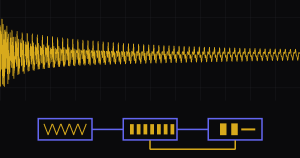
A comb filter is what you get when a sound is added to a slightly delayed copy of itself. Some frequencies line up and get louder, others arrive out of step and cancel, and the result is a row of evenly spaced peaks and notches that looks like the teeth of a comb.
The spacing follows the delay. With equal levels, the first notch sits at 1 divided by twice the delay, the next ones at odd multiples of it, and the peaks at whole multiples of 1/delay. A 1 ms delay notches 500 Hz, 1,500 Hz, 2,500 Hz and so on, with +6 dB peaks at 1 kHz, 2 kHz and 3 kHz. Comb filtering, the comb filter effect and a comb filter are all the same thing; the first name usually means the accident, the last one the tool.
In a mix, comb filtering is the hollow, phasey sound you get from two mics on one source or a speaker next to a hard wall. In sound design, the same structure gives you flangers, metallic resonators, plucked strings and the core of classic digital reverbs. This entry covers both: how it works, what I measured on a real two-mic recording, how to fix it, and how to use it on purpose.
Not to be confused with two other comb filters. In older TVs, 2D and 3D comb filters in “PAL and NTSC analog television decoders reduce artifacts such as dot crawl” (Wikipedia, Comb filter). And a CIC (cascaded integrator-comb) filter is the sample-rate-conversion filter from Hogenauer’s paper “An economical class of digital filters for decimation and interpolation” (DSPRelated, CIC filter introduction). Same math family, different job. This page is about audio.
- A comb filter adds a delayed copy of a signal to itself. With equal levels the notches sit at odd multiples of 1/(2 × delay): 1 ms notches 500 Hz, 1.5 kHz, 2.5 kHz and up.
- On a real two-mic tuba recording I measured a notch between 398 and 431 Hz on all 27 notes, 17.4 dB deep at the median. One fixed 1.54 ms shift of the dynamic mic cleared it on every note, but it had to be a delay: moving that mic earlier barely helped.
- Time sets where the notches go, level sets how deep they are. A copy 6 dB down still leaves 9.6 dB between peaks and notches; at the 3:1 mic rule’s 9.54 dB it’s still 6.0 dB. The rule reduces combing, it doesn’t remove it.
- A polarity flip only fixes a copy that is inverted. A copy that arrives at a different time needs time alignment, and the right amount is best found by ear or by a scan, not by notch maths alone.
- Flangers are swept comb filters; phasers are not, because their notches aren’t evenly spaced. A short feedback comb tuned to a note rings at that pitch (Karplus-Strong plucks); several longer ones in parallel build the echoes of a Schroeder reverb.
How a comb filter works
There are two basic shapes.
Feedforward comb: the delayed copy is added once. In Julius O. Smith’s notation (his DSP textbook at Stanford) that’s y(n) = b0 × x(n) + bM × x(n − M), with M the delay in samples; set b0 = 1 and bM = g, the level of the copy. At equal level (g = 1) and M samples of delay, “we obtain M nulls, which are points (frequencies) of zero gain” between 0 Hz and the sample rate (J.O. Smith, CCRMA: Feedforward Comb Filter Amplitude Response). This is the comb you get from mics, reflections and doubled tracks.
Feedback comb: the output is fed back into the delay, so the copy repeats and decays. “The feedback comb filter uses feedback instead of a feedforward signal” and stays stable only while the feedback is below 1 (CCRMA: Feedback Comb Filters). Instead of deep notches it makes sharp resonant peaks, and the sound starts to ring.
For a feedforward comb with the copy at the same polarity. Flip the copy’s polarity and peaks and notches swap places. 34.3 cm per ms comes from the speed of sound, “very nearly 343 m/sec” at 20 °C (University of North Texas, The Speed of Sound).
The name is old. Manfred Schroeder’s 1962 paper on artificial reverb already describes the feedback loop’s frequency response as “a comb with periodic maxima and minima” (Schroeder, Natural Sounding Artificial Reverberation, JAES 1962).
How comb filtering sounds at different delays
Hollow, thin and a bit “phasey”. On drums and full mixes it often reads as a loss of low end or punch rather than an obvious effect. On noise, cymbals and reverb tails you can hear the pattern as a faint pitch, and if the delay changes you hear it sweep, the classic jet sound.
What you notice depends on the delay. Sound On Sound’s Paul White puts the worst case simply: “the most extreme case being when the peak of one signal coincides exactly with the trough of the other” (Sound On Sound, Q. What exactly is comb filtering?). Very short delays put a few wide notches high up, which sounds more like a strange EQ. Longer delays pack hundreds of narrow notches into the audible range, which sounds more like a colour or a room.
There is no single agreed “problem window”. DPA says the delay “typically ranges from less than one ms to approximately 25 ms” (DPA Mic University). iZotope starts at “0.075 milliseconds” and goes to about 15 ms (iZotope), and QSC talks about a copy “delayed between 2-30ms” (QSC Sound Advice). The table shows why the edges are blurry: the math works the same at every delay, only the notch spacing changes.
| Delay | First notch | Notch spacing | Notches below 20 kHz | Path difference |
|---|---|---|---|---|
| 0.1 ms | 5,000 Hz | 10,000 Hz | 2 | 3.4 cm |
| 0.5 ms | 1,000 Hz | 2,000 Hz | 10 | 17.2 cm |
| 1 ms | 500 Hz | 1,000 Hz | 20 | 34.3 cm |
| 3 ms | 167 Hz | 333 Hz | 60 | 102.9 cm |
| 5 ms | 100 Hz | 200 Hz | 100 | 171.5 cm |
| 10 ms | 50 Hz | 100 Hz | 200 | 343.0 cm |
| 20 ms | 25 Hz | 50 Hz | 400 | 686.0 cm |
What causes comb filtering in a mix?
Anything that lets the same sound arrive twice, from a fraction of a millisecond to a few tens of milliseconds apart, at similar level.
- Two or more mics on one source. Kick in and kick out, snare top and overheads, a guitar cab with a close mic and a room mic. Every 34 cm of extra distance adds about 1 ms.
- Reflections. A desk, a console, a window or a bare wall next to the mic or your monitors sends a late copy into the mic or your ears.
- Duplicated or parallel tracks. A parallel compression or saturation bus on an aux channel whose plugin adds latency that the DAW doesn’t compensate. A layered sample nudged a few milliseconds off the original.
- Stereo tricks folded to mono. A short delay on one side widens a part in stereo, and the two sides comb when summed. Sound On Sound’s Matt Houghton warns such parts “will disappear or, at best, change in tone and level when mixed to mono, due to phase cancellation.” (Sound On Sound, Can Haas delays be mono-compatible?)
Comb filtering is one specific form of phase cancellation: the form a time delay creates. That’s the detail that decides how you fix it.
I ran into a textbook case recently. I was trimming a two-mic tuba sample library down, and summing the condenser and the dynamic mic straight away left a hole in the low mids. At the time I lined the two up by cross-correlation and moved on. For this entry I went back to the same files and measured the comb properly. It taught me something about fixing it.
What I measured: three tests
All numbers below come from one deterministic numpy script (October 2026). Test 1 uses real recordings; tests 2 and 3 are worked out and cross-checked with FFTs.
1. A real two-mic recording: one notch, every note
I took all 27 sustained notes of the library, each recorded at 44.1 kHz on one condenser and one dynamic mic. For each note I compared the straight sum of the two mics with what two unrelated signals of the same levels would add up to (their power sum). Wherever the sum falls below that line, the mics are cancelling. This measures dips against the power sum, not peak to notch as in test 2.
The result was the same on every note, from the lowest to the highest. The deepest cancellation in the low mids (150 Hz to 1 kHz) sat between 398 and 431 Hz (median 420 Hz), 14.8 to 22.7 dB below the power sum (median 17.4 dB). That notch doesn’t care which note is playing, because it comes from the mic setup, not the instrument. For a pure delay, a notch there means about 1.19 ms, the same as 41 cm in air.
Then I scanned one fixed shift of the dynamic mic for the whole set, from 100 samples earlier to 100 later, the way you’d nudge a track. The shift that worked was a delay of 68 samples (1.54 ms), not the 1.19 ms the notch suggested: these two mics, of different types and in different spots, don’t differ by a pure delay.
The direction mattered completely. At the best shift, the worst dip anywhere between 100 Hz and 2 kHz went from a median -17.5 dB to +0.5 dB: no dip left (worst note -1.2 dB). Shifting by the notch-implied 1.19 ms left -14.4 dB one way and -10.8 dB the other.
The window is narrow. Between 66 and 76 samples of delay the median worst dip stays at -1.1 dB or better; at 62 or 80 samples it’s back to -6.6 and -9.3 dB. Mixing the dynamic mic 6 dB lower without aligning only shrinks the dip to a median -6.9 dB. Alignment fixed it; turning it down only made it smaller.
2. How much level difference you need
Time decides where the notches go. Level decides how deep they are. If the copy is g times as loud as the original, the peaks rise to 20 × log10(1 + g) and the notches fall to 20 × log10(1 − g). Equal level gives a bottomless notch; anything quieter gives a ripple.
The 3:1 rule for spaced mics comes from this: with several mics on several sources, keep each mic at least three times as far from the neighbouring mic (and so roughly from the neighbouring source) as from its own source. The neighbour’s sound then arrives about 9.54 dB quieter in free field, if both mics have the same sensitivity and gain.
DPA’s advice is to “Attenuate delayed sound picked up by the microphone by at least 10 dB to minimize the problem of comb filtering.” (DPA) At 10 dB down that’s about 5.7 dB from peak to notch (+2.4 / −3.3), and at the 3:1 rule’s 9.54 dB about 6.0 dB, instead of an infinite hole. Shure’s Marc Henshall agrees: “even when following the 3-to-1 rule, some amount of phase cancellation is inevitable.” (Shure, Recording Drums Part 5)
3. Why a combed bass line loses weight on some notes
I doubled a band-limited sawtooth with a 5 ms delayed copy at equal level, at six pitches. The same delay pushed the fundamental of A3 up by 5.6 dB but cut E-flat 4 by 9.2 dB and F-sharp 2 by 12.6 dB. The overall level of those two notes barely moved (+0.13 dB and +0.06 dB), because boosted upper harmonics made up for it. So the note doesn’t get quieter, it loses its fundamental and sounds thinner.
A delay of several milliseconds (latency, a DI plus a distant mic) changes the tone note by note. With a 1 ms delay, on the other hand, any fundamental below about 330 Hz gets louder, not quieter (A1 +5.9 dB, F-sharp 2 +5.7 dB in my test). One special case is musical: delay a copy by exactly half a period and every odd harmonic cancels (all of them, in all six runs), leaving the same note an octave up. Two 100 Hz saws offset by 5 ms do exactly this.
How to fix comb filtering
Work through these in order.
- Time-align, don’t just flip. A polarity flip fixes a copy that is inverted. A copy that arrives at a different time needs moving: nudge one track by the path difference (about 1 ms per 34 cm), or use a phase/time alignment plugin. Paul White notes that “some engineers take great care to adjust the track delays in their DAWs” (Sound On Sound). My tuba test shows why to listen while you nudge: try both directions in small steps, because the right spot can be a fraction of a millisecond wide.
- If you can’t align, make one copy clearly quieter. With bleed from several sources there is no single right shift. Ride the second mic or the parallel bus down; at 10 dB below, the ripple is down to about +2.4 / −3.3 dB, between the 3:1 and 12 dB rows of the chart.
- Use the 3:1 rule when you place mics on separate sources. Treat it as a starting point, not a guarantee.
- Kill the reflection. Move the mic or monitors away from the desk or wall, angle them, or put absorption at the reflection point.
- Check delay compensation. If a parallel chain sounds thinner than either side alone, look for an uncompensated plugin or an external insert.
- Mono-check wide parts. Anything widened with a short delay will comb in mono. If mono matters, widen with something else.
What doesn’t work: EQ. You can boost into a notch, but the notches move with every change in source position, and for a bass line they hit different notes differently. Fix the time or the level first.
Comb filters as a sound-design tool
Used on purpose, it’s one of the most useful shapes in audio. Julius O. Smith calls comb filters “basic building blocks for digital audio effects” (CCRMA: Comb Filters).
- Flanger: a feedforward comb with a moving delay. “Flanging is modeled quite accurately as a feedforward comb filter” (CCRMA: Flanging). As White puts it, varying the delay “makes the comb filter sweep through its frequency range, picking out different harmonics as it moves.”
- Phaser: not a comb. It uses a chain of all-pass filters, and unlike a flanger it has “a limited number of nonuniformly spaced notches.” (CCRMA: Phasing) To my ears that’s why a phaser sounds smoother and less pitched than a flanger.
- Resonator: a feedback comb tuned to a note rings at that pitch and its harmonics. Feed it noise or drums and you get metallic, pitched tones.
- Plucked strings: the Karplus-Strong algorithm is a feedback comb with a gentle lowpass in the loop. In CCRMA’s description, “The delay line is initially filled with random numbers.” (CCRMA REALSIMPLE) Each trip around the loop averages neighbouring samples, which darkens the noise into a decaying pluck. Kevin Karplus writes that “In about 1979, Alex Strong and I developed a technique” (Karplus, Digitar); the paper appeared in Computer Music Journal, “7(2), Summer 1983”.
- Reverb: here the combs are long and set to different lengths, so they build echo density rather than a pitch. Schroeder’s 1962 design ran them in parallel (“Four such comb filters in parallel give 100 echoes per second”) and combined them with all-pass stages. Freeverb “uses four Schroeder allpasses in series and eight parallel Schroeder-Moorer filtered-feedback comb-filters” per channel (CCRMA: Freeverb).
Many tools offer one directly. Kilohearts’ Comb Filter plugin is “Free with an account” and its cutoff sets “the distance between each peak.” (Kilohearts) In Ableton Live 12, the Auto Filter has a Comb type that “produces a series of peaks or notches across the frequency spectrum and can produce flanger-like effects when modulated.” (Ableton Live 12 manual) Sound On Sound’s Serum review notes “there are comb filters, flangers and phasers” in its filter list (SOS, Serum review, 2015).
Tuning a comb: why the high notes go sour
A tuned comb or Karplus-Strong voice needs a delay of sample rate divided by pitch, which is rarely a whole number of samples. I worked out the rounding error at nine pitches. At 44.1 and 48 kHz, up to A4 a whole-sample delay stays within about 6.5 cents of the target. Higher up it falls apart: -14.4 cents at A5 (48 kHz), -30.4 cents for a Karplus-Strong A6 at 44.1 kHz, and -74.8 cents at C8 (44.1 kHz). Careful implementations add a fractional delay, typically a tuning all-pass filter in the loop, as in the extended Karplus-Strong algorithm (CCRMA: Extended Karplus-Strong).
Feedback sets how much it rings. In my numbers a feedback of 0.9 gives 25.6 dB between peaks and troughs, and a 220 Hz loop takes about 298 ms to die away by 60 dB; 0.99 gives 46.0 dB and about 3.1 seconds. Schroeder’s 1962 paper does the same arithmetic for a loop gain of 0.7: “this ratio is 1.7/.3”, about 15 dB.
Comb filter settings to start with
Four starting points for any comb filter plugin or synth filter:
- Classic flange: delay around 1 to 5 ms, swept slowly by an LFO, 50/50 mix, a little feedback. Run a bright source through it: a sawtooth, a drum bus, cymbals.
- Tuned metallic resonance: a feedback comb with key tracking on, feedback around 0.9, fed with short noise bursts or a drum loop. Route an envelope to the feedback in the modulation matrix for movement.
- Octave-up trick: on one held note, set the delay to half the note’s period (for A3 at 220 Hz that’s about 2.27 ms) with the copy at equal level. The odd harmonics cancel and you hear a clean octave up. It only works for that one pitch, so vibrato or a pitch bend breaks it.
- Plucks from noise: a short burst from a noise generator into a keytracked feedback comb with a lowpass in the loop. That’s Karplus-Strong in a subtractive patch. Follow it with a band-pass filter to shape the body.
Frequently asked questions
What is comb filtering in simple terms?
Comb filtering happens when a sound is mixed with a slightly delayed copy of itself. Some frequencies add up and get up to 6 dB louder, others cancel, leaving evenly spaced notches across the spectrum. Plotted, the response looks like the teeth of a comb. A 1 ms delay notches 500 Hz, 1.5 kHz, 2.5 kHz and so on.
What does comb filtering sound like?
Comb filtering sounds hollow, thin and phasey, as if heard through a tube. Very short delays, around 0.1 ms, leave only a couple of wide notches and sound like an odd EQ. Delays of a few milliseconds pack dozens of narrow notches into the audible range. If the delay moves, the notches sweep: the jet sound of a flanger.
What causes comb filtering?
Comb filtering is caused by the same sound arriving twice at similar levels, per DPA under 1 ms to about 25 ms apart. Typical causes are two mics on one source, reflections from a desk or wall, parallel tracks with uncompensated plugin latency, and short stereo delays summed to mono. Each 34 cm of extra distance adds about 1 ms.
How do you get rid of comb filtering?
Time-align the two signals first: nudge one track by the delay, about 1 ms per 34 cm, or use an alignment plugin, and listen in both directions. A polarity flip only helps if one copy is inverted. If you can’t align, make one copy at least 10 dB quieter and remove reflections. EQ can’t fix it.
Is a phaser a comb filter?
No. A flanger is a comb filter with a moving delay, so its notches repeat evenly across the whole spectrum: at a 1 ms delay that’s 20 notches below 20 kHz. A phaser uses a chain of all-pass filters instead, which gives only a few unevenly spaced notches. To my ears it sounds smoother and less pitched as a result.
Does the 3:1 rule stop comb filtering?
Not completely. The 3:1 rule makes the neighbouring source about 9.5 dB quieter in each mic, in free field and with equal mic sensitivity and gain. That shrinks the comb to about 6 dB between peaks and notches instead of a total cancellation. It’s a good starting point; time alignment and level still do the rest.
Back to Music Production Terms Index Page