What is a bitcrusher?
A bitcrusher is a digital audio effect that makes a sound deliberately worse. It lowers the bit depth, the sample rate, or both, and the errors it creates are the sound you hear: grit, hiss, buzzy harmonics and metallic, out-of-tune overtones. Wikipedia’s one-line definition is “an audio effect that produces distortion by reducing the resolution or bandwidth of digital audio data” (Wikipedia, Bitcrusher).
The effect is also called bit crushing, bit reduction or decimation, and it’s the classic route to lo-fi sounds. Those names hide two different processes that most plugins put on two different knobs. One knob throws away loudness steps. The other throws away samples. They fail in different ways, and once you know which one is doing what, a bitcrusher stops being a “destroy” button and becomes a precise tool.
I’ve used a lot of bitcrusher plugins over the years. These days I also crush in hardware, inside the synth voice itself, and I’ll come back to why that’s a different experience. First, the mechanics, then three things I measured that the knob labels don’t tell you.
- A bitcrusher does two separate things: bit depth reduction (fewer loudness steps) and sample rate reduction (fewer samples per second, which causes aliasing).
- In my test, pitch and level decided where the crushing error landed. At 4 bits and -1 dBFS, 92.0% of the error on a 97 Hz tone sat on its harmonics, like a fuzz pedal, but only 0.6% on a 2.7 kHz tone, which turned into inharmonic hiss. Turned down to -20 dBFS, even the 2.7 kHz tone went fuzz-like (70.3%).
- A round-to-nearest bitcrusher also works like a gate. In my test at 4 bits, anything peaking below -24 dBFS became digital silence, which is why tails and fades vanish.
- Sample rate reduction moves pitches: a 5 kHz tone held at a 6 kHz rate came out mainly as a 1 kHz tone.
How does a bitcrusher work?
Digital audio stores a waveform as a list of numbers. The bit depth decides how many different values each number can take. The sample rate decides how many numbers are stored per second. A bitcrusher cuts one or both, and each cut leaves its own fingerprint.
Bit depth reduction: fewer loudness steps
Each bit doubles the number of available levels. 16 bits give 65,536 steps, 8 bits give 256, and 4 bits only 16. The crusher rounds every sample to the nearest remaining step, so a smooth sine turns into a staircase. The rounding error is the new sound.
Engineers have a rule for how loud that error is. Analog Devices’ converter tutorial gives the signal-to-noise ratio of an ideal N-bit quantizer as “SNR = 6.02N + 1.76dB, over the dc to fs/2 bandwidth” (Analog Devices, MT-001, Rev. A 2008). Roughly 6 dB per bit, then. That puts 16-bit audio at about 98 dB, 12-bit at 74 dB and 8-bit at 50 dB.
The formula only tells you how much error there is, not what it sounds like. The same tutorial warns that with simple, repeating signals the error is not random: “the quantization noise appears concentrated at the various harmonics of the input signal, just where you don’t want them.” For a bitcrusher, that’s exactly where you do want them. My measurements below show when that happens, and when it doesn’t.
Sample rate reduction: fewer samples, folded pitches
The second knob is usually called rate, downsample or decimate. It holds each sample for several sample periods instead of fetching a new one, which effectively lowers the sample rate. The catch is Nyquist. A sampled system can only represent frequencies up to half its sample rate. Analog Devices states the rule as a sampling frequency “at least twice the highest frequency contained in the signal” (Analog Devices, MT-002).
A real converter filters out everything above that limit first. Most bitcrushers don’t, at least by default. Whatever sits above half the new rate folds back down as a different frequency, called an alias. Music Technology described it in 1989 as “the echoing of frequencies in the upper half of the sampling rate into the lower half” (Music Technology, Akai S950 review, January 1989). Aliases aren’t tied to the musical key, which is why a crushed lead sounds clangy and slightly detuned rather than simply duller.
The same problem exists inside synthesizers, where oscillators have to avoid aliasing on purpose. My virtual analog entry measures how much of it a naive sawtooth produces.
What I measured: three things the knob doesn’t tell you
To see what a crusher really does, I ran a small numpy test at 48 kHz. A 440 Hz sine at -1 dBFS went through an ideal round-to-nearest quantizer at 16 down to 1 bit. I measured the signal-to-noise ratio and, more usefully, how much of the error energy landed exactly on the tone’s harmonics below the Nyquist limit. Then I repeated that at other pitches and levels, added dither, fed quieter signals through a 4-bit setting, and pushed test tones through a plain sample-and-hold rate reducer. The test is deterministic: the same script gives the same numbers every run.
A caveat first. This is a textbook crusher. Commercial plugins add filters, dither options, soft clipping and their own rounding rules, so their numbers will differ. The principles carry over, but the high-note hiss in finding 1 depends on the 48 kHz session rate and on the crusher not oversampling.
1. Low notes crush into harmonics, loud high notes into hiss
The measured SNR followed the 6.02N rule closely: 96.9 dB at 16 bits, 73.2 dB at 12 and 49.0 dB at 8, about 1 dB under the formula because my tone peaked at -1 dBFS. The interesting number is the harmonic share. At 8 bits and above, only about 4 to 8% of the error energy sat on the harmonics of 440 Hz. The rest was scattered across the spectrum between them, where it behaves like hiss. At 6 bits the harmonic share jumped to 19.4%, at 4 bits to 67.7%, and at 3 bits to 87.6%.
That’s where a bitcrusher stops sounding like an old, noisy recording and starts sounding like a fuzz pedal. Down to 4 bits, the harmonics were all odd ones (3rd, 5th, 7th), the same family a square wave has. At 3 bits and below, even harmonics crept in too, because a quantizer like this has one more step below zero than above it, so the top of the wave clips first.
One tone isn’t the whole story, so I repeated the test at four pitches and two levels:
| Tone | Level | 12 bits | 8 bits | 6 bits | 4 bits |
|---|---|---|---|---|---|
| 97 Hz | -1 dBFS | 0.8% | 13.8% | 74.1% | 92.0% |
| 97 Hz | -20 dBFS | 9.4% | 88.3% | 96.4% | 99.1% |
| 440 Hz | -1 dBFS | 7.7% | 4.5% | 19.4% | 67.7% |
| 440 Hz | -20 dBFS | 19.6% | 36.5% | 82.9% | 96.0% |
| 1,013 Hz | -1 dBFS | 0.1% | 0.1% | 3.5% | 14.3% |
| 1,013 Hz | -20 dBFS | 1.0% | 14.5% | 65.6% | 91.4% |
| 2,711 Hz | -1 dBFS | 0.0% | 0.1% | 1.4% | 0.6% |
| 2,711 Hz | -20 dBFS | 0.3% | 5.5% | 11.5% | 70.3% |
At 8 bits and below the pattern is consistent, and it’s useful. Fewer bits and quieter signals push the error onto harmonics. Higher notes push it the other way. At -1 dBFS, a 2.7 kHz tone has only 8 harmonics below the 24 kHz limit, so most of its quantization error is made of higher harmonics that fold back between them, and it stayed hiss-like even at 4 bits. At -20 dBFS the same tone crossed over at 4 bits (70.3%). Because that hiss is folded-back error, it depends on the 48 kHz rate: a crusher that oversamples folds back less of it.
In practice, a crushed bassline turns into fuzz, while loud high leads turn into clangy, inharmonic grit. Quiet passages cross over at higher bit settings than loud ones.
Dither changes the picture. Adding a small amount of random noise before rounding, up to one step either way, pushed the harmonic share at 4 bits down from 67.7% to 1.0%. The price was about 5 dB less SNR. So dither gives you an honest, hissy low-resolution recording. Leaving it off gives you the buzzy, gated “crushed” character. Some plugins offer a dither switch, and now you know what it does.
2. A round-to-nearest bitcrusher is also a gate
Round-to-nearest has a side effect that confuses people. Any sample smaller than half a step rounds to zero. At 4 bits, half a step sits at -24 dBFS. In my test, a sine peaking at -24 dBFS kept only 8.8% of its samples, and at -30 dBFS the output was completely silent.
- -6 dBFS in: 92% of samples non-zero, level almost unchanged
- -18 dBFS in: 67% non-zero, a buzzy square-ish wave
- -24 dBFS in: 8.8% non-zero, short clicks around each peak
- -30 dBFS and below: digital silence
The general rule is that a round-to-nearest crusher at N bits silences everything below about -6.02 times N dBFS. That’s -48 dBFS at 8 bits and -24 dBFS at 4 bits. Reverb tails, fades and quiet ghost notes are the first to go, and the crusher behaves like a hard noise gate with its threshold set by the bit depth. Two fixes work. Raise the level going into the crusher and pull it down after it, or use a design that adds dither or noise. Some crushers place their steps on either side of zero instead of on it (a mid-rise quantizer). They never output zero, so quiet input turns into a small square wave instead of silence.
3. Sample rate reduction changes the pitch you hear
For the rate test I held each sample with no anti-aliasing filter, the way a bare rate knob works. Here’s where the energy went:
| Tone in | Held at | Limit (half the rate) | Loudest out | Three strongest components |
|---|---|---|---|---|
| 5,000 Hz | 6,000 Hz | 3,000 Hz (above the limit, folds) | 1,000 Hz | 1,000 Hz (-6 dB), 5,000 Hz (-20 dB), 7,000 Hz (-23 dB) |
| 3,000 Hz | 8,000 Hz | 4,000 Hz (below the limit) | 3,000 Hz | 3,000 Hz (-8 dB), 5,000 Hz (-12 dB), 11,000 Hz (-19 dB) |
| 15,000 Hz | 26,040 Hz | 13,020 Hz (above the limit, folds) | 15,000 Hz | 15,000 Hz (-11 dB), 6,960 Hz (-12 dB), 11,040 Hz (-12 dB) |
| 11,000 Hz | 26,040 Hz | 13,020 Hz (below the limit) | 11,000 Hz | 11,000 Hz (-8 dB), 15,040 Hz (-14 dB), 10,960 Hz (-14 dB) |
| 440 Hz | 4,000 Hz | 2,000 Hz (below the limit) | 440 Hz | 440 Hz (-6 dB), 3,560 Hz (-24 dB), 4,440 Hz (-26 dB) |
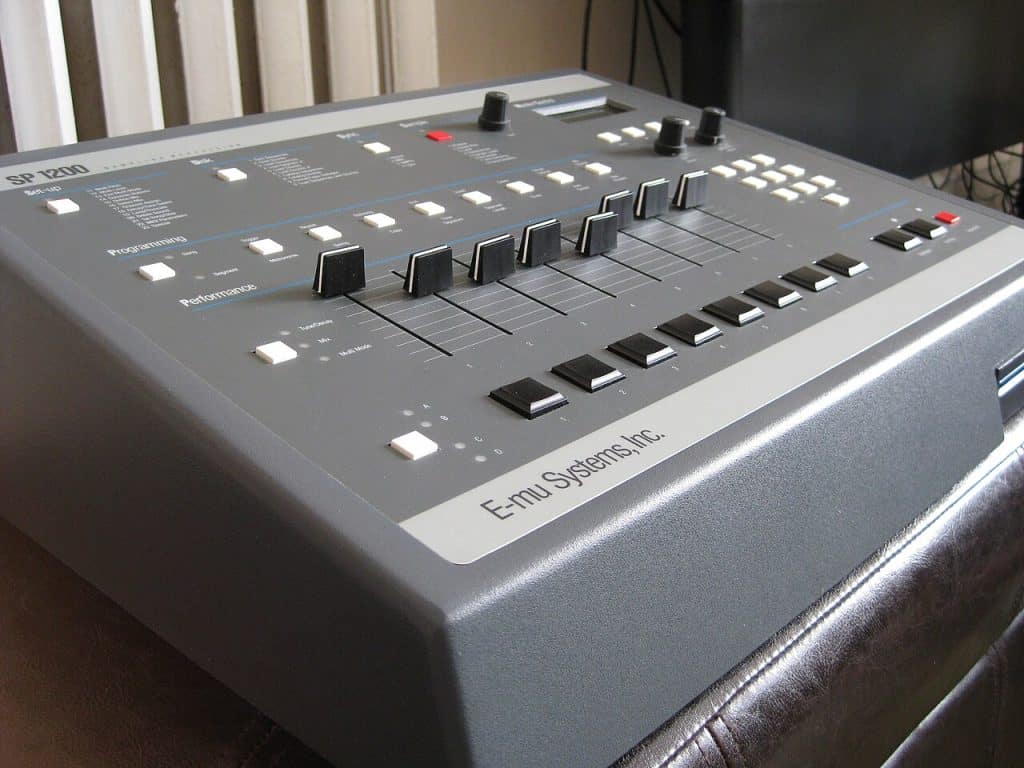
The first row is the surprise. Hold a 5 kHz tone at a 6 kHz rate and the loudest thing coming out is a 1 kHz alias, about 14 dB louder than the 5 kHz component. The third row uses the SP-1200’s 26.04 kHz rate: a 15 kHz overtone folds down to 11.04 kHz at almost the same level.
The 6,960 and 10,960 Hz components in the 26.04 kHz rows come from holding at that rate inside a 48 kHz session. A real SP-1200 running at 26.04 kHz wouldn’t make them, which is one more reason a plugin isn’t the hardware.
Even a tone below the limit isn’t safe. A 440 Hz tone at a 4 kHz rate kept its pitch, but the hold steps added images, mirror copies of the tone around the hold rate, at 3,560 and 4,440 Hz. Those aren’t harmonics of 440, which is where the metallic ring of low rates comes from.
Bit crushing vs distortion, saturation and wavefolding
All four add harmonics, so they’re easy to mix up. The difference is what shapes the waveform. Distortion, clipping and saturation bend the wave according to its level, through a smooth or hard curve. Wavefolding mirrors peaks back into the wave. A bitcrusher cuts it into steps in level and time.
Can a bitcrusher be analog? Only half of it. The rate side can be analog, using a clocked sample-and-hold circuit, but bit depth only exists once the signal becomes numbers.
A pedal that calls itself an analog bit crusher can simply mean extreme clipping. Cosmodio describes the BIT switch on its Pet Yeti as “the most extreme hard clipping physically possible” (Cosmodio, Pet Yeti). Other builds go the other way and put a real converter chip in the signal path. Parasit Studio’s DIY Beverly BitCrusher is “based on an 8-bit Analog-To-Digital converter IC”, with a knob that sets the converter’s clock (Parasit Studio, Beverly BitCrusher). Inside synths, the line blurs further. A waveshaper can have a crusher curve, and that’s how I use it most these days.
Crushing inside the synth voice
On my Mayer EMI Vibes MD850, the shaper has a CRUSHER type. The owner’s manual describes it in five words: “Bit crusher adds quantization steps” (Vibes MD850 Owner’s Manual v1.2, page 56). I use it to give sounds more character, and it feels different from a plugin at the end of a chain.
The manual explains why. The shaper can be inserted “after OSC1 or OSC2 or the MIX of all OSC1, OSC2, NOISE”, and the mix section is where the signal is routed to filter A or B. So the crusher comes before the filter, in every voice. Its curve is a modulation destination in the matrix, listed as “Shaper Curve Modulation”, and the manual warns that “the output signals of the shaper can generate aliasing artifacts”.
In practice that means two things. The crushed harmonics go into the filter, so you can play the filter against the grit. Each note is crushed on its own, so chords don’t smear into one mass of intermodulation, the extra tones that appear when several notes are distorted together, the way they do with a crusher on the whole mix. Some synth firmwares build a crusher in too: the FM-1+VA firmware I covered in my M-VAVE FM-1 custom firmware post adds a Bitcrush effect.
Where the sound comes from: 8-bit and 12-bit machines
Bit crushing imitates a limitation that early digital instruments couldn’t avoid. Memory and converters were expensive, so samplers and computers stored audio at 8 or 12 bits and low rates. The specs below come from period reviews, manuals and the manufacturers themselves.
| Machine | Bit depth | Sample rate | Spec source |
|---|---|---|---|
| Fairlight CMI (Series I/II) | 8-bit linear (10-bit converter) | 2.1 to 30.2 kHz (1982 manual) | E&MM, Oct 1984; CMI manual, 1982 |
| E-mu Emulator | 8-bit, companded | 30 kHz, fixed | E&MM, Jun 1982; MT, Feb 1991 |
| Ensoniq Mirage | 8-bit | 10 to 33 kHz | E&MM, Jul 1985; Mirage manual |
| E-mu SP-12 | 12-bit linear | 26.04 kHz | One Two Testing, Aug 1985; Rossum |
| Akai S900 | 12-bit | 7.5 to 40 kHz | E&MM, Jul 1986 |
| E-mu SP-1200 | 12-bit linear | 26.04 kHz | Sound On Sound, Oct 1987; Rossum |
| Akai MPC60 | 12-bit non-linear (16-bit converter) | 40 kHz, fixed | MT, Apr 1988; MPC60 manual |
| Akai S950 | 12-bit | up to 48 kHz | MT, Jan 1989 |
| Commodore Amiga (4 channels) | 8-bit | up to 28,867 Hz | Amiga Hardware Reference Manual, 1989 |
Two details are worth knowing. First, “8-bit” didn’t always mean 8-bit quality. The original Emulator used “companding 8-bit A/D and D/A conversion”, which a 1982 review put at about 72 dB against “approximately 52dB for straight 8-bit conversion” (the 6.02N formula gives about 50 dB) (Electronics & Music Maker, June 1982).
Second, the famous 12-bit drum machines weren’t all the same 12 bits. A 1985 review of the SP-12 called it “the first drum machine to offer 12-bit linear as opposed to 8-bit companding sampling” (One Two Testing, August 1985). The MPC60, by contrast, sampled with “a 16 bit analog-to-digital converter” and then compressed the data “into a special 12-bit non-linear storage format” (MPC60 V3.1 Operator’s Manual).
So a plain 12-bit setting gives you a linear staircase. That’s close to an SP-1200 and not quite an MPC60. A few crushers, such as TAL-Bitcrusher with its companding control, get closer to the non-linear formats. The SP-1200’s grit also comes from its 26.04 kHz rate, which is why SP-style presets set both knobs. For the MPC side of the story, see my history of the Akai MPC.
Where did the name come from? I couldn’t find a documented first product called a “bitcrusher”. Bit reduction as a plugin goes back at least to 1998. Sound On Sound’s 1998 review of Emagic Logic Audio Platinum describes a DQ plug-in that “offers a choice of bit-depth reductions and degrees of clipping” (Sound On Sound, October 1998).
What is a bitcrusher used for?
Most uses fall into four groups. For a full rundown of plugins, built-in DAW crushers, pedals and starting settings, see my guide to bitcrusher plugins and pedals.
- Drums and samples: 12 bits around 26 kHz for SP-1200-style crunch on breaks and samples, often on a parallel bus.
- Bass and 808s: low notes crush into harmonics, as measured above, so a hard-crushed parallel copy (around 4 to 6 bits) adds upper harmonics that make a sub audible on small speakers. Blend it in low so the low end stays solid; my guide on how to mix 808s covers the rest of that chain.
- Chiptune and retro leads: 4 to 8 bits at low rates. The Game Boy’s wave channel used “4 bits x 32 steps” (Game Boy Programming Manual, 1999).
- Glitch and transitions: automate the rate or bit depth so a part degrades into a fill. Automation on hardware such as the Akai MPC Live III makes this easy.
Two habits help in every case. Put a low-pass filter before the crusher to limit aliasing and an EQ after it to tame the harsh top, and use the mix knob instead of crushing 100% wet. A crusher is most convincing when you can only just hear it.
Frequently asked questions
Is bit crushing the same as downsampling?
No. Bit crushing in the strict sense lowers the bit depth, so each sample has fewer loudness steps; 4 bits leave only 16. Downsampling lowers the sample rate, so frequencies above half the new rate fold back as aliases. Most bitcrusher plugins combine both on two separate knobs, which is why the names get used interchangeably.
Why does my sound disappear with a bitcrusher?
Because of rounding. A crusher that rounds to the nearest step turns every sample smaller than half a step into zero. At 4 bits that happens below about -24 dBFS, at 8 bits below about -48 dBFS. Raise the input gain before the crusher and lower it afterwards, or switch on dither or noise if the plugin has it.
What bit depth sounds like the SP-1200?
Set 12 bits and a sample rate of about 26 kHz. The E-mu SP-1200 stored 12-bit linear samples at 26.04 kHz, according to Rossum Electro-Music. The rate matters as much as the bit depth: in a plugin without a pre-filter, anything above 13 kHz folds back as aliasing. A plugin gets the numbers, not the whole machine.
Does a bitcrusher cause aliasing?
The rate control does, by design. Without a filter, everything above half the new rate folds back down, so a 15 kHz overtone held at 26.04 kHz reappears at 11.04 kHz. A low-pass before the crusher stops the input’s own highs from folding, but not harmonics the crusher creates, and no filter afterwards removes an alias.
Can a bitcrusher be analog?
Only partly. Sample rate reduction can use an analog sample-and-hold circuit, but bit depth only exists in digital audio. Some pedals sold as analog bit crushers use extreme clipping instead, and some DIY builds include a real 8-bit converter chip. Synth waveshapers can have one too: the Mayer EMI Vibes MD850 lists CRUSHER as one of its 6 shaper types.
Back to Music Production Terms Index Page