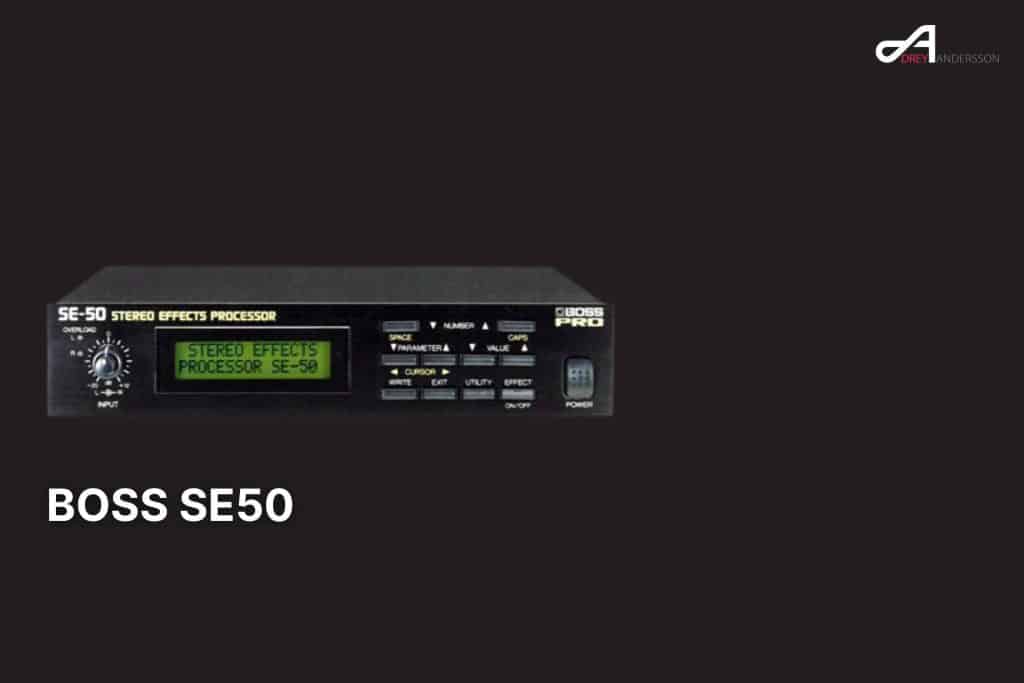
The Boss SE-50 is a half-rack stereo multi-effects processor that Roland launched under the Boss name in 1990, and it was the first half-rack multi-effects unit the company ever built (Boss Classics). It carries 28 effect algorithms and 128 patch locations, and today it changes hands for roughly €50 to €120 depending on condition (Reverb completed sales, July 2026). Mine lives in the rack next to a Yamaha VF1 and still earns its space. You’ll see it written both ways, SE-50 and SE50, but Roland’s own manual hyphenates it throughout.
This page covers what the SE-50 actually is, why it sounds the way it does, what it costs now, and the two things that catch people out when they buy one. If you want the short version, the box below has it.
Key takeaways
- Boss released the SE-50 in 1990 as its first half-rack multi-effects processor, with 28 algorithms and 128 patches, 100 of them user-writable (Roland owner’s manual, p.136).
- Every reverb algorithm runs at 32kHz, which drops the frequency ceiling to 15kHz. That single spec explains the unit’s dark, gritty reverb character.
- It needs 12V AC from a Boss BRB adaptor. A 9V DC Boss PSA will not work and can damage it.
- Completed Reverb sales ran from €120 down to €50 between August 2025 and June 2026, well under the €99 to €190 sellers currently ask.
What is the Boss SE-50?
The SE-50 is a 1990 digital multi-effects processor in a half-rack chassis measuring 218 x 44 x 235mm and weighing 1.6kg (Roland owner’s manual, p.136). Boss built it around 28 fixed algorithms rather than a free routing matrix, so instead of patching effects together yourself, you pick a pre-designed chain and edit its parameters.
That design choice is the whole personality of the box. A modern plugin chain gives you infinite freedom and infinite ways to waste an afternoon. The SE-50 hands you 28 opinions and asks which one you want. Algorithm 21 is a case in point. Roland lists it as compressor into overdrive/distortion into EQ into noise suppressor into delay into chorus into reverb into line driver, and you cannot reorder a single stage of it. Is that limiting? Completely, and that turns out to be the appeal.
Memory splits into 100 user locations and 28 factory presets across 128 numbered slots, and the presets at 101 to 128 cannot be overwritten (Roland Knowledge Base). Boss dates the launch to 1990, though Sound On Sound placed UK availability in “early 1991, to be a bit more precise”. The same magazine described its commercial run bluntly in October 1993: the SE-50 “practically flew off the retailers’ shelves” after what it called rave reviews (Sound On Sound, 1993). It sold in the UK for £390. If you want the other obvious cheap 90s rack at similar money, the Alesis QuadraVerb is the direct comparison.
Why does the SE-50 sound the way it does?
Because its reverbs run at two thirds of the sample rate its stereo delay and chorus do. The manual states that sampling frequency is set per algorithm, and that at 48kHz the unit responds from 20Hz to 20kHz, while at 32kHz that ceiling falls to 15kHz (Roland owner’s manual, algorithm list). Then it lists which algorithms use which rate, and the pattern is stark.
All seven reverbs, Hall Reverb 1 and 2, Room, Plate, Ambience, Gate Reverb and Stereo Reverb, run at 32kHz. So do Multi Delay, Multi Tap Delay and the four-voice Pitch Shifter. Only Stereo Delay, Space Chorus and Stereo Pitch Shifter get the full 48kHz.
Frequency ceiling by sample rate
Boss SE-50, response measured per the owner’s manual specification page
Source: Roland SE-50 Owner’s Manual, algorithm list and specifications (p.136).
When people call the SE-50 dark, or grainy, or say its reverbs sound vintage in a way a Lexicon does not, they’re describing a documented 15kHz roll-off. It isn’t mystique and it isn’t a fault. Boss spent its sample rate where the ear notices it most, on delays and chorus, and economised on the reverb tails.
Worth knowing before you chase that character: any modern reverb with a lowpass at 15kHz gets you most of the way there. What it won’t give you is the four-voice pitch shifter, which is the algorithm I actually keep this box for.
Is the Boss SE-50 actually noisy?
Roland specifies residual noise at less than -95dBm, IHF-A weighted, measured with the rear LEVEL switch set to -20dBm (owner’s manual, p.136). That’s a respectable figure for 1990. Owners, though, disagree sharply about how it behaves in a real room, and both sides are worth reading.
Writing on Reverb in August 2025, a verified buyer using the handle Mike R. was scathing: “I had a new one back in 1992 and used it until 2002 and always thought it was horribly noisy. I just got ahold of one again now and guess what? It’s still horribly noisy. With decades of experience in proper gain staging I find no way to make this hiss monster quiet.” He isn’t alone. Reviewing it on Audiofanzine in 2007, Claygues reported hiss “sometimes a lot of hiss on some algorithms”, and oxyde31 rated the reverbs and delays as more than correct in 2011 while dismissing the saturation and compressor outright.
Against that, another verified Reverb buyer, Neoklis D., wrote in August 2023: “Great sound, no evident DIGITAL texture, lots of parameters, ease of use, ultra fast response to midi.” He mentions owning five of them. Reverb buyers rate the unit 4.5 out of 5 across four reviews.
So who’s right? Probably both. My own experience sits closer to the second camp. The noise floor has never bothered me in a mix, and I suspect that’s the crux of the disagreement: solo a 32kHz reverb tail on a quiet source and you’ll hear hiss, bury it under a track and you won’t. Check the rear LEVEL switch too, since it selects between -20dBm and +4dBm operating levels and a mismatch there costs you headroom you didn’t know you’d lost.
What does a Boss SE-50 cost in 2026?
Reverb’s price guide estimates €61 to €133 for units in good to mint condition, calculated from 43 orders (Reverb, checked 20 July 2026). Completed sales tell a more useful story than asking prices, and they’ve been drifting down.
Completed Reverb sales, August 2025 to June 2026
Final prices in EUR, condition as graded by the seller
Source: Reverb transaction history, 12 orders, retrieved 20 July 2026. Bars scaled against the €120 high.
Now compare that with what sellers want. The thirteen listings live on Reverb the day I checked ranged from €99 to €190, and the price guide sits between the two.
Asking price versus what people actually pay
Ranges plotted on a €0 to €200 scale, July 2026
Source: Reverb price guide and transaction history, 20 July 2026.
The gap between those bars is your negotiating room. So what’s a fair offer? Anchor on the completed sales, not the asking prices: a seller wanting €190 is asking above every recorded transaction of the past year. European listings also skew expensive. On the US market the same day, asking prices ran from $30 for an ungraded unit up to $179, with the bulk clustered between $95 and $125, and most of those shipped from Japan. Factor in import duty before treating a Japanese listing as the bargain it looks like.
What to check before you buy one
Two things, and neither is obvious from a listing photo. Scan enough listings and you’ll notice sellers advertising both of them as features, which tells you how often they go wrong.
The memory battery. Like most gear of this generation, the SE-50 keeps its 100 user patches alive on an internal backup battery. When it dies, your patches go with it. I’ve replaced the one in mine. Several current listings advertise “new battery” in the title, and that’s worth real money because it means someone has already opened the unit and dealt with it.
The power supply. This one deserves its own section, below, because getting it wrong does more than inconvenience you. Listings that say “no power supply” are cheaper for a reason.
Beyond those, check that the backlit display still lights evenly, and ask whether the LEVEL switch on the rear moves cleanly. Neither is expensive to fix, but both are annoying.
Which power supply does the Boss SE-50 need?
It needs 12V AC from a Boss BRB-series adaptor, drawing 1A (Roland owner’s manual, p.136). The manual’s accessory list gives the BRB-120, 220 and 240; Roland’s support pages widen that to the BRB-100, 120, 220, 230 or 240 and add that voltage and plug types differ by region. The manual prints the instruction on the rear panel diagram in capitals, “USE BOSS BRB ADAPTOR ONLY”, and warns that any other adaptor “could result in damage, malfunction, or electric shock.”
Read that specification carefully, because it’s the single most common mistake made with this unit. AC, not DC. The Boss PSA that powers half the pedals ever made is 9V DC and will not run an SE-50. The BRC-120 is 14V DC and, despite the similar name, is a different adaptor for different gear.
Boss shipped the correct supply with the unit, which is why listings bundling one command a premium and why “w/ Power Adapter” turns up in so many titles. If yours arrives bare, match the specification exactly: 12V AC output, at least 1A, correct polarity-free AC barrel. When in doubt, check Roland’s own recommendation page rather than a marketplace listing.
How do you rack-mount a half-rack SE-50?
Boss sold a rack adaptor called the RAD-50 for exactly this, and the manual is explicit that the more common RAD-10 “cannot be used for this unit” (owner’s manual, p.136). Both are long discontinued and neither is easy to find, so here’s what I did instead.
I mounted mine using a Thomann Thon Rack Adapter 1U 25, which holds two half-rack modules side by side in a single rack space. Mine carries the SE-50 and a VF1 in parallel. The Thon tray already has the correct hole spacing for two modules, so no drilling is involved.
The part worth writing down is the screws, because the tray doesn’t come with the right ones. I researched this properly and settled on M4 x 10mm pan-head screws in black (Linsenkopfschrauben). Two of those hold both modules solidly with no flex. Get the length wrong and you either bottom out against the chassis or leave the module loose.
Quick reference: Thon Rack Adapter 1U 25, two half-rack modules per rack space, fixed with two M4 x 10mm black pan-head screws. Works for the SE-50 paired with any other half-rack unit of similar depth.
Boss SE-50 specifications
Every figure below comes from the specifications page of the official Roland owner’s manual, which you can download from Roland as a PDF.
| Specification | Value |
|---|---|
| Patch memories | 100 user + 28 preset = 128 total |
| Algorithms | 28, in single, multi and dual-parallel configurations |
| Sampling frequency | 48kHz / 32kHz, set per algorithm |
| Frequency response | 20Hz-20kHz at 48kHz; 20Hz-15kHz at 32kHz |
| Residual noise | Less than -95dBm (IHF-A) |
| Rated input / output level | -20dBm or +4dBm, rear switch |
| Input gain range | -20dB to +12dB |
| Input impedance | 1M ohm |
| Output load impedance | More than 50k ohm |
| Channels | 2 in, 2 out |
| Display | 16 characters x 2 lines, backlit LCD |
| MIDI | IN and OUT only, no THRU |
| Other jacks | Effect Remote, Number Shift, AC adaptor |
| Power | 12V AC, Boss BRB-120/220/240, 1A draw |
| Dimensions | 218 x 44 x 235mm |
| Weight | 1.6kg |
| Rack adaptor | RAD-50 (the RAD-10 does not fit) |
One note on a spec you’ll see repeated elsewhere. Plenty of pages state a 16-bit converter figure for the SE-50, but Roland’s own specification page doesn’t print a bit depth, so I’ve left it out rather than repeat a number I can’t source.
Boss SE-50 full algorithm list
All 28, named and grouped as Roland lists them, with the effector chains spelled out in the names themselves (Roland Knowledge Base). There’s a tidy detail buried in the numbering that no other reference seems to mention: algorithm n ships as factory preset 100 + n, so preset 116 is the vocoder demonstrating algorithm 16. Those 28 presets fill slots 101 to 128 and cannot be overwritten.
| No. | Algorithm | Factory preset | Configuration |
|---|---|---|---|
| 1 | HALL REVERB 1 | 101 | Single |
| 2 | HALL REVERB 2 | 102 | Single |
| 3 | ROOM REVERB | 103 | Single |
| 4 | PLATE REVERB | 104 | Single |
| 5 | AMBIENCE | 105 | Single |
| 6 | GATE REVERB | 106 | Single |
| 7 | STEREO REVERB | 107 | Single |
| 8 | MULTI DELAY X5 | 108 | Single |
| 9 | MULTI TAP DELAY X5 | 109 | Single |
| 10 | STEREO DELAY | 110 | Single |
| 11 | SPACE CHORUS | 111 | Single |
| 12 | PITCH SHIFTER X4 | 112 | Single |
| 13 | STEREO PITCH SHIFTER | 113 | Single |
| 14 | STEREO FLANGER | 114 | Single |
| 15 | STEREO PHASER | 115 | Single |
| 16 | VOCODER + CHORUS + NOISE SUPPRESSOR | 116 | Multi |
| 17 | ROTARY + DISTORTION + NOISE SUPPRESSOR | 117 | Multi |
| 18 | KEYBOARD 1: EQ + DELAY + CHORUS + REVERB | 118 | Multi |
| 19 | KEYBOARD 2: PHASER + EQ + CHORUS + REVERB | 119 | Multi |
| 20 | RHODES: EQ + PHASER + NOISE SUPPRESSOR + CHORUS + PANNING + REVERB | 120 | Multi |
| 21 | GUITAR: COMPRESSOR + OVERDRIVE/DISTORTION + EQ + NS + DELAY + CHORUS + REVERB + LINE DRIVER | 121 | Multi |
| 22 | VOCAL: LIMITER + ENHANCER + NOISE SUPPRESSOR + DELAY + CHORUS + REVERB | 122 | Multi |
| 23 | STEREO ENHANCER: LIMITER + ENHANCER + NOISE SUPPRESSOR | 123 | Multi |
| 24 | 2 CHANNEL MIXER: EQ + NS + REVERB/CHORUS/DELAY | 124 | Multi |
| 25 | REVERB 1 + REVERB 2 | 125 | Dual parallel |
| 26 | GATE REVERB + REVERB | 126 | Dual parallel |
| 27 | CHORUS + REVERB | 127 | Dual parallel |
| 28 | DELAY + REVERB | 128 | Dual parallel |
Three of these do the heavy lifting in my rack. Pitch Shifter X4, algorithm 12, spreads four independently tunable voices across two octaves in either direction; detune them, feed it a drum loop, and the phase interaction between the voices thickens the source in a way that’s hard to reproduce elsewhere. Its stereo sibling at 13 reaches only one octave either way, so the two aren’t interchangeable despite the similar names.
Space Chorus, algorithm 11, is one of only three that run at the full 48kHz, which is why it stays clear where the reverbs go dark. And algorithm 16 is where the vocoder lives. Roland’s manual explains it plainly: it “converts sound from a microphone, such as that of a person singing, to the pitch of sounds output from a keyboard”, dividing the mic signal into seven frequency portions. Note what the algorithm name tells you, though. It’s listed as Vocoder + Chorus + Noise Suppressor, so there’s no standalone vocoder mode; you take the chorus and the noise suppressor along with it.
How does the SE-50 compare to the SE-70, RSP-550 and SX700?
Sound On Sound laid out the SE-50 against its successor in October 1993, and the numbers favour the SE-70 on paper (Sound On Sound, 1993). What the spec sheet doesn’t capture is the pitch shifter. Posters on Gearspace have argued for years that the SE-70 never quite reproduced what the SE-50 does to a drum loop, and having kept the older box for exactly that algorithm, I’d agree with them.
| Spec | SE-50 | SE-70 |
|---|---|---|
| Algorithms | 28 | 45 |
| Patches | 128 | 145 |
| Max effects per algorithm | 8 | 16 |
| Front-panel buttons | 10 | 6 |
Now for a correction, because this one circulates widely. You’ll read on forums that the Roland RSP-550 is simply the SE-50 in a full-width rack. It isn’t. Roland’s own documentation gives the RSP-550 39 algorithms across three categories, against the SE-50’s 28, and the RSP-550 carries a dedicated standalone vocoder algorithm that the SE-50 lacks entirely. They’re relatives, not twins.
Later in the decade Boss replaced both SE units with the SX700, which traded some raw effect quality for Roland Sound Space 3D placement.
Is the Boss SE-50 worth buying in 2026?
My verdict: 4 out of 5. At €50 to €120, yes, with conditions. You’re buying three things that remain genuinely useful: the four-voice pitch shifter, the 48kHz Space Chorus, and a 7-band vocoder that costs far more to obtain any other way. Everything else it does, a plugin does more cleanly.
Buy it if you want those specific algorithms, or if you want hardware you can bend in real time over MIDI without opening a laptop. Skip it if you’re looking for a clean general-purpose reverb, because a 15kHz ceiling is a real constraint and modern software will beat it comfortably.
One pairing note. If you’re putting together a budget rack and want a reverb that sounds expensive without costing it, the SE-50 isn’t the box for that job. Its reverbs are characterful rather than pristine. Spend a little more on a Yamaha REV500, or a TC Electronic M300, and let the SE-50 do the pitch shifting and chorus work it’s actually good at. Two cheap boxes doing what each does well beats one box doing everything adequately, and both of those sit in the same money bracket as the SE-50 itself. There’s no sense pairing a €100 processor with a €500 reverb.
Want to hear one before committing? Tim Draksler’s CRANK IT UP #34 from May 2026 runs through it at length, and Fergie’s Guitar stuff covers the delay and reverb algorithms in detail.
Frequently asked questions
What is the Boss SE-50 used for?
The SE-50 is a half-rack multi-effects processor used for reverb, delay, chorus, flanging, phasing, pitch shifting and vocoding. Producers reach for it mainly for its four-voice pitch shifter and its 48kHz Space Chorus. It runs 28 fixed algorithms rather than a free routing matrix, so you select a chain and edit its parameters.
How much is a Boss SE-50 worth in 2026?
Reverb’s price guide estimates €61 to €133 for good to mint units, based on 43 orders. Completed sales between August 2025 and June 2026 ran from €120 down to €50, so actual transaction prices sit below the €99 to €190 that sellers typically ask. Units including the original power adaptor command a premium.
Which power supply does the Boss SE-50 need?
It requires 12V AC from a Boss BRB-series adaptor, which Roland lists as the BRB-100, 120, 220, 230 or 240. This is alternating current, not DC. The common Boss PSA supply is 9V DC and will not run the unit, and the similarly named BRC-120 is 14V DC. Roland warns that other adaptors risk damage or electric shock.
Does the Boss SE-50 have a vocoder?
Yes, a 7-band vocoder, but only inside algorithm 16, which Roland lists as Vocoder + Chorus + Noise Suppressor. There’s no standalone vocoder mode, so the chorus and noise suppressor come with it. The manual describes it converting a microphone signal to the pitch of notes played on a keyboard. The Roland RSP-550 offers a dedicated vocoder algorithm instead.
Is the Boss SE-50 noisy?
Roland specifies residual noise below -95dBm, IHF-A weighted. Owner opinion splits sharply: some report persistent hiss regardless of gain staging, while others hear no meaningful noise floor at all. Check the rear LEVEL switch, which selects between -20dBm and +4dBm operation, since a mismatch there costs headroom and raises apparent noise.
Back to Music Production Terms Index Page